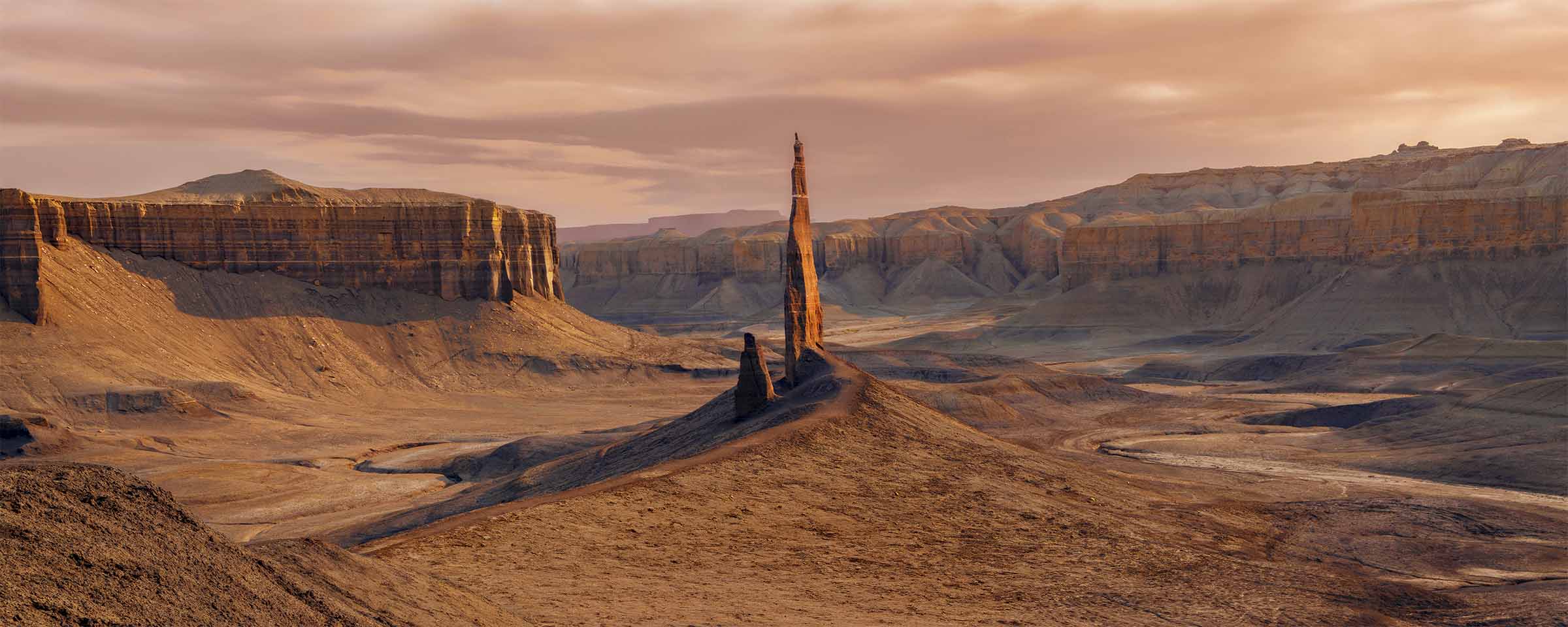
A 5:2 panoramic photograph of a sandstone spire in the Caineville Badlands, Utah, at sunset, available as a limited edition print in three sizes.
Artist's Story
The Caineville Badlands in southern Utah are made of Mancos Shale, laid down flat on the floor of an inland sea about ninety million years ago, when a seaway split North America down the middle. Everything since has been subtraction. Water and wind work this rock toward the horizontal, and what still stands above the valley floor stands because something harder is sitting on top of it.
I made three trips here before the photograph existed. I had the composition on the first visit and kept losing the light. This one was midsummer, past a hundred degrees, no shade to move into, and a fire burning somewhere nearby had thinned the whole sky to a soft brown. About twenty minutes before sunset the cloud opened and the light ran the length of the valley. I would rather the fire had not been burning. It gave me a version of this place I had not seen on any earlier visit, and I have thought since about how much of what I found here I did not choose.
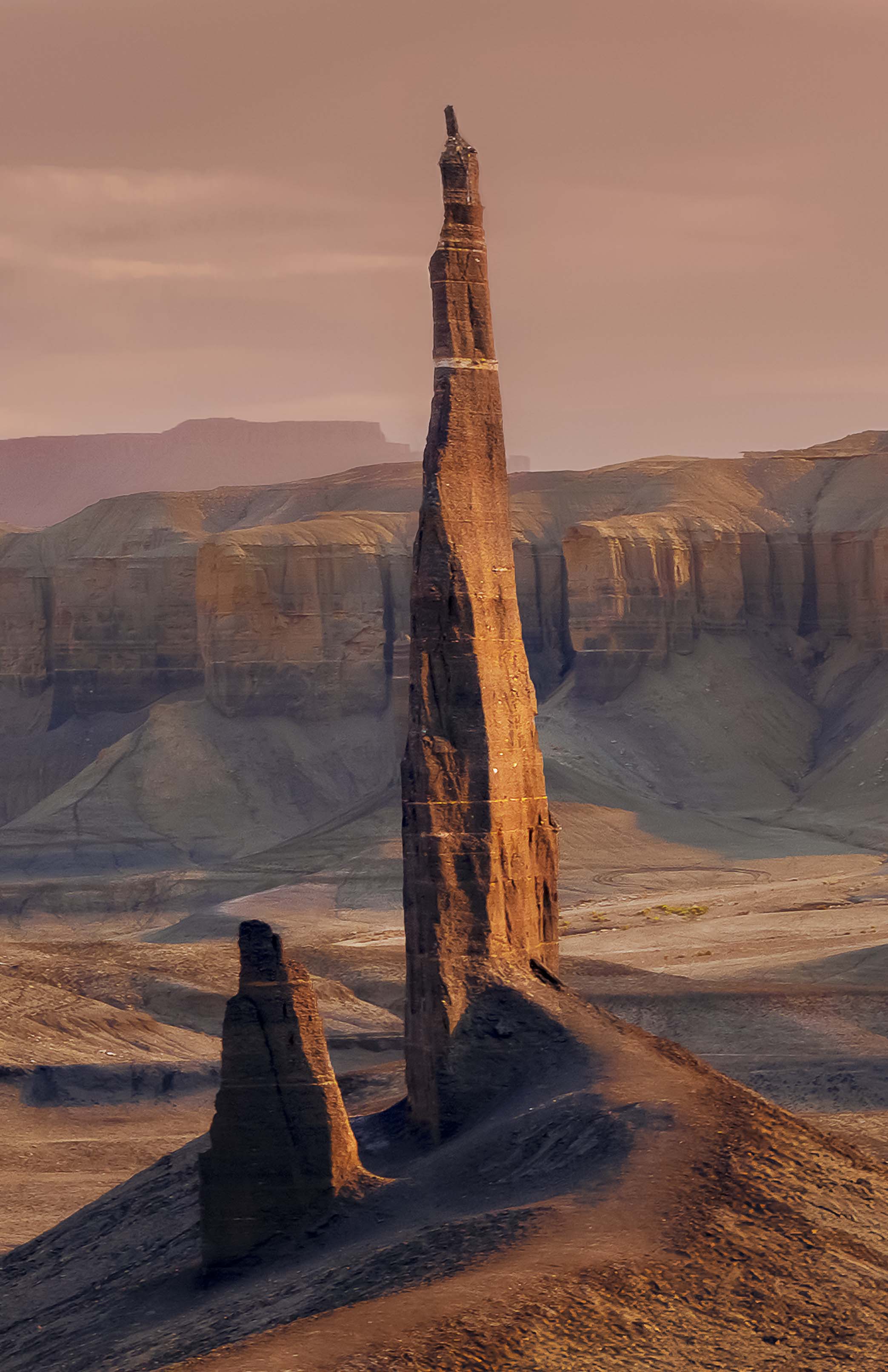
A vertical reads to us as something that went up. Aspiration, achievement, a thing that rose above its surroundings. This one did not rise. Its summit is a surviving scrap of a surface that once ran level across the whole valley at that height, and everything else at that elevation is gone. The spire is not an exception to the erosion. It is the last piece of what the erosion has been taking.
The Spire is that remnant, holding the old ground line for twenty minutes before the light went.
There is a particular effect that comes from standing in front of something on a timescale you cannot hold. I wrote about what it does to a person, and why it belongs somewhere you live, in Why Awe Belongs on Your Walls.
The spire and the valley behind it. The same horizontal beds run through the spire and through the cliffs on either side, which is how you know it is a remnant rather than an outcrop. A second, smaller spire stands at the left, further along in the same process. Click to view at full size.
About This Photograph
Photographed in the Caineville Badlands near Caineville, Wayne County, Utah, about twenty minutes before sunset in midsummer. This is a single frame image in color. The subject is a sandstone spire standing above the badlands floor, with mesas and eroded slopes beyond. The rock here is Mancos Shale, deposited on the bed of the Western Interior Seaway during the Late Cretaceous roughly ninety million years ago; the soft Blue Gate shale erodes rapidly while the harder Emery sandstone above resists, which is why the mesas keep flat tops while the ground below is cut into rills and gullies. Smoke from a wildfire burning nearby that evening thinned the light and shifted the color of the sky. It also took the extremes out of the photograph, which carries no true black and nothing approaching white, holding the whole frame in a narrow warm range. Presented as a horizontal panorama, offered as an archival limited edition from 40 by 16 inches to 80 by 32 inches on acrylic, metal, or archival paper.
The Spire
Steve Austinhttps://www.steveaustinphotography.com/
Location
Caineville Badlands, Wayne County, Utah
Subject
A sandstone spire holding the old ground line above the badlands floor
Capture
Single frame, twenty minutes before sunset, wildfire smoke in the air
Format
Photograph · horizontal panorama, 5:2
Sizes
40 × 16 in · 60 × 24 in · 80 × 32 in
Print Media
TruLife Acrylic · ChromaLuxe Metal · Baryta paper
Edition
Limited, 25 / 50 / 100 by presentation
What it Does in a Room
A photograph with no black and no white in it does something a high-contrast one cannot. It stays quiet at any size.
Five to two sits between a scene and a band. It is wider than a two to one panorama, so the eye travels rather than takes it in at once, but it keeps enough height to hold a foreground, a middle distance, and a horizon. In a room that combination matters. A very wide, very shallow frame extends a wall and little else. This proportion extends the wall and opens it, which is why it settles above a long sofa, a credenza, a run of cabinetry, or a headboard and then keeps working after the first glance. It asks for a run of wall rather than height, and about a quarter as much height as width. Sixteen to thirty-two inches will do it.
Here the width is holding a distance rather than a subject. The foreground slope enters at the bottom left, the spire stands at the middle, and the mesas run out to both edges and keep going past them. That gives the picture depth without a focal point, so the eye travels along the valley instead of stopping, and the vertical in the center works as a marker rather than as a target. On a wall the effect is spacious. It reads as a room opening onto somewhere much larger, which is what a panorama at this proportion is for and what this particular frame happens to contain.
The tonal range is what distinguishes it. Smoke in the air that evening removed both ends: there is no true black anywhere in this photograph and nothing approaching white, so the whole frame sits in a narrow warm band from soft pink through ochre to dusty brown. That makes it the calmest piece in the collection on a wall. It does not assert, it does not resolve into a graphic shape from across a room, and it never becomes the loudest thing in a space. Against plaster, oak, walnut, leather, wool, travertine, and unglazed stone it belongs immediately, since it shares their range. Against cool grays it becomes the one warm element and reads as light on the wall. What it rewards most is a room where nothing needs to compete, and a wall long enough to let the valley run.
Not sure which size the room calls for, or want dimensions not listed here? Sizes beyond 80 × 32 are available on request and ship crated by freight. That conversation is welcome before an order is placed. Start that conversation and I will answer within one business day.
The Spire, limited edition printSteve Austin95012100USD11https://schema.org/InStock
Questions about this photograph
How small is too small for a photograph this wide?
At five to two, the Intimate size is forty inches across and sixteen inches tall. That is a workable proportion at a modest scale, wide enough to read as a panorama and tall enough to keep the foreground, the valley, and the mesas as three separate distances. What compresses first is the spire. At sixteen inches tall it becomes a thin dark mark near the middle of the frame, and the whole argument of the photograph depends on it reading as a piece of rock with layers in it rather than as a line. A forty by sixteen print works well above a console, along a hallway, or on a narrower wall where a taller piece would not fit. The Collected at sixty by twenty-four is where the spire regains its bulk. The Statement at eighty by thirty-two is where the valley behind it opens into real distance. If you are weighing a size against a specific wall, choosing the right print size covers the measurements and the viewing distances in more detail.
What changes at the largest size?
The layering, everywhere, which is the evidence for what the picture claims. At forty by sixteen the spire is a shape and the mesas are cliffs. At eighty by thirty-two the horizontal bedding resolves across all of it: the courses running through the spire itself, the same courses continuing in the mesa faces on both sides of the valley, and the point where the harder cap sits on the softer rock beneath. Once you can see those beds you can read the elevations, and the claim the photograph makes stops being something you are told and becomes something you can check. The badlands floor resolves at the same time, into the fine rills and gullies that are the shale going away. It is one of the few photographs where the largest size does not just show you more, it shows you the argument. Why scale matters covers what happens perceptually when a landscape reaches the size where the eye has to travel across it.
What kind of room does this photograph suit?
Almost any of them, and it is the calmest piece in the collection. The smoke in the air that evening took both ends out of the tonal range, so there is no true black anywhere and nothing approaching white, and the whole frame sits in a narrow warm band from soft pink through ochre to dusty brown. A print like that never becomes the loudest thing in a room. Against plaster, oak, walnut, leather, wool, travertine, and unglazed stone it belongs immediately, because it shares their range. Against cool grays it becomes the one warm element in the space. Against strong color it will simply recede, which is worth knowing: this is a piece for a room that is already quiet rather than one that needs quieting. What it rewards most is a long wall and even daylight, since nothing in the frame needs a light aimed at it and a raking light would only flatten what depth it has.
Every work ships insured and arrives with a signed certificate of authenticity.
If a piece is damaged in transit, the choice of replacement is always yours, and your edition number stays with you.
Production time runs 2 to 3 weeks for metal, 3 to 4 weeks for acrylic and paper, and 5 to 6 weeks for framed work.
Collector's Choice · TruLife ® Acrylic in Italian Frame
Collector Edition of 25· Lumachrome TruLife Acrylic · Handcrafted Italian Frame
TruLife acrylic in a handcrafted Italian frame with a linen liner chosen for the image. Frame series, finish, and liner are settled with you after the order, and production begins from there. The frame and liner add about fourteen inches to the finished dimensions, worth allowing for when planning placement.
Signature Edition · TruLife ® Acrylic, Float Mount
Signature Edition of 50· Lumachrome TruLife Acrylic · Gallery Float Mount
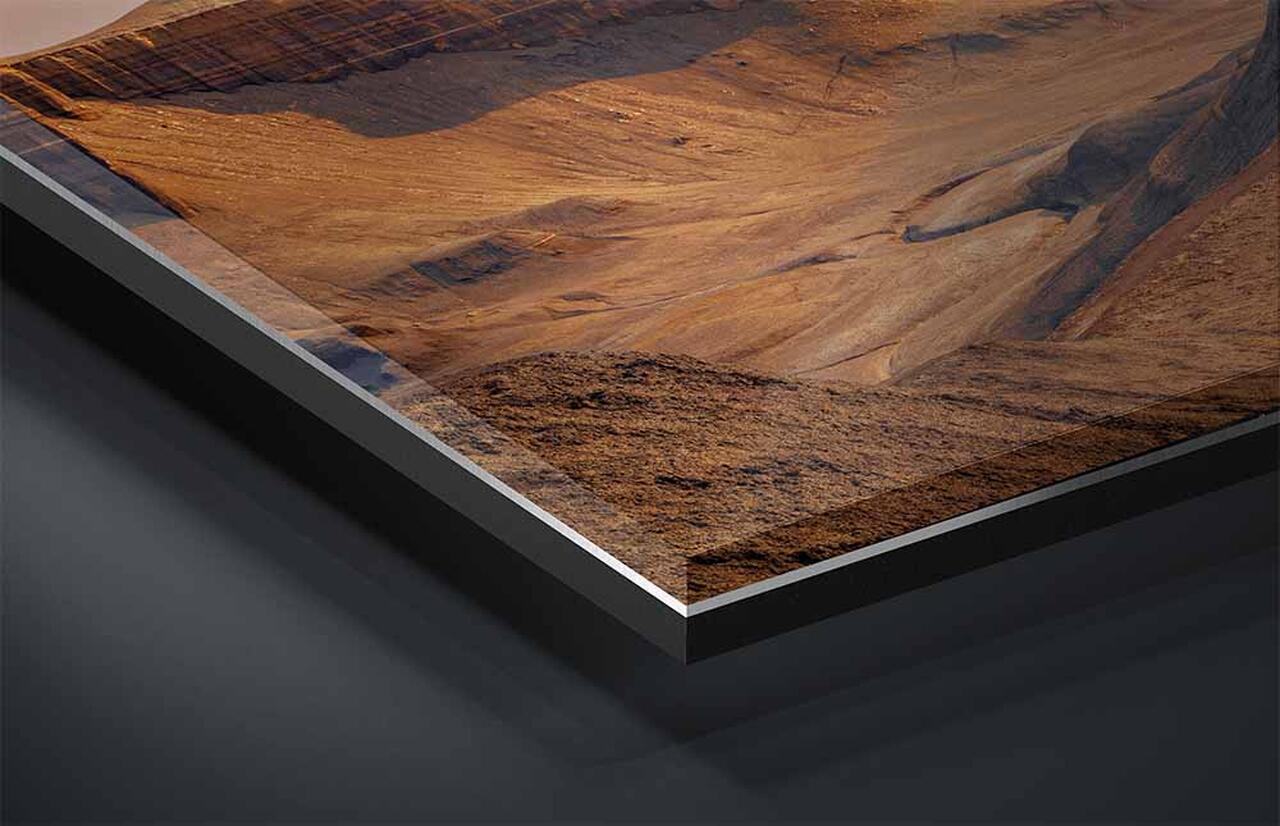
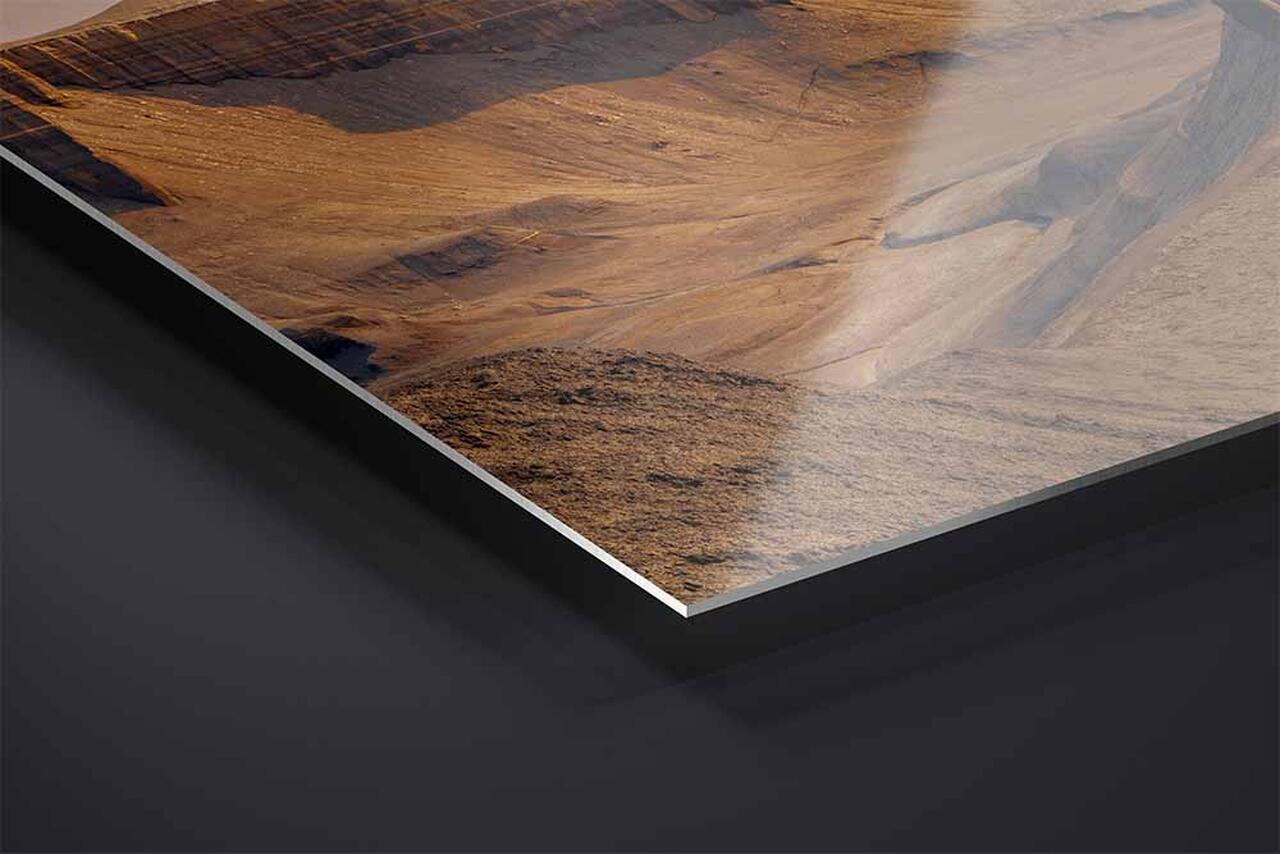
Face-mounted to TruLife acrylic and floated approximately one inch from the wall, with no frame to mediate between the image and the room. UV-resistant, anti-reflective, and scratch-resistant, with a lifetime guarantee against fading.
Signature Edition of 50· ChromaLuxe Metal Print · Gallery Float Mount
Color infused into the aluminum panel itself, floated from the wall on a concealed system. Where acrylic produces luminosity, metal produces clarity. Exceptional fade resistance with no glazing or coating required.
Fine Art Edition of 100· Hahnemühle Baryta Fine Art Paper
Printed without acrylic, so light meets the paper surface directly. Highlights stay luminous, shadows keep their nuance, and the surface has a tactile quality the other presentations approach differently. The understated choice, and the traditional one.
Complimentary shipping within the continental United States. International collector shipping available upon request.
Still deciding
Designing for Stillness
A guide to choosing art for restorative spaces
How to tell whether an image will still hold you in a year, how scale changes what a photograph does in a room, and how to match a piece to the work a room actually performs. It cites the research it draws on, and it is equally clear about where that research stops. About ten minutes to read.