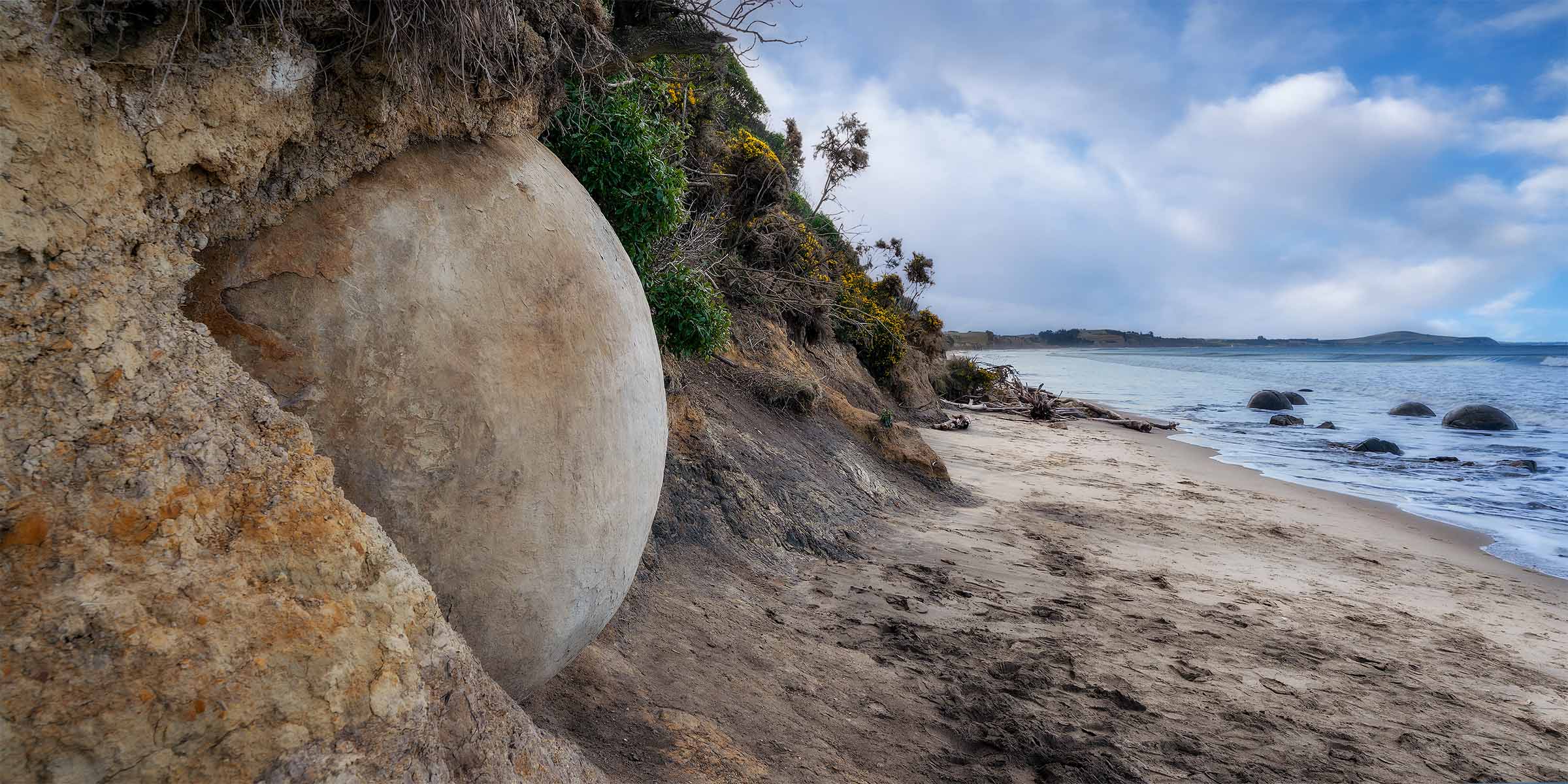
A 2:1 panoramic photograph of a Moeraki boulder still held in the cliff, Koekohe Beach, New Zealand, available as a limited edition print in three sizes and four presentations.
Artist's Story
On Koekohe Beach, on the Otago coast of New Zealand's South Island, the boulders come out of the cliff rather than the sea. They are septarian concretions, and nothing shaped them. Around sixty million years ago calcite began precipitating around small dead things on a seafloor, a shell or a piece of wood, and built outward in layers. The largest took four to five million years to reach full size, buried the entire time under tens of meters of mud. The sea never made them round. It only ever dug them up.
I was working along the base of the cliffs when I stopped at this one, still half held in the face, with the ones already freed lying out in the surf behind it.
What I keep returning to is the direction of it. We read a shape like this as something worked on from outside, by wind or water or a hand, because nearly everything we make is made that way. This one grew from the middle out, in the dark, under fifty meters of mud, around a small dead thing nobody will ever see unless the boulder breaks. The form is not the record of a shaping. It is the record of an accumulation.
The Watcher is the one still in the cliff, set at the height where an eye would be, waiting on the same erosion that put the others in the water.
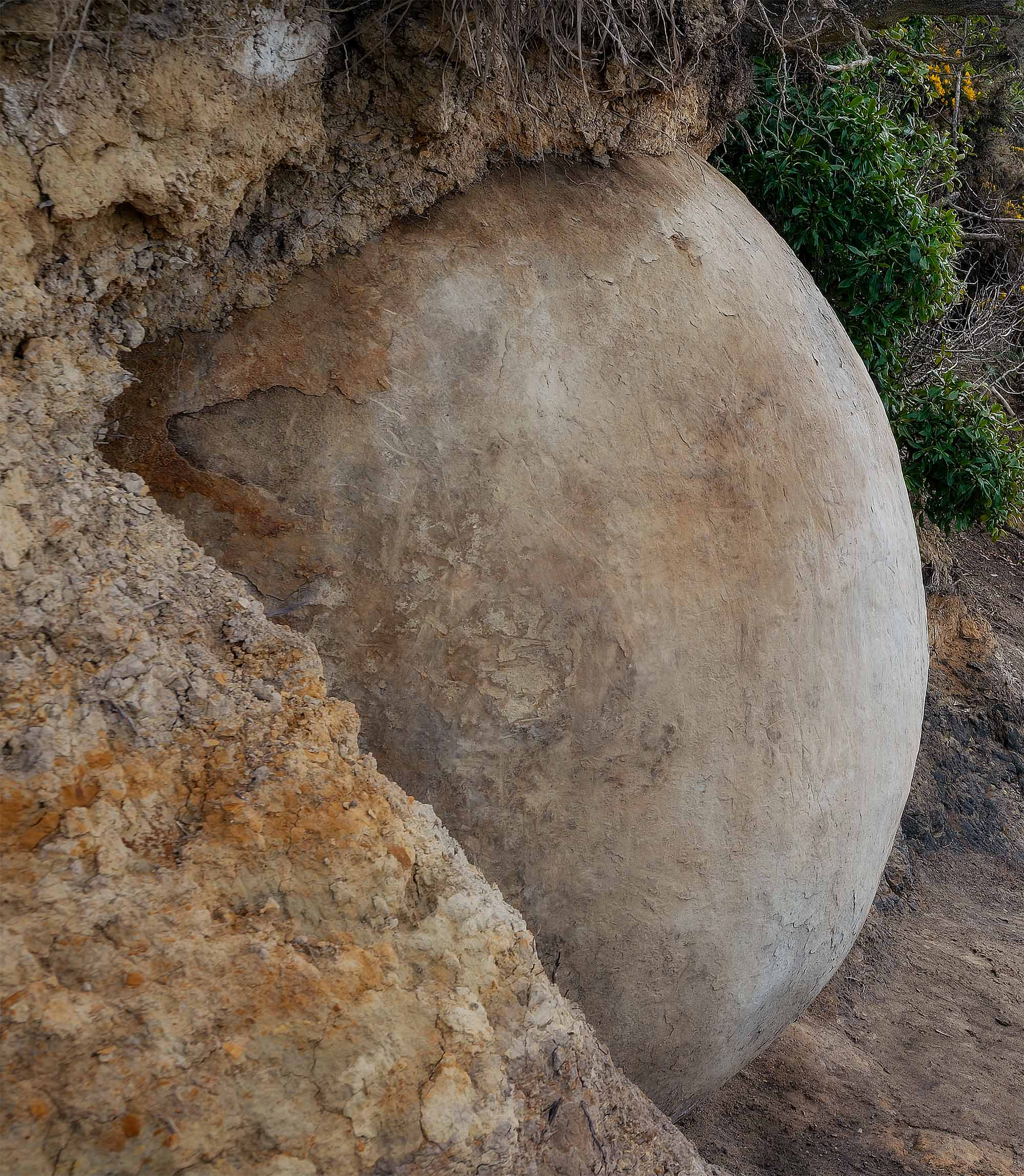
Detail at roughly one third of the frame width. The stone surface fills with scratches and mottling, and the crumbling mudstone still holding the boulder is legible against it. At the smallest print size both read as a smooth pale dome. Click to view at full size.
About This Photograph
Photographed at Koekohe Beach, between Moeraki and Hampden on the Otago coast of New Zealand's South Island. Made in a single frame.
The subject is a Moeraki boulder still partly embedded in the mudstone cliff, with others already freed lying on the beach and in the surf beyond it. The boulders are septarian concretions that formed roughly sixty million years ago in the Paleocene mudstone of the Moeraki Formation, when calcite precipitated around organic nuclei such as shells or wood on the seafloor and built outward in layers. The largest, about two meters across, are estimated to have taken four to five million years to reach full size beneath ten to fifty meters of accumulating marine mud.
Coastal erosion of the soft mudstone releases them onto the beach, where they are protected within a scientific reserve.
The Watcher
Steve Austinhttps://www.steveaustinphotography.com/
Location
Koekohe Beach, Otago, New Zealand
Subject
A Moeraki boulder in the cliff face
Capture
Single frame
Format
Photograph · horizontal panorama, 2:1
Sizes
40 × 20 in · 60 × 30 in · 80 × 40 in
Print Media
TruLife Acrylic · ChromaLuxe Metal · Baryta paper
Edition
Limited, 25 / 50 / 100 by presentation
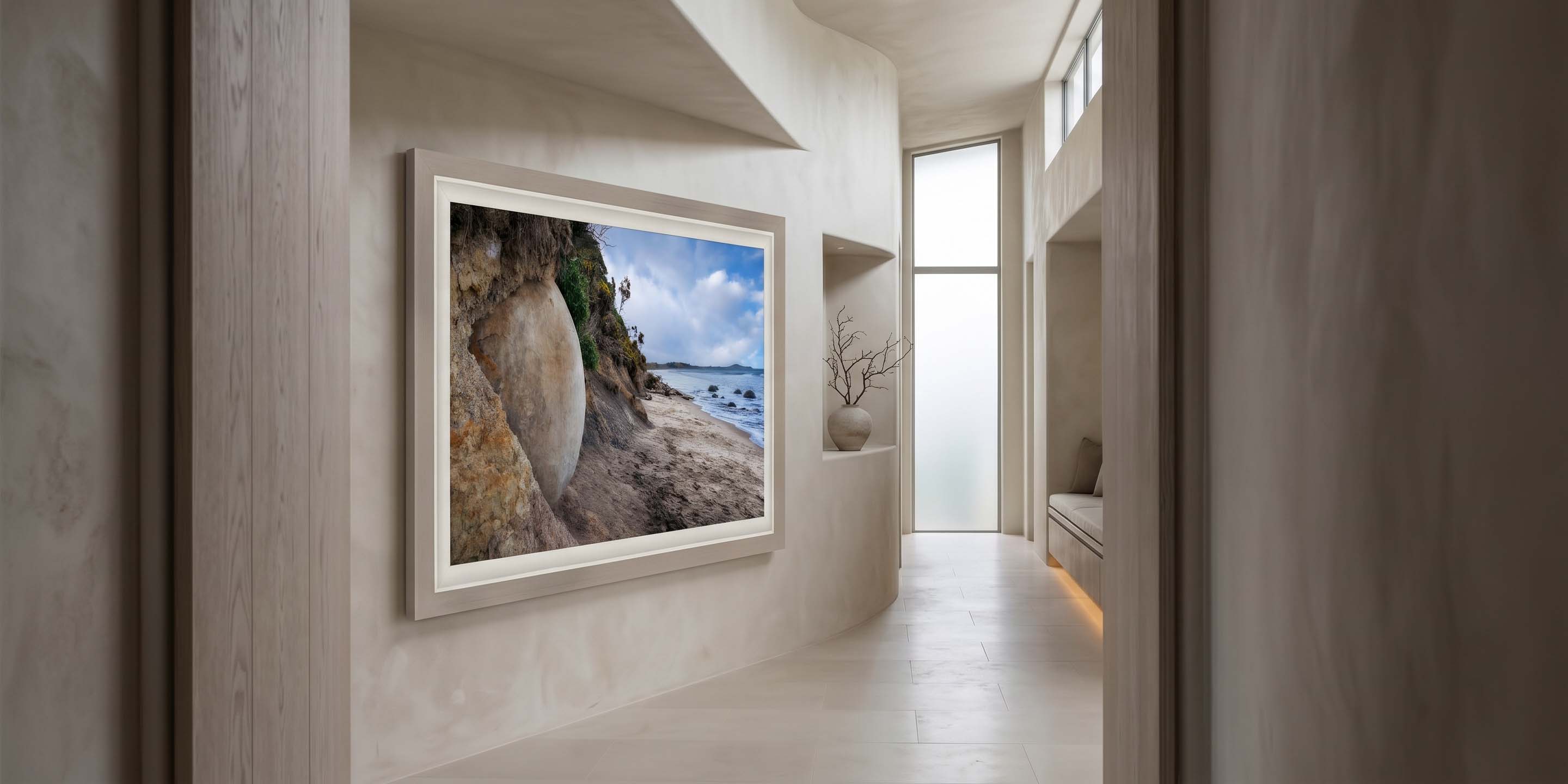
What it Does in a Room
This is the calmest photograph in the collection to live with, and the reason is that it is built out of two halves that agree with each other.
The left side is warm, all ochre cliff and pale stone. The right side is cool, sea and sky and wet sand running out to the horizon. Neither dominates and the two meet in the middle at the boulder, which sits between them in temperature as well as position. That balance is why it settles rather than asserts. There is no single loud passage for the eye to keep returning to and nothing in it that will tire.
It is also the brightest and most evenly lit piece here. The whole frame sits in the middle of the range, with real detail in the shadows under the cliff and nothing anywhere near white. On a wall that means it holds its own in daylight without glaring, and it keeps its structure in the evening when a higher contrast image would go to shapes. Of everything in the collection, this is the one least dependent on how a room is lit.
Because of that it is genuinely easy to place. Warm neutrals meet the cliff, cool grays and whites meet the sea, and the photograph has a foot in both. What it does ask for is a wall it can run along. The composition moves from the boulder in the near left out along the beach to the boulders in the surf, and that recession is the whole pleasure of it. Given the width, the eye makes that walk. Crowded against a corner or a door frame, it stops at the boulder and the rest of the beach never arrives.
Not sure which size the room calls for, or want dimensions not listed here? Sizes beyond 80 × 40 are available on request and ship crated by freight. That conversation is welcome before an order is placed. Start that conversation and I will answer within one business day.
The Watcher, limited edition printSteve Austin112513400USD12https://schema.org/InStock
Questions about this photograph
How small is too small for a photograph this wide?
The boulder stops being smooth. At forty by twenty it reads as a pale dome, a shape rather than a surface. At eighty by forty the face fills with detail: fine scratches running across it, faint mottling where the stone changes color, and the grain of something that grew rather than something that was worn. The contact line matters just as much. You can see exactly where the mudstone still grips it, crumbling and loose against stone that is not, and that boundary is the whole story of the photograph in one edge. The boulders out in the surf change too, from dark humps into individual objects at different stages of the same process. At the smallest size that reads as a nice beach. At the largest it reads as a sequence. Why scale matters covers what happens perceptually when a landscape reaches the size where the eye has to travel across it.
What changes at the largest size?
The surface of the boulder is where this one changes. At forty by twenty it reads as smooth stone, a pale dome against the cliff. At eighty by forty it stops being smooth. The polygonal cracking that gives these concretions their name shows across the face, filled with pale calcite, and the whole surface turns out to be a mosaic rather than a shell. You can see where the mudstone still grips it along the left edge and where sixty million years of accumulation left faint concentric banding in the stone. The distance changes too. The boulders out in the surf go from dark humps to individual objects, each one at a different stage of the same process, which is the argument the photograph is making about time. At the smallest size that reads as a nice beach. At the largest it reads as a sequence. Why scale matters covers what happens perceptually when a landscape reaches the size where the eye has to travel across it.
What kind of room does this photograph suit?
More of them than almost anything else here. The frame is split between a warm ochre cliff on the left and a cool sea and sky on the right, and neither side wins, so the photograph reaches toward warm and cool rooms equally. Against oak, linen, and plaster the cliff tones pick up the room. Against cool gray and white the sea does. It will not set a color scheme and it will not argue with one.
It is also the least demanding piece on light. Everything sits in the middle of the range, with detail holding in the shadows under the cliff and nothing approaching white, so it looks right in a bright room and keeps its structure in a dim one. What it does want is a wall long enough for the beach to run out to the horizon. That recession is the pleasure of it, and a wall where the piece sits tight against a corner or a door frame cuts the walk short.
Every work ships insured and arrives with a signed certificate of authenticity.
If a piece is damaged in transit, the choice of replacement is always yours, and your edition number stays with you.
Production time runs 2 to 3 weeks for metal, 3 to 4 weeks for acrylic and paper, and 5 to 6 weeks for framed work.
Each print is made to order and takes its place in a numbered edition, so sales are final. Before you choose, I am glad to help: send a photo of your wall and I will show you this work in your room at true scale, at no charge. Start a conversation
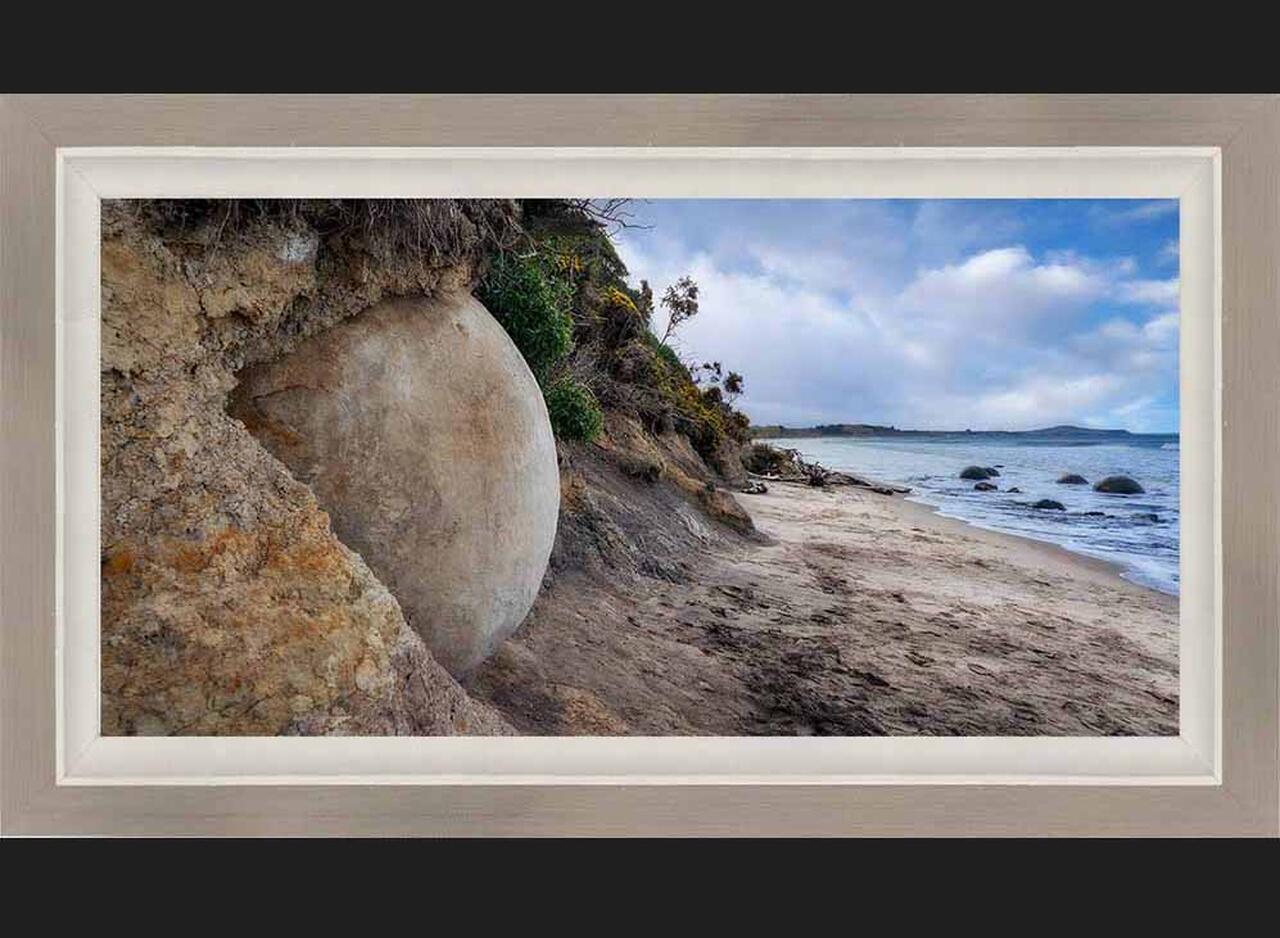
Collector's Choice · TruLife ® Acrylic in Italian Frame
Collector Edition of 25· Lumachrome TruLife Acrylic · Handcrafted Italian Frame
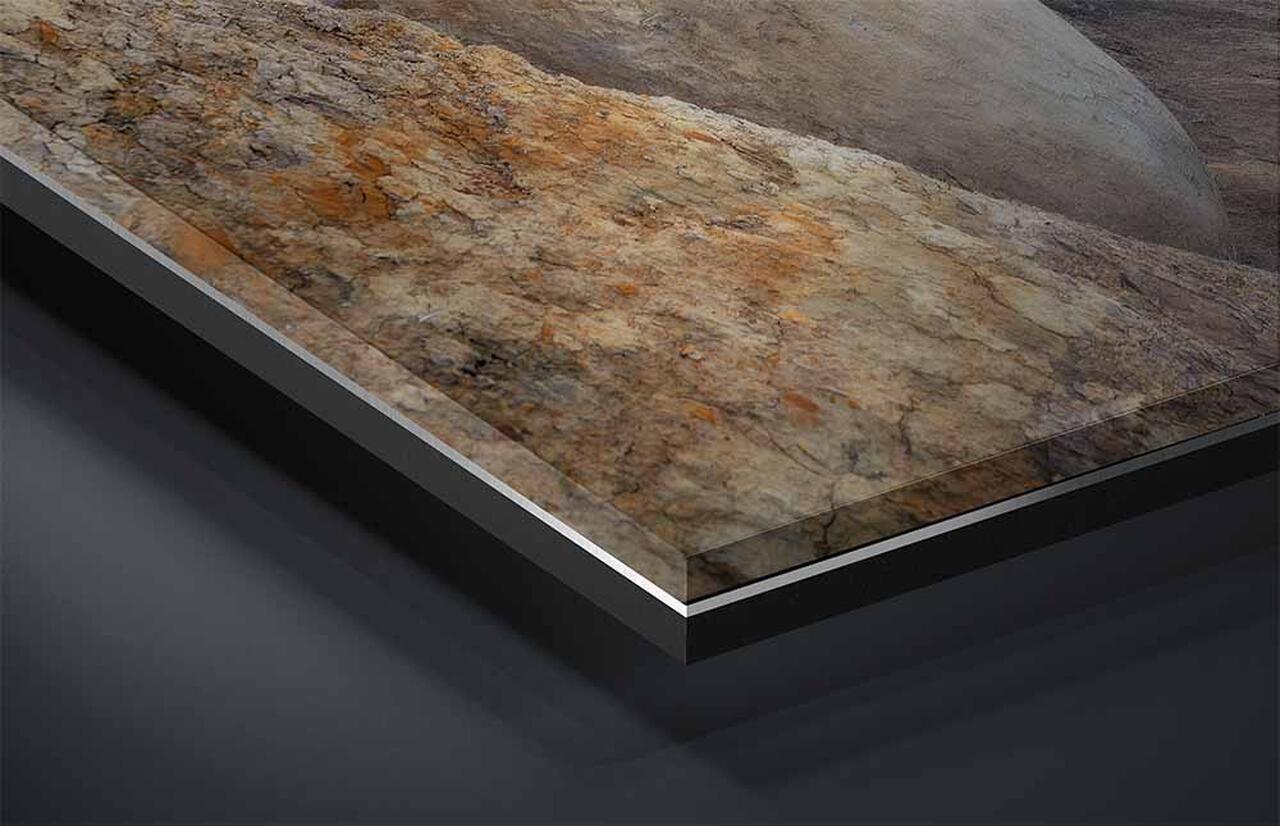
TruLife acrylic in a handcrafted Italian frame with a linen liner chosen for the image. Frame series, finish, and liner are settled with you after the order, and production begins from there. The frame and liner add about fourteen inches to the finished dimensions, worth allowing for when planning placement.
Signature Acrylic Edition of 50· Lumachrome TruLife · Gallery Float Mount
Face-mounted to TruLife acrylic and floated approximately one inch from the wall, with no frame to mediate between the image and the room. UV-resistant, anti-reflective, and scratch-resistant, with a lifetime guarantee against fading.
Signature Metal Edition of 50· ChromaLuxe Print · Gallery Float Mount
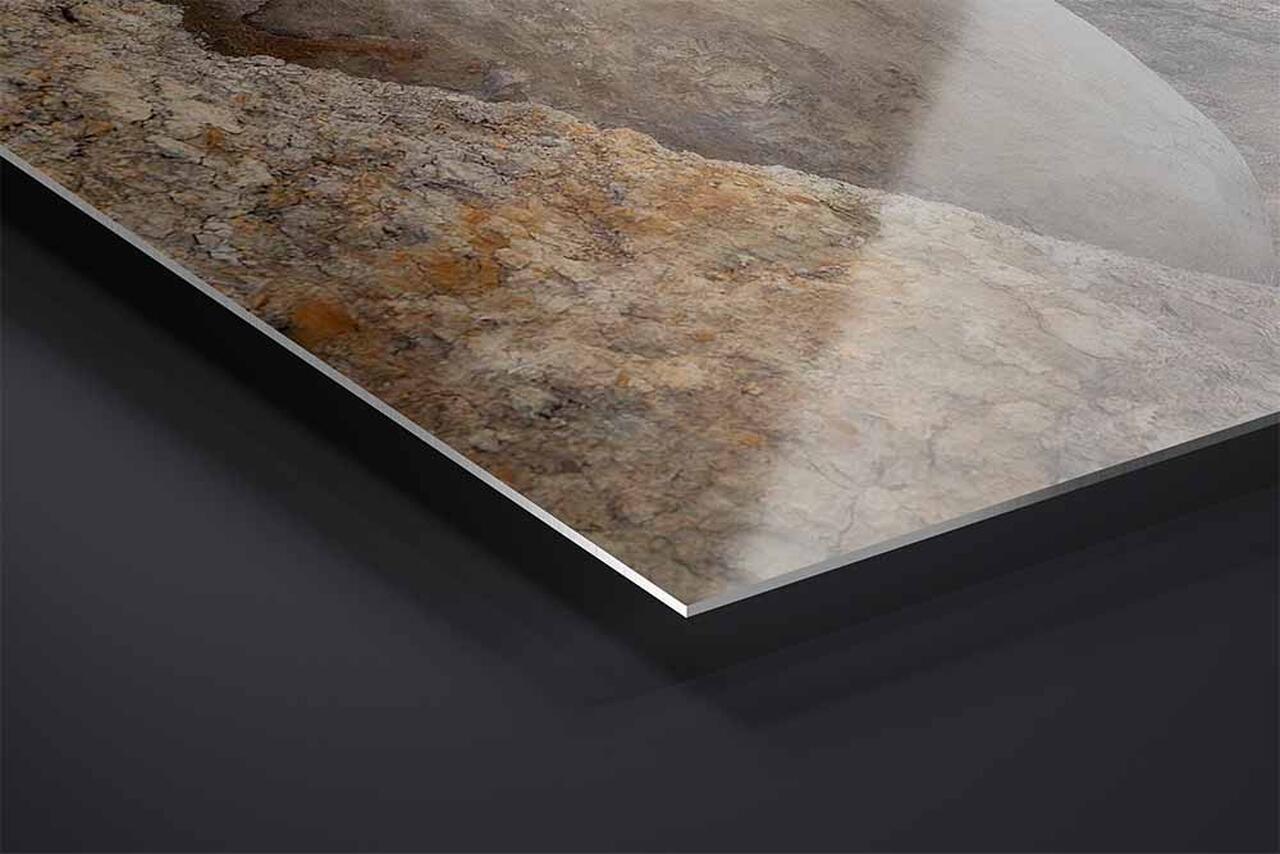
Color infused into the aluminum panel itself, floated from the wall on a concealed system. Where acrylic produces luminosity, metal produces clarity. Exceptional fade resistance with no glazing or coating required.
Fine Art Edition of 100· Hahnemühle Baryta Fine Art Paper
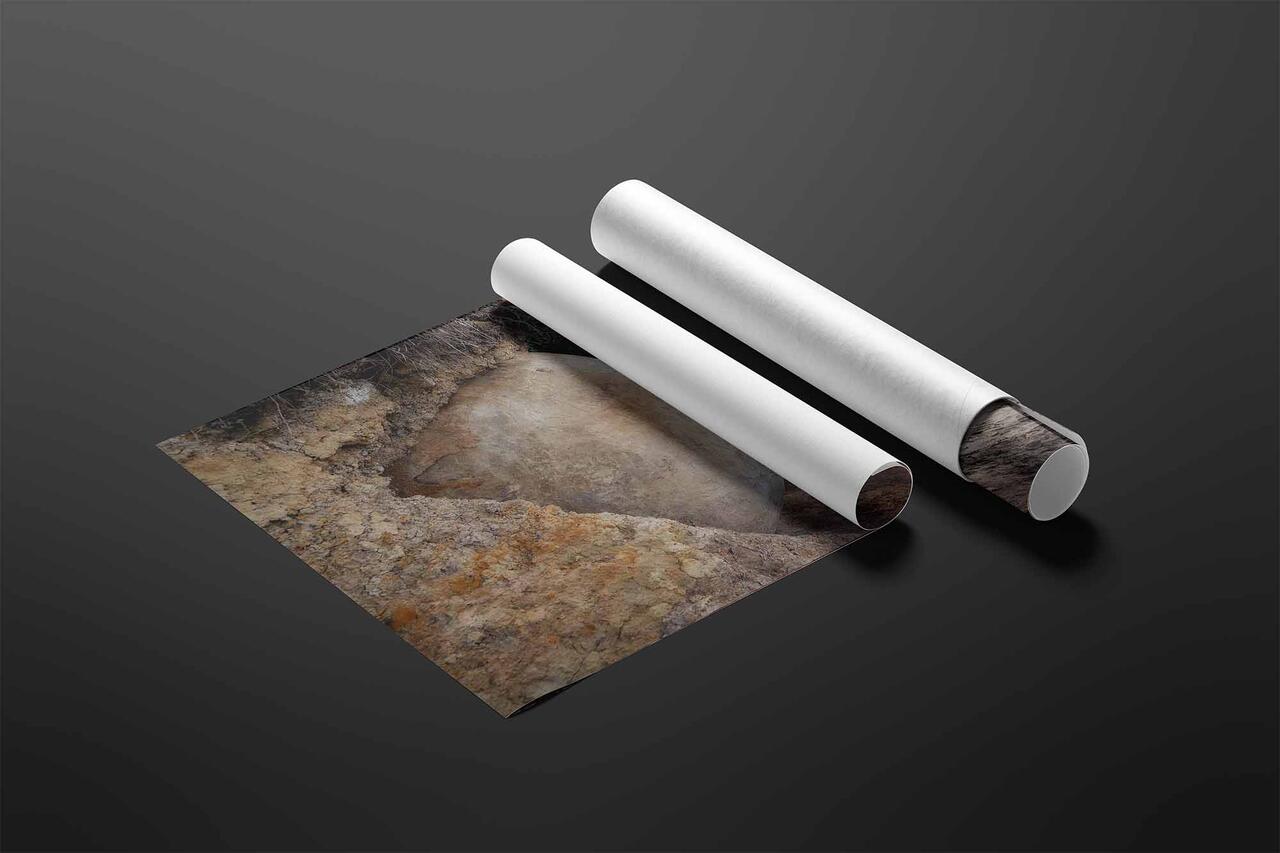
Printed without acrylic, so light meets the paper surface directly. Highlights stay luminous, shadows keep their nuance, and the surface has a tactile quality the other presentations approach differently. The understated choice, and the traditional one.
Complimentary shipping within the continental United States. International collector shipping available upon request.
Still deciding
Designing for Stillness
A guide to choosing art for restorative spaces
How to tell whether an image will still hold you in a year, how scale changes what a photograph does in a room, and how to match a piece to the work a room actually performs. It cites the research it draws on, and it is equally clear about where that research stops. About ten minutes to read.