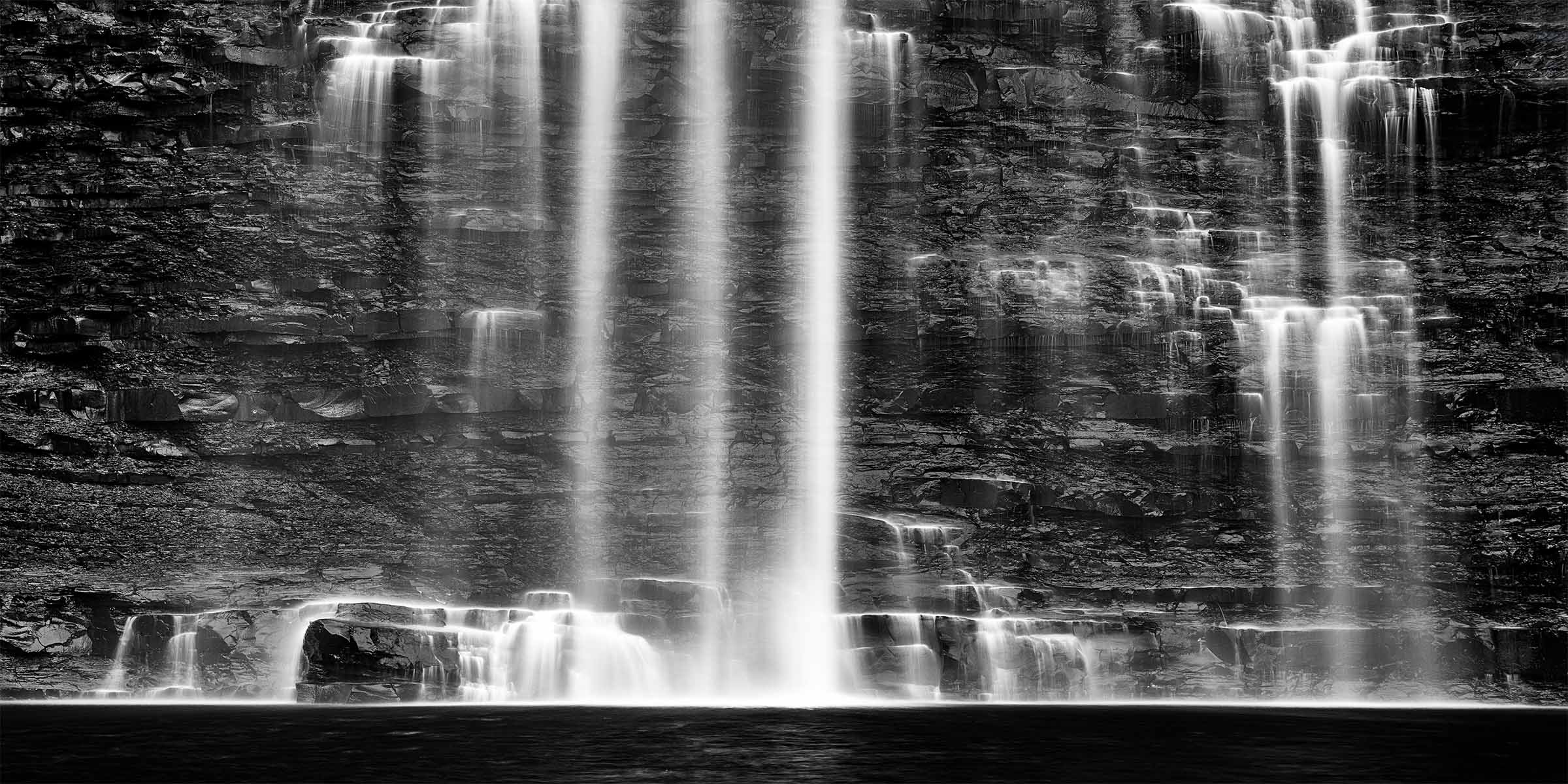
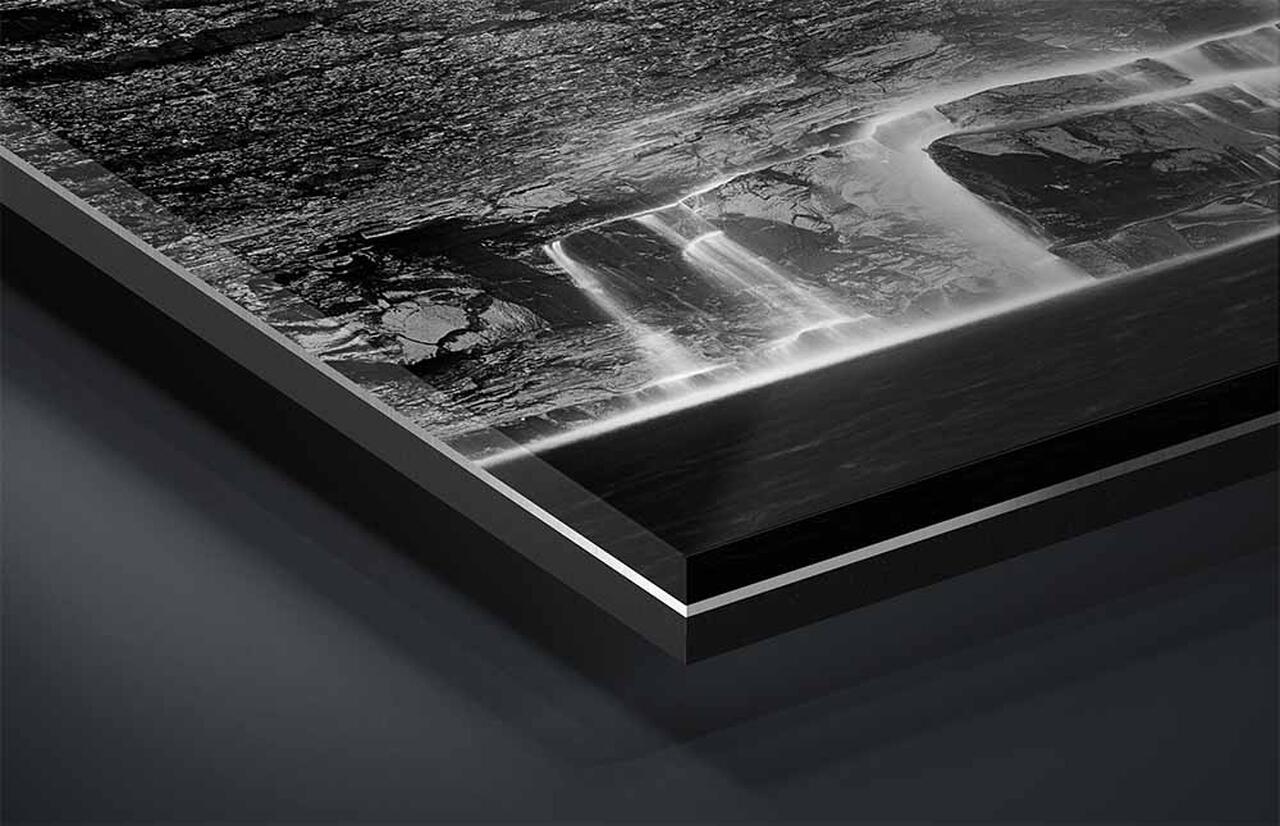
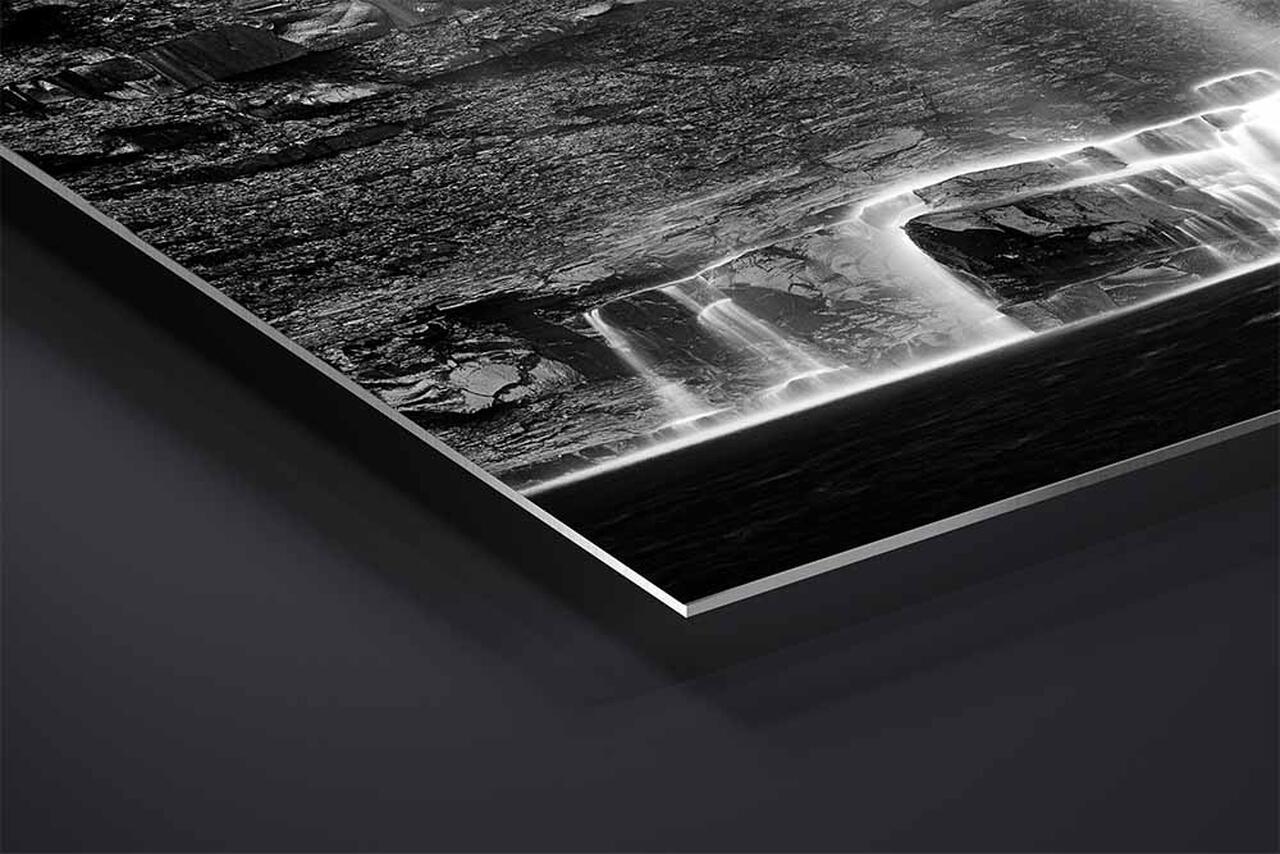
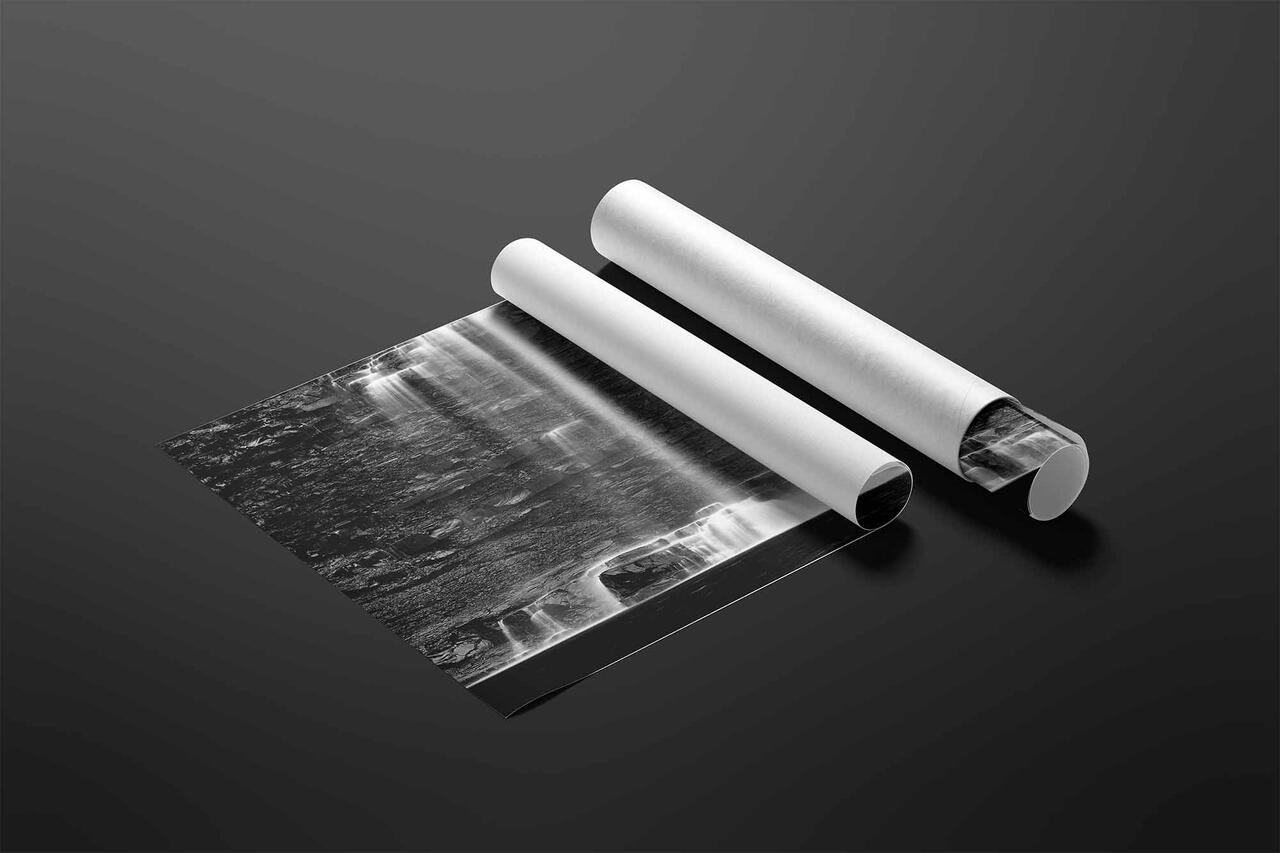
A 2:1 panoramic black and white photograph of Salmon River Falls in Oswego County, New York, available as a limited edition print in three sizes.
Artist's Story
Not all water falls the same way.
At Salmon River Falls, in Oswego County, New York, the water was not crashing or roaring the day I came. It broke instead into many separate streams, each finding its own path down the layered rock face, following the edges and contours as though water and stone had reached some long agreement about how the descent should go.
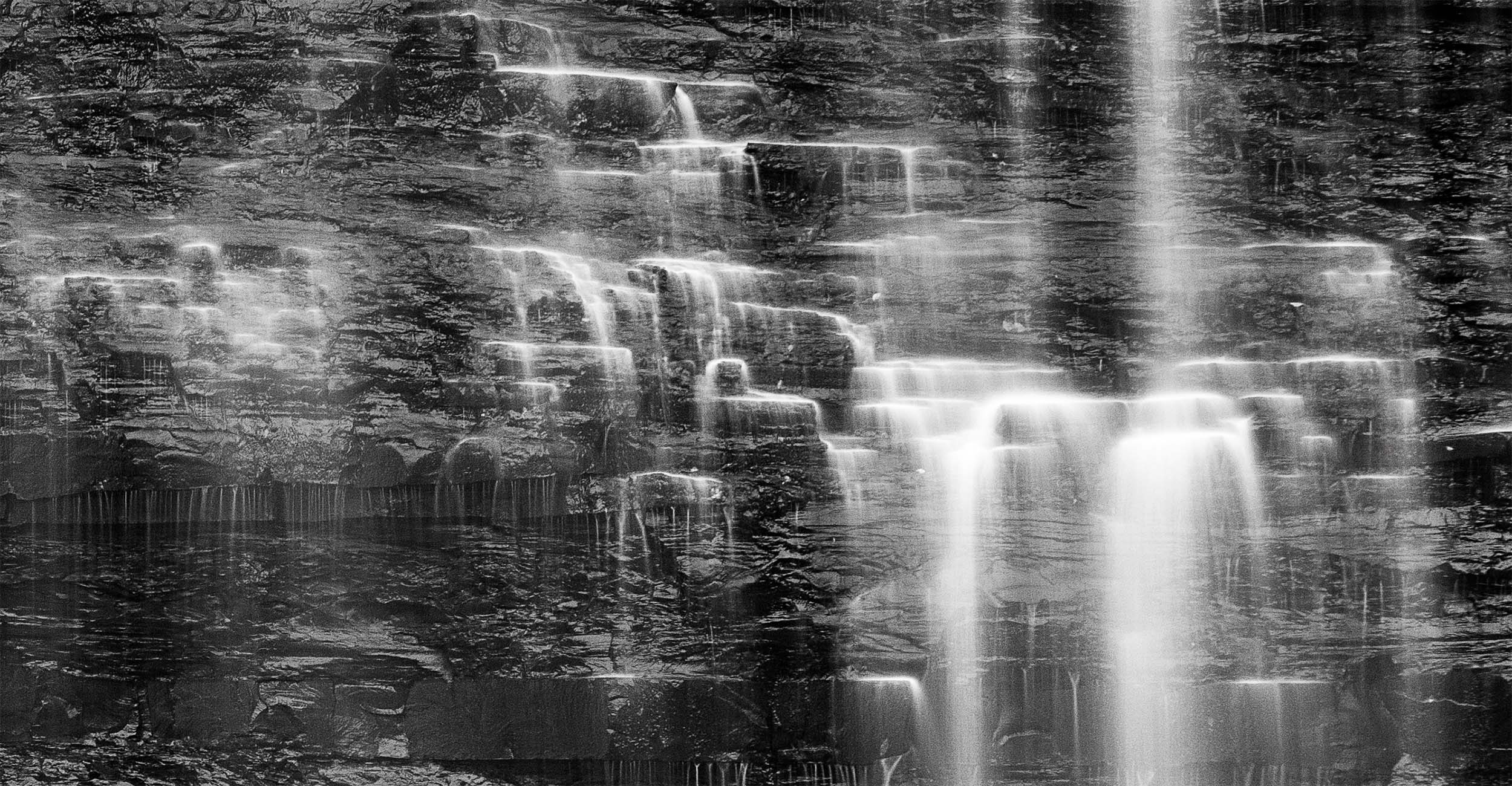
They have, and the agreement is legible in the cliff. A hard cap of Oswego sandstone sits on softer Pulaski shale. The shale wears back faster, the sandstone is left standing out over it as a ledge, and that arrangement repeats down the whole face. Every edge the water finds is a place where the soft rock gave way first. Ten thousand years of that, and the wall has been worked into the most efficient arrangement there is for letting water go.
I worked in close, and let a long exposure gather the falling streams into something between silk and light against the dark, wet stone. What held me was not force but the sound, a layered conversation of many streams moving over rock at different speeds. Water at one pitch is noise. Water at twenty is something the mind will follow for a long time without tiring of it, and without being asked to.
There is a further deflation available, and I will take it. The river's flow here is controlled by a dam three miles upstream. The gentleness I found was not weather. It was a release schedule.
The Weeping Wall is a face shaped by erosion, running on a timetable set by a power company, and the quiet it produces is real anyway.
The quiet that settled at the base of these falls is the kind a still image can carry into a room. I wrote about building that stillness at home in Designing Calm Spaces in a Visually Noisy World.
The stepped cascades at the right of the frame, about one fifth of the frame width. Hard rock standing out over softer rock worn back beneath it, and the water using every edge. Click to view at full size.
About This Photograph
Photographed at Salmon River Falls, in the town of Orwell near Altmar, Oswego County, New York, within the 112-acre Salmon River Falls Unique Area, looking head-on at the falls from near river level. This is a single frame image, made as a black and white long exposure that renders the falling water as smooth vertical columns against the rock. The subject is Salmon River Falls, a 110-foot ledge waterfall where the Salmon River drops over resistant Oswego sandstone above softer Pulaski shale. At lower flow it separates into several parallel streams, as seen here, becoming a single torrent only at high water. Flow in this stretch of the river is controlled by the Lighthouse Hill Dam upstream. The frame holds a wide, multi-stream section falling over stepped, layered rock into a dark pool below. Presented as a horizontal panorama, offered as an archival limited edition print from 40 by 20 inches to 80 by 40 inches on acrylic, metal, or archival paper.
The Weeping Wall
Steve Austinhttps://www.steveaustinphotography.com/
Location
Salmon River Falls, Orwell, New York
Subject
The multi-stream face of the falls at low flow, from near river level
Capture
Single frame, long exposure, rendered in black and white
Format
Photograph · horizontal panorama, 2:1
Sizes
40 × 20 in · 60 × 30 in · 80 × 40 in
Print Media
TruLife Acrylic · ChromaLuxe Metal · Baryta paper
Edition
Limited, 25 / 50 / 100 by presentation
What it Does in a Room
A photograph with no color in it and nothing to look at first does something unusual on a wall. It stops asking.
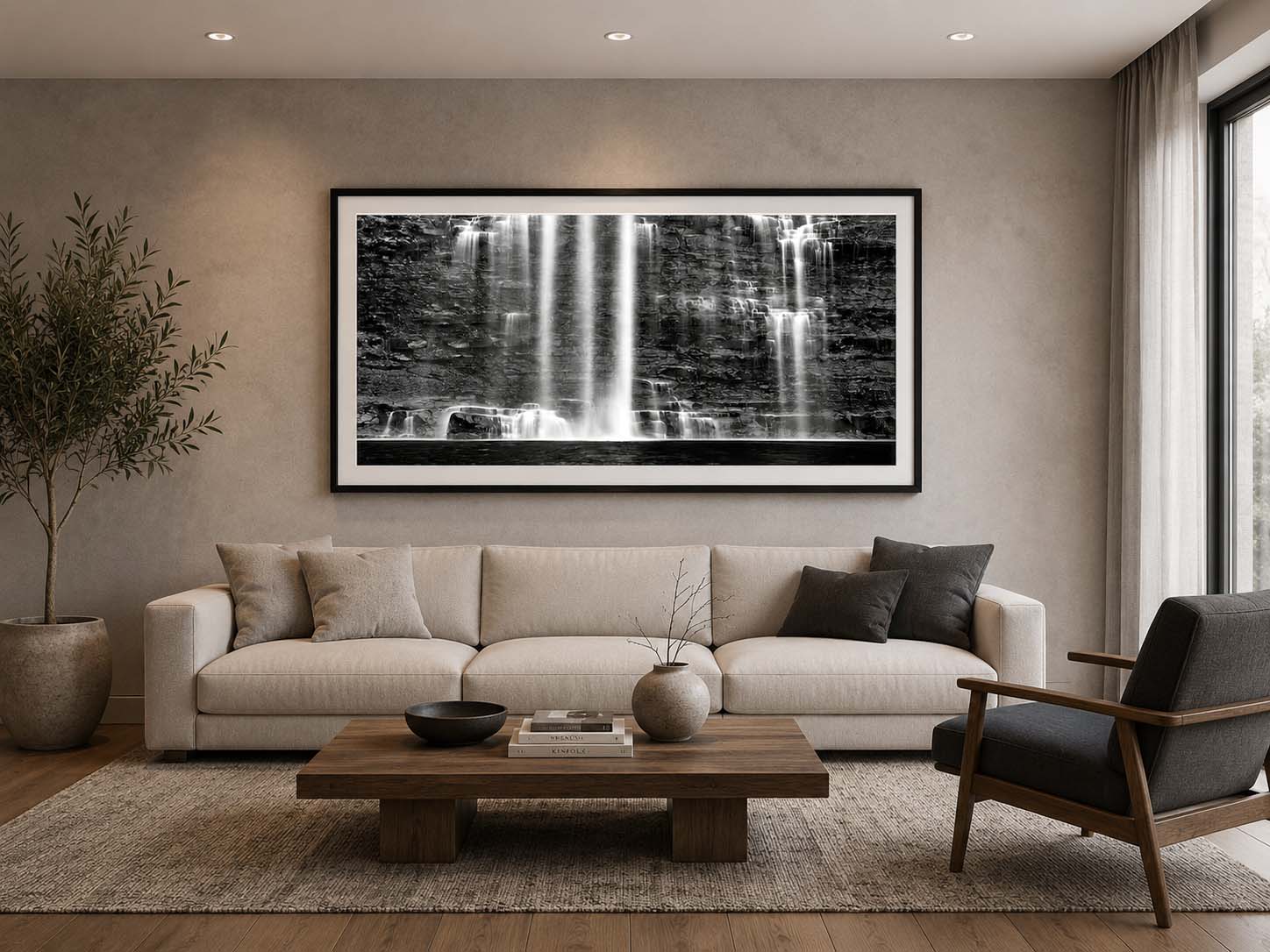
Two to one is the panoramic proportion that still holds a scene. Wider than that and a photograph becomes a band, read left to right like a sentence. Narrower and it reverts to being a picture on a wall. At two to one the frame is decisively horizontal without giving up height, so a composition can fill it rather than merely stretch across it. In a room it works with the architecture instead of against it. Most walls are built on horizontal lines, and a wide frame extends them, which is why this shape settles above a sofa, a credenza, a long console, or a headboard more comfortably than any other. It asks for a run of wall rather than height. Give it one and it makes the wall feel longer than it is.
Here the width is filled edge to edge with the same thing happening at different speeds. There is no subject in the ordinary sense, no single place the eye is meant to arrive at, only vertical columns of water crossing horizontal ledges of rock, repeating across the whole frame. That is why it settles a room rather than commanding one. The eye finds a column, follows it down, moves to the next, and never arrives anywhere it has to stay. A photograph that holds attention without asking for it is a different kind of object from one built around a focal point, and it behaves differently on a wall you pass every day.
Being black and white, it places almost anywhere. There is no color in it to agree or disagree with a room, and the tonal range is full, running from near black in the pool along the bottom to bright white in the falling water, so it separates on a pale wall and on a dark one alike. Warm white plaster, gray, deep green, walnut, stone, exposed brick all work. What it rewards most is a wall you look at from a few feet as well as from across the room, since the water reads as smooth columns at a distance and as separate threads up close. It also does well as the only thing on its wall. This is a photograph made of repetition, and repetition needs room around it to read as rhythm rather than as busyness.
Not sure which size the room calls for, or want dimensions not listed here? Sizes beyond 80 × 40 are available on request and ship crated by freight. That conversation is welcome before an order is placed. Start that conversation and I will answer within one business day.
The Weeping Wall, limited edition printSteve Austin112513400USD12https://schema.org/InStock
Questions about this photograph
How small is too small for a photograph this wide?
At two to one, the Intimate size is forty inches across and twenty inches tall. That is a comfortable proportion, wide enough to read as a panorama but with enough height that it still behaves like a picture rather than a band. Of the panoramic families this is the one that holds up best at its smallest size, and a forty by twenty print will anchor a modest wall on its own. What compresses first here is the rock. At twenty inches tall the cliff behind the water becomes a dark textured field, and the ledges that give the picture its structure start to blur into one another. The water columns hold at every size, so the photograph still works, but the relationship between the water and the rock it is falling over is what the larger sizes give you. The Collected at sixty by thirty is where the ledges separate again. The Statement at eighty by forty is where the whole face becomes readable. If you are weighing a size against a specific wall, choosing the right print size covers the measurements and the viewing distances in more detail.
What changes at the largest size?
The water stops being smooth, though not everywhere. At forty by twenty the long exposure reads exactly as it is meant to, as columns of something between silk and light. At eighty by forty the thin water opens up. Wherever a shallow sheet runs over a ledge it separates into dozens of individual threads at slightly different speeds, some crossing, some breaking away and travelling on their own, while the heavy columns stay smooth and hold the frame together. The rock does the same thing. What reads as dark texture at the smaller size resolves into stacked beds of sandstone and shale, with the wet faces catching light and the recessed courses staying dark, and you can see where the soft rock has worn back and left the hard rock standing out over it. That is the mechanism the whole photograph rests on, and the largest sizes are where you can watch it happening. Why scale matters covers what happens perceptually when a landscape reaches the size where the eye has to travel across it.
What kind of room does this photograph suit?
Almost any of them, because there is no color in it to agree or disagree with anything. The tonal range is full, from near black in the pool along the bottom to bright white in the falling water, which means it separates on a pale wall and on a dark one alike. Warm white plaster, gray, deep green, walnut, stone, exposed brick all work. What it rewards most is being the only thing on its wall. This is a photograph made of repetition, and repetition needs space around it to read as rhythm rather than as busyness, so a clear run of wall does more for it than a good position in a crowded one. It also rewards two viewing distances. From across a room the water reads as smooth columns and the picture is quiet. From a few feet away it becomes thousands of separate threads, and the quiet turns out to have a great deal going on inside it.
Every work ships insured and arrives with a signed certificate of authenticity.
If a piece is damaged in transit, the choice of replacement is always yours, and your edition number stays with you.
Production time runs 2 to 3 weeks for metal, 3 to 4 weeks for acrylic and paper, and 5 to 6 weeks for framed work.
Each print is made to order and takes its place in a numbered edition, so sales are final. Before you choose, I am glad to help: send a photo of your wall and I will show you this work in your room at true scale, at no charge. Start a conversation
Collector's Choice · TruLife ® Acrylic in Italian Frame
Collector Edition of 25· Lumachrome TruLife Acrylic · Handcrafted Italian Frame
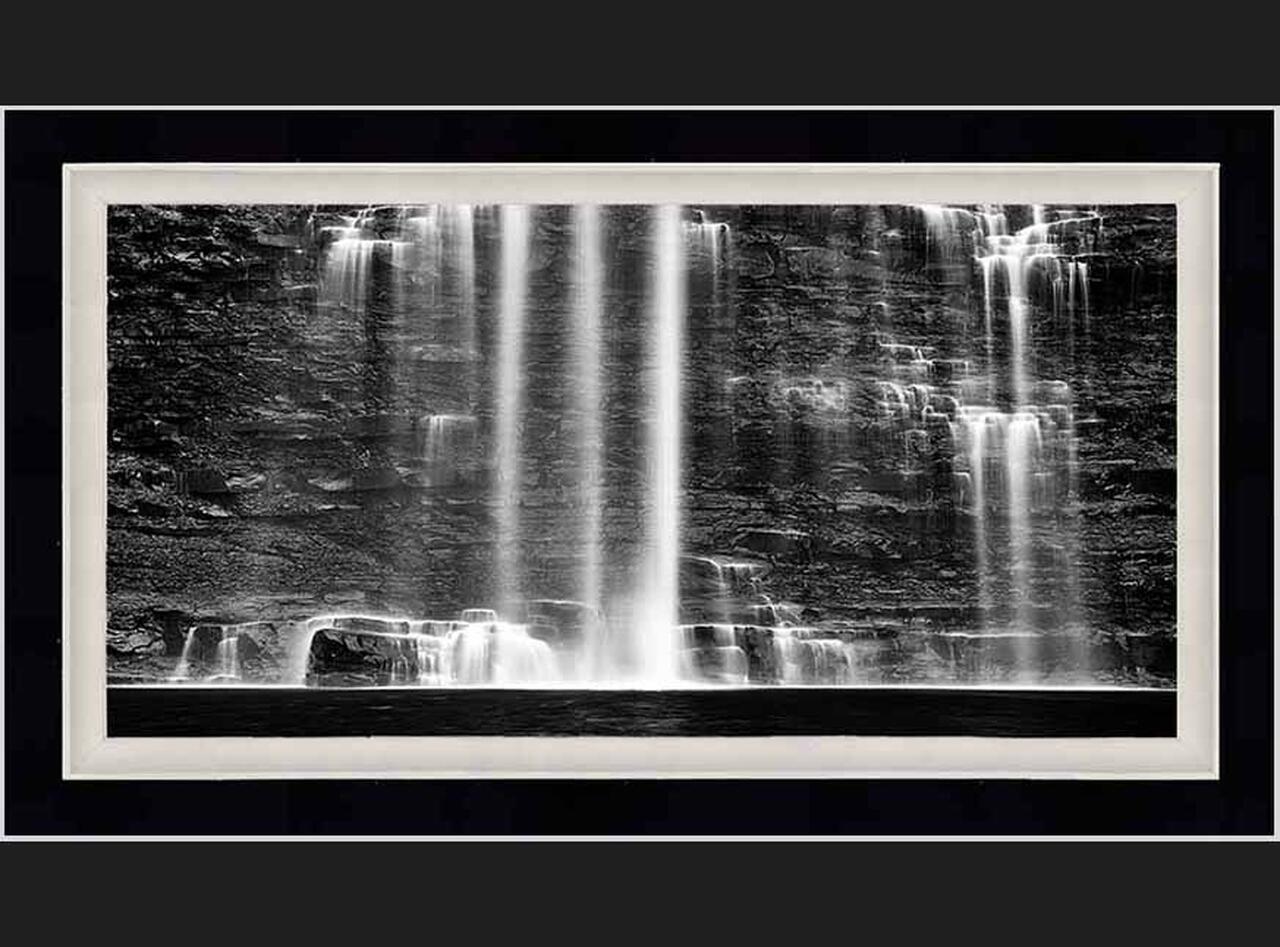
TruLife acrylic in a handcrafted Italian frame with a linen liner chosen for the image. Frame series, finish, and liner are settled with you after the order, and production begins from there. The frame and liner add about fourteen inches to the finished dimensions, worth allowing for when planning placement.
Signature Acrylic Edition of 50· Lumachrome TruLife · Gallery Float Mount
Face-mounted to TruLife acrylic and floated approximately one inch from the wall, with no frame to mediate between the image and the room. UV-resistant, anti-reflective, and scratch-resistant, with a lifetime guarantee against fading.
Signature Metal Edition of 50· ChromaLuxe Print · Gallery Float Mount
Color infused into the aluminum panel itself, floated from the wall on a concealed system. Where acrylic produces luminosity, metal produces clarity. Exceptional fade resistance with no glazing or coating required.
Fine Art Edition of 100· Hahnemühle Baryta Fine Art Paper
Printed without acrylic, so light meets the paper surface directly. Highlights stay luminous, shadows keep their nuance, and the surface has a tactile quality the other presentations approach differently. The understated choice, and the traditional one.
Complimentary shipping within the continental United States. International collector shipping available upon request.
Still deciding
Designing for Stillness
A guide to choosing art for restorative spaces
How to tell whether an image will still hold you in a year, how scale changes what a photograph does in a room, and how to match a piece to the work a room actually performs. It cites the research it draws on, and it is equally clear about where that research stops. About ten minutes to read.