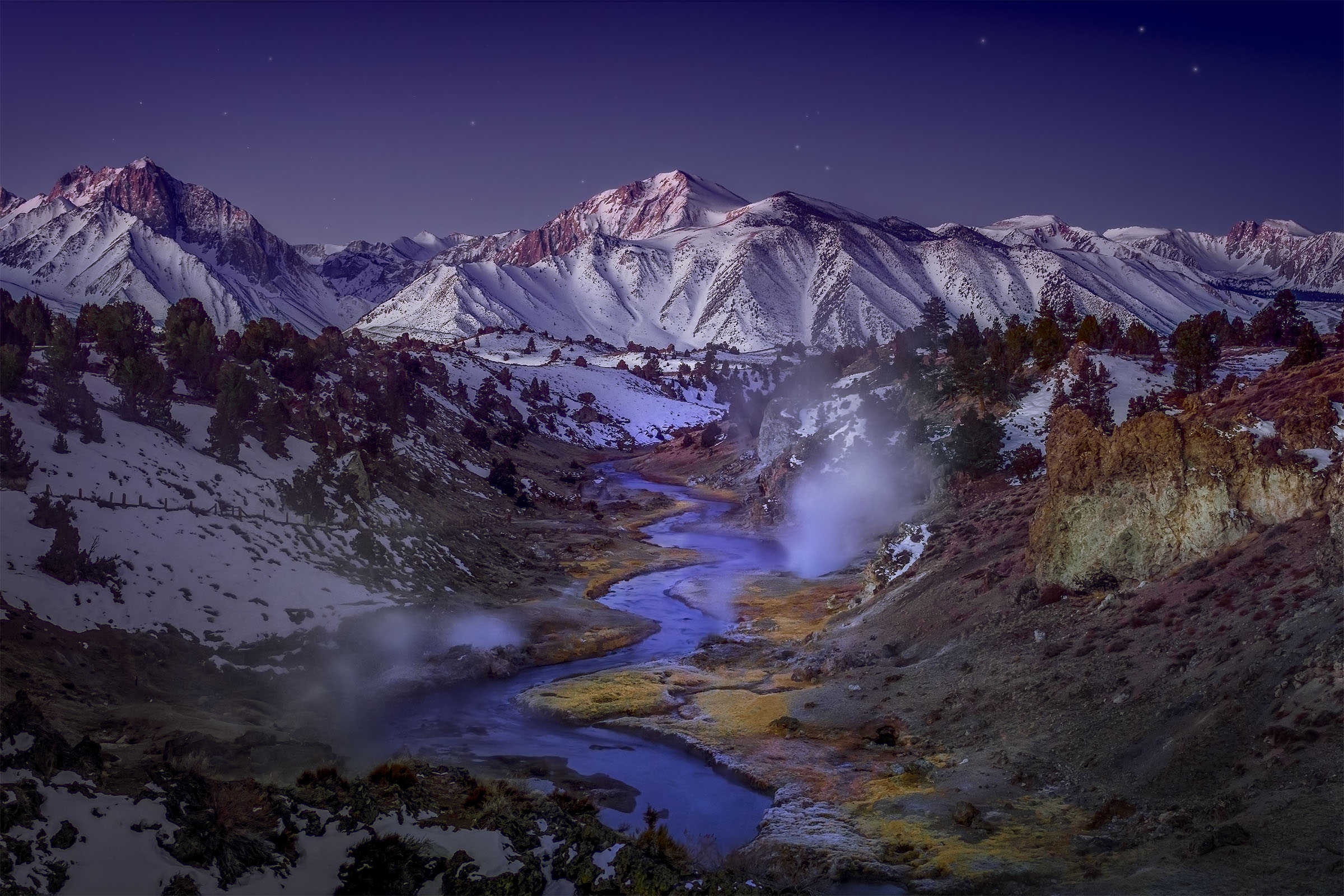
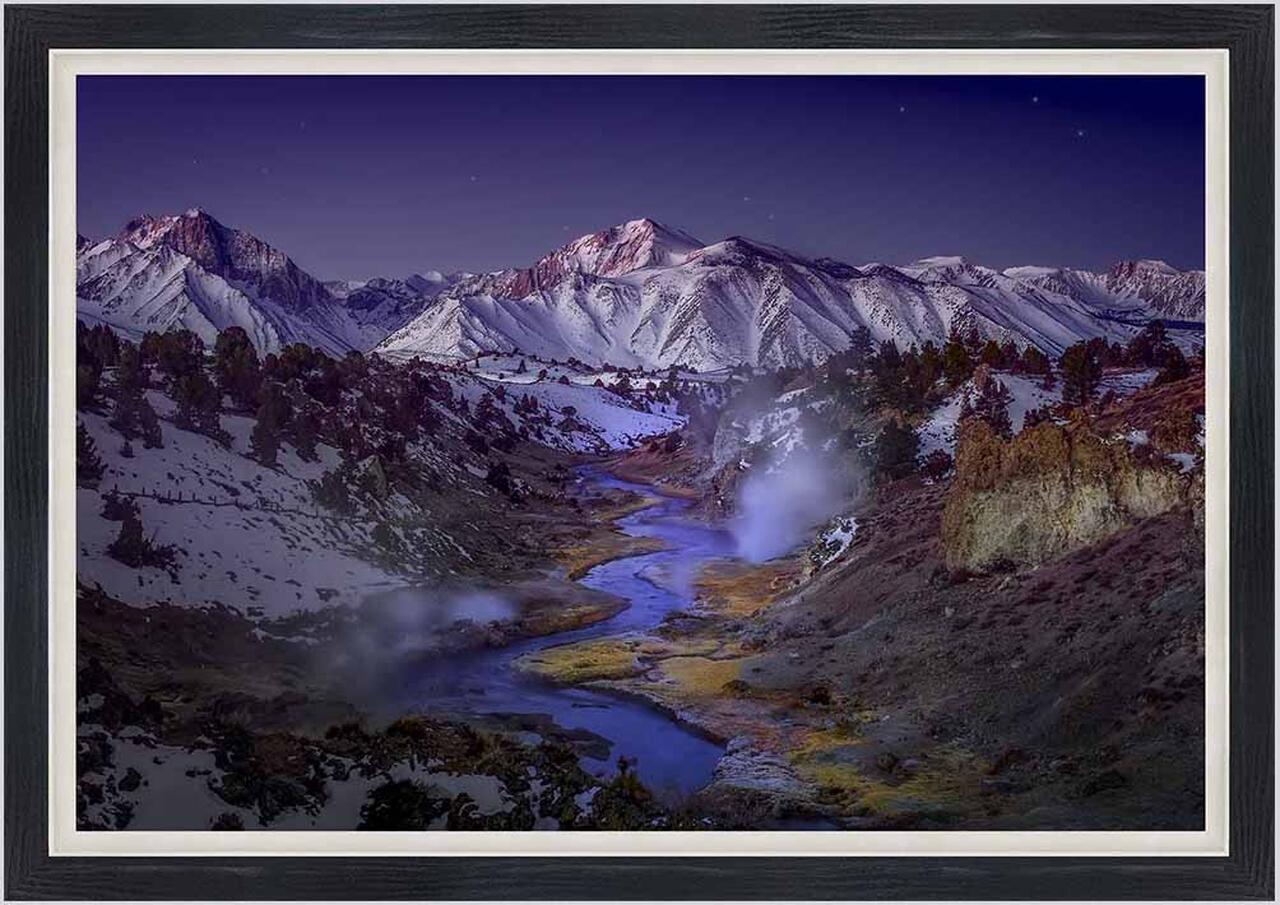
A 3:2 photograph of steam rising from Hot Creek before dawn beneath the snow-covered Sierra Nevada near Mammoth Lakes, California, available as a limited edition print in four sizes.
Artist's Story
I snowshoed in before dawn. There were still stars out, nothing on the valley floor had any light on it yet, and the only color anywhere was a thin band of alpenglow along the tops of the Sierra crest.
In front of me, in a snowfield, was a creek that was steaming.
It arrives as snowmelt, cold, running down out of Mammoth Lakes. Where it enters this gorge it crosses a set of faults, and those faults are open all the way down to an aquifer a few hundred feet below the surface. What is in that aquifer has been heated by magma still sitting under the Long Valley Caldera, and it comes up through the faults into the creek bed. Some of the pools here reach ninety-three degrees Celsius, which at this elevation is boiling.
So there is snowmelt and there is near-boiling water in the same channel, a few feet apart, and every temperature in between somewhere along the bank.
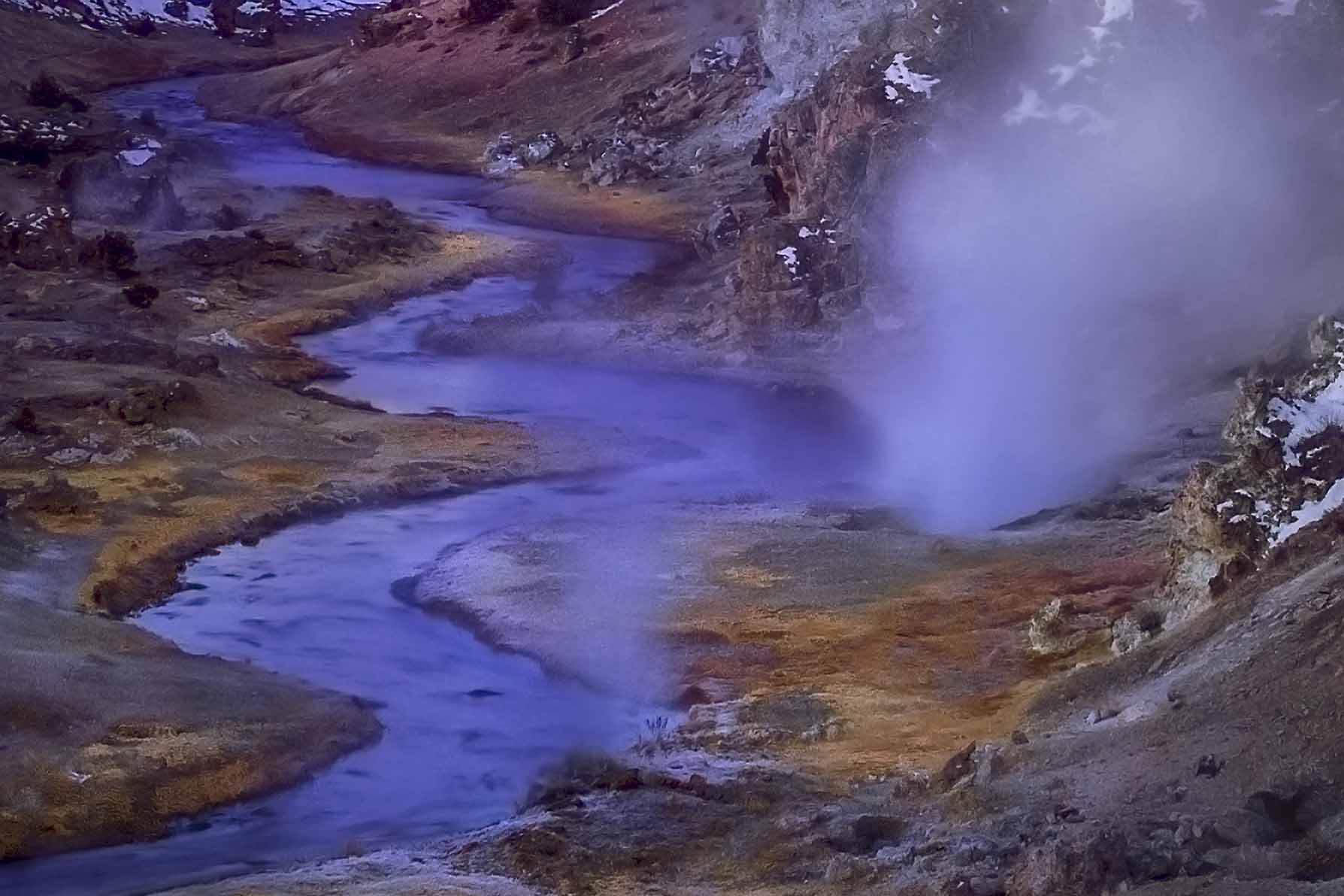
That gradient is why the ground beside the water has color in it in the middle of winter. Heat-loving bacteria and algae live throughout the springs in this caldera, and organisms of that kind are narrow about temperature. Each one occupies its own band and cannot survive far outside it. What that produces along a cooling stream is a sequence of colors laid down in order, one after another, according to how hot the ground is at each point.
The white is a different thing. That is travertine, calcium carbonate the water has been carrying up and setting down around the edges of the pools.
When the Earth Breathes is a valley of snow with a warm stripe running through it, and something under the ground that has not let it close over.
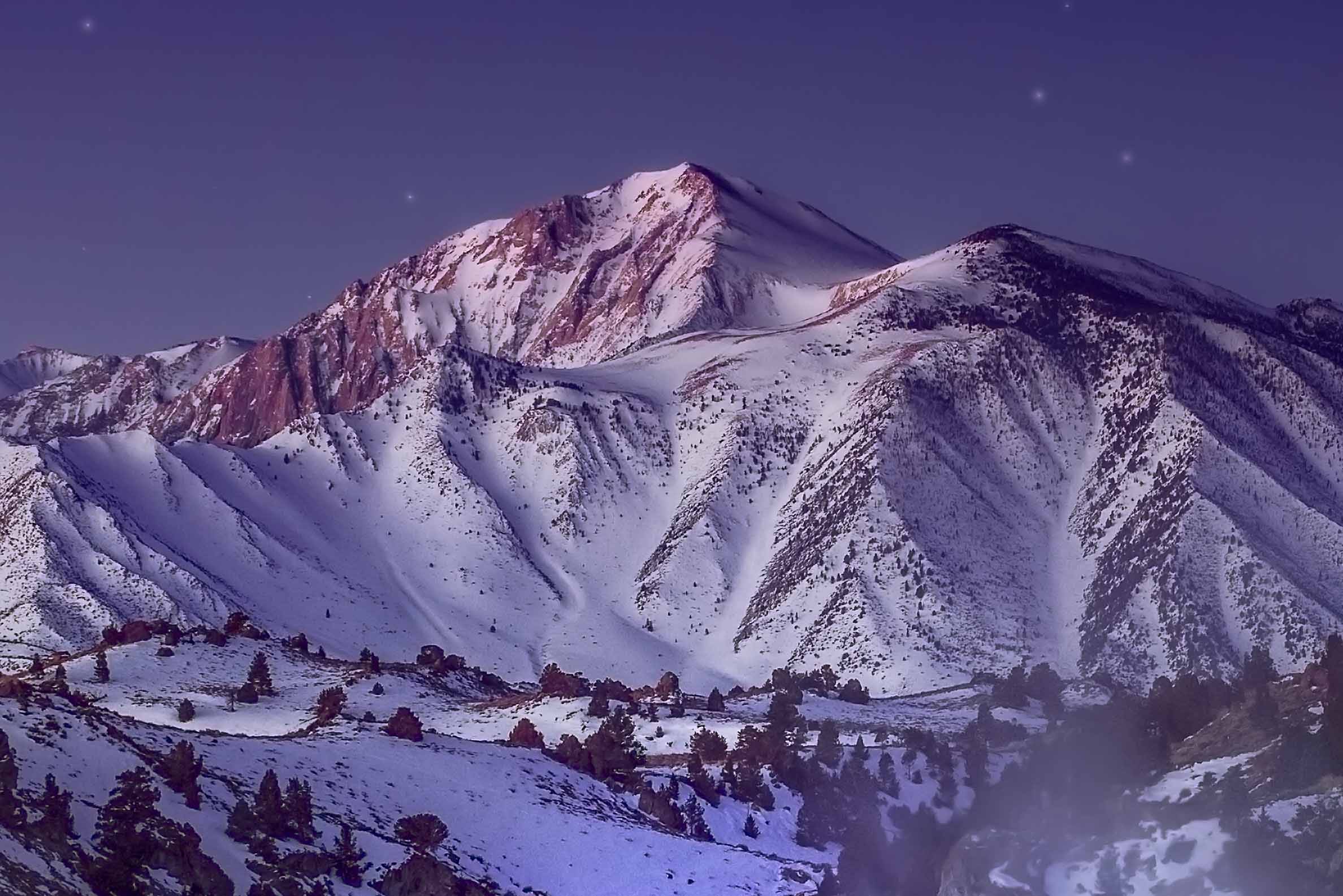
The Sierra crest at about a third of the frame width. Individual couloirs and ridges separate from one another, the avalanche paths read as smooth chutes between them, and the alpenglow on the summit shows as a band with a definite lower edge rather than a glow. Across the slopes the scattered conifers stand as separate trees on the snow, and along the ridge the exposed rock resolves into faces with layering in them. In the sky above, the stars read as points. Click to view at full size.
The creek at about a quarter of the frame width. The color along the banks separates into distinct zones with edges between them, orange against rust against a paler yellow, each holding its own ground and stopping where the next begins. The white travertine reads as a crust with texture rather than as snow. At the right the plume stands clear of the ground it rises from, and the rock behind it shows through where it thins. Click to view at full size.
About This Photograph
Hot Creek Geologic Site, Mono County, California, about eight miles southeast of Mammoth Lakes, looking west toward the Sierra Nevada crest before sunrise in winter. This is a single frame image. The site sits within the Long Valley Caldera and is managed by the Forest Service and monitored by the Geological Survey.
The steam is not the water vapor itself, which is invisible. What appears in the picture is where that vapor has met freezing air and condensed back into droplets, which is why the plumes stand up so clearly on a winter morning and are barely visible in summer, and why each one begins a little above the ground rather than at the vent.
Despite being a photograph of a snowfield, nothing in this frame is bright. Its brightest sustained passage measures a hundred and sixty-three out of two hundred and fifty-five, the lowest in the collection, and no part of it reaches pure white. The snow here is lit by a sky that has not yet had the sun in it.
When the Earth Breathes
Steve Austinhttps://www.steveaustinphotography.com/
Location
Hot Creek, Mammoth Lakes, California
Subject
Geothermal steam · Sierra Nevada · winter dawn
Capture
Single frame before sunrise
Format
Photograph · horizontal, 3:2
Sizes
24 × 16 in · 36 × 24 in · 48 × 32 in · 60 × 40 in
Print Media
TruLife Acrylic · ChromaLuxe Metal · Baryta paper
Edition
Limited, 25 / 50 / 100 by presentation
What it Does in a Room
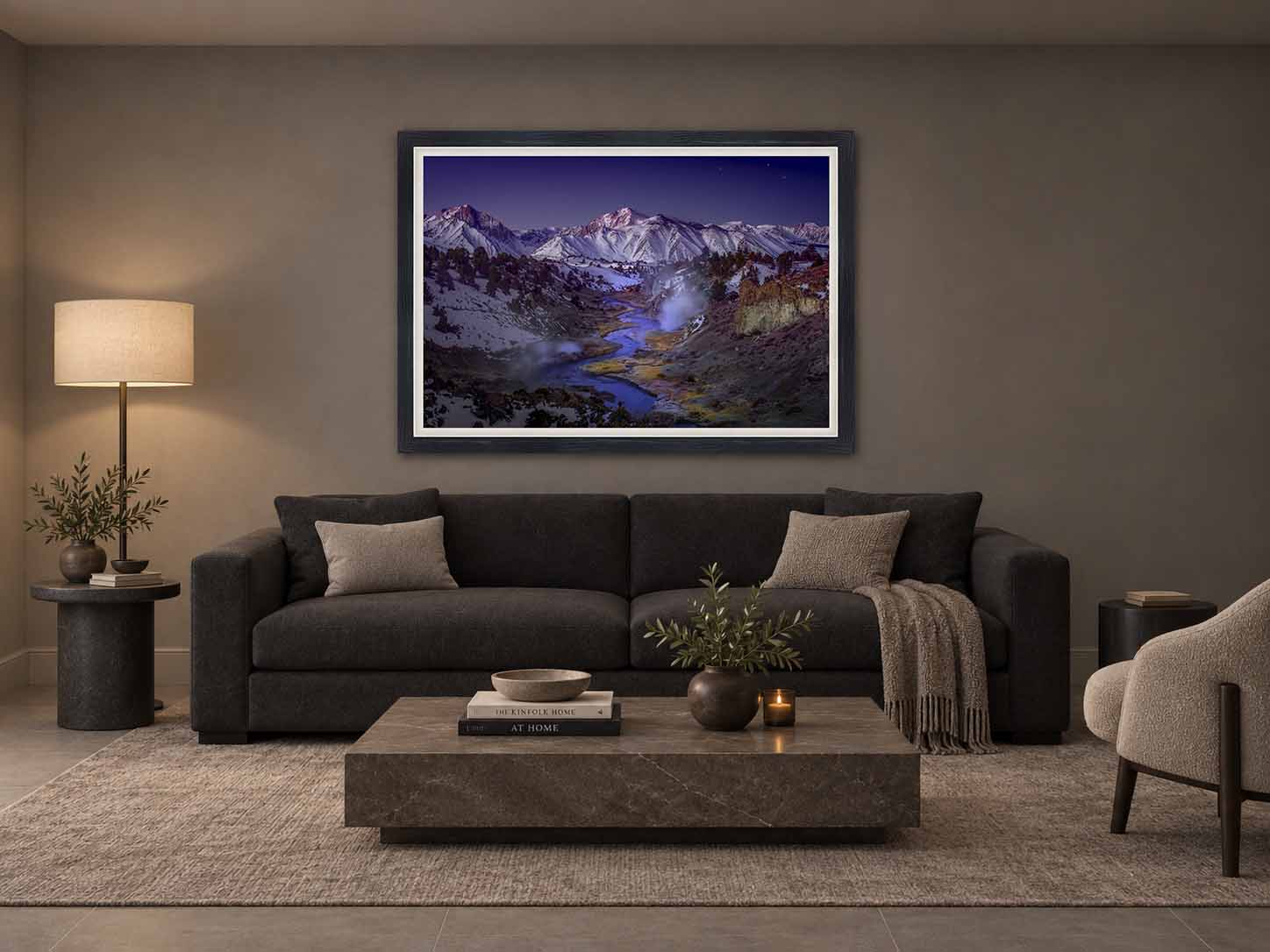
There are stars in this photograph, and they are the smallest thing in the entire collection. A star occupies a few pixels in the file and a fraction of an inch on a print, which sets two conditions nothing else here imposes. It has to be printed large enough for them to survive, since below a certain size they simply go, and it has to hang somewhere dim enough for them to be visible, because a star is only a small light against a dark ground and a bright room raises the ground until there is nothing to see against. In a well-lit room at a small size this is a picture of a steaming creek. In a low-lit room at a large size it is a picture of a steaming creek at night, which is a different thing.
It also has depth rather than bands. Most of this collection is panoramic and built in horizontal layers, which read as a sequence of distances stacked up the frame. This one is arranged front to back: rock and snow at your feet, the creek winding away through the middle ground, then the hills, then a mountain range twenty miles off. On a wall that opens the plane rather than decorating it, and it means the piece works best where a viewer has room to stand back and let the recession do its work. In a narrow space, three feet from a corridor wall, the depth compresses and most of what the composition is doing is lost.
The third thing is that the subject cannot be seen. What this photograph is about is heat, and heat does not photograph. Everything visible is a consequence of it: the steam, the water that has not frozen, the color on the banks in the middle of winter. That makes it a piece that pays a viewer back for knowing something, and it belongs where that is likely, a room where people talk, a wall someone passes with a guest, rather than a room where it will be seen only in passing and never explained.
Not sure which size the room calls for, or want dimensions not listed here? Sizes beyond 60 × 40 are available on request and ship crated by freight. That conversation is welcome before an order is placed. Start that conversation and I will answer within one business day.
When the Earth Breathes, limited edition printSteve Austin65011000USD15https://schema.org/InStock
Questions about this photograph
How small is too small for a photograph this shape?
At the Intimate size the picture is twenty-four inches across and sixteen inches tall, and the large structure holds: the mountains, the creek winding through, the steam, and the snow. What goes first, and completely, are the stars. There are perhaps a dozen of them and each is a few pixels across, so below the middle sizes they are gone and the photograph stops being a night picture. The color on the banks goes at the same point, compressing from a sequence of separate bands into a single warm smear, which removes the thing this page is about. The plumes survive at any size because they are large and soft. The Collected at thirty-six by twenty-four is where the bands separate and the stars return. If you are weighing a size against a specific wall, choosing the right print size covers the measurements and the viewing distances in more detail.
What changes at the largest size?
The bank becomes a sequence. At sixty by forty the color alongside the creek separates into distinct zones with edges between them, orange against yellow against a paler green, each one holding its own ground, and you can follow a band along the water and see where it stops. The white travertine reads as a crust with texture rather than as snow. On the mountains the individual couloirs and ridges separate and the alpenglow shows as a band with a definite lower edge rather than a glow. In the middle distance the junipers stand as individual trees on the snow slopes. And the stars become points rather than suggestions, which is what makes the sky read as night rather than as dusk. Why scale matters covers what happens perceptually when a landscape reaches the size where the eye has to cross it.
What kind of room does this photograph suit?
Rooms with low light and some floor space in front of the wall. A family room, a sitting room, a study, a bedroom. It hangs at ordinary height and needs a viewer to be able to stand back from it. On materials it is easy, because it is dark and cool throughout and finds a partner in gray stone, charcoal, plaster, and deep paint alike, though it will look thin against bright white. Two things to avoid. Do not light it directly, since a beam raises the sky and the stars go with it. And keep it away from a strongly warm scheme, because the only warm color in the picture is a narrow band along the creek and a thread of alpenglow, and a room full of amber will absorb both. When your mind needs to rest takes the question further.
Every work ships insured and arrives with a signed certificate of authenticity.
If a piece is damaged in transit, the choice of replacement is always yours, and your edition number stays with you.
Production time runs 2 to 3 weeks for metal, 3 to 4 weeks for acrylic and paper, and 5 to 6 weeks for framed work.
Each print is made to order and takes its place in a numbered edition, so sales are final. Before you choose, I am glad to help: send a photo of your wall and I will show you this work in your room at true scale, at no charge. Start a conversation
Collector's Choice · TruLife ® Acrylic in Italian Frame
Collector Edition of 25· Lumachrome TruLife Acrylic · Handcrafted Italian Frame
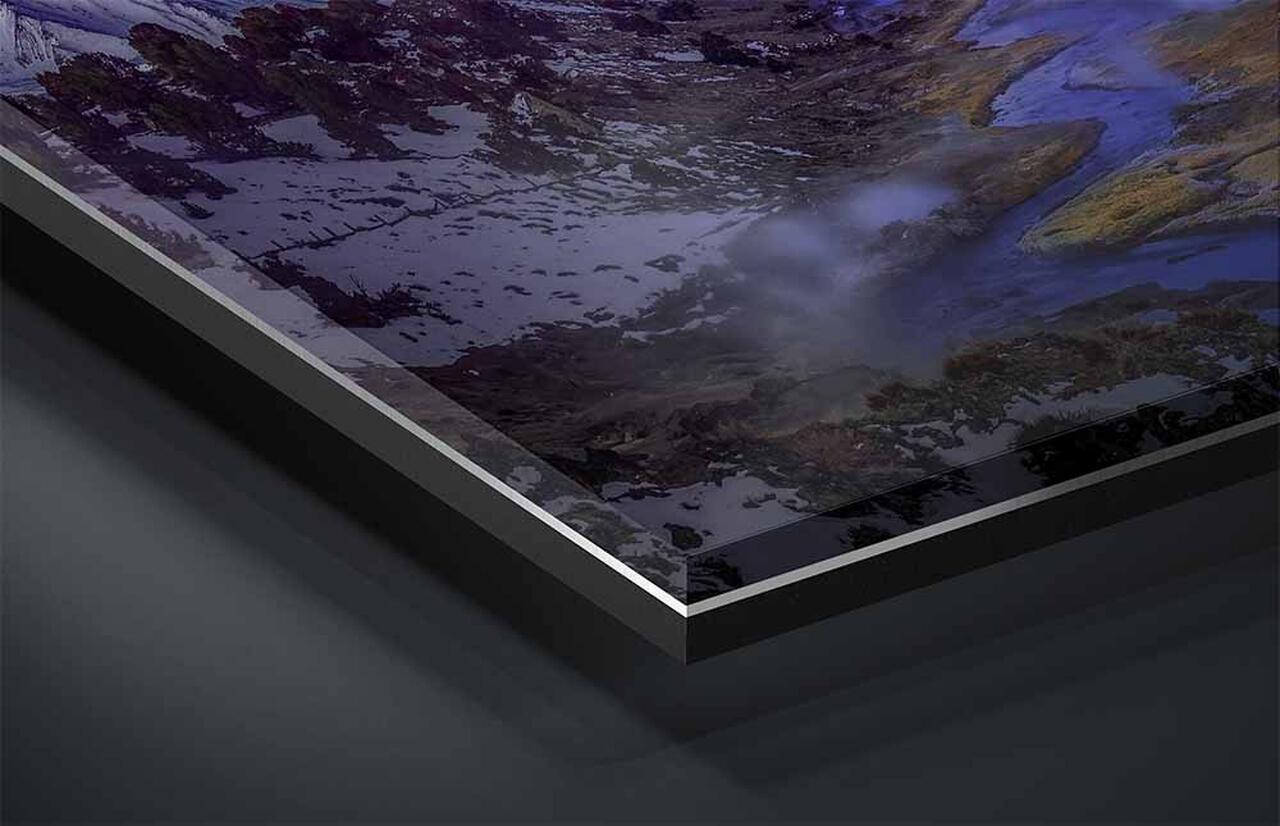
TruLife acrylic in a handcrafted Italian frame with a linen liner chosen for the image. Frame series, finish, and liner are settled with you after the order, and production begins from there. The frame and liner add about fourteen inches to the finished dimensions, worth allowing for when planning placement.
Signature Acrylic Edition of 50· Lumachrome TruLife · Gallery Float Mount
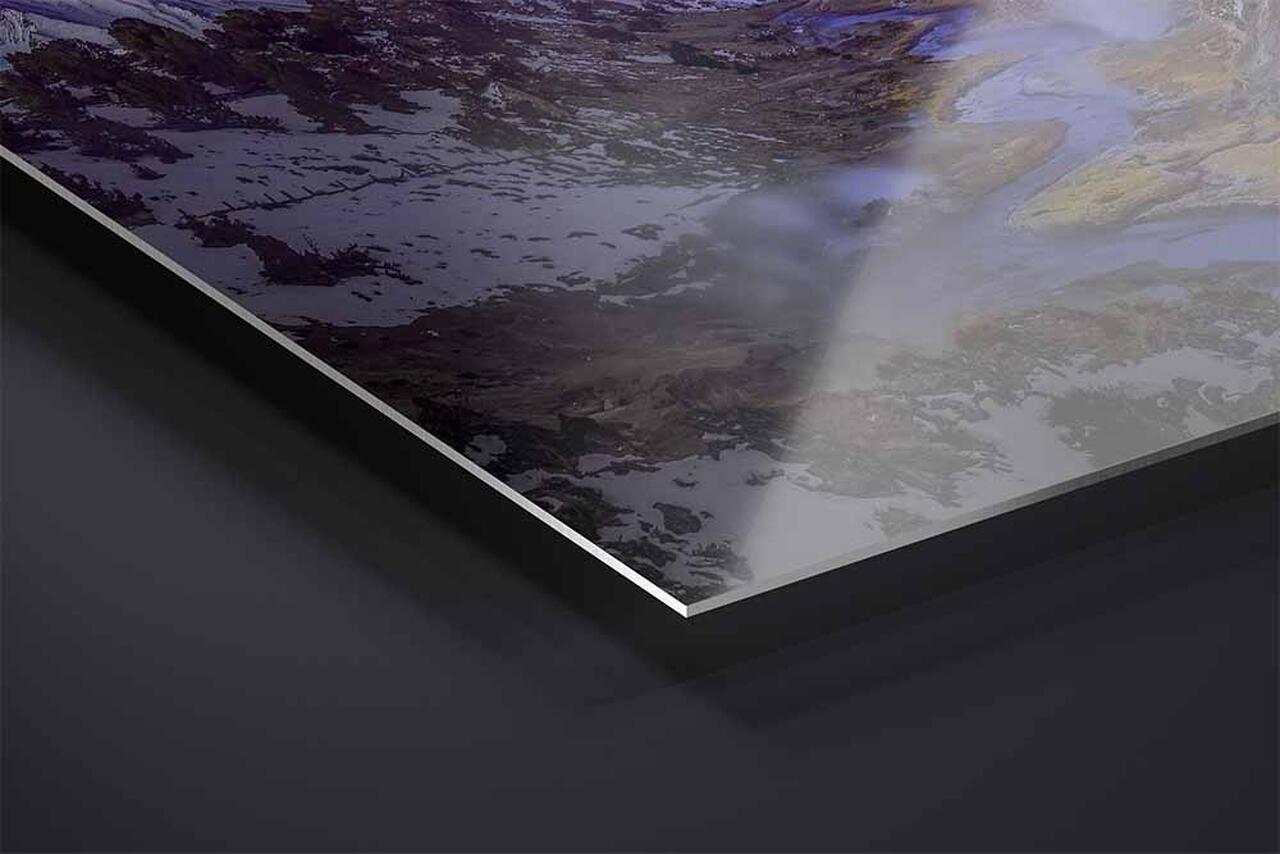
Face-mounted to TruLife acrylic and floated approximately one inch from the wall, with no frame to mediate between the image and the room. UV-resistant, anti-reflective, and scratch-resistant, with a lifetime guarantee against fading.
Signature Metal Edition of 50· ChromaLuxe Print · Gallery Float Mount
Color infused into the aluminum panel itself, floated from the wall on a concealed system. Where acrylic produces luminosity, metal produces clarity. Exceptional fade resistance with no glazing or coating required.
Fine Art Edition of 100· Hahnemühle Baryta Fine Art Paper
Printed without acrylic, so light meets the paper surface directly. Highlights stay luminous, shadows keep their nuance, and the surface has a tactile quality the other presentations approach differently. The understated choice, and the traditional one.
Complimentary shipping within the continental United States. International collector shipping available upon request.
Still deciding
Designing for Stillness
A guide to choosing art for restorative spaces
How to tell whether an image will still hold you in a year, how scale changes what a photograph does in a room, and how to match a piece to the work a room actually performs. It cites the research it draws on, and it is equally clear about where that research stops. About ten minutes to read.