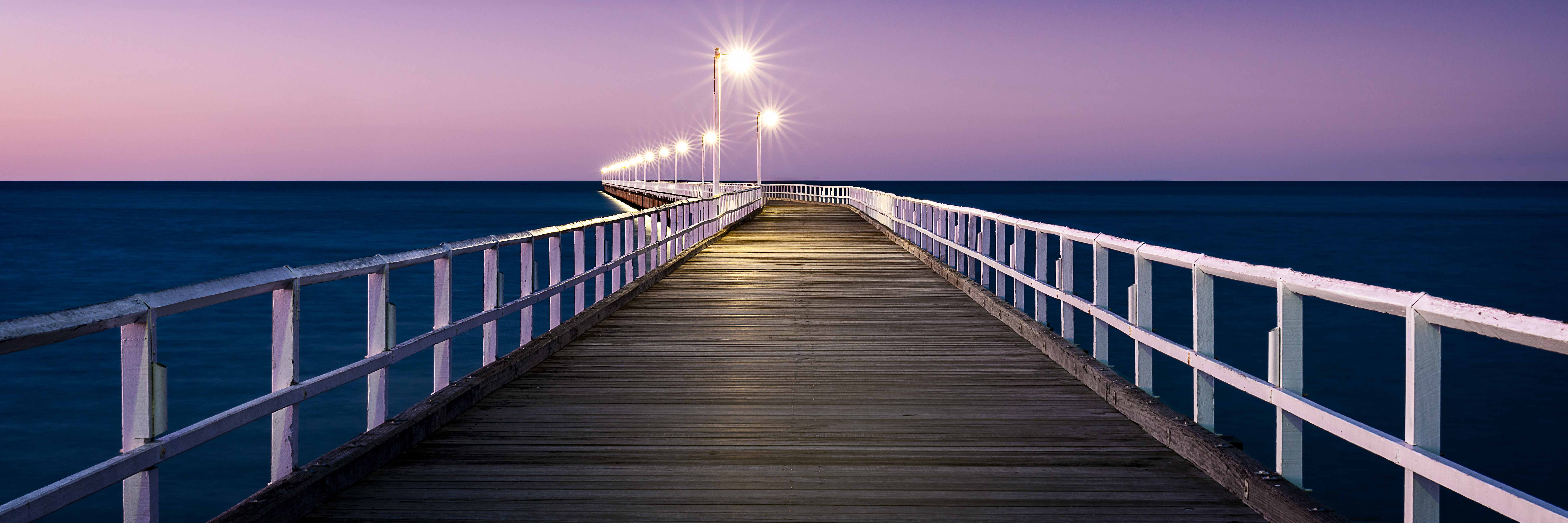
A 3:1 panoramic photograph of Urangan Pier at dusk in Hervey Bay, Queensland, Australia, available as a limited edition print in three sizes.
Artist's Story
I walked out at dusk, after the day's fishermen had packed up their gear, when the only sounds left were water against the pilings and my own steps on the boards.
Urangan Pier runs 868 meters into Hervey Bay, on the Queensland coast, and it was never built for walking. It went up between 1913 and 1917, originally about 1,107 meters, pushed out far enough to find water deep enough for ships in a bay with a large tide. Trains ran its length for most of a century, carrying sugar, coal and timber out to be loaded. The last ship left in January 1985.
Here is the part that should not work. It is made of wood, and it has been standing in warm seawater since 1913. Marine borers, the shipworm chief among them, will go through an ordinary timber pile in a few years. They will go through a creosote-treated one in under six.
It was built from turpentine. The tree grows up the east coast of Australia and its heartwood carries a high silica content, which is to say there is sand in the wood. That is why turpentine blunts saw blades, and it is why borers cannot make headway in it, and it is why turpentine was the timber Australian engineers reached for whenever they had to put wood in the sea. Piles were often driven with the bark still on, for the extra layer.
That bought about seventy years. When the pier closed, 239 meters of it came down and the rest was saved by a public campaign, restored, and reopened in 1999.
Most of the original turpentine is gone now. By 2009 the last section had been rebuilt with steel piles sleeved in plastic, and a later refurbishment replaced piles, headstocks, girders and cross braces along the full length with a composite design rated for a hundred years. The wood got it through the twentieth century and then handed the job on.
Where Attention Leads is the deck at dusk. What holds it up is a different photograph, Into the Infinite, made from underneath.
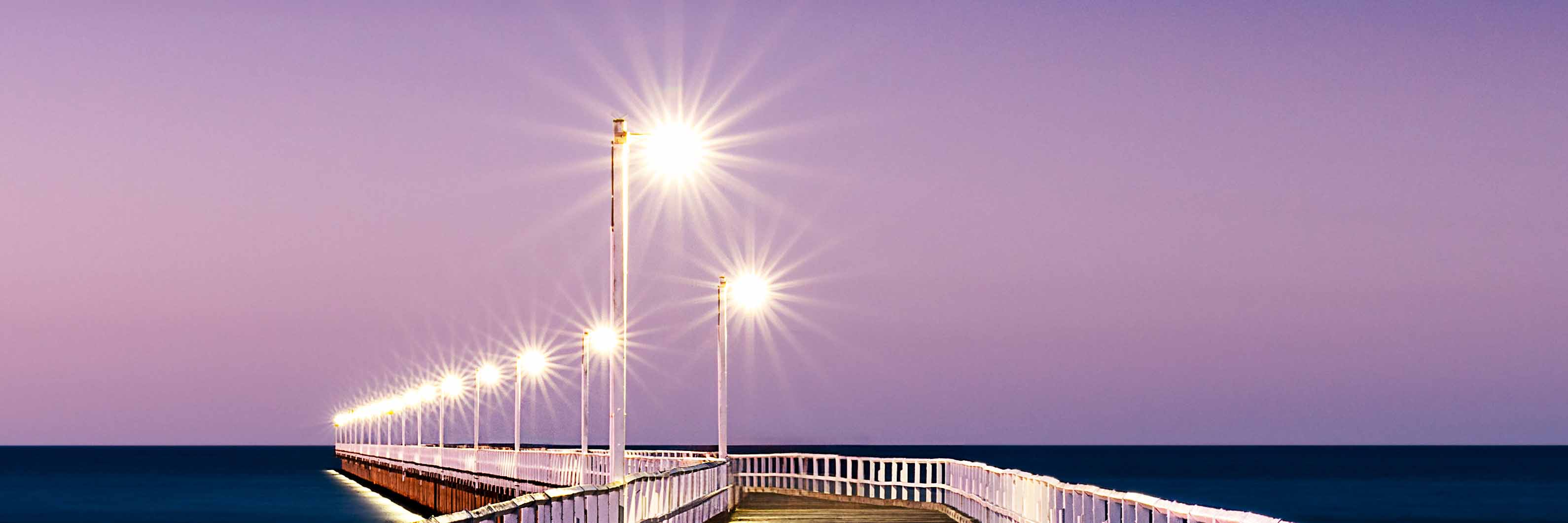
The lamps at about a third of the frame width. On a ninety inch print this section runs roughly thirty inches across. The diffraction rays extend as clean separate lines and can be counted: sixteen on each of the near lamps, which is an eight-bladed aperture. The balusters resolve one by one down both railings until they merge, the deck boards separate with the gaps between them visible, and at the far end the pier reads as a structure with a shape rather than a bright blur. Click to view at full size.
About This Photograph
Urangan Pier, Hervey Bay, Queensland, Australia, looking out along the deck toward the open water of the Great Sandy Strait, at dusk shortly after sunset. This is a single long exposure in low light. The pier is heritage listed and now carries pedestrians only.
The lamps show diffraction spikes rather than round points. Light bends around the blades of the lens aperture and spreads into rays, and the number of rays is set by the number of blades, doubled if that number is odd. Count the points on one lamp in this photograph and you have counted the blades in the lens that made it. There are sixteen, which means eight blades.
This photograph holds the widest range of any in the collection. Around its border alone, brightness runs from fourteen to a hundred and ninety-two out of two hundred and fifty-five, a span of a hundred and seventy-eight points, from the lit railing at one corner to the dark water at another.
Where Attention Leads
Steve Austinhttps://www.steveaustinphotography.com/
Location
Urangan Pier, Hervey Bay, Australia
Subject
Timber pier · dusk lamps · Hervey Bay
Capture
Single frame, long exposure at dusk
Format
Photograph · horizontal panorama, 3:1
Sizes
36 × 12 in · 60 × 20 in · 90 × 30 in
Print Media
TruLife Acrylic · ChromaLuxe Metal · Baryta paper
Edition
Limited, 25 / 50 / 100 by presentation
What it Does in a Room
This photograph changes with the light in the room more than anything else in the collection, and by a measurable margin. Its border alone spans a hundred and seventy-eight points of brightness, from lit railing at one corner to dark water at another, and no other piece here comes close. In a bright room the dark half closes up and what you get is a row of lamps and a pale deck against something indistinct. In a low-lit room the water opens, the railings separate from the sea behind them, and the whole structure appears. Both are good, and they are not the same picture. It is worth seeing it in the light it will actually live in before choosing a size.
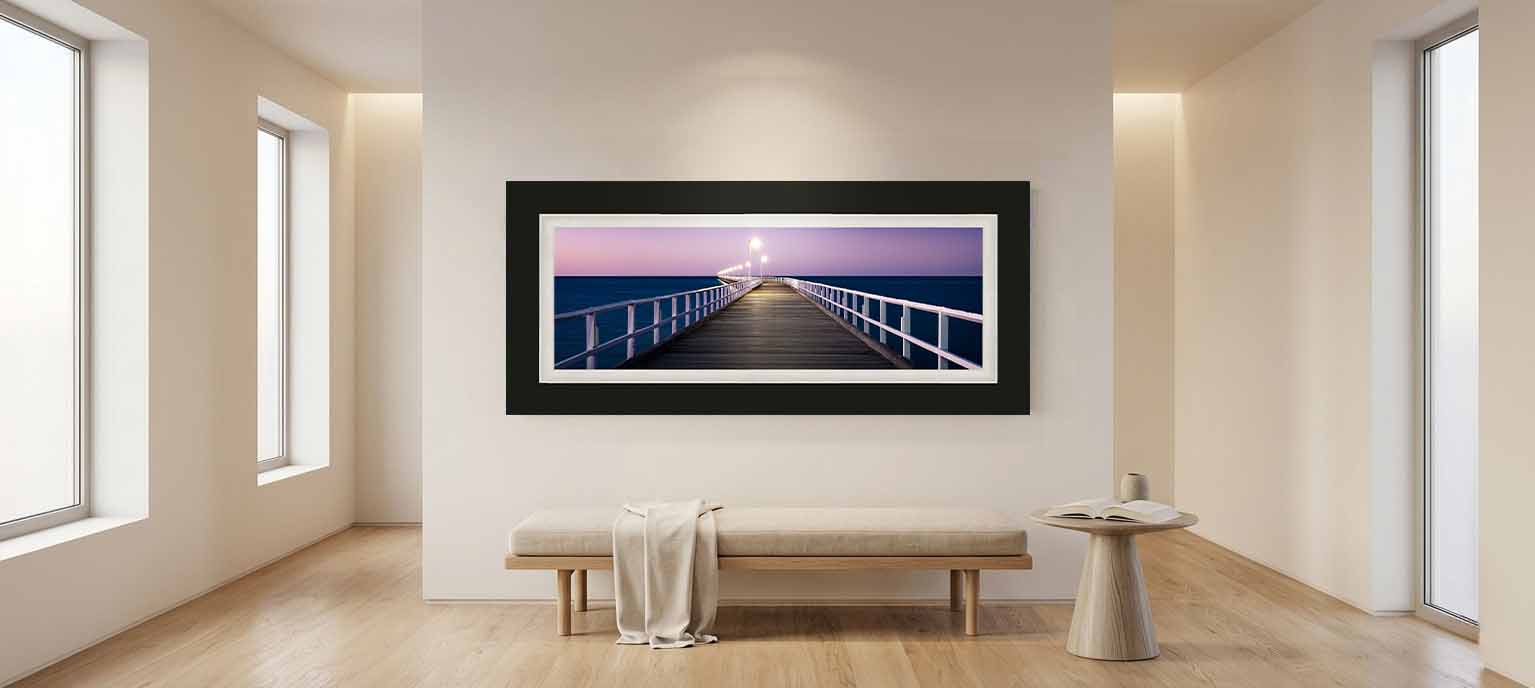
It is also made from a position a viewer can occupy. The camera stood on the deck at standing eye height, with the railings at hand level and the boards running away underfoot, and the composition is symmetrical about the center line. Hung at ordinary height and viewed square on, a person standing in front of it is standing exactly where the photograph was made. Viewed from an angle, that collapses, and it becomes a picture of a pier rather than a place on one. This is a piece to put at the end of a room, on the wall you face, rather than on one you pass along.
The third thing is a practical freedom. The upper third of this frame is empty sky with nothing in it but the lamps, which means there is very little to lose at the top. It will take a high hang, a spot under a soffit, or a wall where the top edge sits above comfortable sightline, and give up almost nothing, because the part that would be sacrificed is the part carrying no information. Almost nothing else in this collection can be hung high without cost.
Not sure which size the room calls for, or want dimensions not listed here? Sizes beyond 90 × 30 are available on request and ship crated by freight. That conversation is welcome before an order is placed. Start that conversation and I will answer within one business day.
Where Attention Leads, limited edition printSteve Austin70012900USD11https://schema.org/InStock
Questions about this photograph
How small is too small for a photograph this wide?
At the Intimate size the picture is thirty-six inches across and twelve inches tall, and the large structure holds easily. The deck, the two lines of railing, and the lamps all read from across a room, and the symmetry is legible at any size. What goes is everything about the pier that makes it a real object. The individual balusters merge into a pale band, the deck boards stop being separate boards, and the far end of the pier, which is a hundred small elements compressed into an inch of print, becomes a smudge with lights in it. The starbursts also shrink to points, which removes the one thing in the frame a viewer can count. The Collected at sixty by twenty is where the balusters separate again. If you are weighing a size against a specific wall, choosing the right print size covers the measurements and the viewing distances in more detail.
What changes at the largest size?
The pier becomes carpentry. At ninety by thirty the deck boards separate with the gaps between them visible and the grain running along each one, and the bolt heads and plates at the base of the railing posts come clear. Along the near railings the paint shows its wear, the brushwork, the chipped edges, and the darker timber underneath where it has gone. The balusters resolve one by one all the way down both sides until they merge, which is what gives the picture its depth. On the lamps the diffraction rays extend as clean separate lines and the number of them becomes countable. At the far end the pier resolves into a structure with a shape rather than a bright blur, and the deck at that distance shows as a surface rather than a line. Why scale matters covers what happens perceptually when a photograph reaches the size where the eye has to cross it.
What kind of room does this photograph suit?
Rooms with controlled light and a wall you face. A breakfast room, a study, a sitting room, the end of an open plan. On materials it is unusually easy, because violet is a hue almost nothing in a house carries: not wood, not stone, not plaster, not leather. There is nothing for it to clash with. Two things to avoid. Do not hang it opposite a bright window, since the darkest half of the picture is where most of its information sits and daylight bouncing off the surface will take that half away. And keep it clear of other pier or jetty images, including its companion piece made beneath this same structure, because the two are the same subject from two positions and are stronger in separate rooms. When your mind needs to rest takes the question further.
Every work ships insured and arrives with a signed certificate of authenticity.
If a piece is damaged in transit, the choice of replacement is always yours, and your edition number stays with you.
Production time runs 2 to 3 weeks for metal, 3 to 4 weeks for acrylic and paper, and 5 to 6 weeks for framed work.
Collector's Choice · TruLife ® Acrylic in Italian Frame
Collector Edition of 25· Lumachrome TruLife Acrylic · Handcrafted Italian Frame
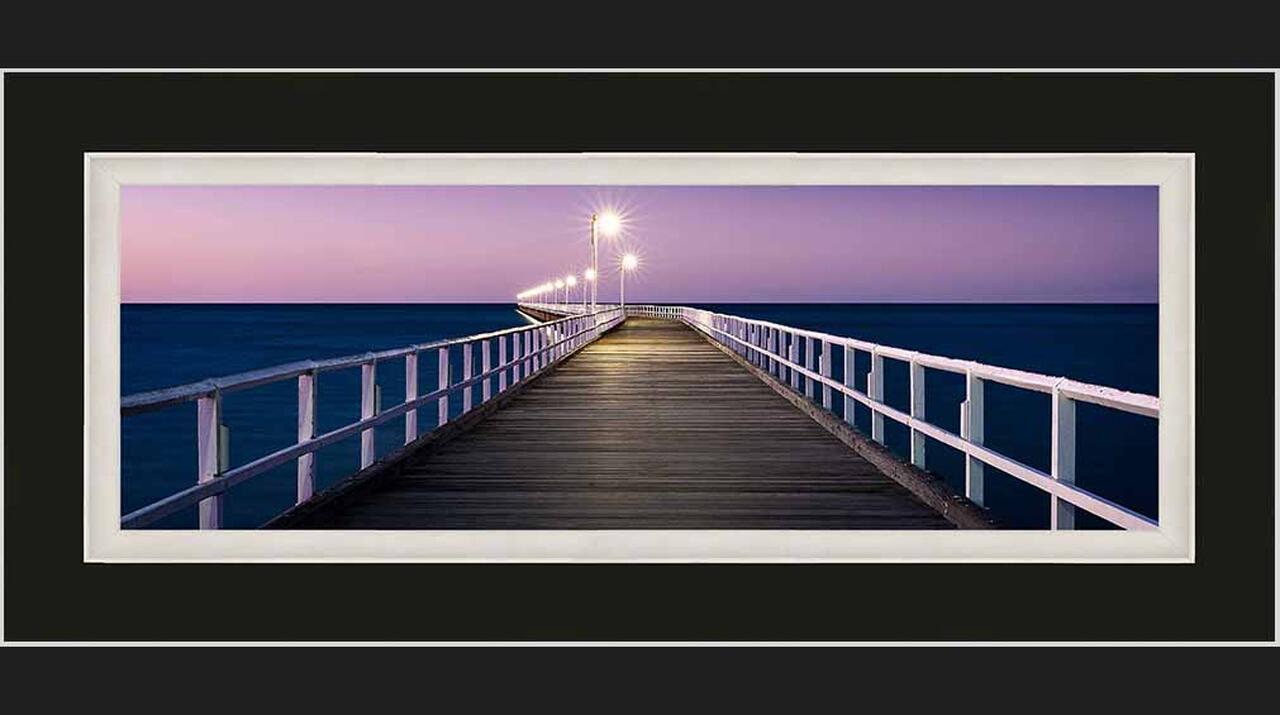
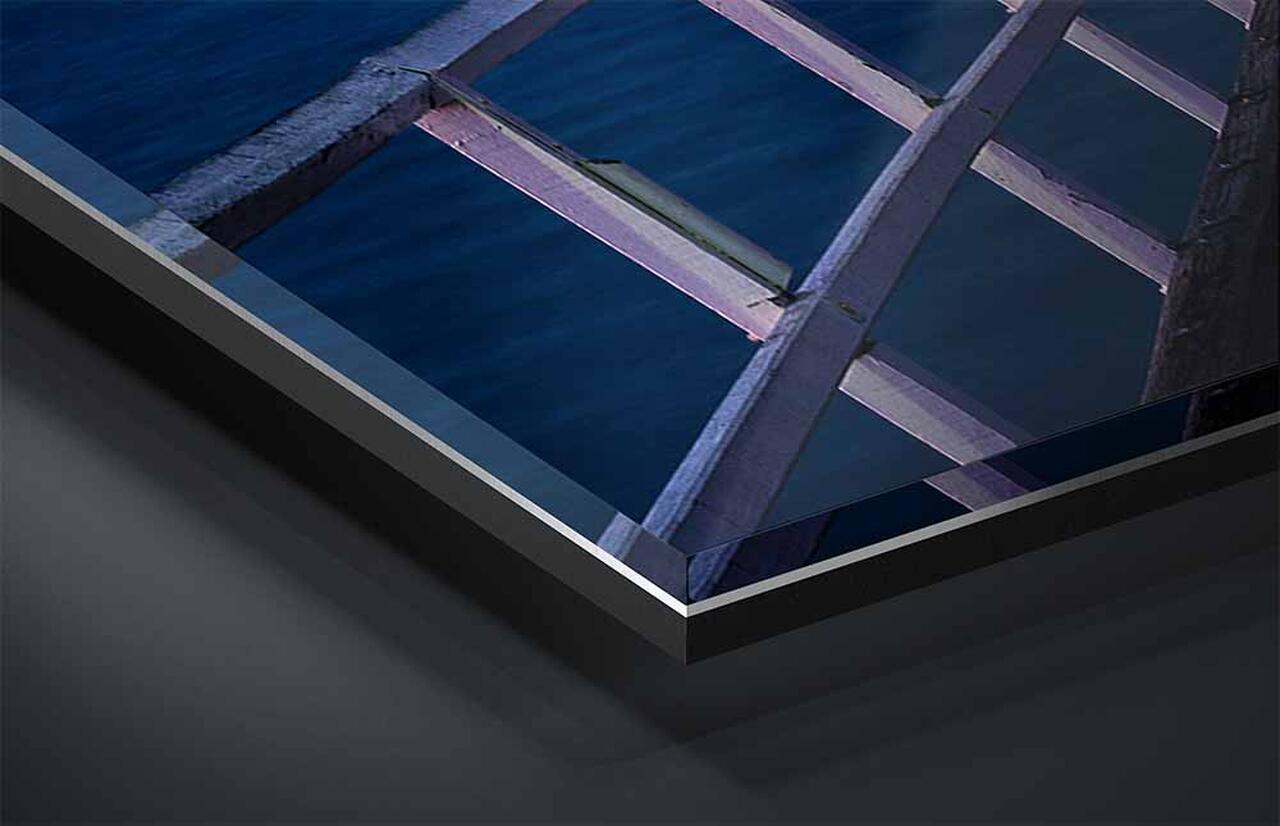
TruLife acrylic in a handcrafted Italian frame with a linen liner chosen for the image. Frame series, finish, and liner are settled with you after the order, and production begins from there. The frame and liner add about fourteen inches to the finished dimensions, worth allowing for when planning placement.
Signature Edition · TruLife ® Acrylic, Float Mount
Signature Edition of 50· Lumachrome TruLife Acrylic · Gallery Float Mount
Face-mounted to TruLife acrylic and floated approximately one inch from the wall, with no frame to mediate between the image and the room. UV-resistant, anti-reflective, and scratch-resistant, with a lifetime guarantee against fading.
Signature Edition of 50· ChromaLuxe Metal Print · Gallery Float Mount
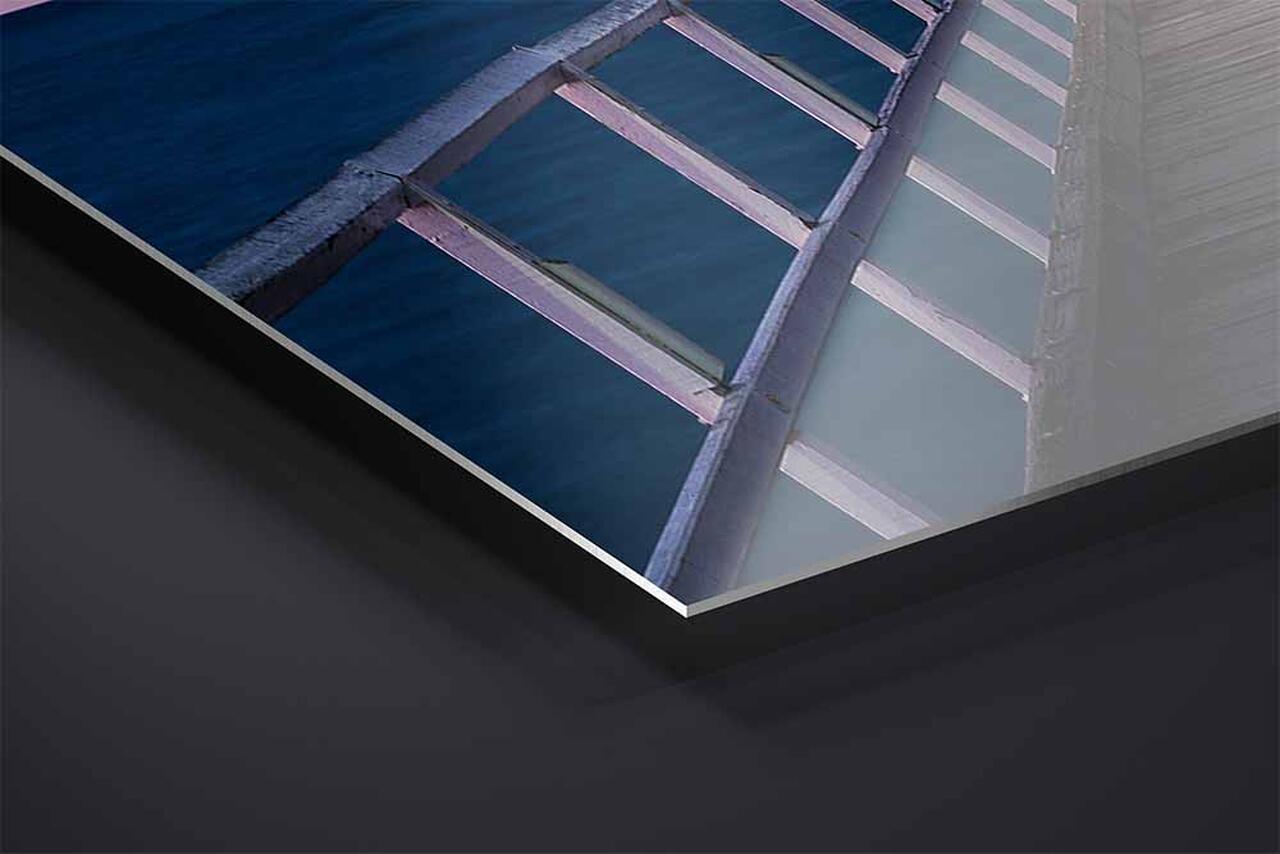
Color infused into the aluminum panel itself, floated from the wall on a concealed system. Where acrylic produces luminosity, metal produces clarity. Exceptional fade resistance with no glazing or coating required.
Fine Art Edition of 100· Hahnemühle Baryta Fine Art Paper
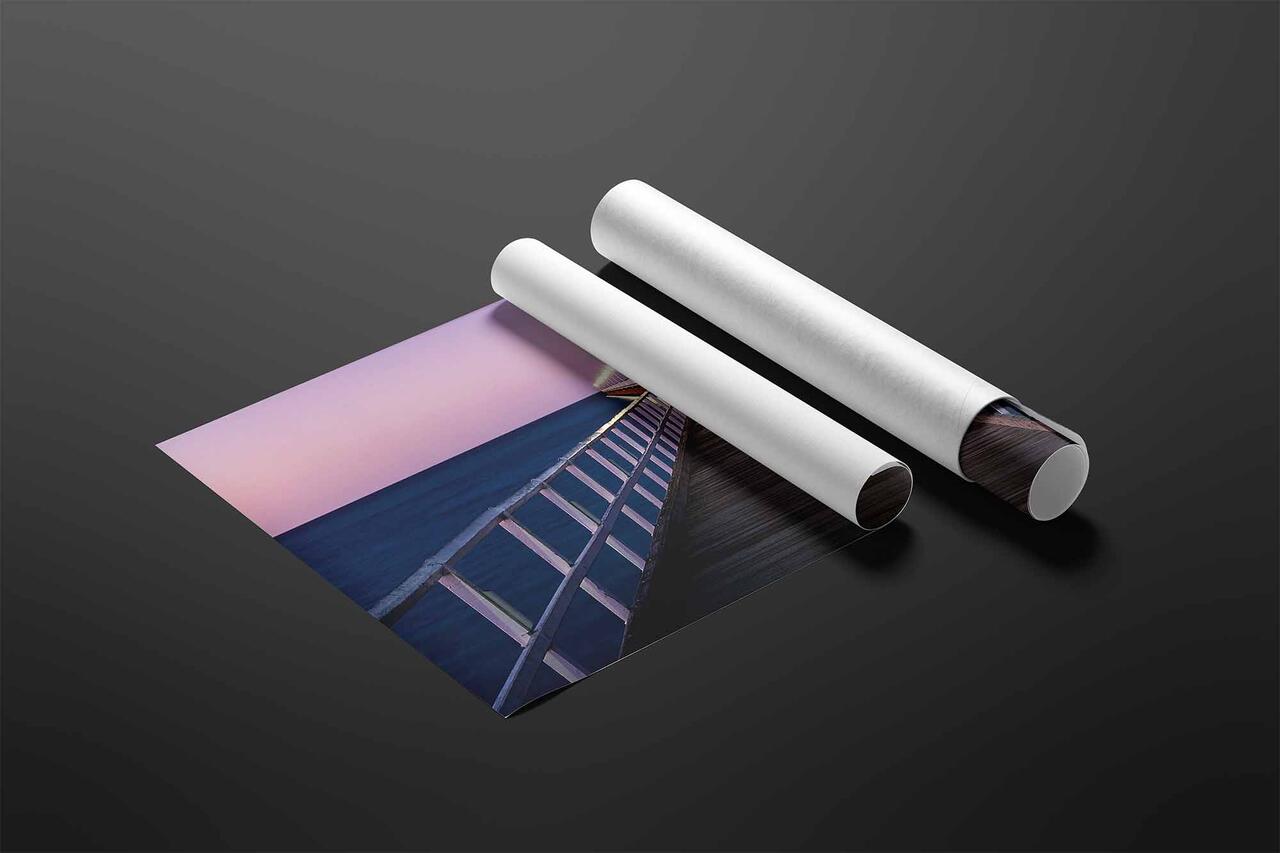
Printed without acrylic, so light meets the paper surface directly. Highlights stay luminous, shadows keep their nuance, and the surface has a tactile quality the other presentations approach differently. The understated choice, and the traditional one.
Complimentary shipping within the continental United States. International collector shipping available upon request.
Still deciding
Designing for Stillness
A guide to choosing art for restorative spaces
How to tell whether an image will still hold you in a year, how scale changes what a photograph does in a room, and how to match a piece to the work a room actually performs. It cites the research it draws on, and it is equally clear about where that research stops. About ten minutes to read.