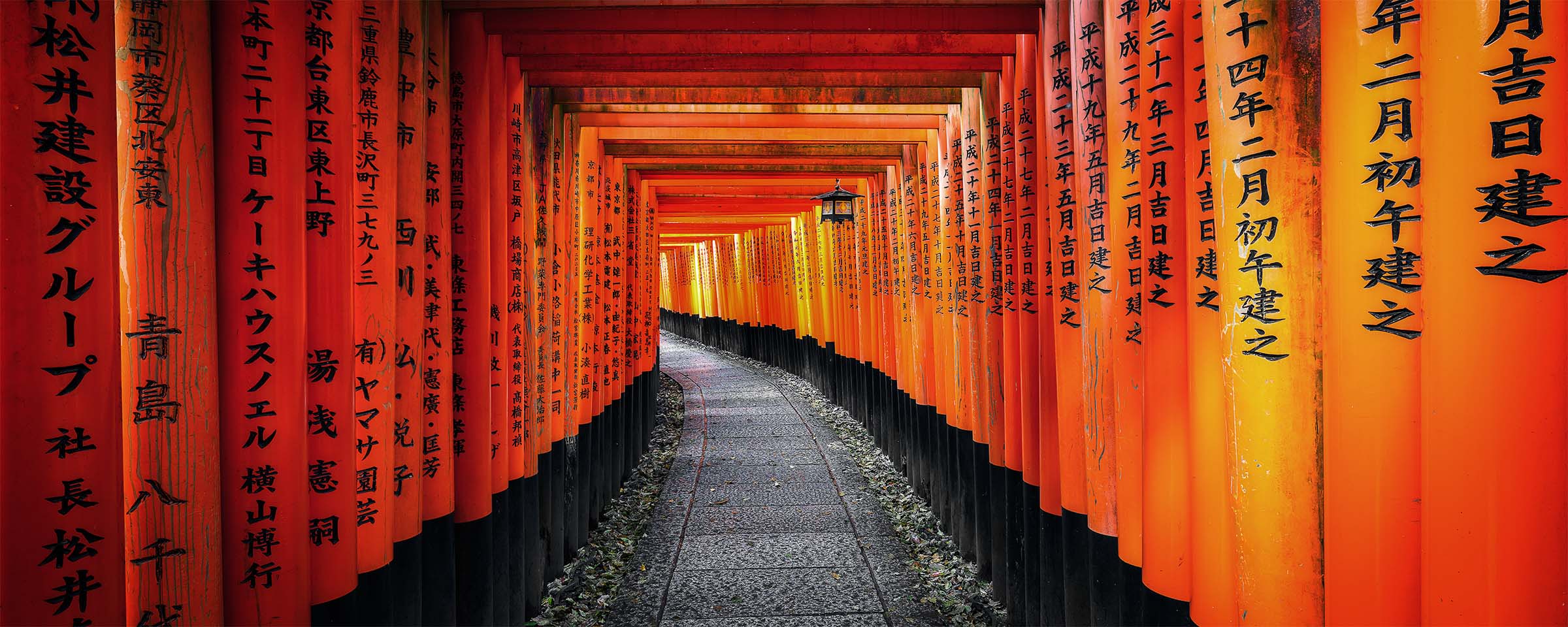
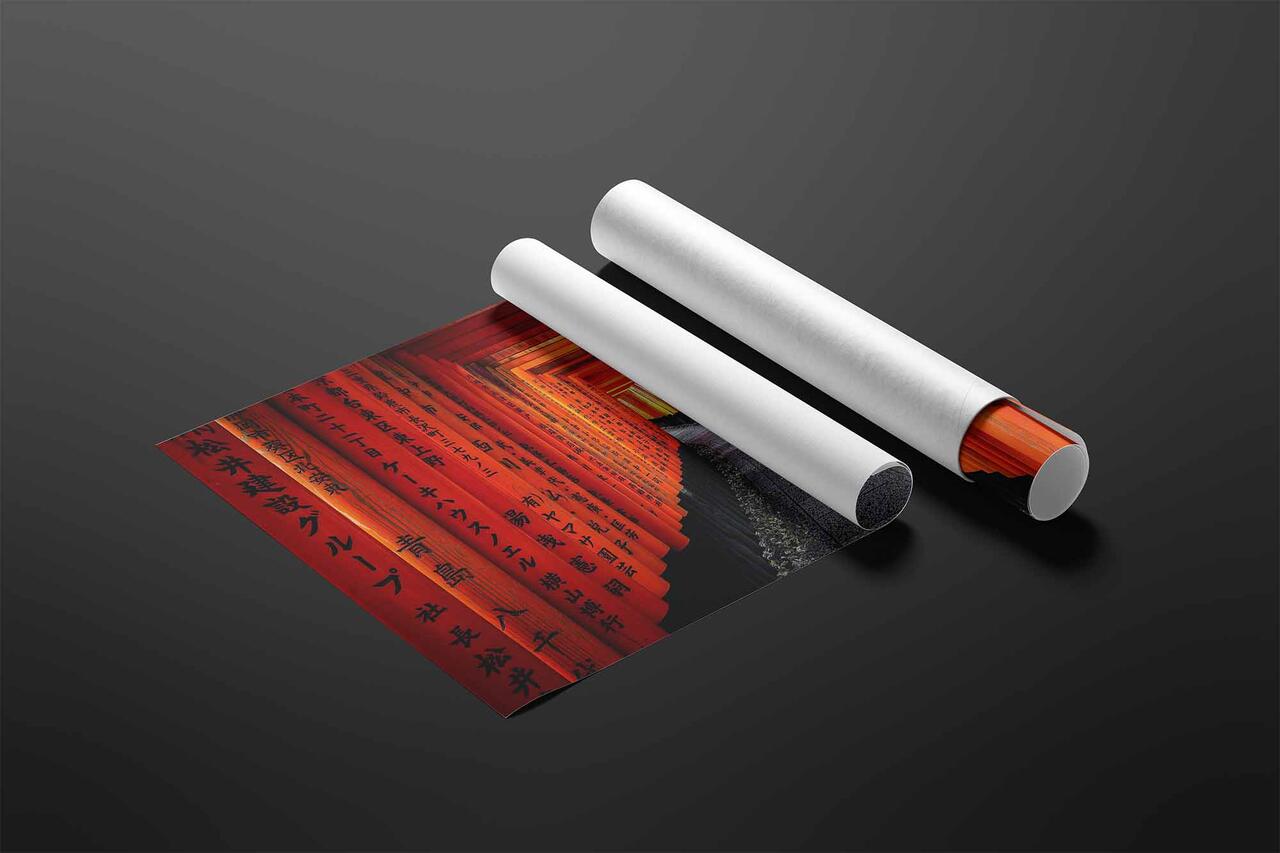
A 5:2 panoramic photograph of the vermilion torii gates at Fushimi Inari in Kyoto, Japan, available as a limited edition print in three sizes.
Artist's Story
Every gate along the Senbon Torii at Fushimi Inari, in Kyoto, was placed by someone who wanted to say thank you.
The vermilion torii are not decoration. They are offerings. Individuals, families, and companies pay for them, and every one carries the name of the giver and the date of the gift, painted in black on the back. What looks like architecture is a list of names.
I walked it early, before the light had fully arrived, when the color was still deepening and the stone underfoot held the quiet of the morning.
Every surface here is someone's name. Every gate is a wish that was answered, or one still hoped for, set down by a person you will never meet and left standing for whoever comes next.
Where Prayers Walk is the corridor between the two rows, one lantern hanging partway along, and the path bending out of sight before it ends. Somebody paid for every one of them.
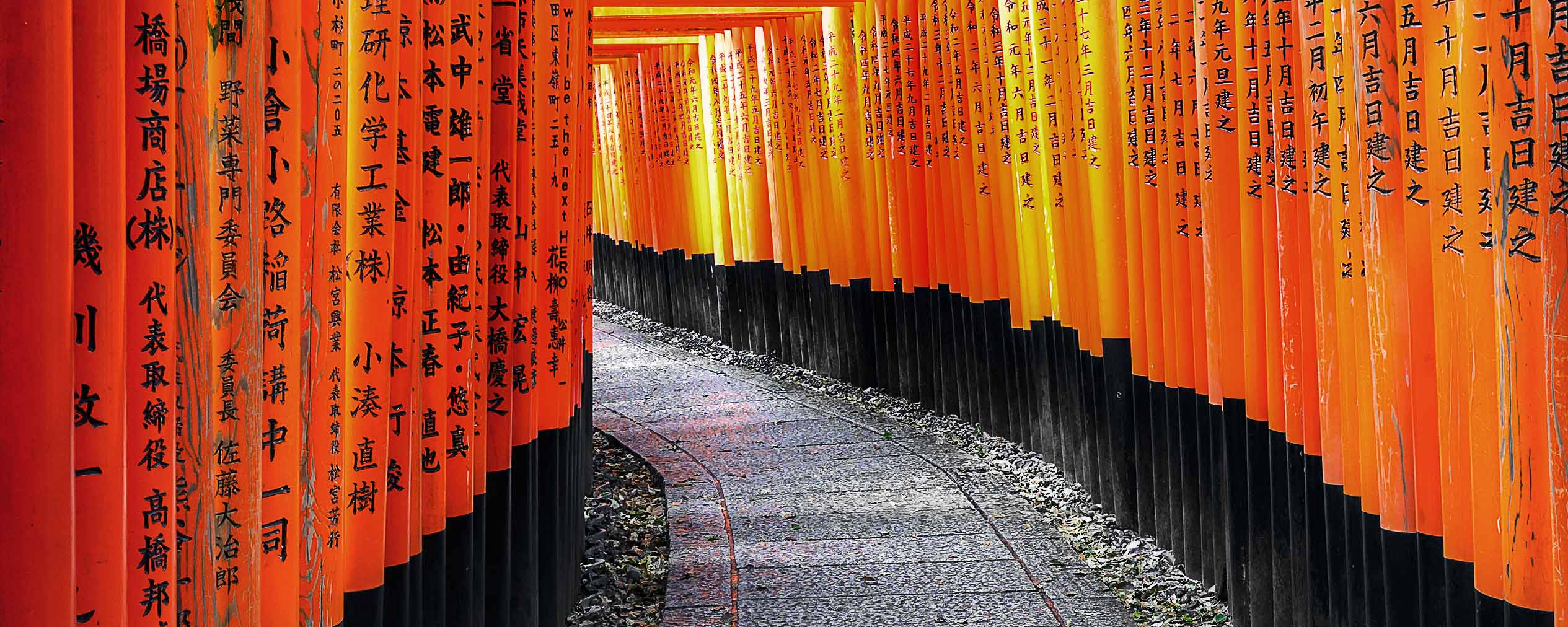
The bend at about a third of the frame width. On an eighty inch print this section runs roughly twenty-six inches across. The paving separates into individual stones, leaf litter collects along both margins, and the inscriptions on the nearest posts resolve into legible characters. Click to view at full size.
About This Photograph
Along the Senbon Torii, the two dense rows of vermilion gates at Fushimi Inari Taisha in the Fushimi ward of southern Kyoto, Japan, early in the morning before the day's crowds. This is a single frame image. The frame looks down the stone path between the closely spaced torii, each post inscribed in black on its back face with the donor's name and the date of the gift, a hanging lantern partway along.
The corridor bends out of sight near the middle of the frame, so the path has no visible end.
The shrine was founded in 711 and is the head of tens of thousands of shrines to Inari, the Shinto deity of rice, harvest, and prosperity. Roughly ten thousand torii wind up Mount Inari, which rises to 233 meters behind it. Vermilion is traditionally held both to ward off evil and to preserve the wood.
Where Prayers Walk
Steve Austinhttps://www.steveaustinphotography.com/
Location
Fushimi Inari Taisha, Kyoto, Japan
Subject
Senbon Torii · vermilion gates · Mount Inari
Capture
Single frame, early morning
Format
Photograph · horizontal panorama, 5:2
Sizes
40 × 16 in · 60 × 24 in · 80 × 32 in
Print Media
TruLife Acrylic · ChromaLuxe Metal · Baryta paper
Edition
Limited, 25 / 50 / 100 by presentation
What it Does in a Room
This is the most saturated photograph in the collection, and not by a small margin. Measured across the frame, nine tenths of the pixels sit above ninety percent chroma, almost all of it one hue. That concentration is why it works where a multicolored picture of the same intensity would not. The eye adapts to a single dominant wavelength within a minute or two, and after that the room reads normally again and the picture reads as depth rather than as noise.
It is a dark picture carrying bright color, which means it rewards a lit wall more than most work does. Under a picture light or a lamp within a few feet, the vermilion deepens, the black lettering separates cleanly from the posts, and the stone in the lower half opens up into texture. In flat overhead light the same print reads flatter and more graphic. Both are worth seeing before it is hung for good.
Close range gives it a second life. Every surface in the frame carries writing, and at arm's length that stops being pattern and becomes individual characters, each one a name and a date. A landscape usually gives up everything it has from across the room. This one holds something back for whoever walks up to it, which makes it well suited to a wall people pass rather than only look at.
Not sure which size the room calls for, or want dimensions not listed here? Sizes beyond 80 × 32 are available on request and ship crated by freight. That conversation is welcome before an order is placed. Start that conversation and I will answer within one business day.
Where Prayers Walk, limited edition printSteve Austin95012100USD11https://schema.org/InStock
Questions about this photograph
How small is too small for a photograph this wide?
At five to two, the Intimate size is forty inches across and sixteen inches tall. Sixteen inches is not much height for a corridor, and this picture handles it better than most because the composition is built from converging lines rather than from a subject sitting somewhere in the frame. The two rows still draw inward, the path still runs to the middle, and the color still arrives as one solid block. What goes at that size is the writing. At forty by sixteen the characters on the nearest posts are about half an inch tall and the ones further in are marks, so the frame reads as pattern rather than as language, which is a fair photograph and a graphic one. The Collected at sixty by twenty-four is where the nearest columns of characters become individual shapes and the corridor starts to feel like somewhere you could step into. If you are weighing a size against a specific wall, choosing the right print size covers the measurements and the viewing distances in more detail.
What changes at the largest size?
The pattern becomes writing. At the Statement size, eighty by thirty-two, the nearest posts stand nearly a foot wide and their inscriptions run an inch or more per character, so a reader can pick out a company, a town, a month. That changes what the picture is. Across a room it is a red corridor. At close range it is dozens of separate people. The posts themselves resolve at the same width, from flat color into painted wood with grain, weather streaks, and repainted edges, and the path below opens into individual stones with leaf litter caught along the margins. The lantern stops being a dark shape and becomes a lantern. Nearly seven feet is also enough width that the converging rows reach past the edge of what you take in at once, which is what makes the corridor read as something you are standing in rather than looking at. Why scale matters covers what happens perceptually when a landscape reaches the size where the eye has to cross it.
What kind of room does this photograph suit?
A long wall in a room that can let it lead. This is a strong photograph and it does its best work as the thing a room is organized around, which suits a dining room, a study, an entry, or the long wall of an open plan space. Quiet surroundings give it the most room to work: white, bone, warm plaster, pale stone, unpainted wood. Against those the vermilion is the only color present and everything else arranges itself in relation to it. It also pairs well with materials that answer the warmth without competing for the hue, so leather, brass, and dark wood all sit comfortably nearby. Give it a wall of its own and a light aimed at it, and it will carry a room by itself. Why large art changes how a room feels takes the question further.
Every work ships insured and arrives with a signed certificate of authenticity.
If a piece is damaged in transit, the choice of replacement is always yours, and your edition number stays with you.
Production time runs 2 to 3 weeks for metal, 3 to 4 weeks for acrylic and paper, and 5 to 6 weeks for framed work.
Collector's Choice · TruLife ® Acrylic in Italian Frame
Collector Edition of 25· Lumachrome TruLife Acrylic · Handcrafted Italian Frame
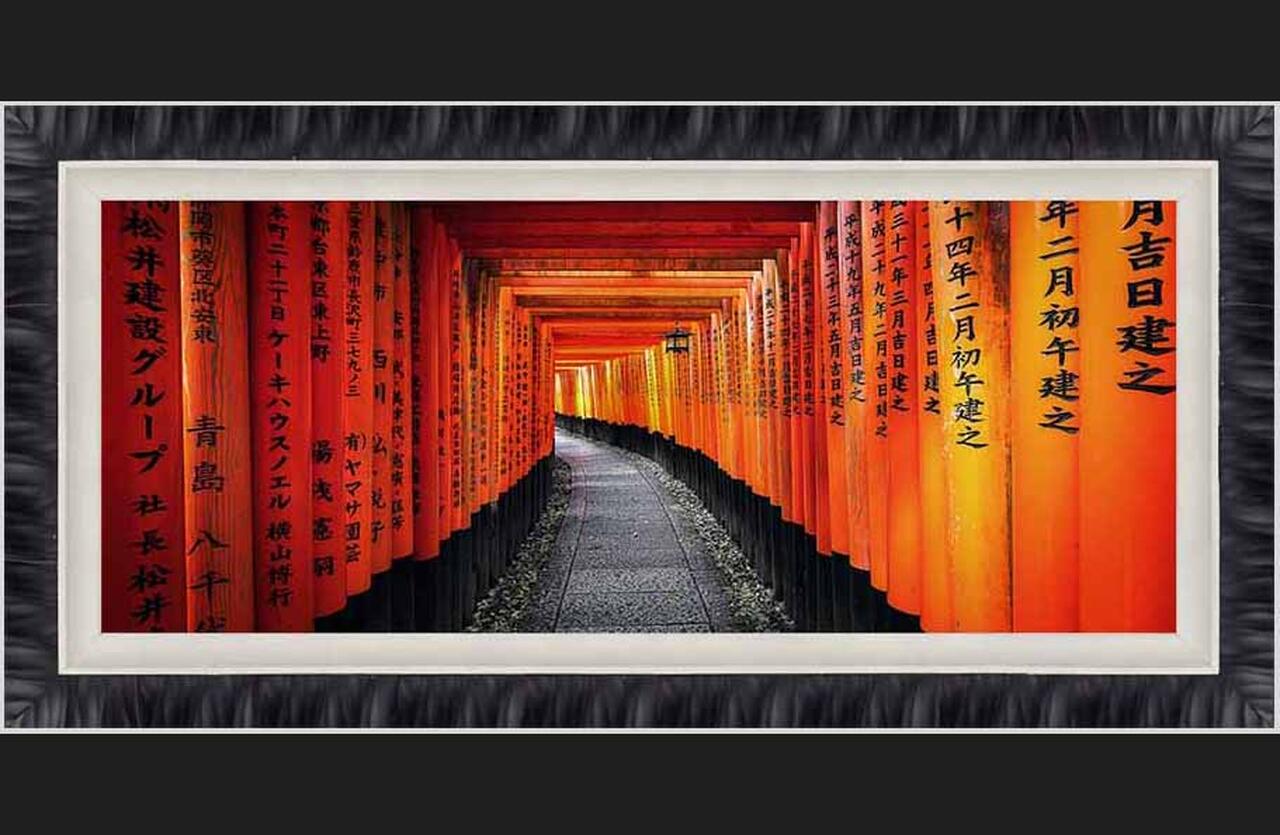
TruLife acrylic in a handcrafted Italian frame with a linen liner chosen for the image. Frame series, finish, and liner are settled with you after the order, and production begins from there. The frame and liner add about fourteen inches to the finished dimensions, worth allowing for when planning placement.
Signature Edition · TruLife ® Acrylic, Float Mount
Signature Edition of 50· Lumachrome TruLife Acrylic · Gallery Float Mount
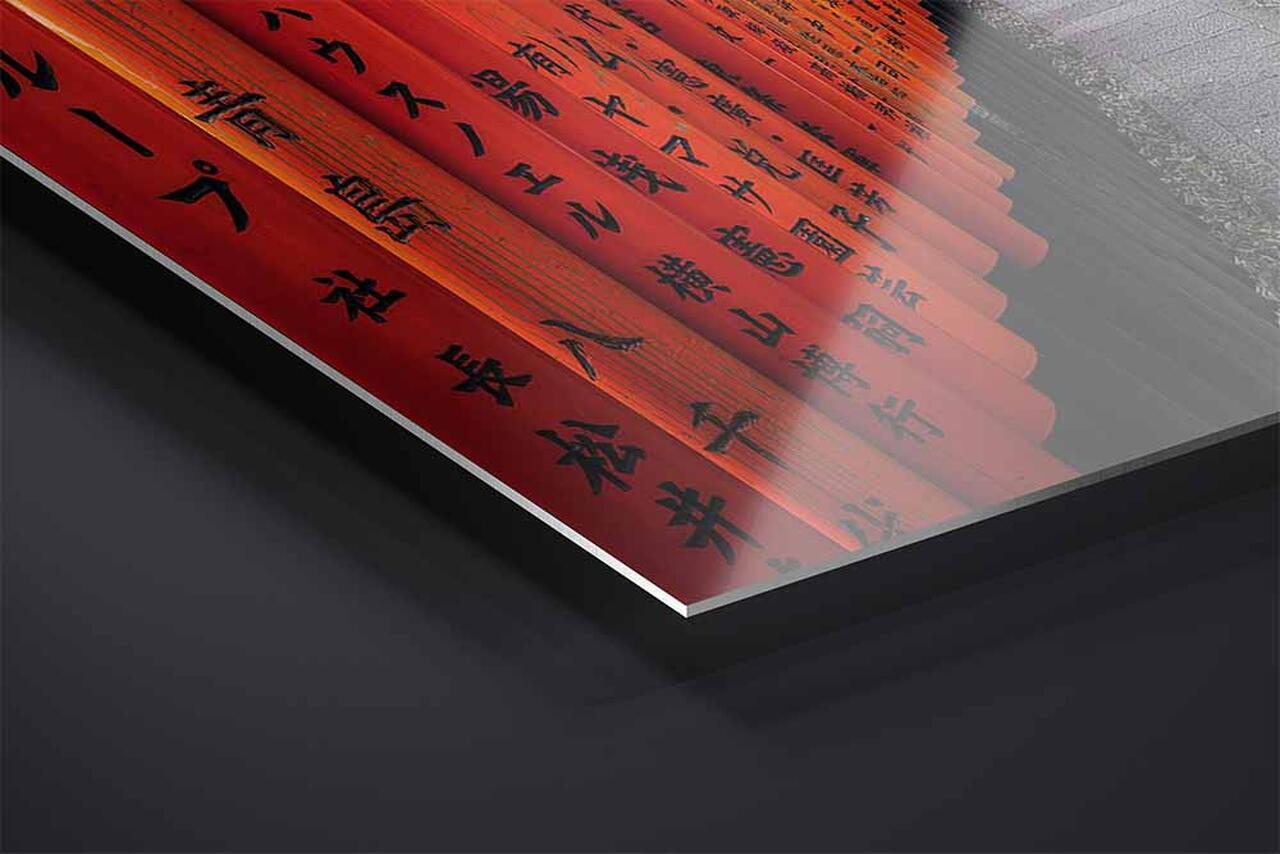
Face-mounted to TruLife acrylic and floated approximately one inch from the wall, with no frame to mediate between the image and the room. UV-resistant, anti-reflective, and scratch-resistant, with a lifetime guarantee against fading.
Signature Edition of 50· ChromaLuxe Metal Print · Gallery Float Mount
Color infused into the aluminum panel itself, floated from the wall on a concealed system. Where acrylic produces luminosity, metal produces clarity. Exceptional fade resistance with no glazing or coating required.
Fine Art Edition of 100· Hahnemühle Baryta Fine Art Paper
Printed without acrylic, so light meets the paper surface directly. Highlights stay luminous, shadows keep their nuance, and the surface has a tactile quality the other presentations approach differently. The understated choice, and the traditional one.
Complimentary shipping within the continental United States. International collector shipping available upon request.
Still deciding
Designing for Stillness
A guide to choosing art for restorative spaces
How to tell whether an image will still hold you in a year, how scale changes what a photograph does in a room, and how to match a piece to the work a room actually performs. It cites the research it draws on, and it is equally clear about where that research stops. About ten minutes to read.