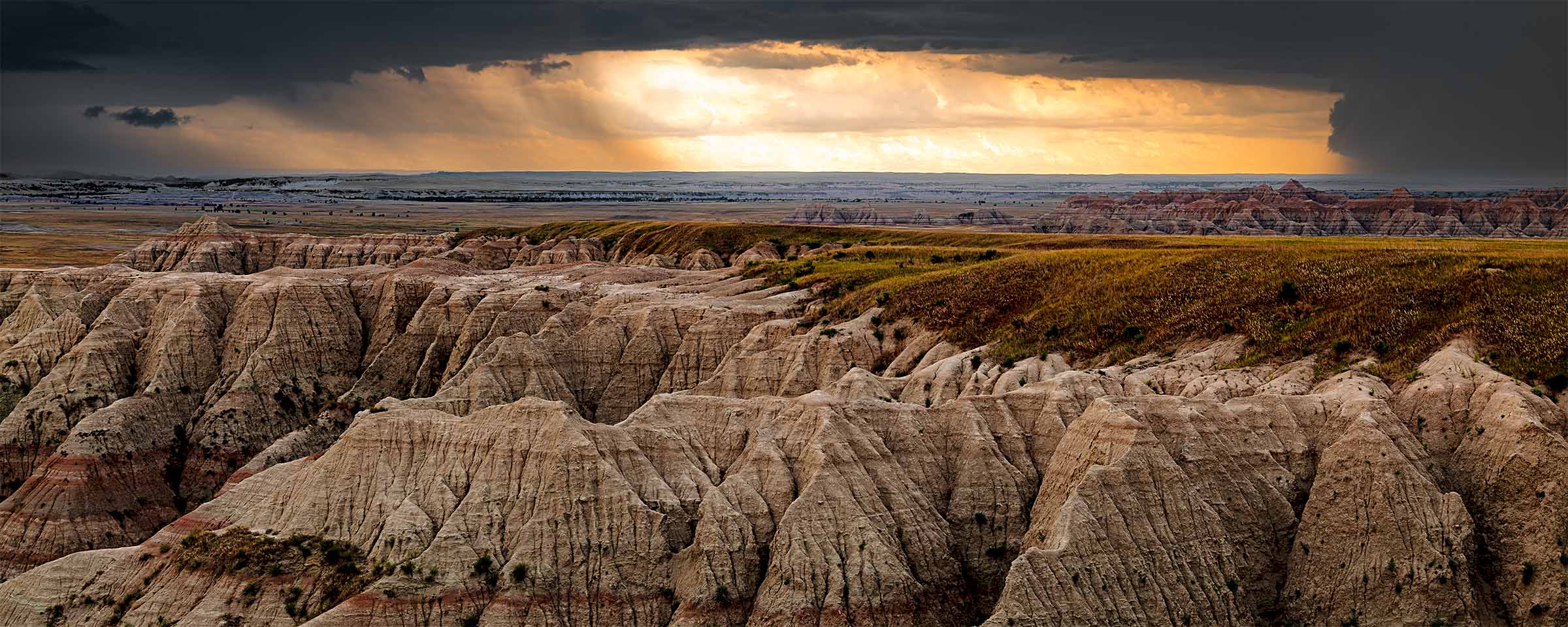
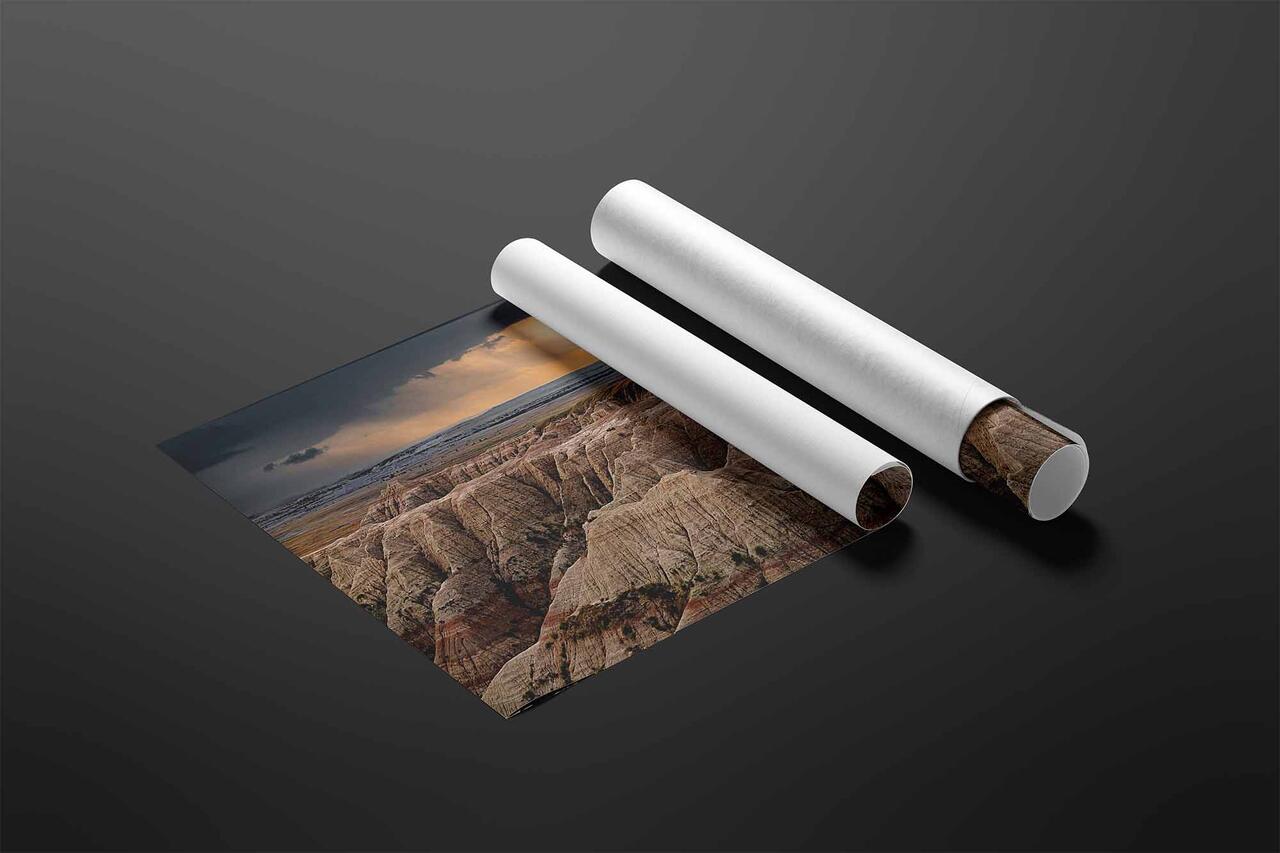
A 5:2 panoramic photograph of a summer storm breaking over the buttes of Badlands National Park, South Dakota, available as a limited edition print.
Artist's Story
The Badlands of South Dakota look like the oldest thing you have ever seen and are among the youngest features in the park system. The rock is old, sediment laid down between seventy-five and twenty-six million years ago, but the shapes are not. Water has only been cutting these buttes and spires for about half a million years, and it is still cutting them, roughly an inch a year, fast enough that the whole formation will be gone in another half-million.
I was on the rim when a summer storm came across the plain, dark and total, and then the sun found a gap in the wall of it and poured through onto the eroded ground.
The storm is not a visitor to this landscape. It is the author of it. The cloudbursts that make the drama in a scene like this are the same cloudbursts that carve the place, an inch at a time, wall by wall. What looks like weather passing over ancient permanent rock is actually the two halves of one process, the shaping and the shaped, caught in the few minutes the light let me see them together. The formation in front of me was mid-sentence, and the storm was still writing it.
Badlands Burn is that collision, the fastest-eroding ground in the park lit by the very weather that is wearing it away.
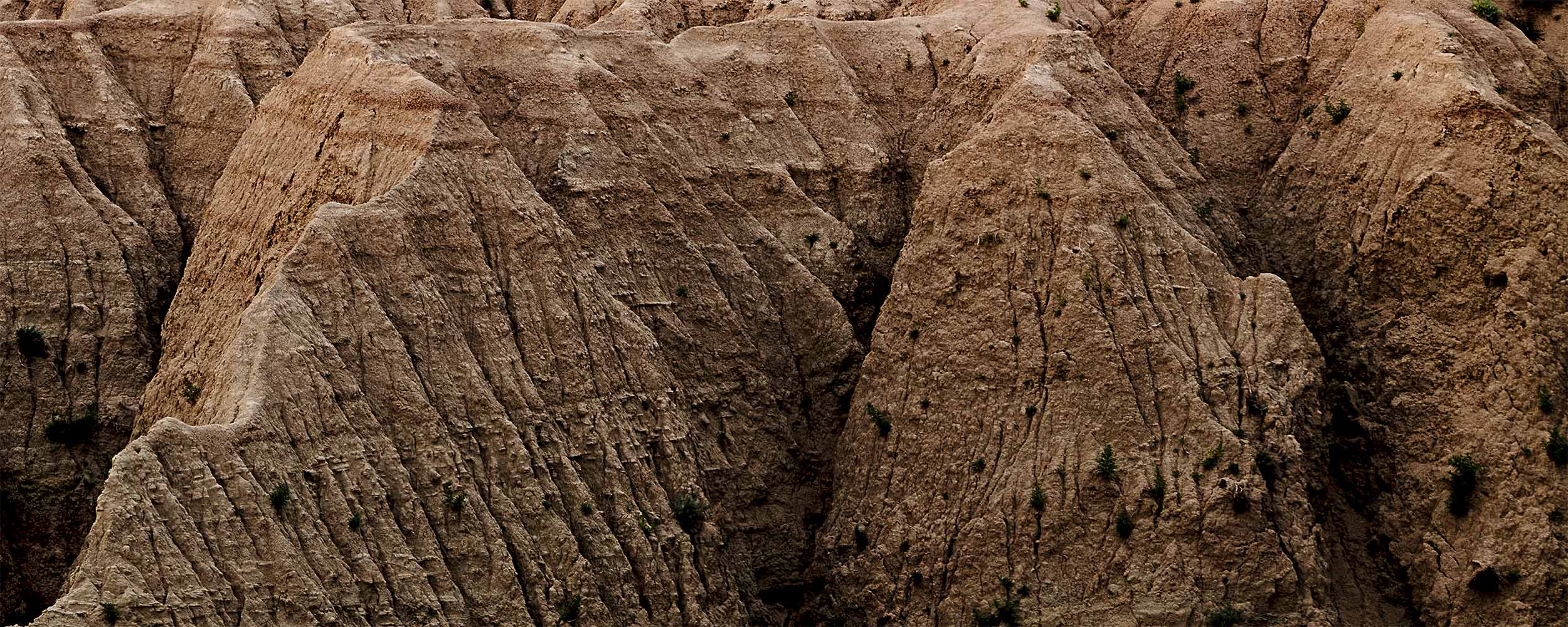
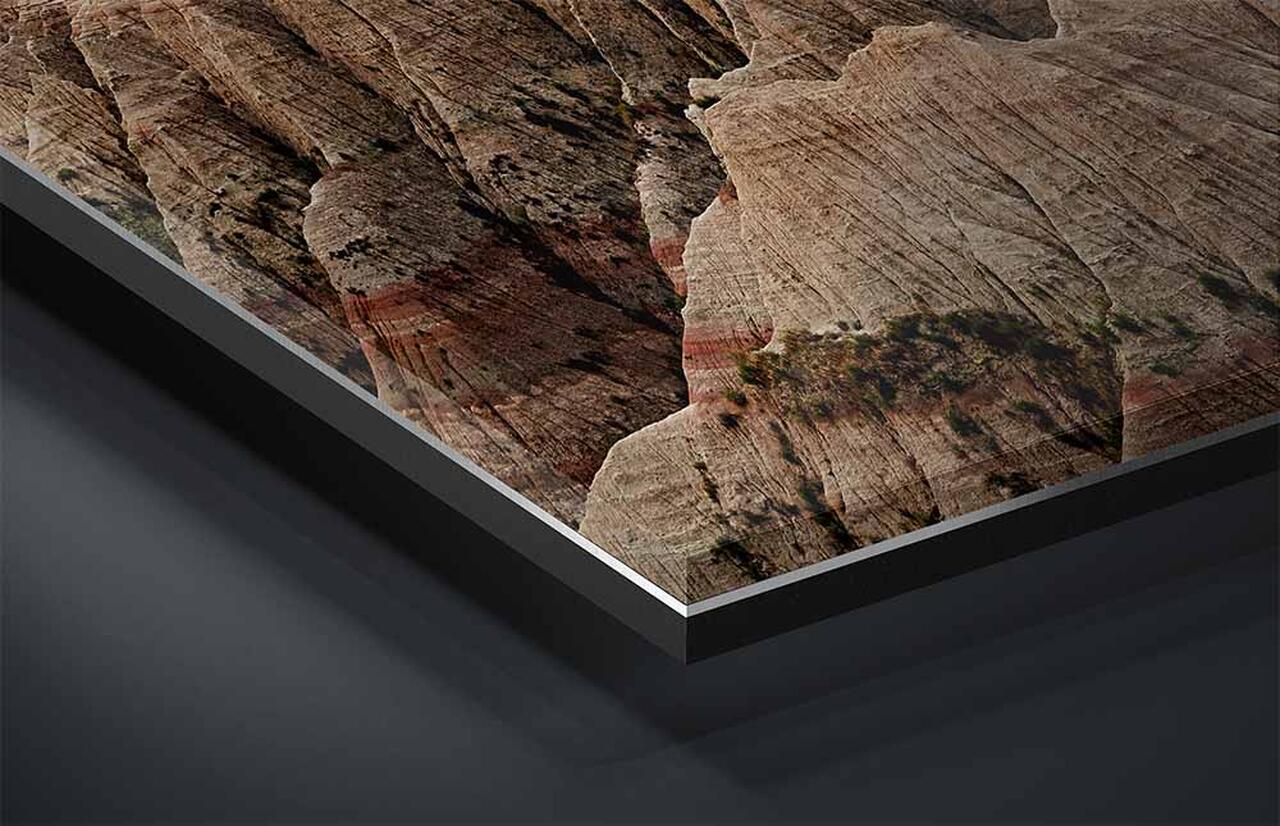
The near walls, about a quarter of the frame width. Every one of those vertical channels was cut by water coming off the top. Click to view at full size.
About This Photograph
Photographed in Badlands National Park, in southwestern South Dakota, as a summer storm broke over the formations at sunset. This is a single frame image in color. The subject is the park's eroded buttes and pinnacles below a storm sky, with mixed-grass prairie between the rock and the horizon. The formations are cut from sediment deposited between roughly 75 and 26 million years ago, but have taken their present shape only over about the last 500,000 years. The Badlands erode at roughly one inch per year, among the fastest rates of any national park, largely through the kind of summer cloudburst seen here, and are projected to erode away entirely within another 500,000 years. The Lakota name for the region is mako sica, meaning bad land, and the park's South Unit is co-managed with the Oglala Lakota Nation.
Badlands Burn
Steve Austinhttps://www.steveaustinphotography.com/
Location
Badlands National Park, South Dakota
Subject
Eroded buttes and prairie under a breaking summer storm at sunset
Capture
Single frame, summer storm at sunset, from the rim
Format
Photograph · horizontal panorama, 5:2
Sizes
40 × 16 in · 60 × 24 in · 80 × 32 in
Print Media
TruLife Acrylic · ChromaLuxe Metal · Baryta paper
Edition
Limited, 25 / 50 / 100 by presentation
What it Does in a Room
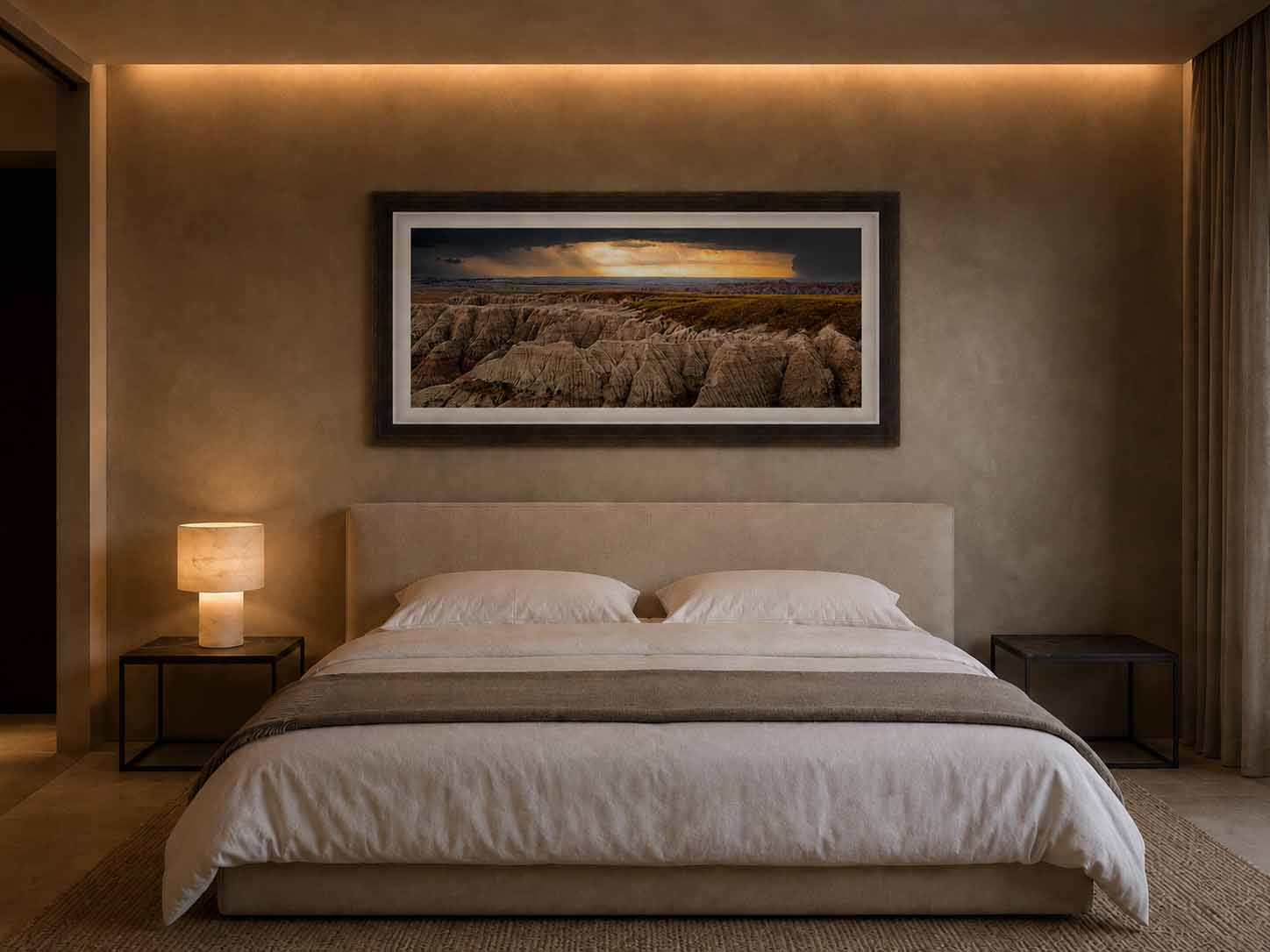
A photograph with weather in it does one thing a still landscape cannot. It puts the room in a moment rather than a place.
Five to two sits between a scene and a band. It is wider than a two to one panorama, so the eye travels rather than takes it in at once, but it keeps enough height to hold a foreground, a middle distance, and a horizon. In a room that combination matters. A very wide, very shallow frame extends a wall and little else. This proportion extends the wall and opens it, which is why it settles above a long sofa, a credenza, a run of cabinetry, or a headboard and then keeps working after the first glance. It asks for a run of wall rather than height, and about a quarter as much height as width. Sixteen to thirty-two inches will do it.
Here the proportion is holding a distance, and the distance is the subject. The eroded ground fills the bottom half and runs right up to the viewer, the prairie lies out beyond it, and the storm stands over the far horizon with the light coming through underneath it. That is three depths in one frame, and the width is what keeps them separate. On a wall the effect is spatial rather than decorative. The room gains a long view it did not have, and the storm reads as being genuinely far off, which is the difference between a photograph of weather and a photograph of somewhere with weather in it.
The color is warm and dark, and the two halves work differently. The sky carries the light, gold and amber under a bank of near-black cloud. The ground below is ochre, rust, and bone, saturated in the grass and softer in the eroded rock. There is no cool note anywhere in the frame. That makes warm and neutral rooms the natural home: plaster, oak, walnut, leather, brass, travertine, and unglazed stone all agree with it immediately. Against strong blue or green the two will compete. It is also a dark photograph overall, weighted low, with the sky as the only bright passage, so it will not brighten a room. What it rewards most is a light aimed at it and a room that is not fighting for attention, because the sky becomes the brightest thing in the space and the piece works best when it is allowed to be.
Not sure which size the room calls for, or want dimensions not listed here? Sizes beyond 80 × 32 are available on request and ship crated by freight. That conversation is welcome before an order is placed. Start that conversation and I will answer within one business day.
How small is too small for a photograph this wide?
At five to two, the Intimate size is forty inches across and sixteen inches tall. That is a workable proportion at a modest scale, wide enough to read as a panorama and tall enough to keep the rock, the prairie, and the storm as three separate distances. This photograph asks a little more of size than most, though, because those distances are what it is about. At sixteen inches tall the eroded ground compresses into texture, the prairie becomes a band, and the storm moves forward until it feels close rather than far away. A forty by sixteen print works well above a console, along a hallway, or on a narrower wall where a taller piece would not fit. The Collected at sixty by twenty-four is where the ground pulls back and the plain opens out. The Statement at eighty by thirty-two is where the storm returns to the horizon and the picture regains the distance it was made for. If you are weighing a size against a specific wall, choosing the right print size covers the measurements and the viewing distances in more detail.
What changes at the largest size?
Distance, before anything else. Most of what this photograph does depends on how far away that storm is, and distance is the first thing a small print collapses. At forty by sixteen the sky sits close over the rock. At eighty by thirty-two the plain opens back up between them and the weather moves back to where it belongs, miles off across the prairie, which is where it was. Everything else follows from that. The eroded ground resolves into individual gullies and the fine vertical rills running down every wall, so you can see the erosion pattern the story describes rather than take it on trust. The prairie separates into grass rather than a gold band. And the rain falling out of the base of the storm becomes visible as rain, hanging in shafts under the cloud rather than reading as haze. That last one matters most, because the rain is the thing doing the carving. Why scale matters covers what happens perceptually when a landscape reaches the size where the eye has to travel across it.
What kind of room does this photograph suit?
Warm and neutral rooms, and it will lead them. The sky runs gold and amber under near-black cloud, the ground below is ochre, rust, and bone, and there is no cool note anywhere in the frame. Plaster, oak, walnut, leather, brass, travertine, and unglazed stone all agree with it immediately, and against any of them the piece belongs to the room rather than sitting on top of it. Against strong blue or green the two will compete, since there is nothing cool in the picture to meet them. It is also dark overall, weighted low, with the sky as the only bright passage, so it will not brighten a room. What it rewards most is a light aimed at it and a wall long enough to let the plain run. Given both, a lower-lit room suits it better than a bright one, because the sky becomes the brightest thing in the space and reads as the break in the storm that it was.
Every work ships insured and arrives with a signed certificate of authenticity.
If a piece is damaged in transit, the choice of replacement is always yours, and your edition number stays with you.
Production time runs 2 to 3 weeks for metal, 3 to 4 weeks for acrylic and paper, and 5 to 6 weeks for framed work.
Each print is made to order and takes its place in a numbered edition, so sales are final. Before you choose, I am glad to help: send a photo of your wall and I will show you this work in your room at true scale, at no charge. Start a conversation
Collector's Choice · TruLife ® Acrylic in Italian Frame
Collector Edition of 25· Lumachrome TruLife Acrylic · Handcrafted Italian Frame
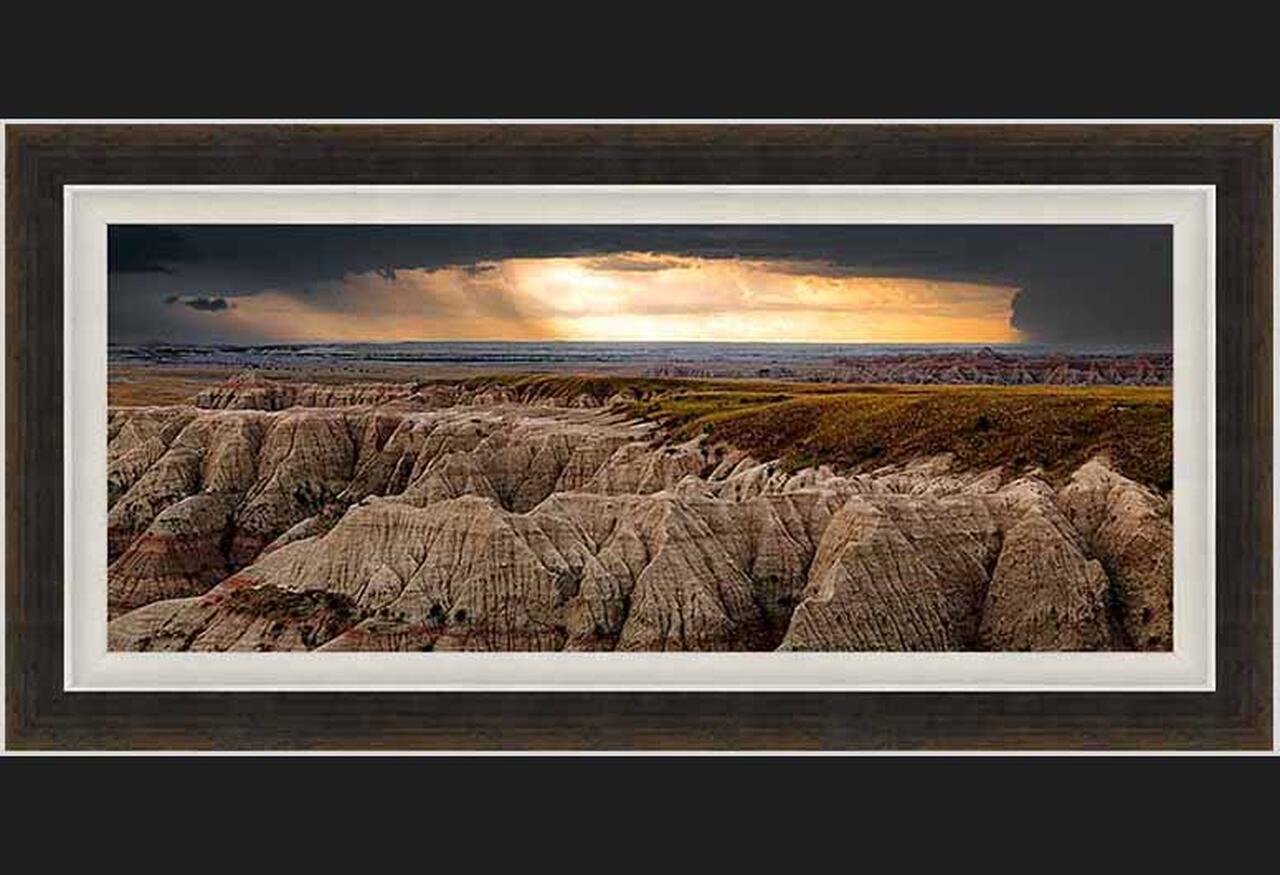
TruLife acrylic in a handcrafted Italian frame with a linen liner chosen for the image. Frame series, finish, and liner are settled with you after the order, and production begins from there. The frame and liner add about fourteen inches to the finished dimensions, worth allowing for when planning placement.
Signature Acrylic Edition of 50· Lumachrome TruLife · Gallery Float Mount
Face-mounted to TruLife acrylic and floated approximately one inch from the wall, with no frame to mediate between the image and the room. UV-resistant, anti-reflective, and scratch-resistant, with a lifetime guarantee against fading.
Signature Metal Edition of 50· ChromaLuxe Print · Gallery Float Mount
Color infused into the aluminum panel itself, floated from the wall on a concealed system. Where acrylic produces luminosity, metal produces clarity. Exceptional fade resistance with no glazing or coating required.
Fine Art Edition of 100· Hahnemühle Baryta Fine Art Paper
Printed without acrylic, so light meets the paper surface directly. Highlights stay luminous, shadows keep their nuance, and the surface has a tactile quality the other presentations approach differently. The understated choice, and the traditional one.
Complimentary shipping within the continental United States. International collector shipping available upon request.
Still deciding
Designing for Stillness
A guide to choosing art for restorative spaces
How to tell whether an image will still hold you in a year, how scale changes what a photograph does in a room, and how to match a piece to the work a room actually performs. It cites the research it draws on, and it is equally clear about where that research stops. About ten minutes to read.