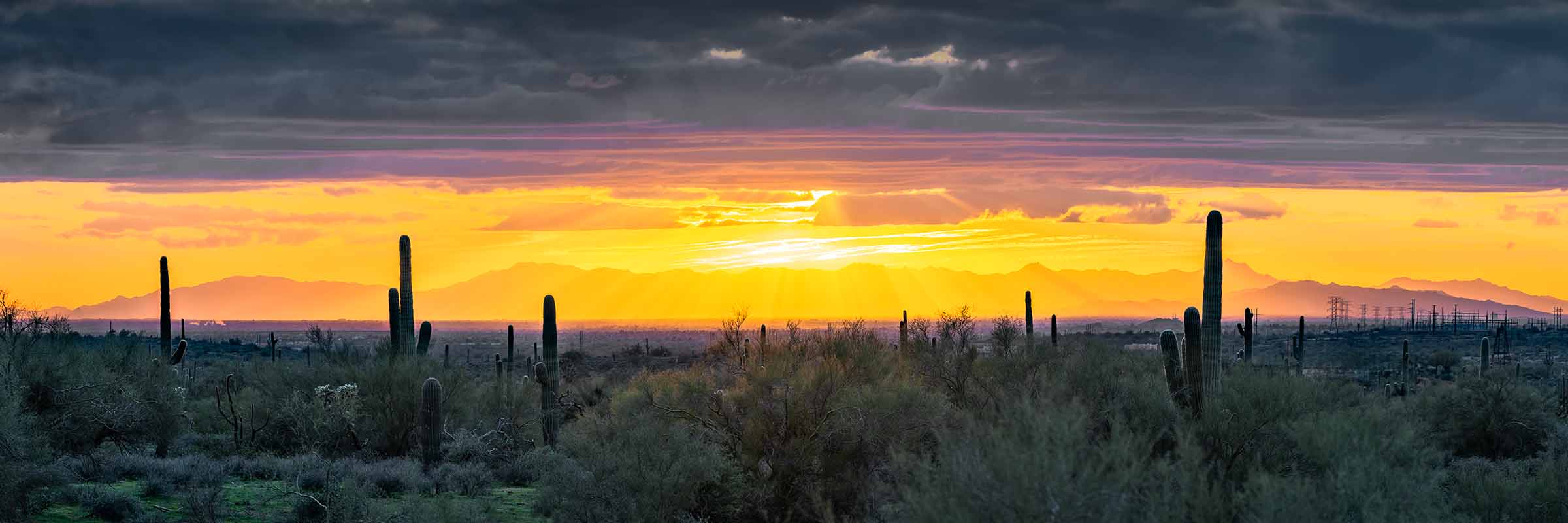
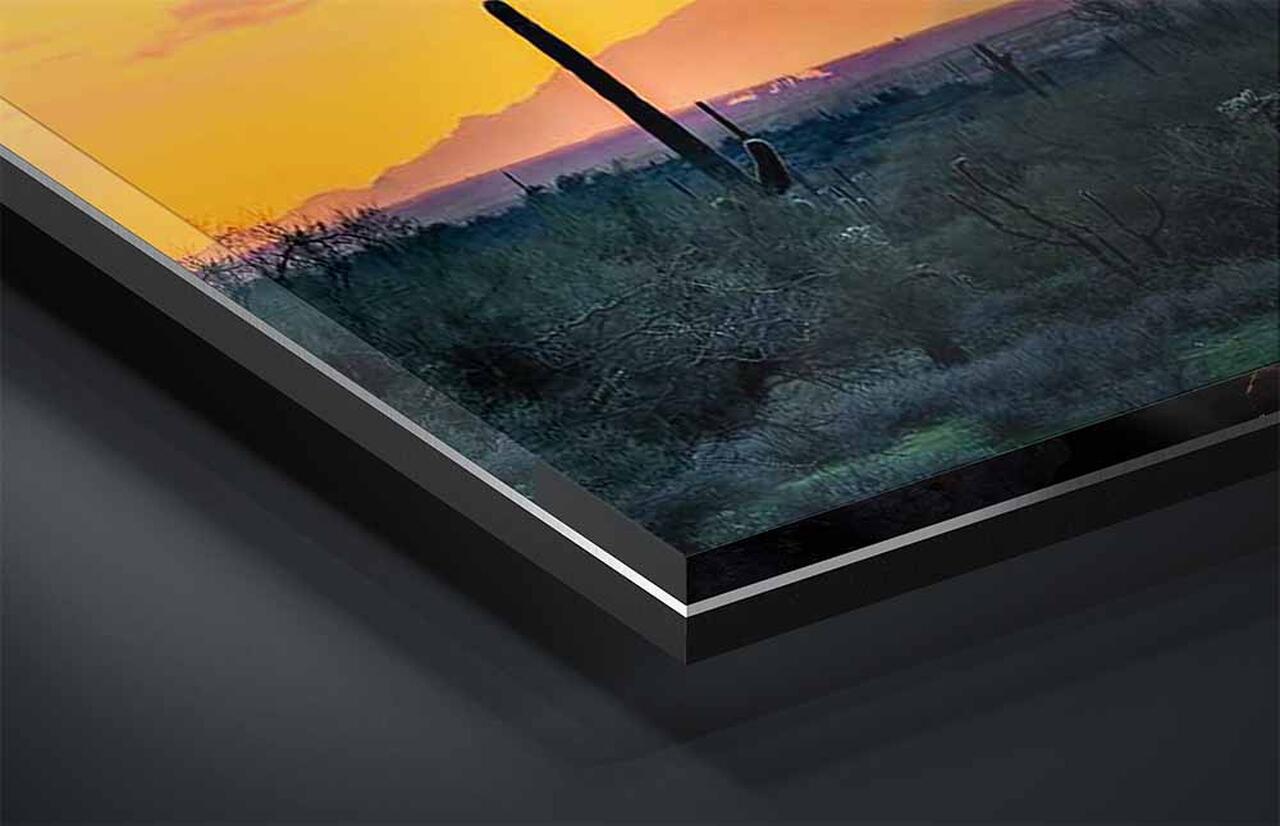
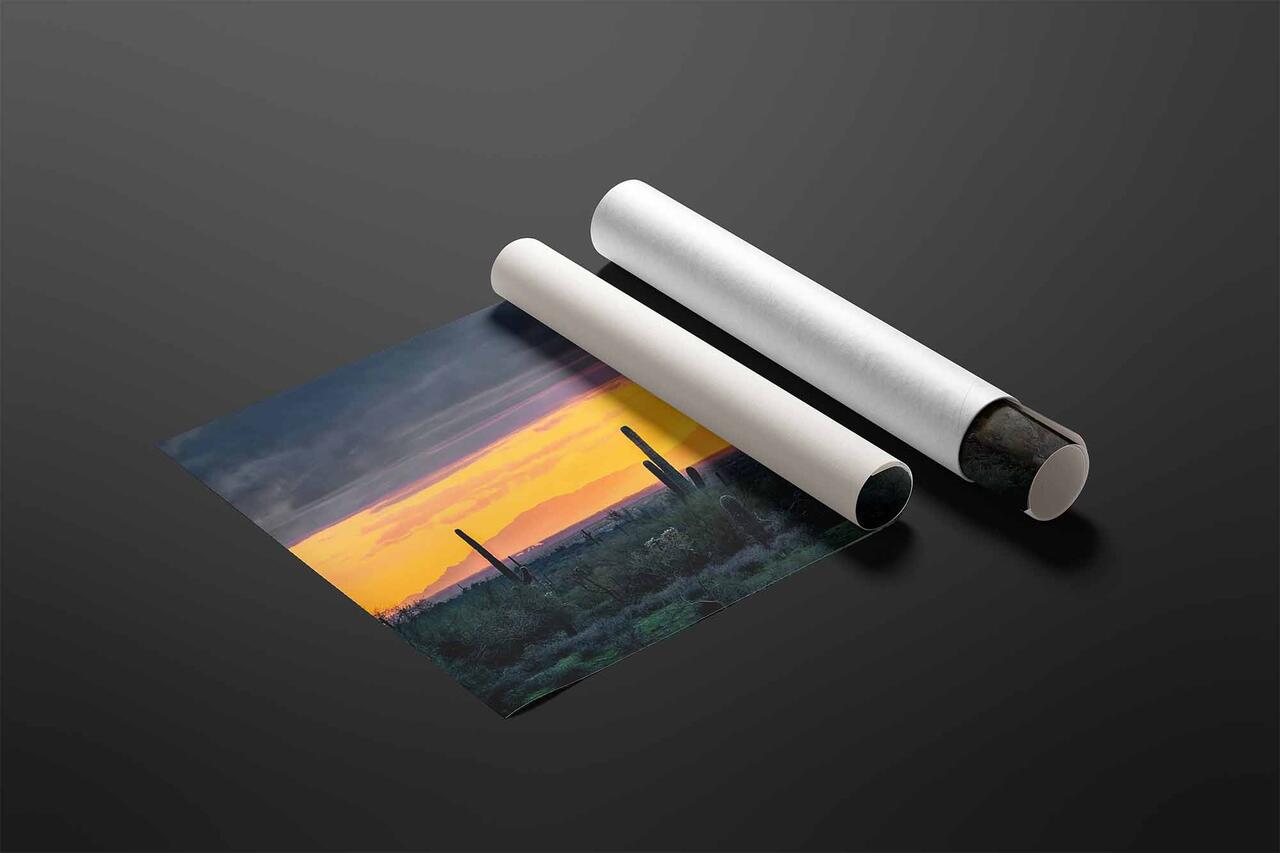
A 3:1 panoramic photograph of crepuscular rays at sunset, Usery Mountains, Arizona, available as a limited edition print in three sizes and four presentations.
Artist's Story
From the Usery Mountains on the eastern edge of Phoenix, the whole valley lies out to the west, and on this evening a spring storm had closed over it in heavy layers. Then the sun found the gap between the cloud base and the far ranges and came through in shafts. They are called crepuscular rays, and strictly speaking they are not rays at all. They are the lit volumes of air between cloud shadows, visible only because dust and moisture are there to scatter the light. And they are parallel. The fan is perspective, the same illusion that narrows a road toward the horizon.
I was on the mountain when it opened. The saguaros on the slope below me had already gone dark, the ranges across the valley were flattening into layers, and I worked through the few minutes it lasted. From that height the shafts appeared to converge on one point, somewhere out past the far edge of the city.
Which means the shape of the thing depended on where I was standing. The sun was doing the same thing for everyone in the valley that evening. The fan, the convergence, the sense of something aimed downward at one place, that part required a particular position on a particular hillside. It does not make the light less real. It makes it less general. There is a long tradition of reading a sky like this as a message, and I am not going to argue the point in either direction. I will only say that the part that looks most like intention is the part that came from standing here.
Descent from Heaven is that. Light that was never aimed at anyone, arranged into something that looks exactly as though it was.
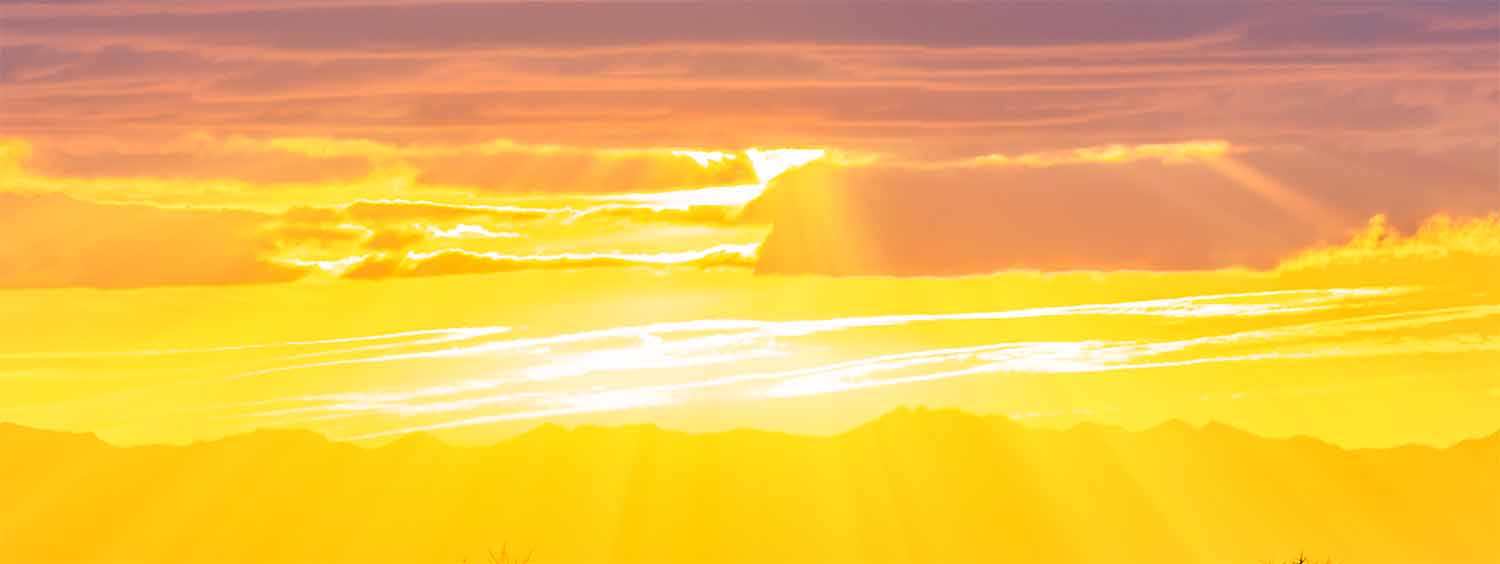
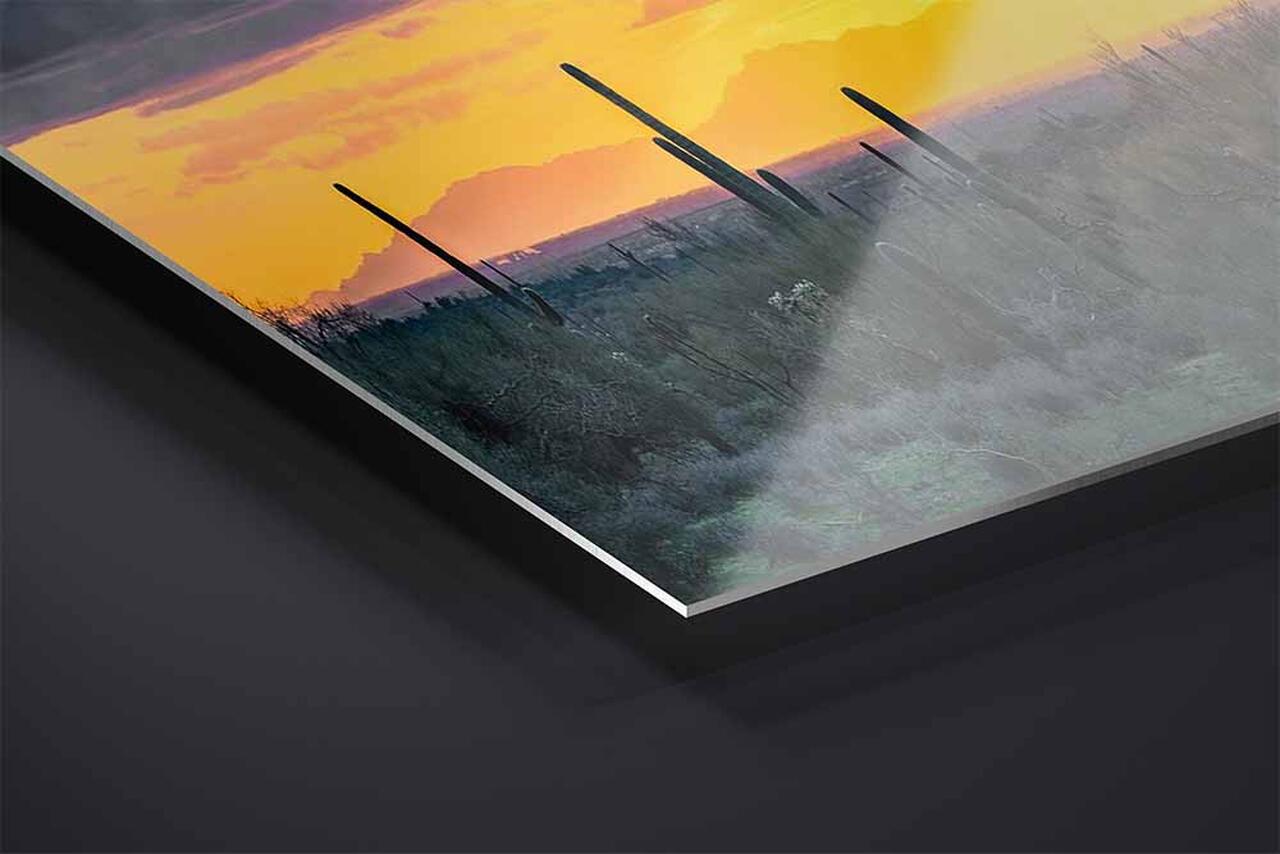
Detail at one tenth of the frame width, from the brightest passage of the photograph. At this scale the shafts separate into distinct volumes of lit air with visible edges, and the thin cloud filaments across the gap resolve individually. At the smallest print size both merge into a single glow. Click to view at full size.
About This Photograph
Photographed from the Usery Mountains on the eastern edge of the Phoenix metropolitan area, Maricopa County, Arizona, looking west across the valley toward the ranges on its far side, at sunset following a spring storm. Made in a single frame.
The subject is a bank of crepuscular rays. These are shafts of sunlight made visible where they scatter off dust and moisture in the air between cloud shadows. The light arriving is effectively parallel, and the apparent fanning is an effect of linear perspective, the same one that narrows a road toward the horizon.
The frame holds saguaro and Sonoran Desert scrub across the foreground, the valley floor and its far ranges beyond, and a heavy storm layer above. The city occupies the middle distance, with transmission lines visible along the horizon toward the right of the frame.
Descent from Heaven
Steve Austinhttps://www.steveaustinphotography.com/
Location
Usery Mountain Regional Park, Arizona
Subject
Crepuscular rays over the Phoenix valley
Capture
Single exposure at sunset
Format
Photograph · horizontal panorama, 3:1
Sizes
36 × 12 in · 60 × 20 in · 90 × 30 in
Print Media
TruLife Acrylic · ChromaLuxe Metal · Baryta paper
Edition
Limited, 25 / 50 / 100 by presentation
What it Does in a Room
This is the loudest photograph in the collection, and that is a placement fact before it is an aesthetic one.
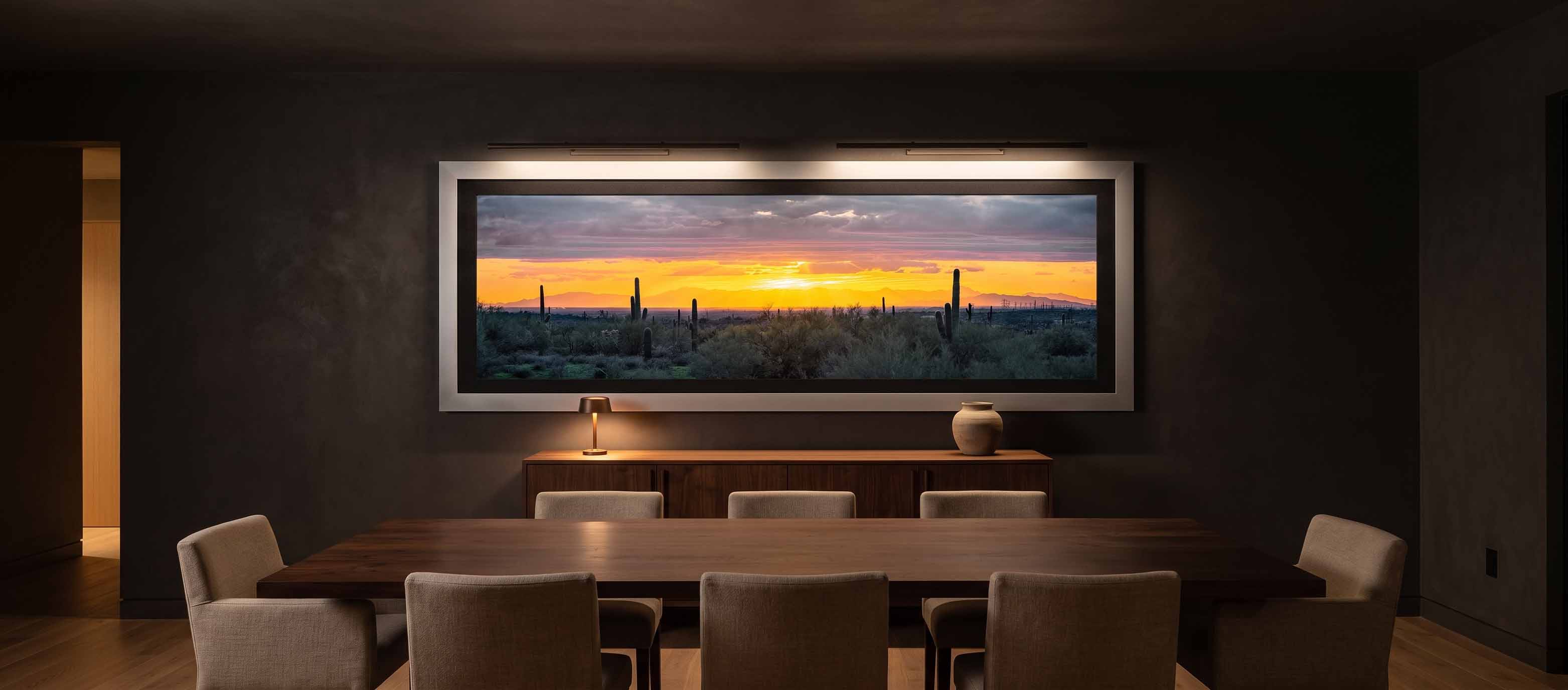
The range runs from true black in the scrub to near white where the sun breaks through, and the frame is dominated by saturated orange and gold across its whole middle. Nothing about it is quiet. On a wall it commands rather than accompanies, which is exactly right in some rooms and wrong in others. A space that is already busy will end up in an argument with it. A space that is spare and dark will be transformed by it.
It is also the most committed photograph here on color. Warm end to end, with the storm layer above and the desert below both reading dark rather than cool, so there is no second direction in it to match against. That makes it simple to place and narrow about where. It agrees immediately with wood, leather, brass, and warm plaster. Against cool gray or blue it will be the warm event in the room and will not settle into that palette. There is no version of this photograph that recedes.
Three to one is the longest proportion offered, and this composition needs the run more than most. The shafts fan outward from a point near the center, and the whole effect depends on the eye reaching the ends of the frame to see them spread. A wall where the piece sits close to a door frame or a cabinet cuts that off and the fan stops being a fan. Given the width, it reads across the room from the moment you enter.
Not sure which size the room calls for, or want dimensions not listed here? Sizes beyond 90 × 30 are available on request and ship crated by freight. That conversation is welcome before an order is placed. Start that conversation and I will answer within one business day.
Descent from Heaven, limited edition printSteve Austin70012900USD11https://schema.org/InStock
Questions about this photograph
How small is too small for a photograph this wide?
At three to one, the Intimate size is thirty six inches across but only twelve inches tall. On most walls that reads as a band rather than a window, which suits a narrow space above a doorway or a hallway run but works against a piece meant to anchor a room. The Collected and Statement sizes are where the width does the work described above. If you are weighing a size against a specific wall, choosing the right print size covers the measurements and the viewing distances in more detail.
What changes at the largest size?
The shafts are the whole question. At twelve inches tall the light between the cloud base and the ranges reads as a single warm glow with some structure in it. At thirty inches tall the individual beams separate. You can see where each one begins at the gap in the cloud, follow it down across the valley, and see the ones that pass behind the far ridgeline rather than in front of it. The foreground does the same thing. What reads small as a dark band of scrub resolves into individual saguaros standing at different distances, some near enough to show their arms against the sky and some reduced to marks on the horizon. That separation is what makes the fan legible as perspective rather than as a decorative burst, which is the argument the photograph is making. Why scale matters covers what happens perceptually when a landscape reaches the size where the eye has to travel across it.
What kind of room does this photograph suit?
A dark or spare one. The image runs from true black in the scrub to near white where the sun breaks through, with saturated orange and gold across everything between, and it does not moderate. In a room with a lot already happening it competes. In a room that is quiet and dim it becomes the reason the room exists. On color it is committed rather than flexible. Warm end to end, with the storm layer and the desert floor both reading dark rather than cool, so there is no second direction in it to match against. Wood, leather, brass, and warm plaster all agree with it immediately. Against cool gray or blue it stays the warm element and does not settle in.
It also asks for width more than most. The shafts fan from a point near the center and the effect only completes when the eye reaches both ends of the frame. On a wall where the piece sits close to a door frame or a cabinet, the fan stops reading as a fan.
Will a photograph this dramatic get tiring to live with?
It can, and the honest answer depends on which room you put it in.
Most of the work in this collection is made to settle attention. This one takes hold of it, and that is a real difference rather than a matter of degree. A photograph that grips is compelling to look at, which is not the same quality as one you can live beside for years without effort. Both belong on walls. But the wrong one in the wrong room becomes a piece you stop seeing on purpose rather than by habit, and that is a worse outcome than never buying it.
So it belongs in a room you enter for a reason and leave again. A dining room, a study, an entry, a space used in the evening. Somewhere the demand it makes on attention is what you came for. In a room you sit in every night, something quieter will serve you better, and there is plenty of that here. The Quiet Ones covers what a calm photograph does instead.
Every work ships insured and arrives with a signed certificate of authenticity.
If a piece is damaged in transit, the choice of replacement is always yours, and your edition number stays with you.
Production time runs 2 to 3 weeks for metal, 3 to 4 weeks for acrylic and paper, and 5 to 6 weeks for framed work.
Each print is made to order and takes its place in a numbered edition, so sales are final. Before you choose, I am glad to help: send a photo of your wall and I will show you this work in your room at true scale, at no charge. Start a conversation
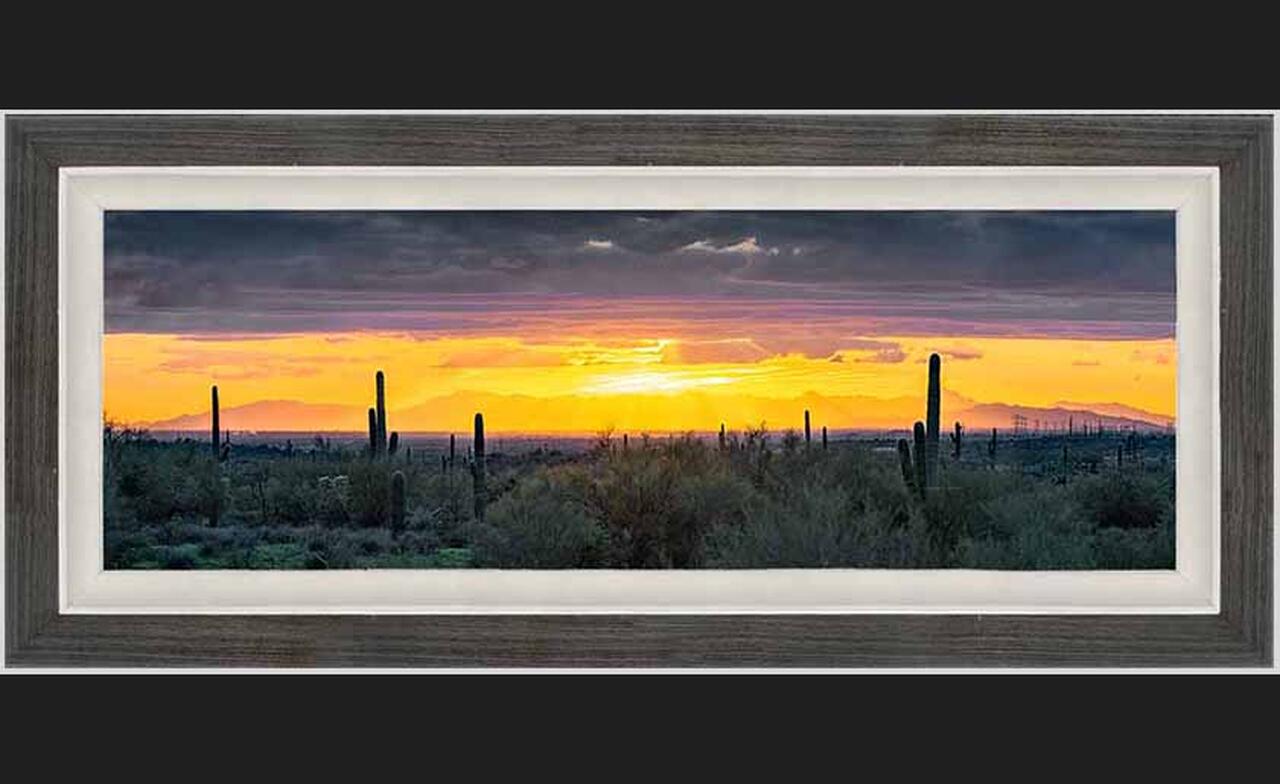
Collector's Choice · TruLife ® Acrylic in Italian Frame
Collector Edition of 25· Lumachrome TruLife Acrylic · Handcrafted Italian Frame
TruLife acrylic in a handcrafted Italian frame with a linen liner chosen for the image. Frame series, finish, and liner are settled with you after the order, and production begins from there. The frame and liner add about fourteen inches to the finished dimensions, worth allowing for when planning placement.
Signature Acrylic Edition of 50· Lumachrome TruLife · Gallery Float Mount
Face-mounted to TruLife acrylic and floated approximately one inch from the wall, with no frame to mediate between the image and the room. UV-resistant, anti-reflective, and scratch-resistant, with a lifetime guarantee against fading.
Signature Metal Edition of 50· ChromaLuxe Print · Gallery Float Mount
Color infused into the aluminum panel itself, floated from the wall on a concealed system. Where acrylic produces luminosity, metal produces clarity. Exceptional fade resistance with no glazing or coating required.
Fine Art Edition of 100· Hahnemühle Baryta Fine Art Paper
Printed without acrylic, so light meets the paper surface directly. Highlights stay luminous, shadows keep their nuance, and the surface has a tactile quality the other presentations approach differently. The understated choice, and the traditional one.
Complimentary shipping within the continental United States. International collector shipping available upon request.
Still deciding
Designing for Stillness
A guide to choosing art for restorative spaces
How to tell whether an image will still hold you in a year, how scale changes what a photograph does in a room, and how to match a piece to the work a room actually performs. It cites the research it draws on, and it is equally clear about where that research stops. About ten minutes to read.