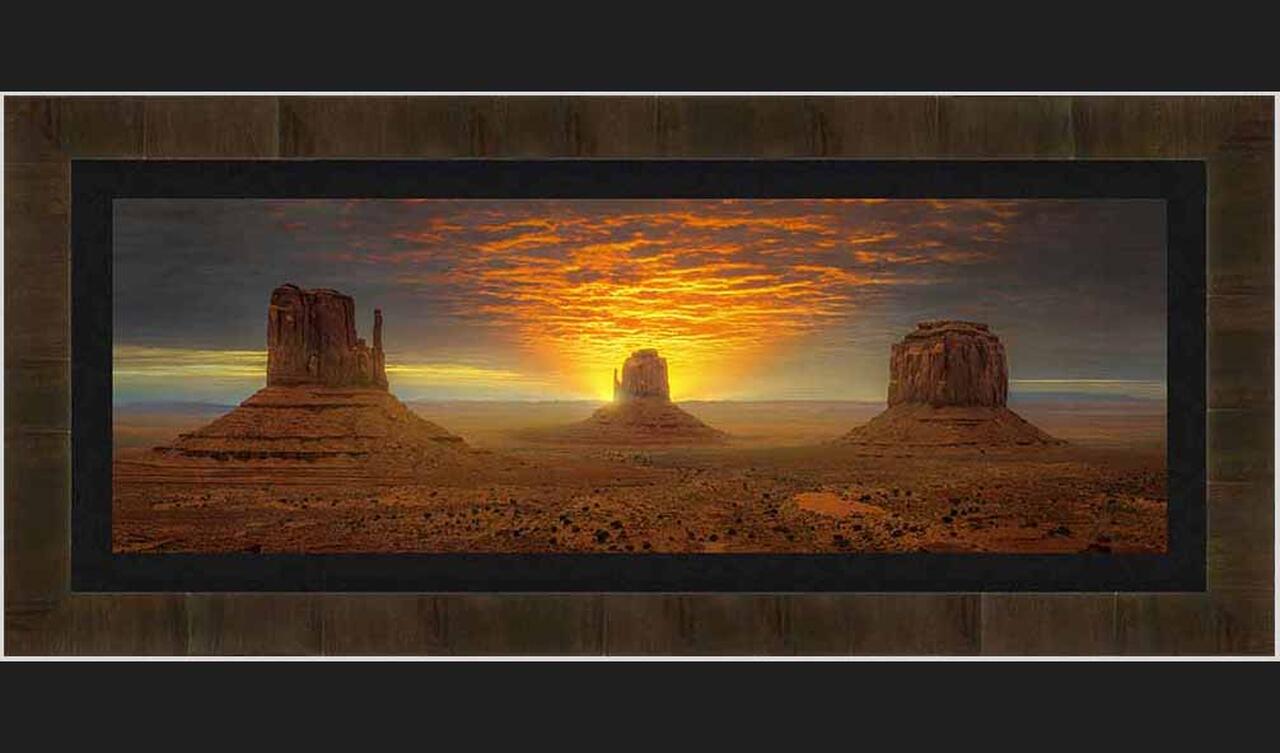
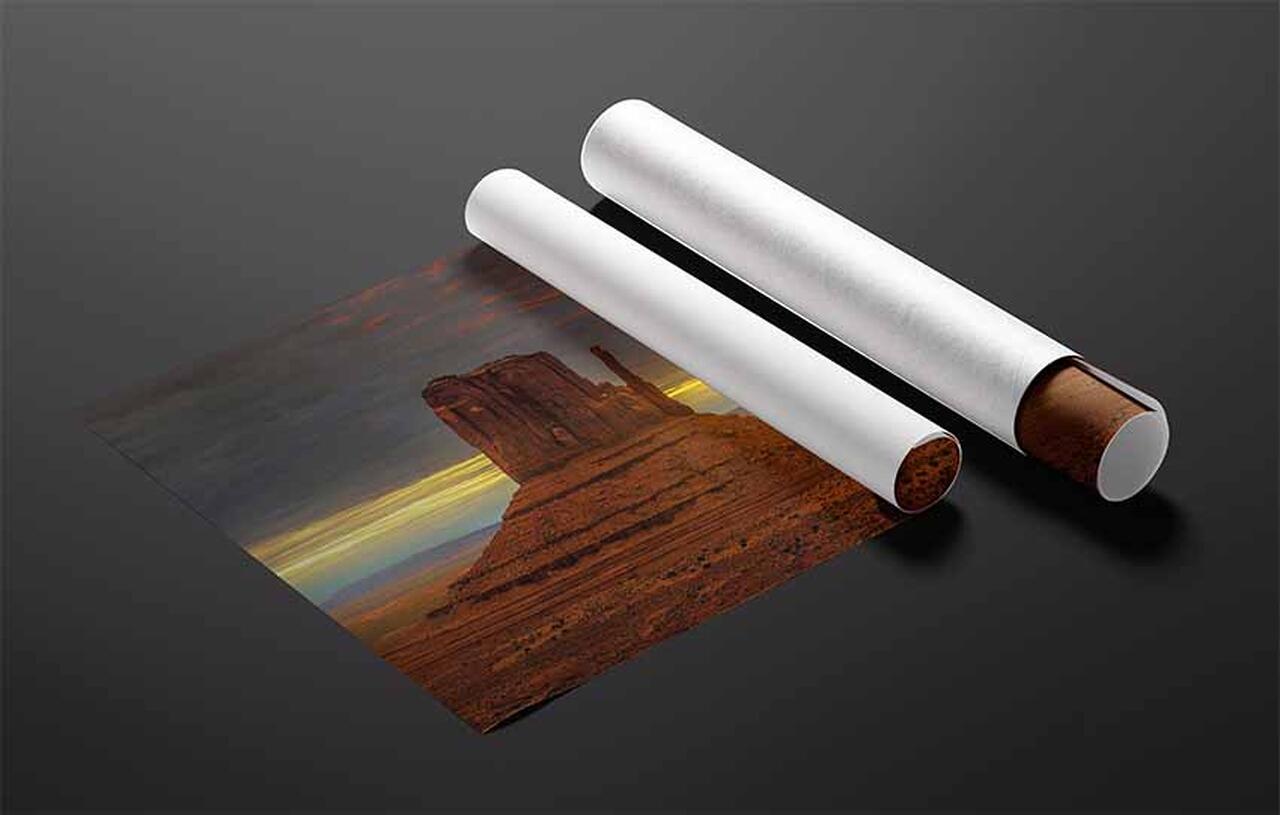
A 3:1 panoramic photograph of the Mitten Buttes at sunrise in Monument Valley, available as a limited edition print in three sizes and four presentations.
Artist's Story
Monument Valley has kept the same three sentinels on its horizon far longer than anyone has been awake to watch them. West Mitten Butte, East Mitten Butte, and Merrick Butte stand in their loose triangle on the Arizona side of the Navajo Nation, red sandstone left in place while the softer ground around them washed away over millions of years. On this morning the valley was silent and the sky hung low and gray, and I expected nothing from it.
I had come well before dawn and waited with a handful of travelers who had turned into companions somewhere in the dark. We did not talk much. Then the sun found a gap at the horizon and the sky took fire, and the light ran between the buttes and out across the sand.
What that light did was not only visual. There is a steadiness that comes from watching daybreak arrive on ground this old, on a schedule that owes nothing to us. The mind, braced through the night for disappointment, lets that bracing go. Attention widens. What felt urgent an hour before takes its proper, smaller place against a horizon that has answered the dark this way since long before us.
Emergence is that moment held still. Not the promise of a single good morning, but the quiet certainty that light comes back to this valley, lifting the same forms out of the dark it has lifted for far longer than memory holds.
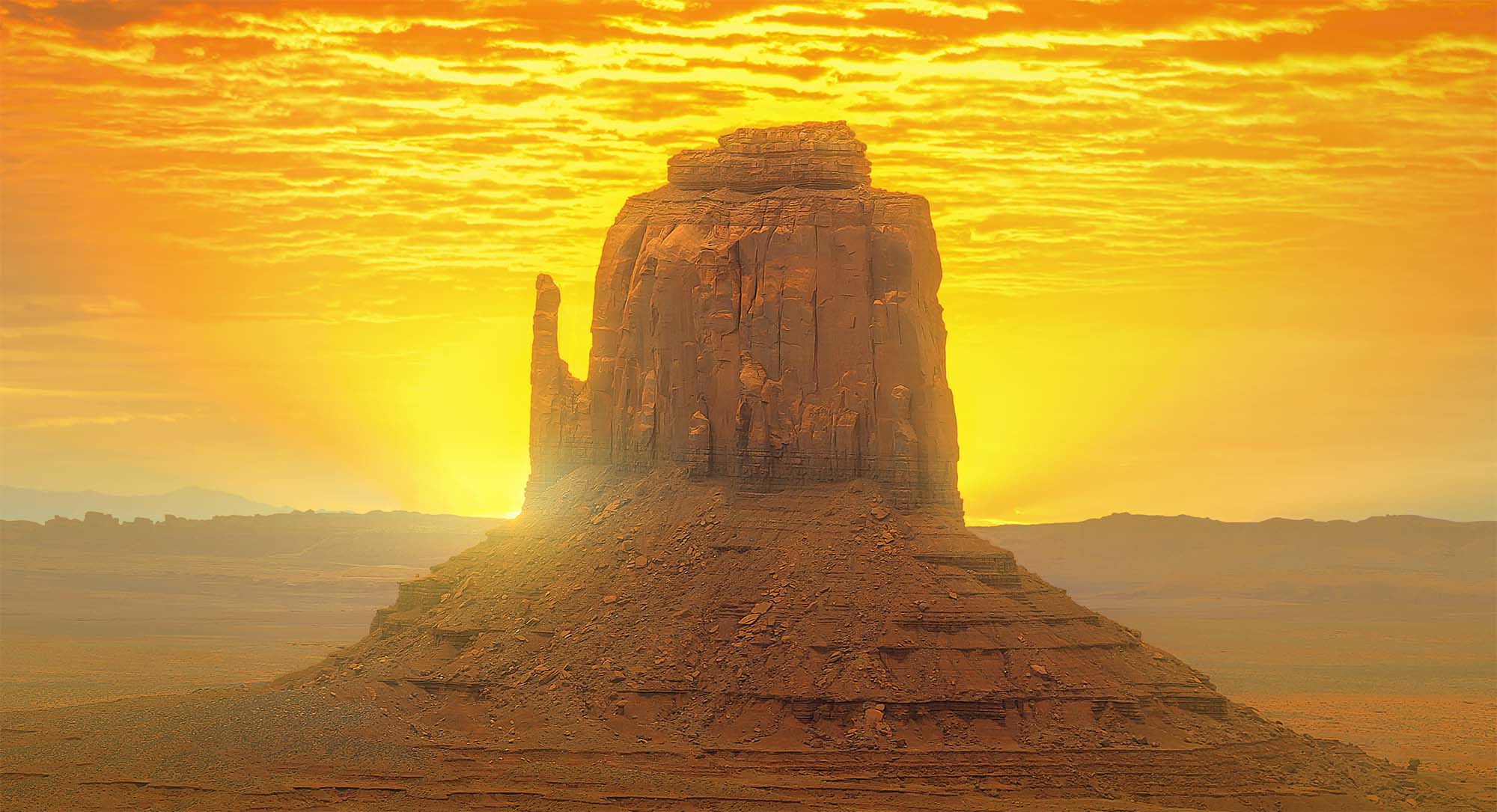
Detail at roughly one tenth of the frame width. The horizontal bedding holds across the flank, individual boulders separate on the talus slope, and the far mesas stay legible through the haze. Click to view at full size.
About This Photograph
Looking east across Monument Valley Navajo Tribal Park toward the Mitten Buttes at sunrise, on the Navajo Nation at the Arizona and Utah border in northeast Navajo County, Arizona. Photographed from the trail entrance with a 24-70mm lens.
Made as a six frame panorama swept in about twenty seconds, during which the light did not measurably change. The frames were stitched and nothing else was done to the scene. Nothing was added, removed, or moved.
The subject is three of the valley's landmark formations in their characteristic triangle: West Mitten Butte and East Mitten Butte, the matched pair whose inward-facing spires give them their name, with Merrick Butte to the south. Their summits reach roughly 6,180 to 6,230 feet above sea level. These are red De Chelly sandstone buttes, remnants of the Permian Cutler Formation, left standing above the valley floor as the softer shale beneath them eroded away. The Navajo Nation established the Tribal Park in 1958.
Emergence
Steve Austinhttps://www.steveaustinphotography.com/
Location
Monument Valley Navajo Tribal Park, Arizona
Subject
The Mitten Buttes and Merrick Butte at sunrise
Capture
Six frame panorama at sunrise
Format
Photograph · horizontal panorama, 3:1
Sizes
36 × 12 in · 60 × 20 in · 90 × 30 in
Print Media
TruLife Acrylic · ChromaLuxe Metal · Baryta paper
Edition
Limited, 25 / 50 / 100 by presentation
What it Does in a Room
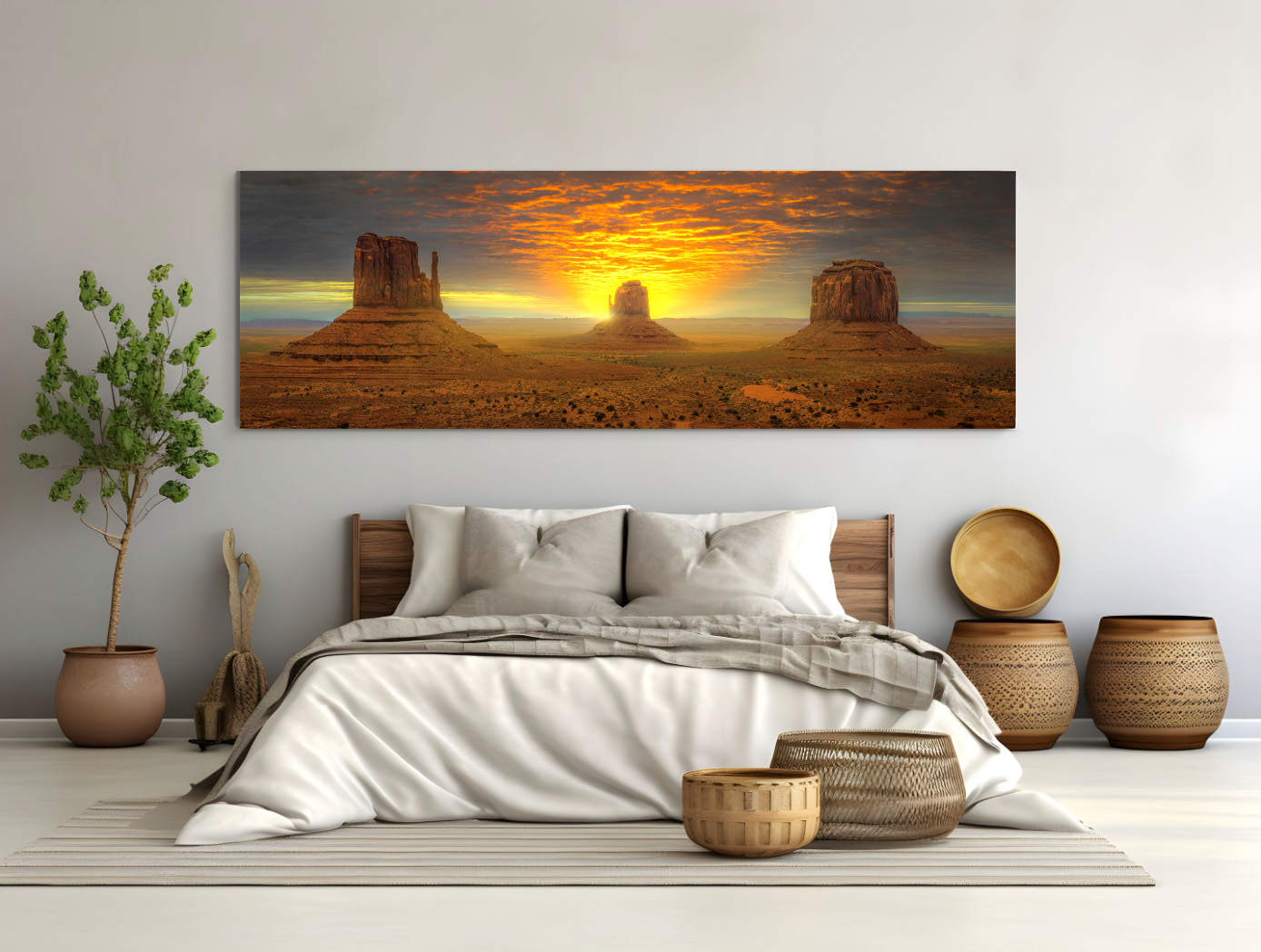
This is the brightest photograph in the collection, and that is the first thing it does in a room. The sky is lit from within, the sun sits at the center of the frame, and the whole image carries more light than the wall it hangs on.
A room reads that as a second window. Not literally, but the eye treats a large bright rectangle as a source rather than as an object, and the surrounding wall settles back around it. That is most useful where there is not enough natural light, an interior wall, a room with one window, a hallway that never gets direct sun. It does the opposite of what a dark photograph does, which is worth knowing if you are choosing between pieces for the same wall.
The composition is symmetrical, with a butte at each edge and the sun between them. Symmetry is restful. There is no tension in it, nothing off balance asking to be resolved, and the eye settles at the center and stays. That also makes it forgiving about placement, since a symmetrical image looks correct hung centered on a wall and does not need to be balanced against anything else in the room.
The warmth is the one thing to think about. Orange, gold, and red sandstone throughout, with no cool relief anywhere in the frame. In a room that is already warm it will amplify rather than balance, and against cool grays and whites it will be the only warm thing in the space, which some rooms want and others do not.
Not sure which size the room calls for, or want dimensions not listed here? Sizes beyond 90 × 30 are available on request and ship crated by freight. That conversation is welcome before an order is placed. Start that conversation and I will answer within one business day.
How small is too small for a photograph this wide?
At three to one, the Intimate size is thirty six inches across but only twelve inches tall. On most walls that reads as a band rather than a window, which suits a narrow space above a doorway or a hallway run but works against a piece meant to anchor a room. The Collected and Statement sizes are where the width does the work described above.
What changes at the largest size?
This photograph has three subjects, one at each edge and one at the center, and how you see them depends entirely on how wide the print is. At thirty six inches across you take in all three at once. The composition reads as a single symmetrical arrangement, which is pleasant and immediate and finished in about a second. At ninety inches across you cannot hold all three in central vision from a normal viewing distance. The eye has to go to one, then travel to the next, and the valley floor between them becomes something you cross rather than something you look past. That crossing is the experience the place actually produces, since standing in Monument Valley means turning your head. A small print reports a symmetrical view. A large one asks you to move through it. Why scale matters covers what happens perceptually when a landscape reaches the size where the eye has to travel across it.
What kind of room does this photograph suit?
A room that needs light more than it needs quiet. This is the warmest and brightest image in the collection, and it will work hardest where the light is poor, on an interior wall, in a room with a single window, or in a space used mostly after dark. The symmetry helps here too, since a centered composition hangs correctly on a wall by itself and does not need other objects to balance against.
What to think about is the warmth. There is no cool relief anywhere in the frame, so in a room already full of warm wood and terracotta it will amplify rather than balance. Against gray, white, and cool neutrals it will be the only warm thing in the space, which is usually the more interesting outcome. The one room to avoid is a bright, warm, south-facing one at midday, where the photograph and the room are doing the same thing and neither gains from it.
Every work ships insured and arrives with a signed certificate of authenticity.
If a piece is damaged in transit, the choice of replacement is always yours, and your edition number stays with you.
Production time runs 2 to 3 weeks for metal, 3 to 4 weeks for acrylic and paper, and 5 to 6 weeks for framed work.
Each print is made to order and takes its place in a numbered edition, so sales are final. Before you choose, I am glad to help: send a photo of your wall and I will show you this work in your room at true scale, at no charge. Start a conversation
Collector's Choice · TruLife ® Acrylic in Italian Frame
Collector Edition of 25· Lumachrome TruLife Acrylic · Handcrafted Italian Frame
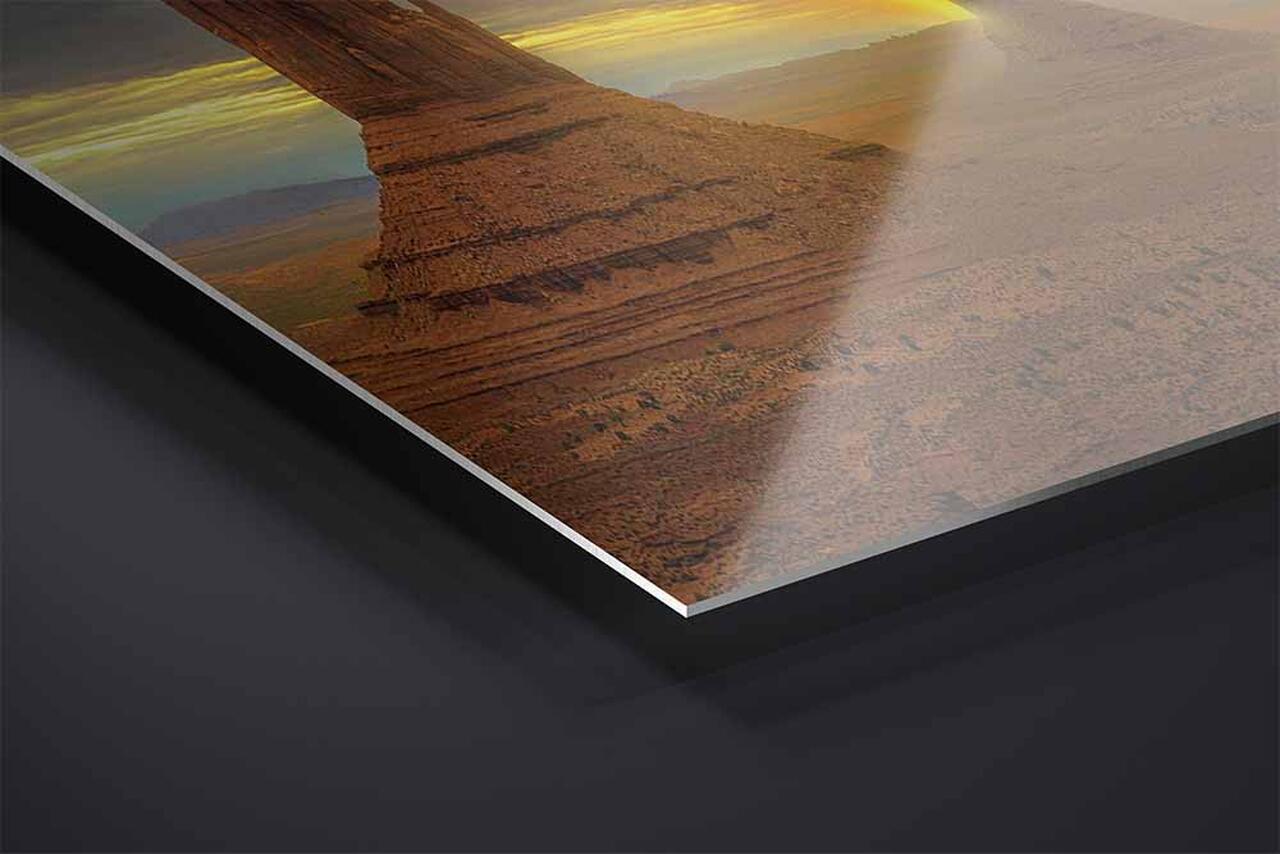
TruLife acrylic in a handcrafted Italian frame with a linen liner chosen for the image. Frame series, finish, and liner are settled with you after the order, and production begins from there. The frame and liner add about fourteen inches to the finished dimensions, worth allowing for when planning placement.
Signature Acrylic Edition of 50· Lumachrome TruLife · Gallery Float Mount
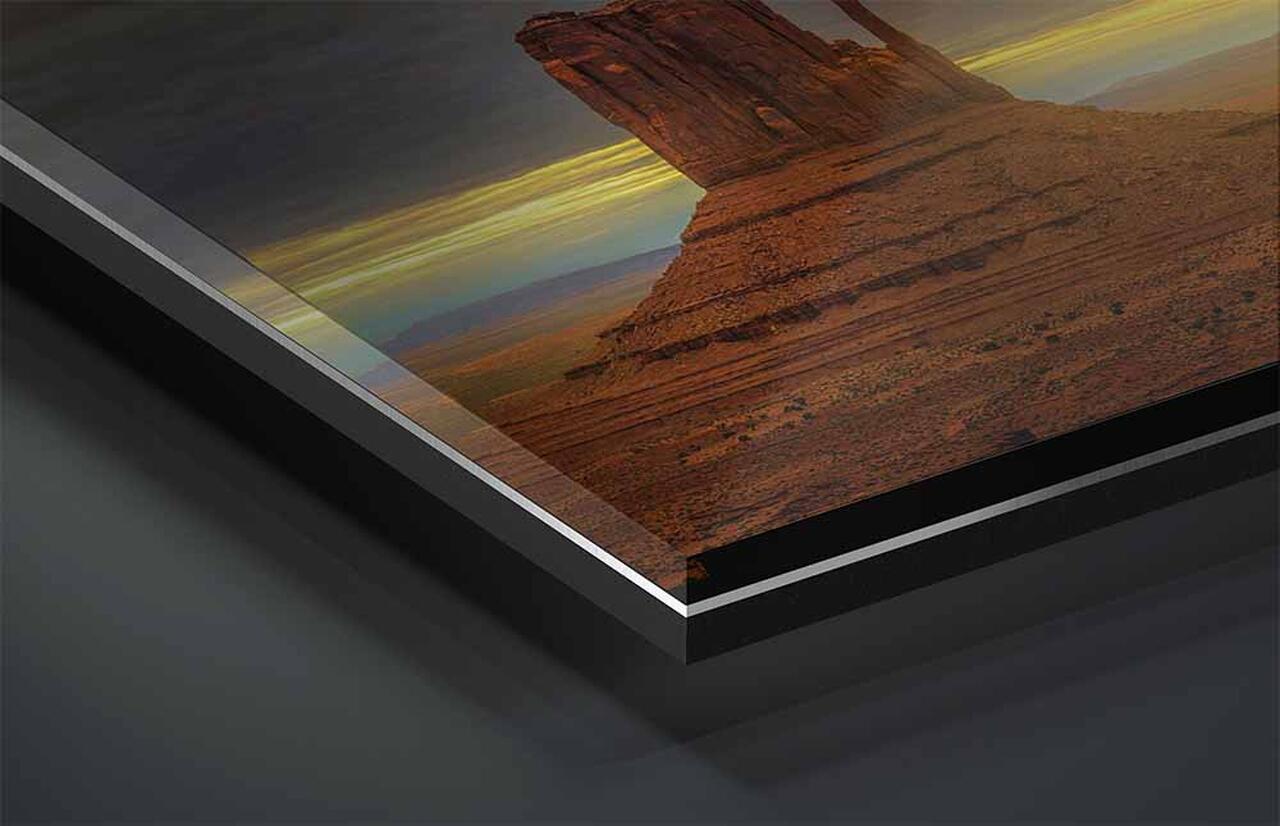
Face-mounted to TruLife acrylic and floated approximately one inch from the wall, with no frame to mediate between the image and the room. UV-resistant, anti-reflective, and scratch-resistant, with a lifetime guarantee against fading.
Signature Metal Edition of 50· ChromaLuxe Print · Gallery Float Mount
Color infused into the aluminum panel itself, floated from the wall on a concealed system. Where acrylic produces luminosity, metal produces clarity. Exceptional fade resistance with no glazing or coating required.
Fine Art Edition of 100· Hahnemühle Baryta Fine Art Paper
Printed without acrylic, so light meets the paper surface directly. Highlights stay luminous, shadows keep their nuance, and the surface has a tactile quality the other presentations approach differently. The understated choice, and the traditional one.
Complimentary shipping within the continental United States. International collector shipping available upon request.
Still deciding
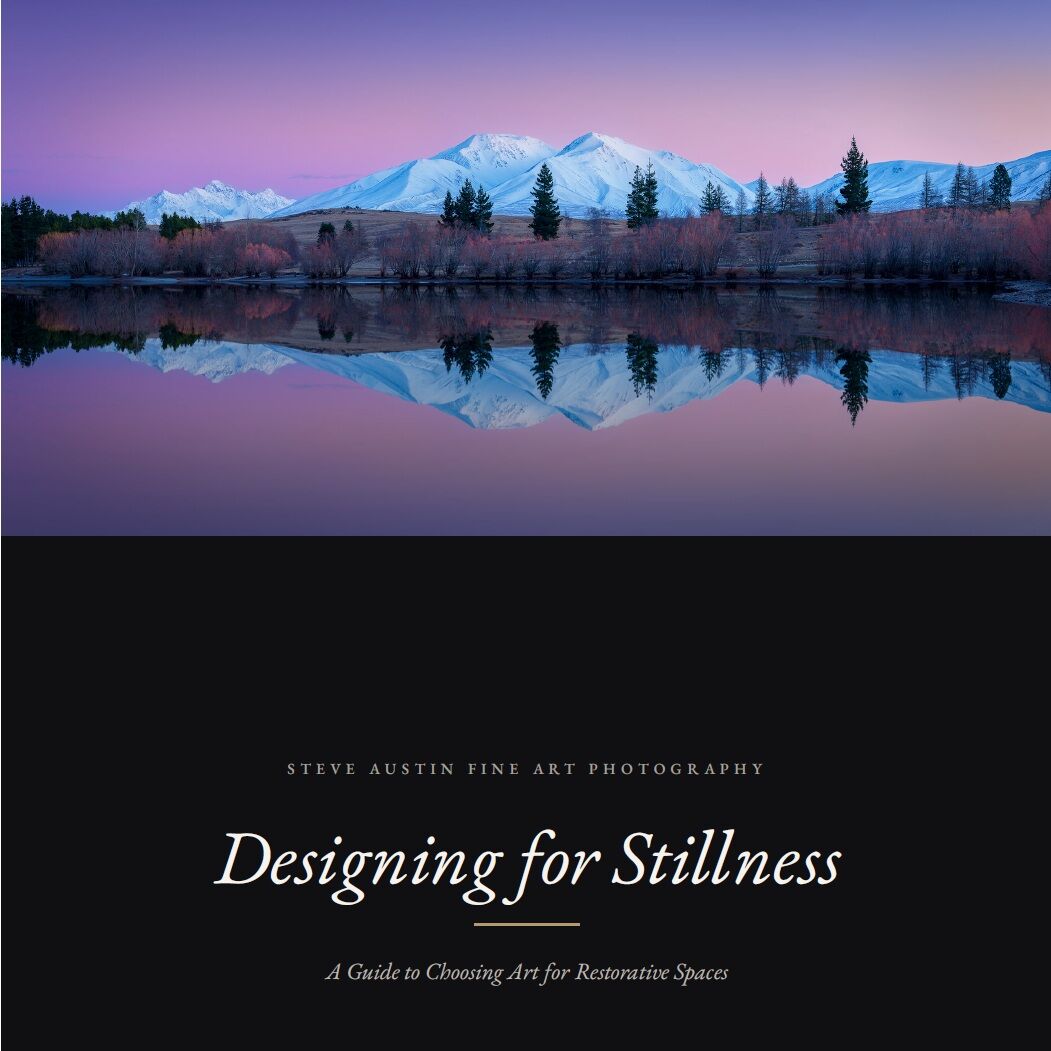
Designing for Stillness
A guide to choosing art for restorative spaces
How to tell whether an image will still hold you in a year, how scale changes what a photograph does in a room, and how to match a piece to the work a room actually performs. It cites the research it draws on, and it is equally clear about where that research stops. About ten minutes to read.