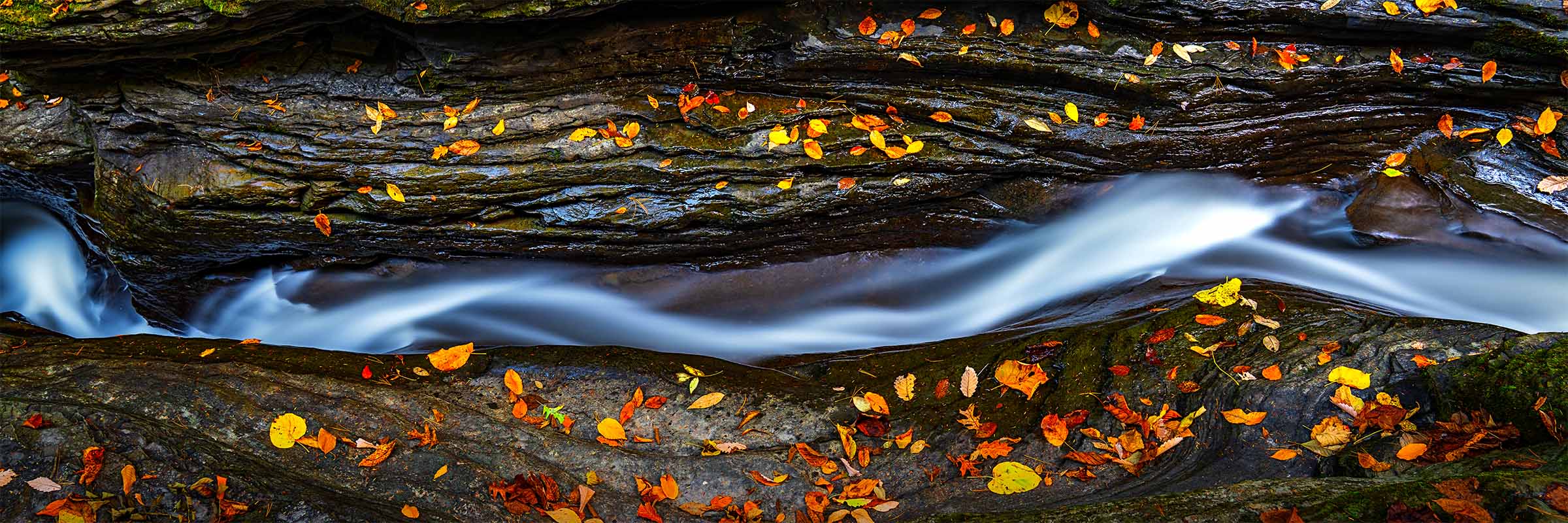
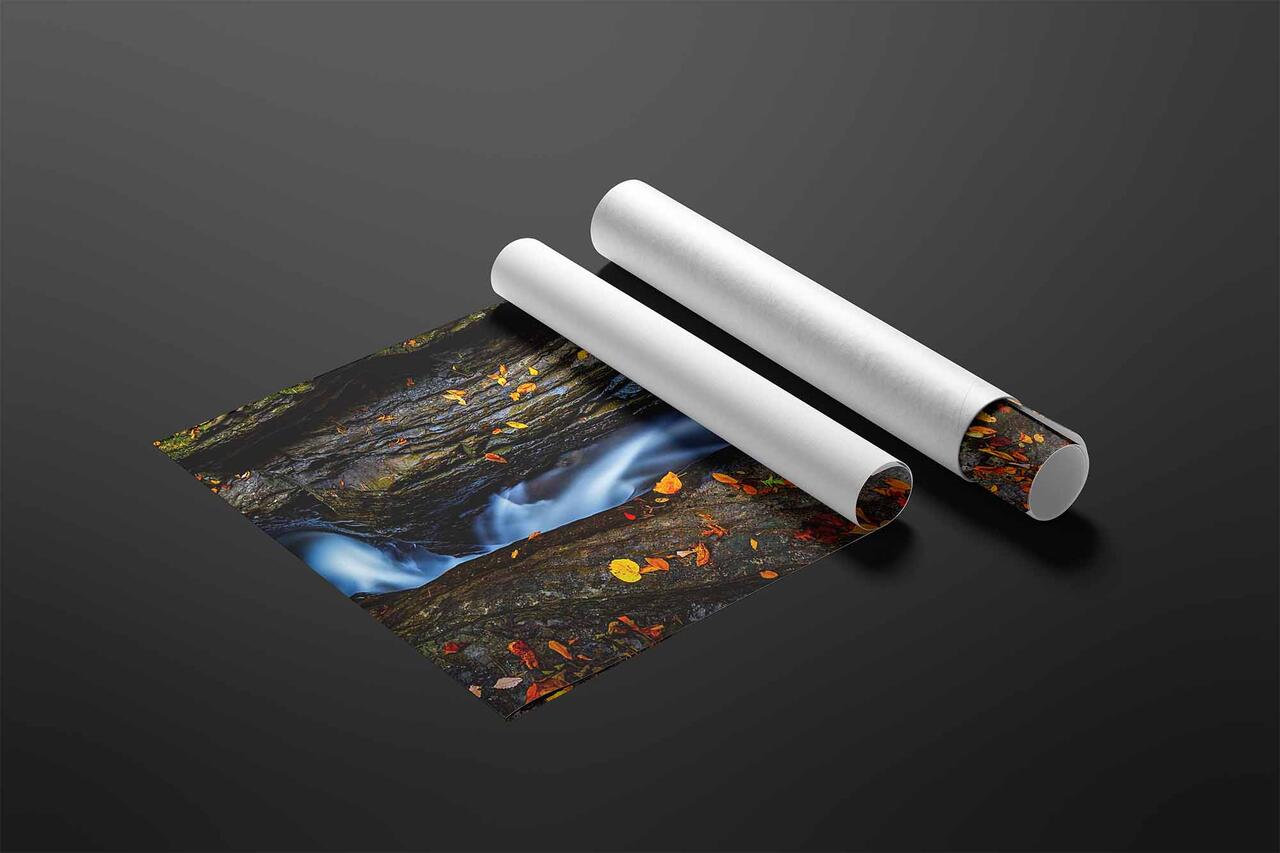
A 3:1 panoramic photograph of Glen Creek running through the gorge at Watkins Glen, New York, in autumn, available as a limited edition print in three sizes.
Artist's Story
At Watkins Glen, in the Finger Lakes of New York, Glen Creek runs through rock about four hundred million years old, in a gorge about twelve thousand. The shale and sandstone were laid down on the floor of a shallow tropical sea. The channel through them was cut after the last ice age, when glaciers deepened the Seneca valley and left this creek hanging above it with a long way down to go. In autumn the leaves come off the hardwoods overhead and settle across the wet stone on both sides.
I stayed with it a while before setting up, then held the shutter open for several seconds.
Which means the water here is not water anyone has seen. An eye watching that stream sees turbulence, churn and spray and a hundred competing directions a second. A long exposure records where the water was on average across the whole interval, and the average comes out smooth. The odd thing is that the gorge is the same operation at another scale. Twelve thousand years of that same chaotic water, averaged, is this shape in the rock. The creek and the camera are doing exactly the same thing. One took several seconds. The other is still working.
Finding the Way is that channel and a few seconds of water passing through it, added up into a form nobody standing there could have seen.
A camera is not only a recording device. Sometimes it is an instrument for seeing something the eye is not built to hold. I wrote about that in How a Photograph Sharpens the Mind.
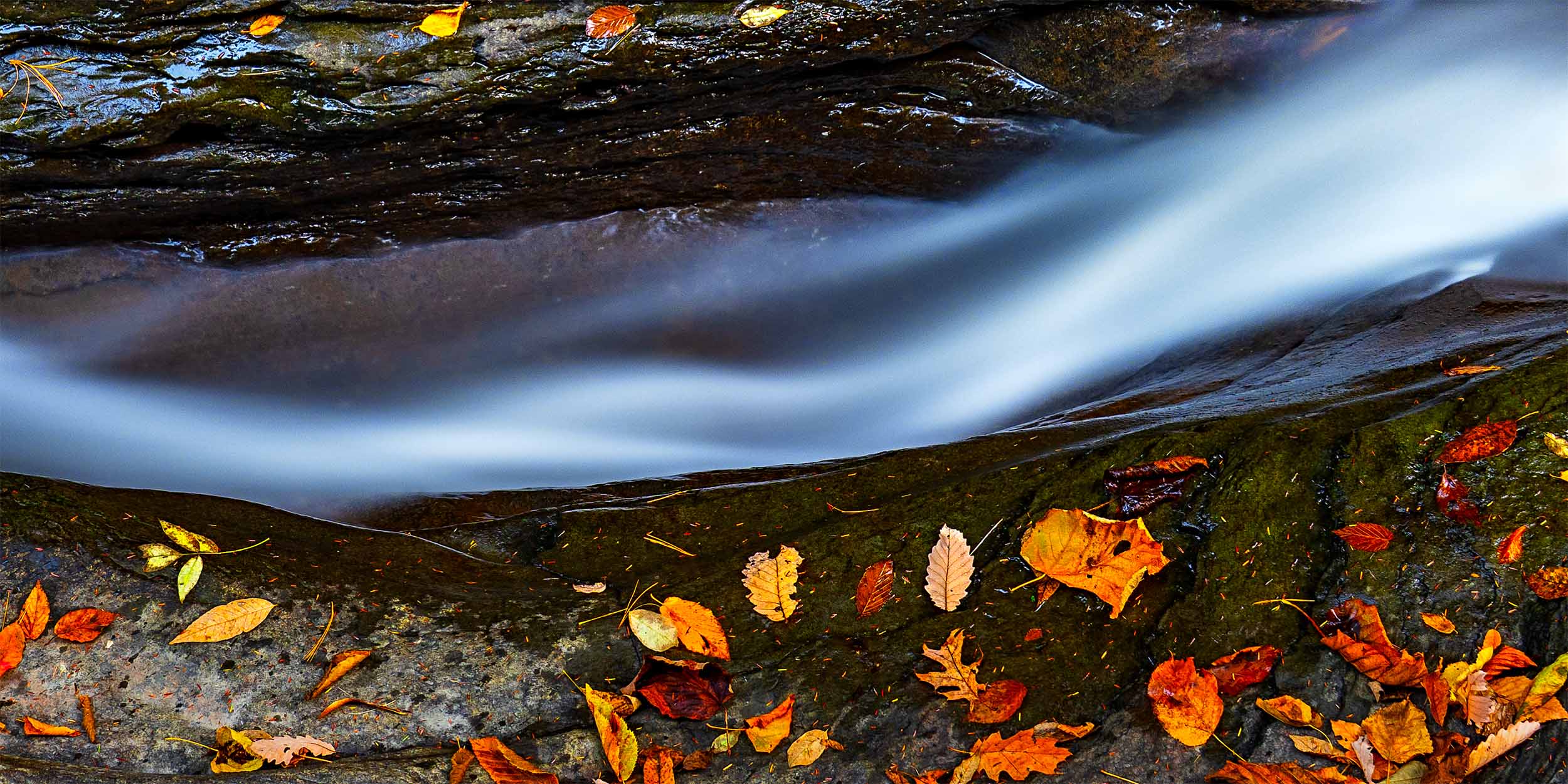
The edge of the channel, about a quarter of the frame width. The leaves resolve and the water does not, which is the whole point of it. Click to view at full size.
About This Photograph
Photographed in Watkins Glen State Park, in Schuyler County at the southern end of Seneca Lake in New York's Finger Lakes region, in autumn. This is a single frame long exposure of several seconds, in color, which renders the moving water as a smooth continuous form. The subject is Glen Creek running through a narrow channel in the gorge bedrock, with fallen hardwood leaves scattered across the wet rock on either side. The rock is Devonian shale and sandstone laid down roughly four hundred million years ago beneath a shallow tropical sea. The gorge itself was cut over about the last 12,000 years, after glaciers deepened the Seneca valley and left Glen Creek as a hanging tributary with 400 feet to descend in two miles. The channel is narrow here because the creek found a softer bed beneath a harder one and cut through it first. Presented as a horizontal panorama, offered as an archival limited edition from 36 by 12 inches to 90 by 30 inches on acrylic, metal, or archival paper.
Finding the Way
Steve Austinhttps://www.steveaustinphotography.com/
Location
Watkins Glen State Park, Schuyler County, New York
Subject
Glen Creek in a narrow bedrock channel, with fallen leaves on the wet rock
Capture
Single frame, long exposure of several seconds, autumn
Format
Photograph · horizontal panorama, 3:1
Sizes
36 × 12 in · 60 × 20 in · 90 × 30 in
Print Media
TruLife Acrylic · ChromaLuxe Metal · Baryta paper
Edition
Limited, 25 / 50 / 100 by presentation
What it Does in a Room
A photograph looking straight down at the ground does something a view never can. It puts the wall underfoot.
Three to one is the widest proportion in the collection, and it behaves differently from everything else. A two to one panorama still reads as a scene you are looking at. At three to one the frame passes beyond what the eye takes in at once, so you read it the way you read a room, by turning your head. That changes what it does to a space. It draws the horizontal line of the wall out and holds it, which makes a room feel longer and lower and calmer, and it settles above a long sofa, a run of cabinetry, a credenza, or a headboard in a way no other shape manages. It asks for a run of wall rather than height, and very little of that height. A band twelve to thirty inches tall will do, which is why this proportion often works above furniture where nothing else fits.
Here the width is carrying a single continuous form. The water enters at one edge and leaves at the other, and the rock beds run parallel to it above and below, so the whole frame is a set of long horizontal lines with one bright one moving through them. That is what makes it restful. There is no focal point and nothing to resolve, only a shape the eye follows from end to end and then follows back. It also has no horizon and no sky, which is rarer than it sounds. Most landscape photographs put the viewer upright in a place. This one puts them above it, looking down, and a print like that reads as a surface rather than as a window, which is a quieter thing to live with.
The color is warm and dark with one cool note running through it. The rock and the leaves are brown, ochre, rust, and gold, saturated but held down by wet stone that reads nearly black, and the water is a cool blue grey, the only cool thing in the frame. That combination places easily. Against oak, walnut, leather, wool, unbleached linen, or aged plaster the warm side takes over and the picture belongs to the room. Against slate, steel, or a cool gray the water comes forward instead and the same photograph reads differently. Very few pieces do both. What it rewards most is a lamp nearby. This is a dark print, weighted low, and the water is the only bright passage in it, so it gives back more in the evening than most people expect.
Not sure which size the room calls for, or want dimensions not listed here? Sizes beyond 90 × 30 are available on request and ship crated by freight. That conversation is welcome before an order is placed. Start that conversation and I will answer within one business day.
Finding the Way, limited edition printSteve Austin70012900USD11https://schema.org/InStock
Questions about this photograph
How small is too small for a photograph this wide?
At three to one, the Intimate size is thirty-six inches across and twelve inches tall. Twelve inches is not much height, and it is worth knowing what that means before choosing it. The main form holds. The water still runs the length of the frame as a single bright ribbon and the rock beds still run parallel above and below it, so the composition works. What compresses is the leaves. At twelve inches tall they become flecks of color scattered across dark stone rather than individual leaves you can identify, and identifying them is a large part of what keeps a person in front of this picture. A thirty-six by twelve print works well in a narrow run of wall, above a doorway, along a stair, or as the one piece on a hallway wall where nothing taller would fit. The Collected at sixty by twenty is where the leaves become leaves again. The Statement at ninety by thirty is where they take on their real size and the rock behind them opens up. If you are weighing a size against a specific wall, choosing the right print size covers the measurements and the viewing distances in more detail.
What changes at the largest size?
The leaves, and the fact that each one is a separate object lying at its own angle on the stone. At thirty-six by twelve they read as color. At ninety by thirty they resolve into individual leaves with their veins and their curled edges visible, some flat against the wet rock, some lifted at one corner, some half submerged with the water running over them. There are hundreds of them and no two are placed the same way. The rock does the same thing at a different scale, its bedding planes separating into distinct layers with the wet surfaces catching light and the recessed courses staying dark. What does not change is the water, which is smooth at every size because a long exposure made it that way. That contrast is worth having large: everything else in the frame gets more detailed as the print grows, and the one thing at the center of it stays exactly as simple as it was. Why scale matters covers what happens perceptually when a landscape reaches the size where the eye has to travel across it.
What kind of room does this photograph suit?
Warm rooms and cool ones, for different reasons, which is unusual. The frame is brown, ochre, rust, and gold across the rock and the leaves, held down by wet stone that reads nearly black, with the water running through it as the one cool blue grey note. Against oak, walnut, leather, wool, unbleached linen, or aged plaster the warm side takes over and the picture belongs to the room. Against slate, steel, or cool gray the water comes forward instead and the same print reads as a different photograph. What it rewards most is a lamp nearby. This is a dark image weighted low, and the water is the only bright passage in it, so it gives back more under warm light in the evening than it does at midday. It also rewards a wall you pass rather than sit under, since the composition runs end to end and reads best when the eye travels along it.
Every work ships insured and arrives with a signed certificate of authenticity.
If a piece is damaged in transit, the choice of replacement is always yours, and your edition number stays with you.
Production time runs 2 to 3 weeks for metal, 3 to 4 weeks for acrylic and paper, and 5 to 6 weeks for framed work.
Collector's Choice · TruLife ® Acrylic in Italian Frame
Collector Edition of 25· Lumachrome TruLife Acrylic · Handcrafted Italian Frame
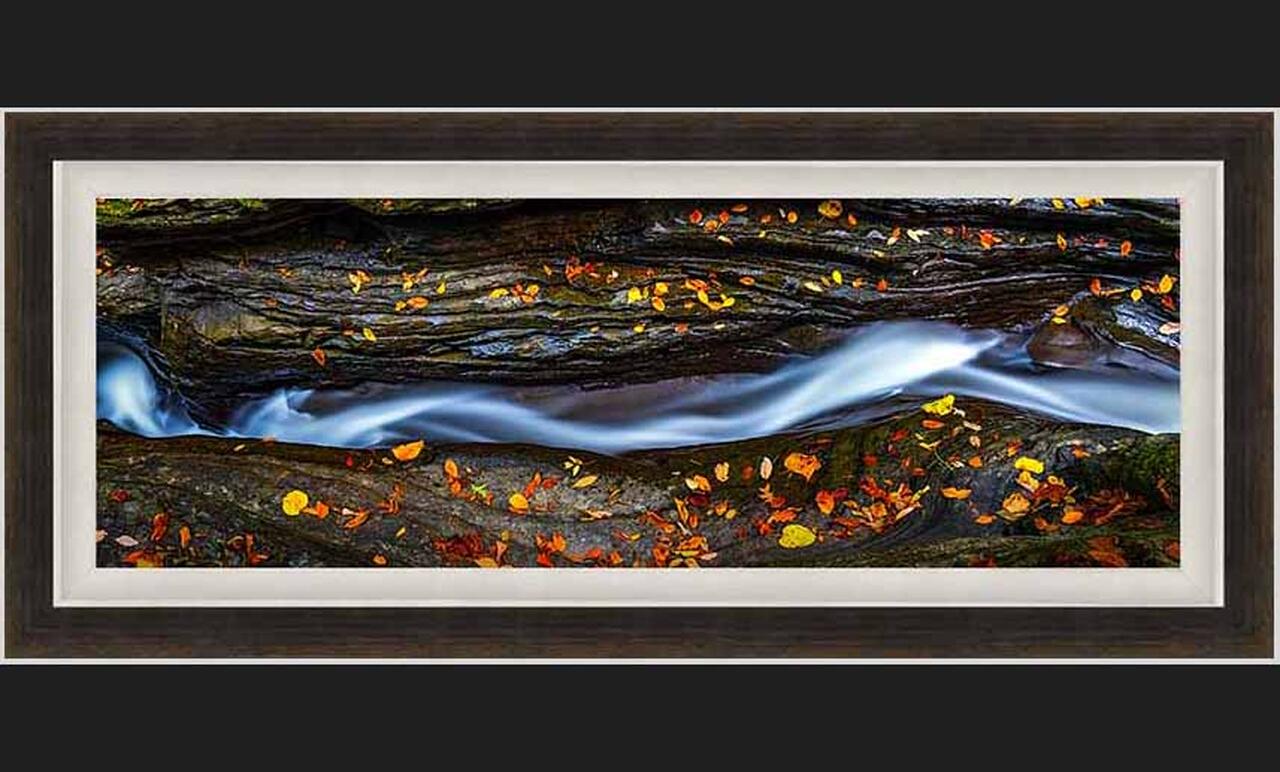
TruLife acrylic in a handcrafted Italian frame with a linen liner chosen for the image. Frame series, finish, and liner are settled with you after the order, and production begins from there. The frame and liner add about fourteen inches to the finished dimensions, worth allowing for when planning placement.
Signature Edition · TruLife ® Acrylic, Float Mount
Signature Edition of 50· Lumachrome TruLife Acrylic · Gallery Float Mount
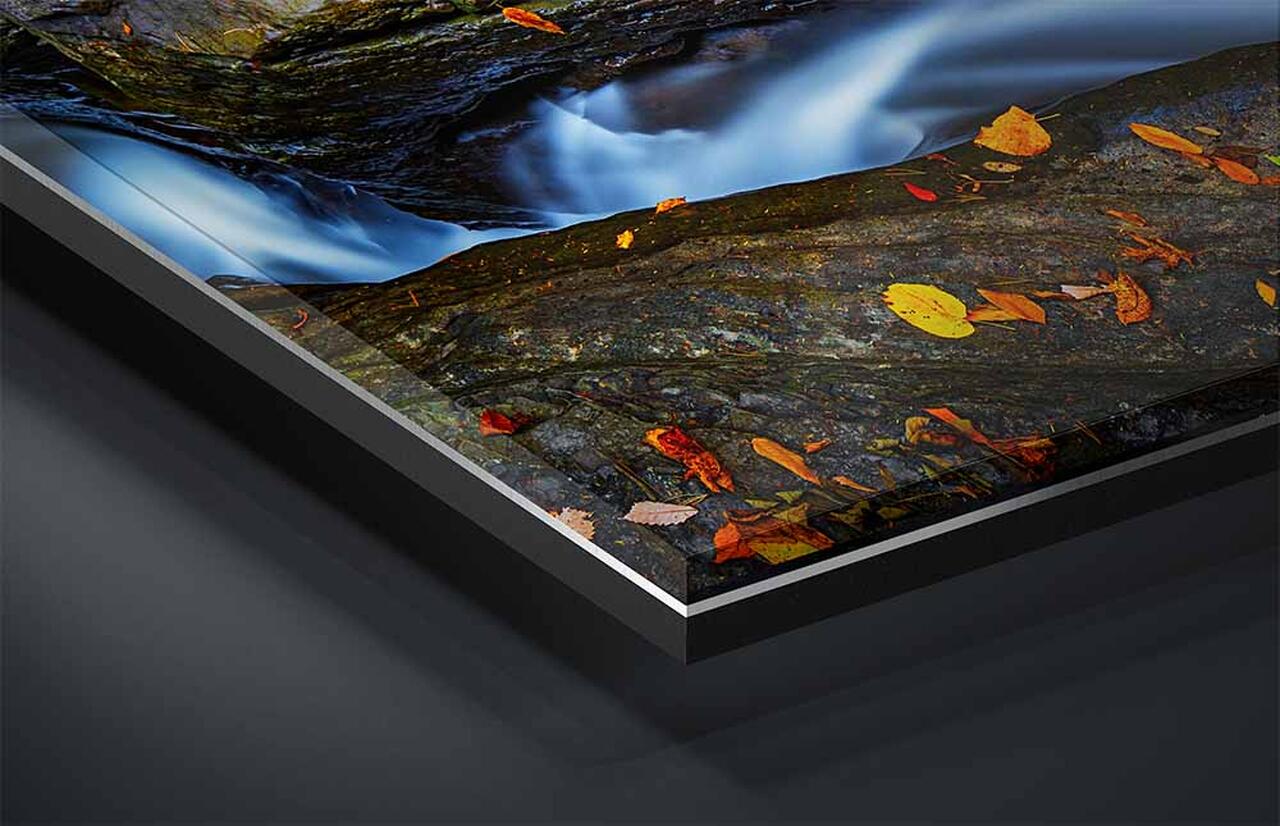
Face-mounted to TruLife acrylic and floated approximately one inch from the wall, with no frame to mediate between the image and the room. UV-resistant, anti-reflective, and scratch-resistant, with a lifetime guarantee against fading.
Signature Edition of 50· ChromaLuxe Metal Print · Gallery Float Mount
Color infused into the aluminum panel itself, floated from the wall on a concealed system. Where acrylic produces luminosity, metal produces clarity. Exceptional fade resistance with no glazing or coating required.
Fine Art Edition of 100· Hahnemühle Baryta Fine Art Paper
Printed without acrylic, so light meets the paper surface directly. Highlights stay luminous, shadows keep their nuance, and the surface has a tactile quality the other presentations approach differently. The understated choice, and the traditional one.
Complimentary shipping within the continental United States. International collector shipping available upon request.
Still deciding
Designing for Stillness
A guide to choosing art for restorative spaces
How to tell whether an image will still hold you in a year, how scale changes what a photograph does in a room, and how to match a piece to the work a room actually performs. It cites the research it draws on, and it is equally clear about where that research stops. About ten minutes to read.