A 2:1 panoramic photograph of a lone willow standing in Lake Wānaka, New Zealand, at dawn, available as a limited edition print in three sizes and four presentations.
Artist's Story
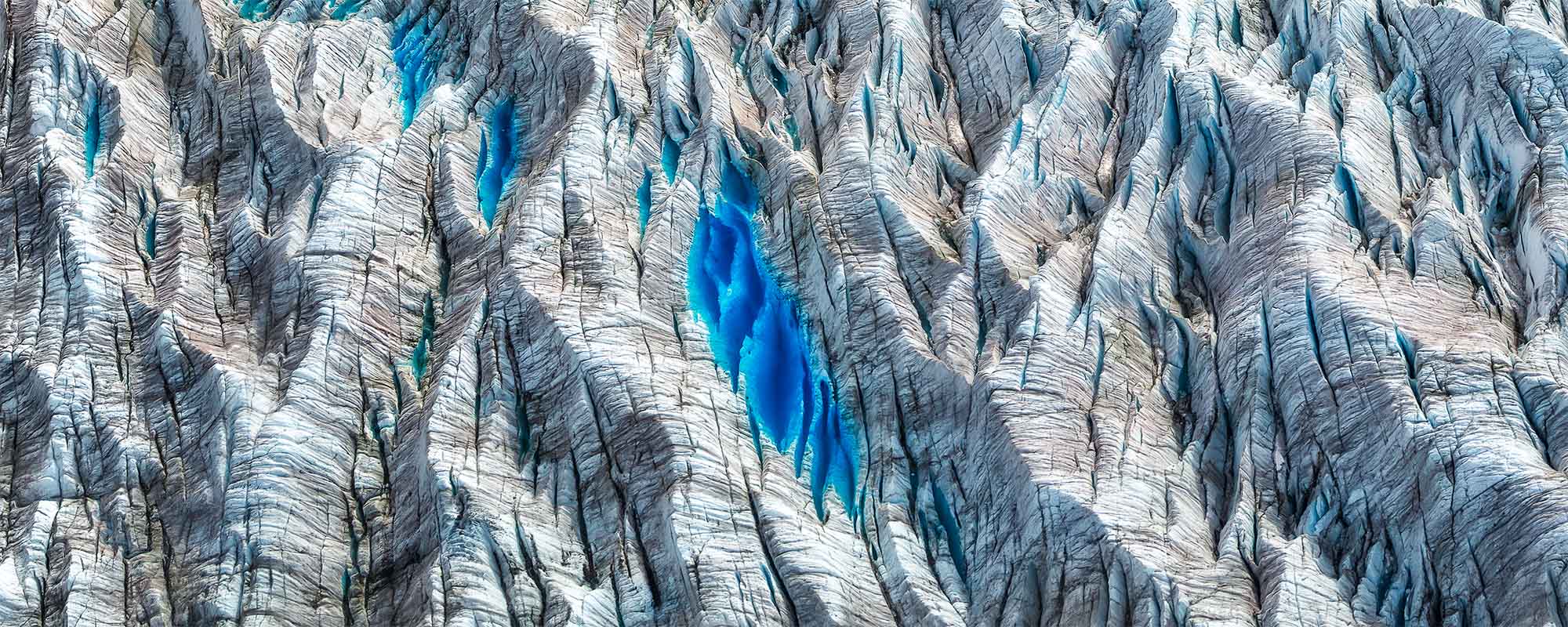
I chartered a plane over Wrangell-St. Elias and spent the flight looking down at a glacier whose name I never learned. What I was after was the pools.
The ice is white, the water sitting in it is blue, and they are the same substance.
Water is blue on its own account. Not borrowed from the sky, not from anything dissolved in it. A water molecule absorbs red light directly, by way of a vibration in its own oxygen-hydrogen bonds, and that transition sits at six hundred and ninety-eight nanometers, right at the red edge of what an eye can register. As far as anyone has established this is the only color in nature produced that way. Every other colored thing is colored by what its electrons do. Water is colored by how it shakes. The effect is far too weak to see in a glass and obvious through three meters.
Glacier ice is water with air in it. Snow compacts into ice and carries a great deal of trapped air down with it, and those bubbles scatter every wavelength straight back before light has traveled far enough for any red to be removed. That is the white. Where the pressure of centuries has squeezed the bubbles out, or where meltwater has collected deep enough to give the light a long run, the red goes and what returns is blue. The proof runs backward too. Break open a face of blue ice and within hours air works into the fractures and the surface turns white again.
Glacier Lagoon is one material photographed twice in the same frame, with the air in it and with the air gone.
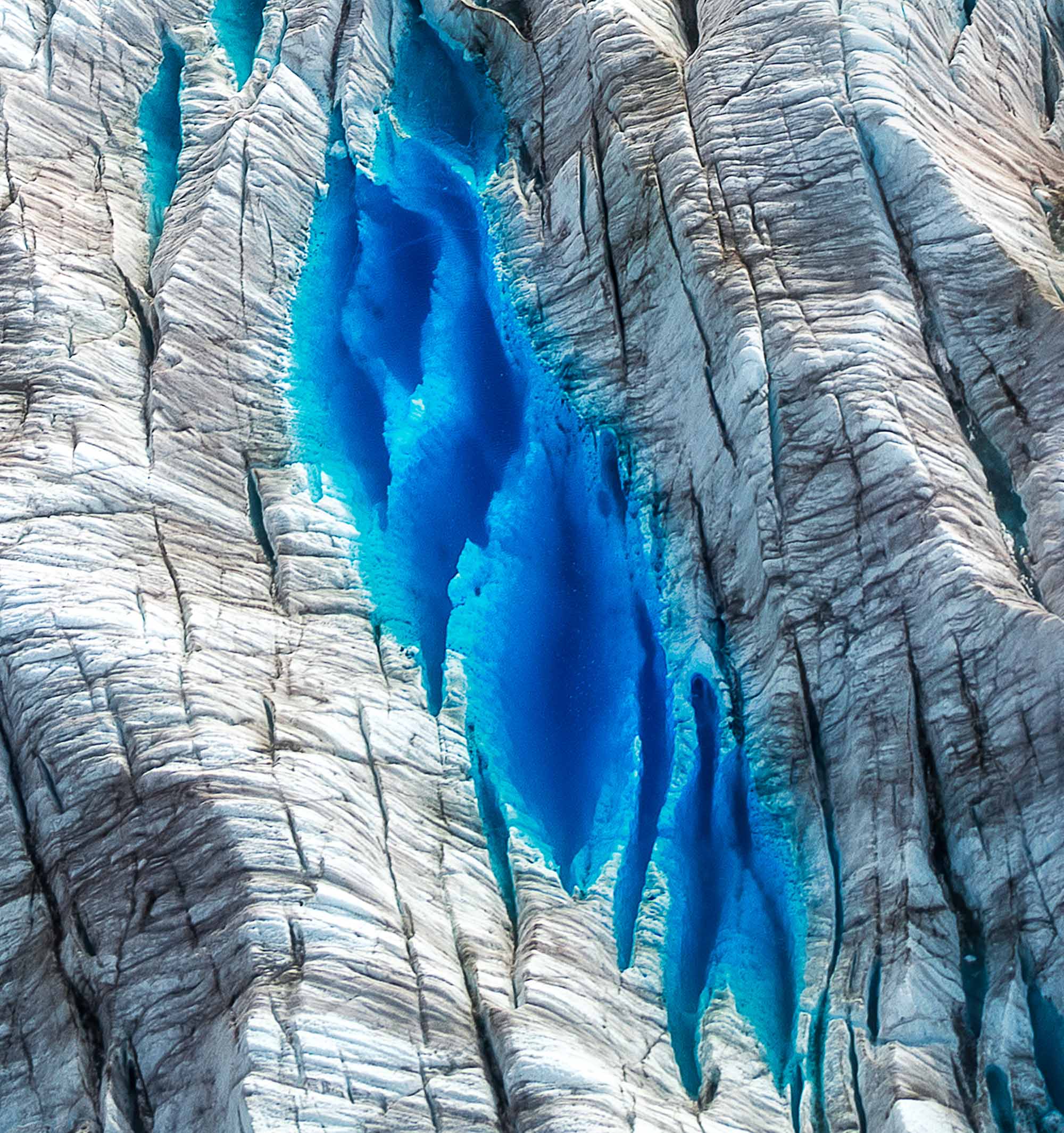
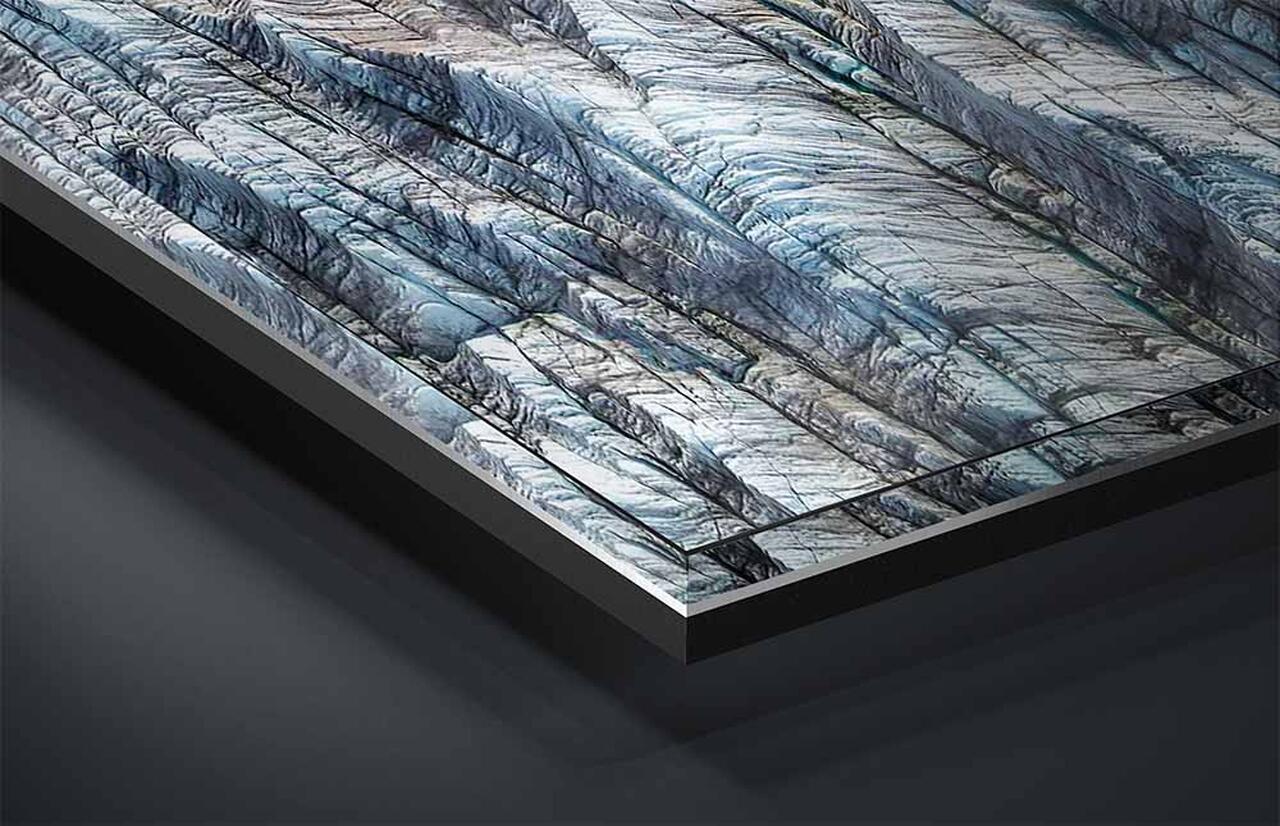
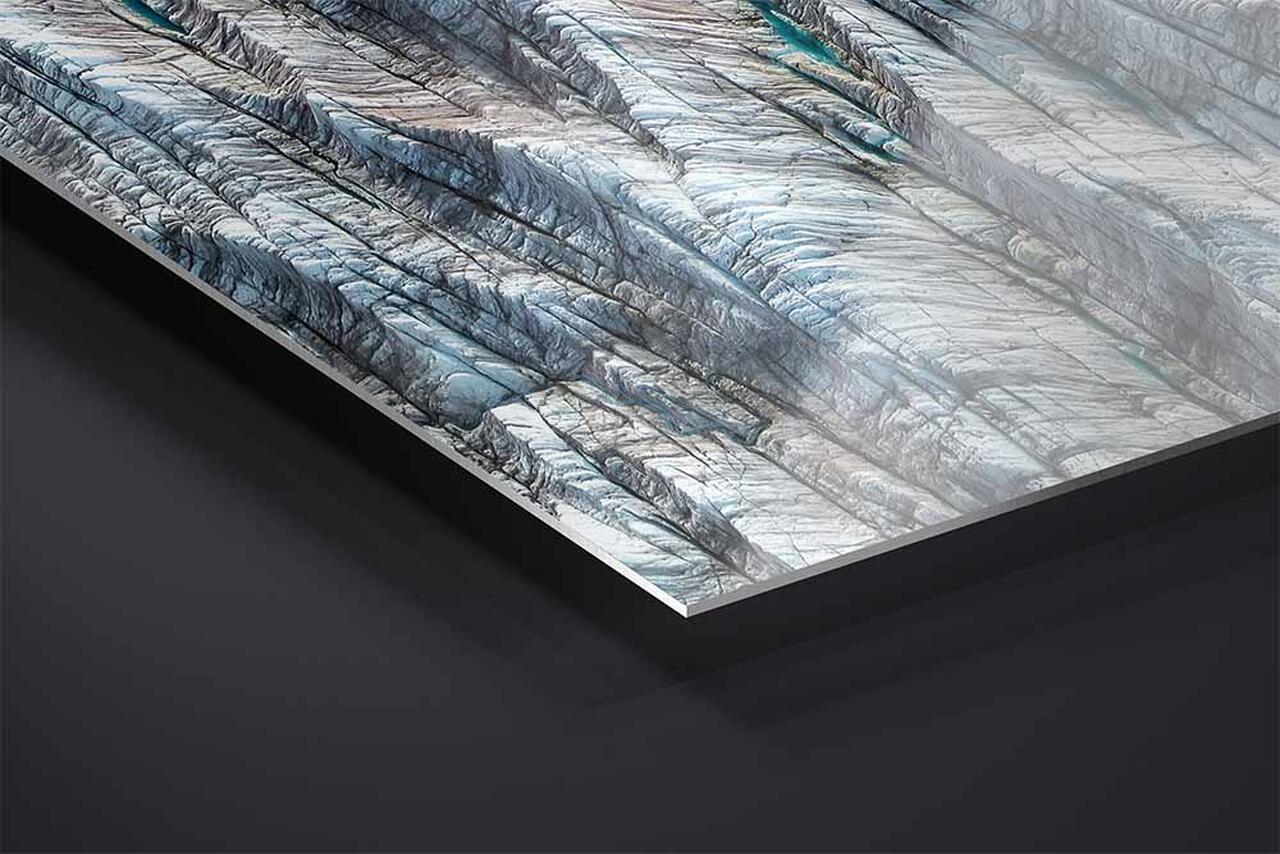
This crop is 24 percent of the frame width, about 19 inches across on the 80 inch print. The rim where white ice gives way to water reads as a distinct edge, and the pool grades from pale turquoise in the shallows to deep blue at its center, which is depth becoming visible: the further light travels through water, the more red is taken out of it. Around the pool the fractures carry shadow inside them and the ridges show the shallow channels meltwater has cut across their surfaces. Click to view at full size.
About This Photograph
An unnamed glacier in Wrangell-St. Elias National Park and Preserve, Alaska, photographed from a chartered aircraft. Single frame. Wrangell-St. Elias is the largest national park in the United States and holds some of the largest glaciers on the continent.
The chevrons running through this frame are a record of speed. Ice down the middle of a glacier travels faster than ice dragging along the valley walls, and that difference tears the surface apart between them. Crevasses open across the direction of greatest tension, which sets them at an angle to the flow rather than square to it, and the angle shifts with the amount of shear. The pattern maps which part of this glacier was moving how fast.
Measured across the frame, this is the brightest photograph in the collection, with close to five percent of it at or near white and barely two percent anywhere near black.
Glacier Lagoon
Steve Austinhttps://www.steveaustinphotography.com/
Location
Wrangell-St. Elias National Park, Alaska, United States
Subject
glacier crevasses · meltwater pools · aerial
Capture
Single frame, aerial
Format
Photograph · horizontal panorama, 2:1
Sizes
40 × 20 in · 60 × 30 in · 80 × 40 in
Print Media
TruLife Acrylic · ChromaLuxe Metal · Baryta paper
Edition
Limited, 25 / 50 / 100 by presentation
What it Does in a Room
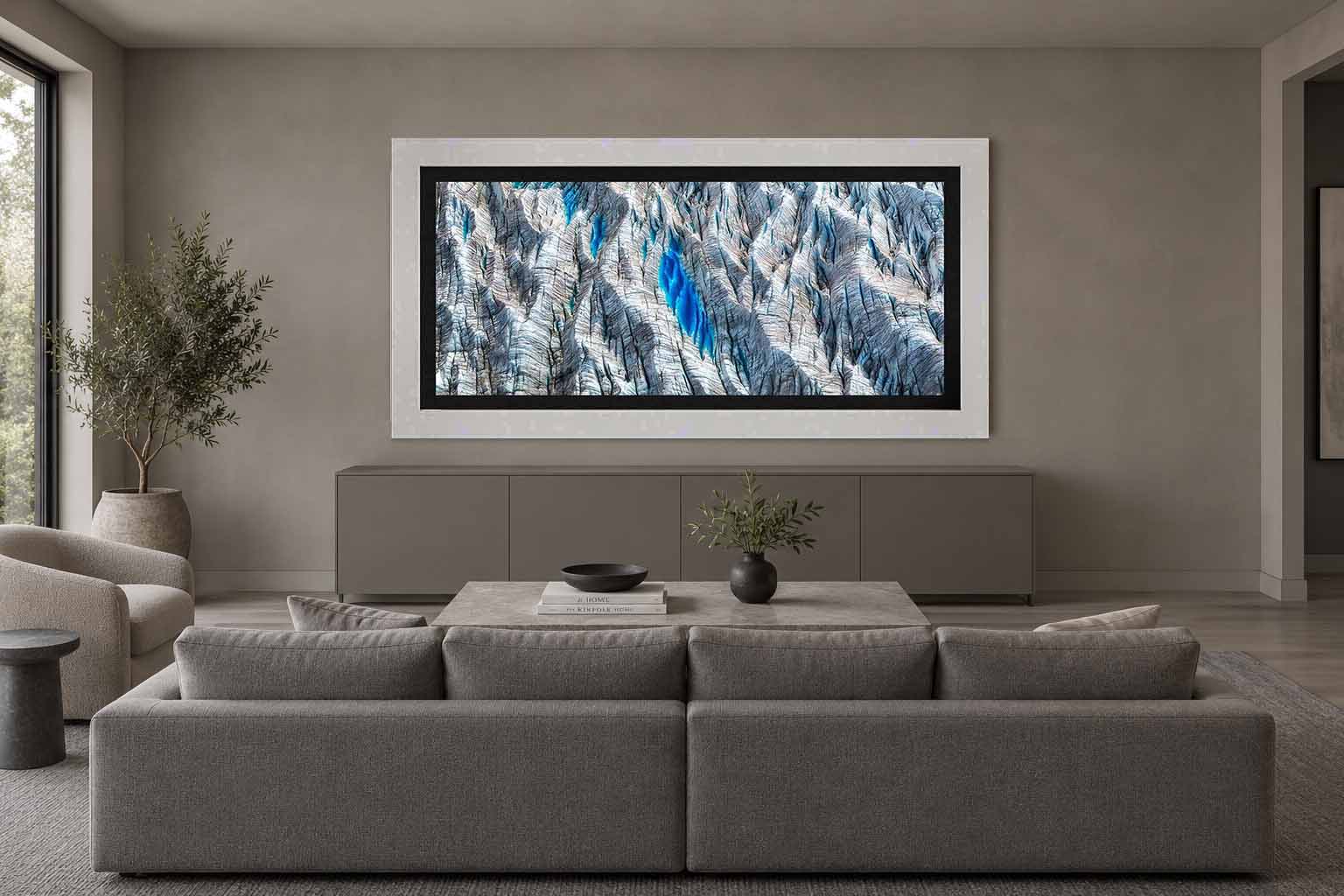
This is the only photograph here that is lighter than the wall it hangs on. Its average is a hundred and forty-two out of two hundred and fifty-five and the darkest forty-pixel block anywhere in it measures forty-seven, so nothing in it is dark. Every other piece in this collection sits darker than its surround and reads as an opening cut into the wall. This one sits brighter and reads as a panel standing in front of one. That inverts the usual relationship and it has a practical consequence: on a mid or dark wall it advances rather than recedes, holds a room from further away than its size suggests, and puts light back into a space instead of taking it out.
Despite the blue, it is the least saturated photograph in the collection. The blue pools cover under a fifth of the frame and everything else is near-neutral gray ice, so the measured saturation comes out lower than anything else here including the black and white. What that means in a room is that it behaves like a texture rather than like a color. It will not impose a hue on a space, it will not force the rest of the room to answer it, and it will not compete with whatever palette is already in place. The blue reads as an accent inside a gray picture rather than as the subject of a blue one, and a room can leave it alone.
It also has no up. Nothing in the frame establishes an orientation: no horizon, no sky, no gravity, no object that has to sit one way round. The brightness measured across the height varies by eighteen points out of two hundred and fifty-five and across the width by fifteen, which is as close to uniform as a photograph gets. The eye enters wherever it happens to land and leaves without having traveled anywhere. That makes it unusually forgiving about position on a wall and unusually good at holding a glance for longer than a composed picture does, because there is no arrangement to finish reading.
Not sure which size the room calls for, or want dimensions not listed here? Sizes beyond 80 × 40 are available on request and ship crated by freight. That conversation is welcome before an order is placed. Start that conversation and I will answer within one business day.
How small is too small for a photograph this wide?
At the Intimate size the picture is forty inches across and sixteen tall, and the large pattern holds. The chevrons hold, the main pool holds, and the sense of a fractured surface holds. What goes is the count. The smaller pools scattered across the frame, of which there are several, shrink to marks and stop reading as water, and once they are gone the picture has one blue incident instead of a field of them. The individual crevasses merge into the ridges between them, so the ice reads as folded rather than as broken. The Collected at sixty by twenty-four brings the smaller pools back as pools. If you are weighing a size against a specific wall, choosing the right print size covers the measurements and the viewing distances in more detail.
What changes at the largest size?
At eighty by thirty-two the crevasse field resolves into individual fractures, each with shadow inside it and a visible lip where the ice has parted. The ridges between them pick up their own surface texture, the sun cups and the shallow channels meltwater has cut across them. The smaller pools become countable and separate, and around every one of them the rim where white ice gives way to blue water reads as a distinct edge rather than a blur. Inside the largest pool the tone changes across its area, which is depth becoming visible, with a shelf discernible under the surface toward one end. The dark bands running through the ice resolve as entrained rock and grit carried along in the flow. And across the smooth unbroken faces, hairline cracks appear where the ice is under tension but has not yet opened. Why scale matters covers what happens perceptually when a photograph reaches the size where the eye has to cross it.
What kind of room does this photograph suit?
A long wall in a mid or dark toned room. A living room, an office, a dining room, a corridor, a landing. Hang it at standard height with the center at about fifty-seven inches. On materials it is the most accommodating piece in the collection, since it carries almost no color of its own and will sit with warm or cool schemes without argument. Three things to avoid. Do not hang it on a white or near-white wall, because the print is brighter than most walls already and a white one removes the contrast entirely and leaves it looking washed. Keep it away from another strongly blue piece in the same view, since the pools are the only color it has and a bluer neighbor will take that away. And do not put a heavily patterned or textured surface nearby, because the fractured ice is the subject and a second busy surface competes with it at the same scale. When your mind needs to rest takes the question further.
Every work ships insured and arrives with a signed certificate of authenticity.
If a piece is damaged in transit, the choice of replacement is always yours, and your edition number stays with you.
Production time runs 2 to 3 weeks for metal, 3 to 4 weeks for acrylic and paper, and 5 to 6 weeks for framed work.
Each print is made to order and takes its place in a numbered edition, so sales are final. Before you choose, I am glad to help: send a photo of your wall and I will show you this work in your room at true scale, at no charge. Start a conversation
Collector's Choice · TruLife ® Acrylic in Italian Frame
Collector Edition of 25· Lumachrome TruLife Acrylic · Handcrafted Italian Frame
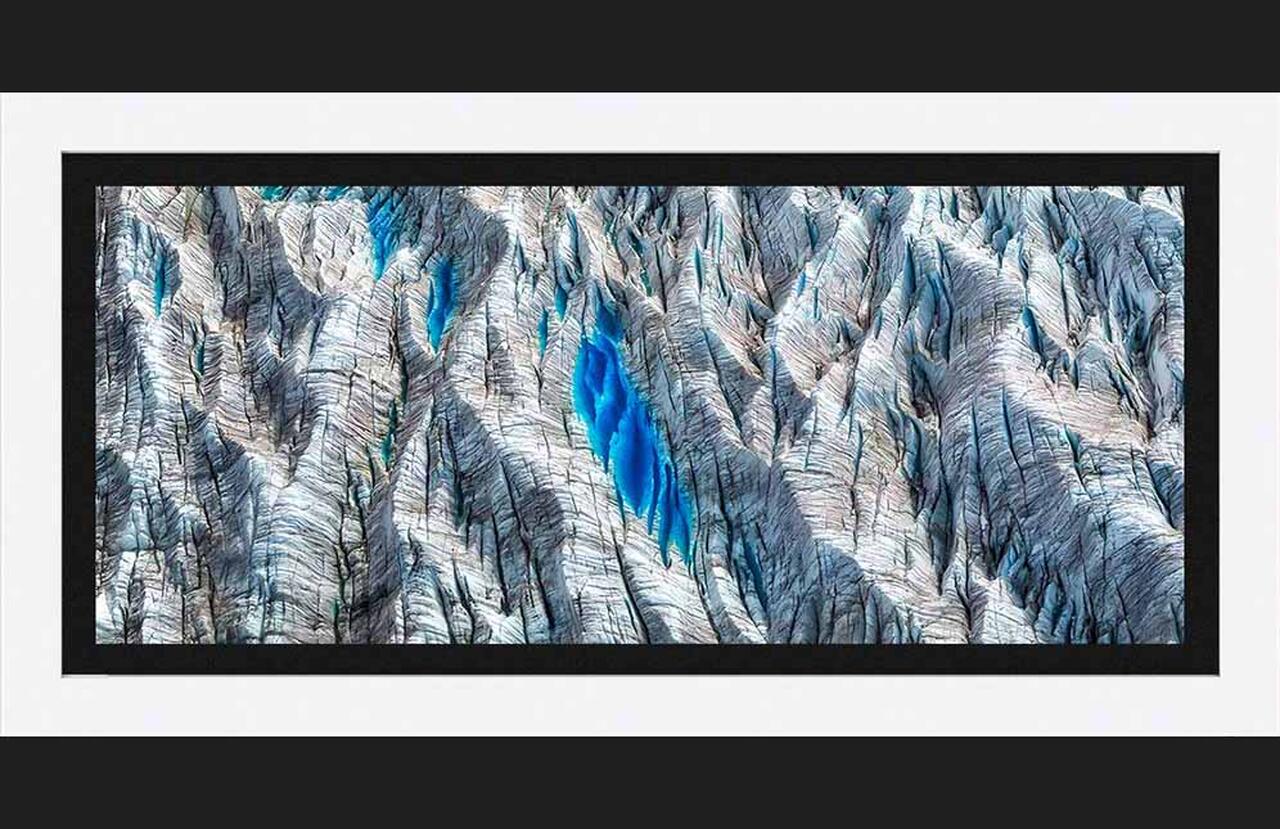
TruLife acrylic in a handcrafted Italian frame with a linen liner chosen for the image. Frame series, finish, and liner are settled with you after the order, and production begins from there. The frame and liner add about fourteen inches to the finished dimensions, worth allowing for when planning placement.
Signature Acrylic Edition of 50· Lumachrome TruLife · Gallery Float Mount
Face-mounted to TruLife acrylic and floated approximately one inch from the wall, with no frame to mediate between the image and the room. UV-resistant, anti-reflective, and scratch-resistant, with a lifetime guarantee against fading.
Signature Metal Edition of 50· ChromaLuxe Print · Gallery Float Mount
Color infused into the aluminum panel itself, floated from the wall on a concealed system. Where acrylic produces luminosity, metal produces clarity. Exceptional fade resistance with no glazing or coating required.
Complimentary shipping within the continental United States. International collector shipping available upon request.
Still deciding
Designing for Stillness
A guide to choosing art for restorative spaces
How to tell whether an image will still hold you in a year, how scale changes what a photograph does in a room, and how to match a piece to the work a room actually performs. It cites the research it draws on, and it is equally clear about where that research stops. About ten minutes to read.