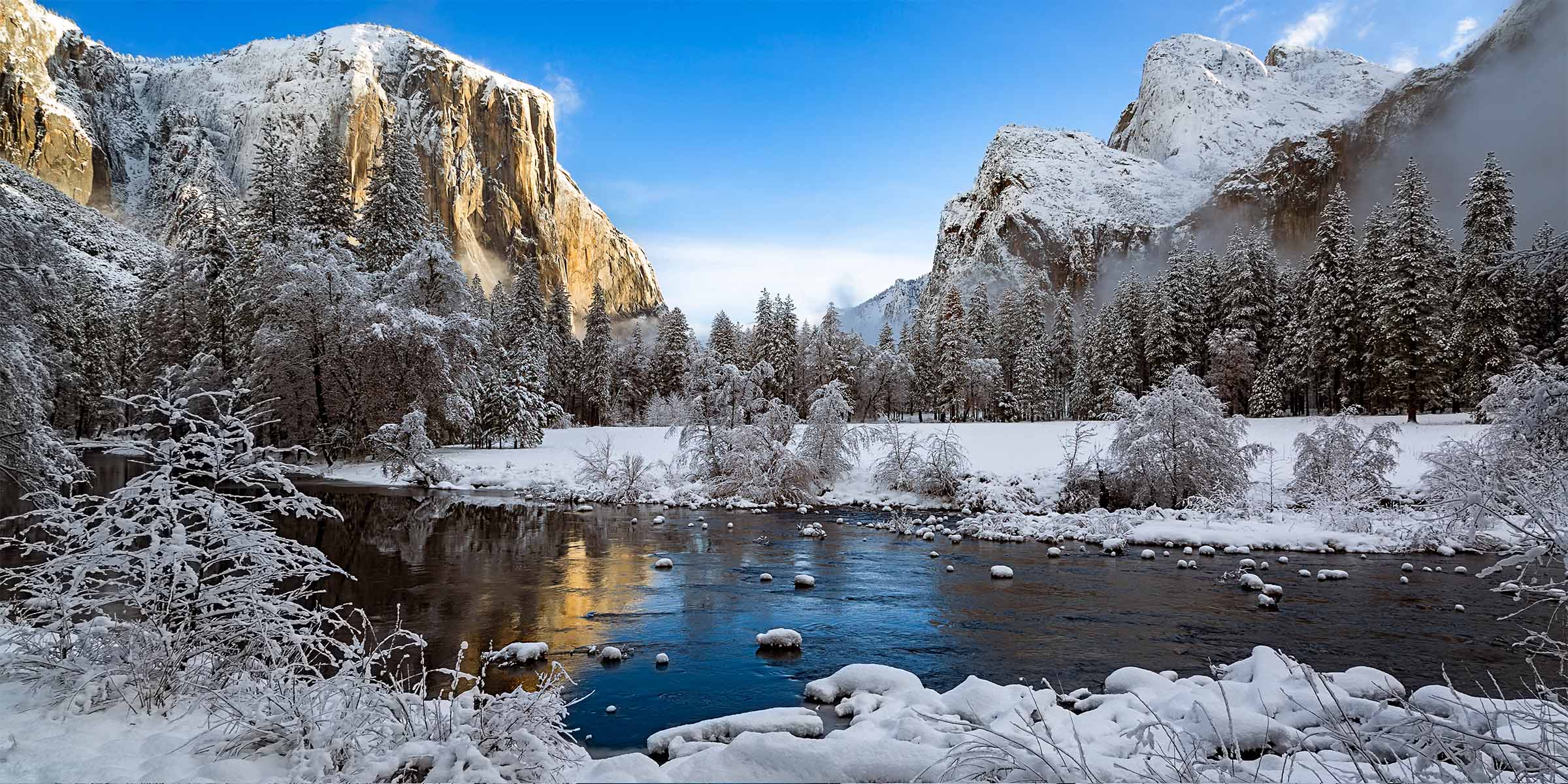
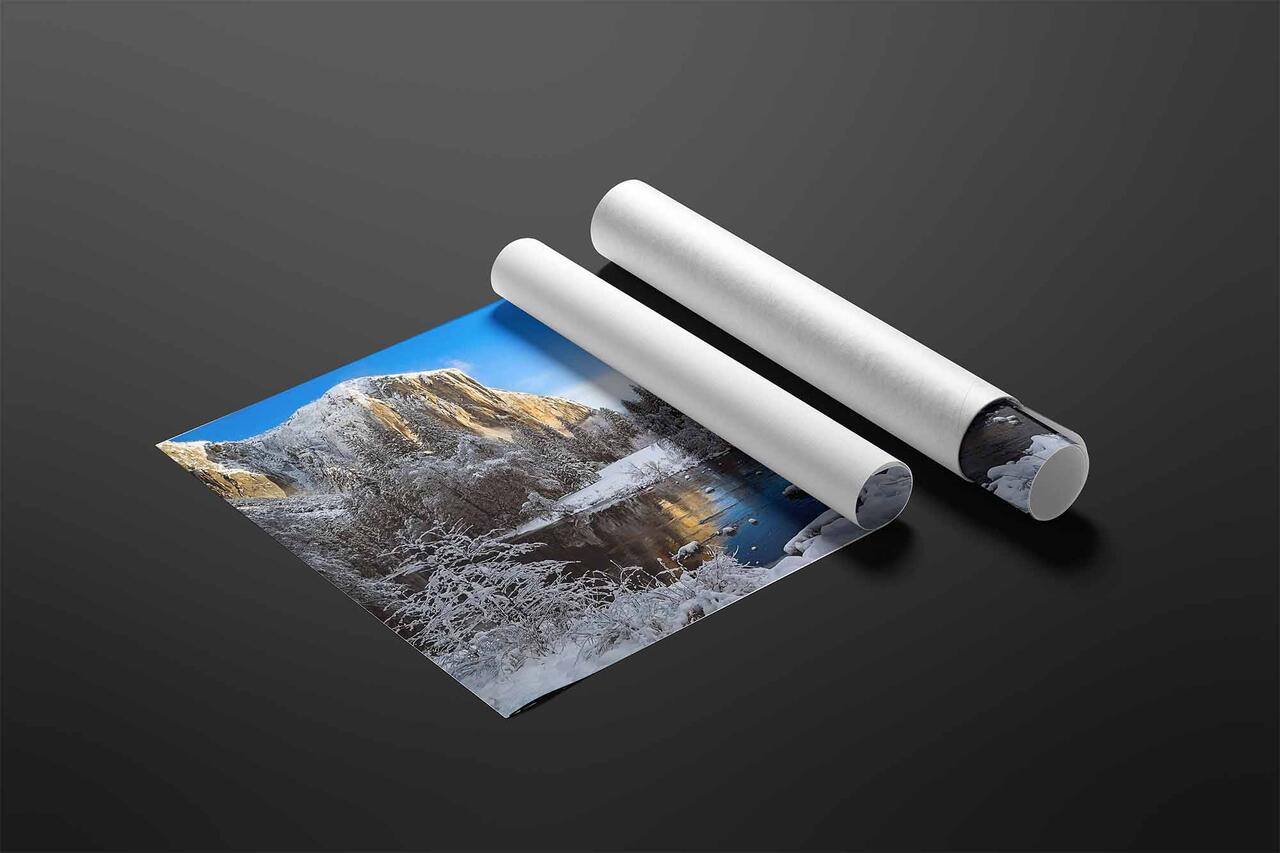
A 2:1 panoramic photograph of El Capitan and Merced River from Valley View after a snowfall, Yosemite National Park, California, available as a limited edition print in three sizes.
Artist's Story
Three days snowed in, and then it stopped. I came out to Valley View at the western end of the valley, with El Capitan standing on the left and Cathedral Rocks on the right, and every tree in sight was loaded.
Loaded is the accurate word. Every branch and every needle in this frame is carrying snow on top of it, which is a different event from a deep fall on the ground and a much rarer one.
Snow only sticks to a twig inside a narrow band of temperature. At or just above freezing the crystals partly melt on the way down and arrive with a film of liquid water on them, which bonds them to whatever they land on and to each other. A few degrees colder and the crystals stay dry and separate, bounce off a branch, and collect on the ground instead. Anyone who has tried to make a snowball in hard cold weather knows the same fact from the other side of it.
It also needs a cold surface to land on. A tree that has sat through a cold spell has branches colder than the air around them, and warm wet snow arriving onto cold wood is what builds a load like this one. So the frame records a sequence rather than a quantity: days of cold, then a front warm enough to carry wet snow, then a stop. It does not keep. A few degrees of warming or any wind at all strips the branches within hours and leaves only the layer on the ground.
Winter's Respite is the gap between the end of the storm and the first wind. It is measured in hours.
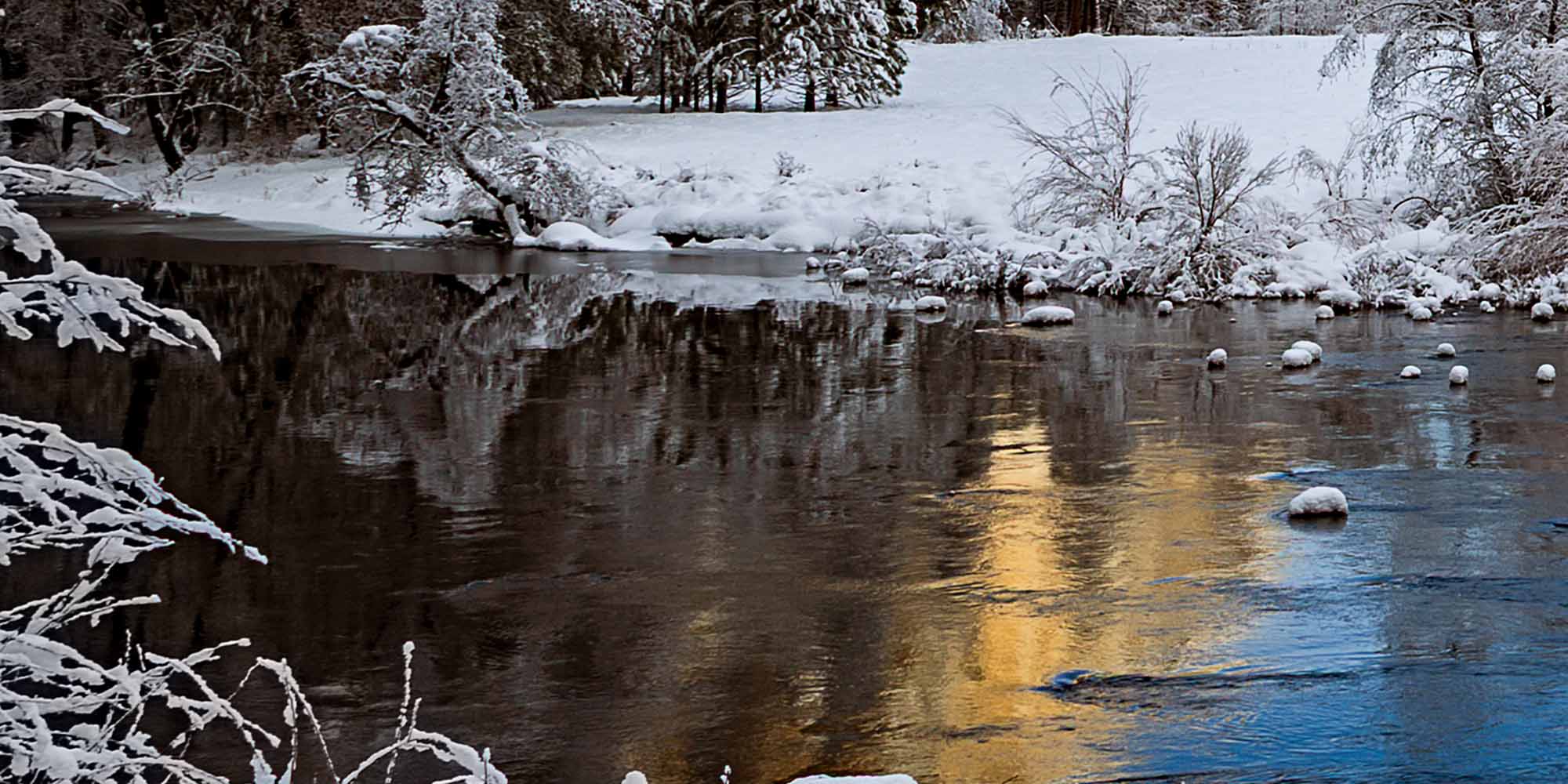
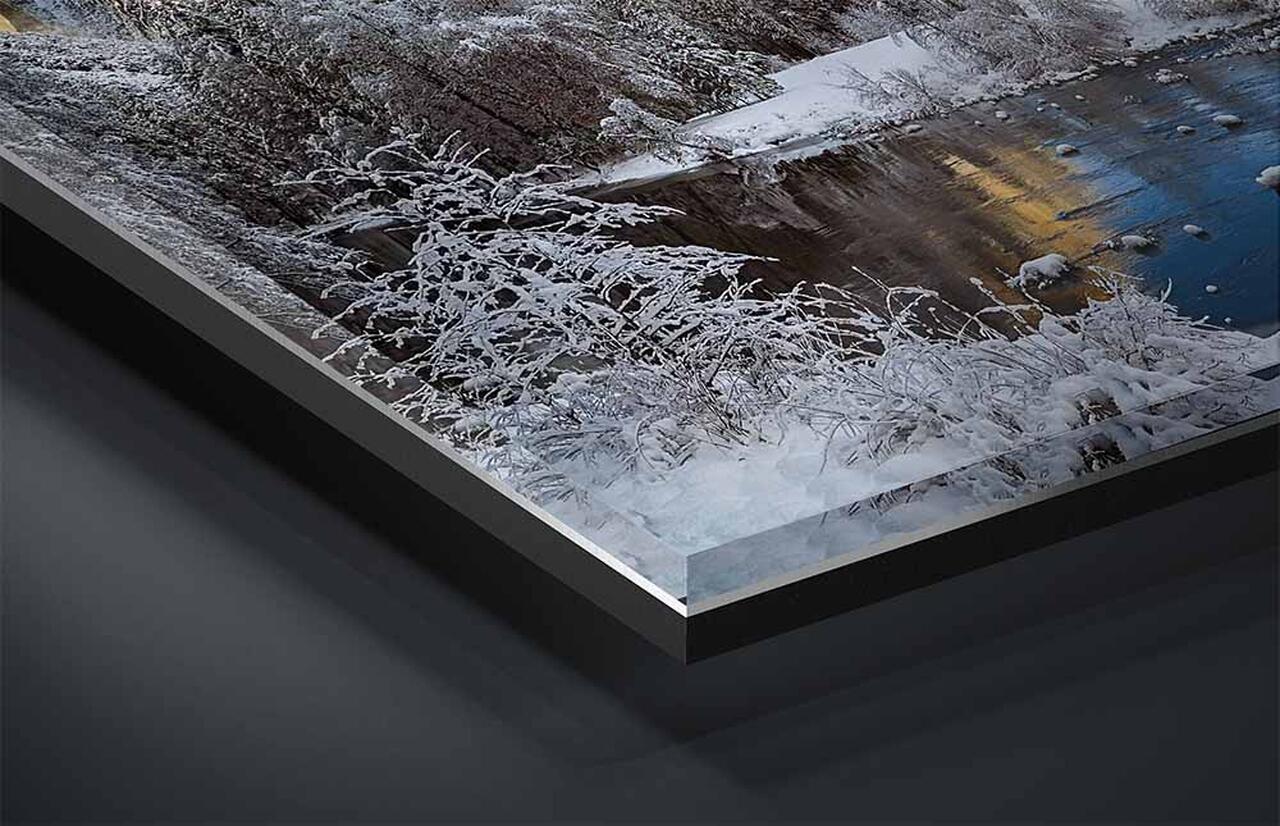
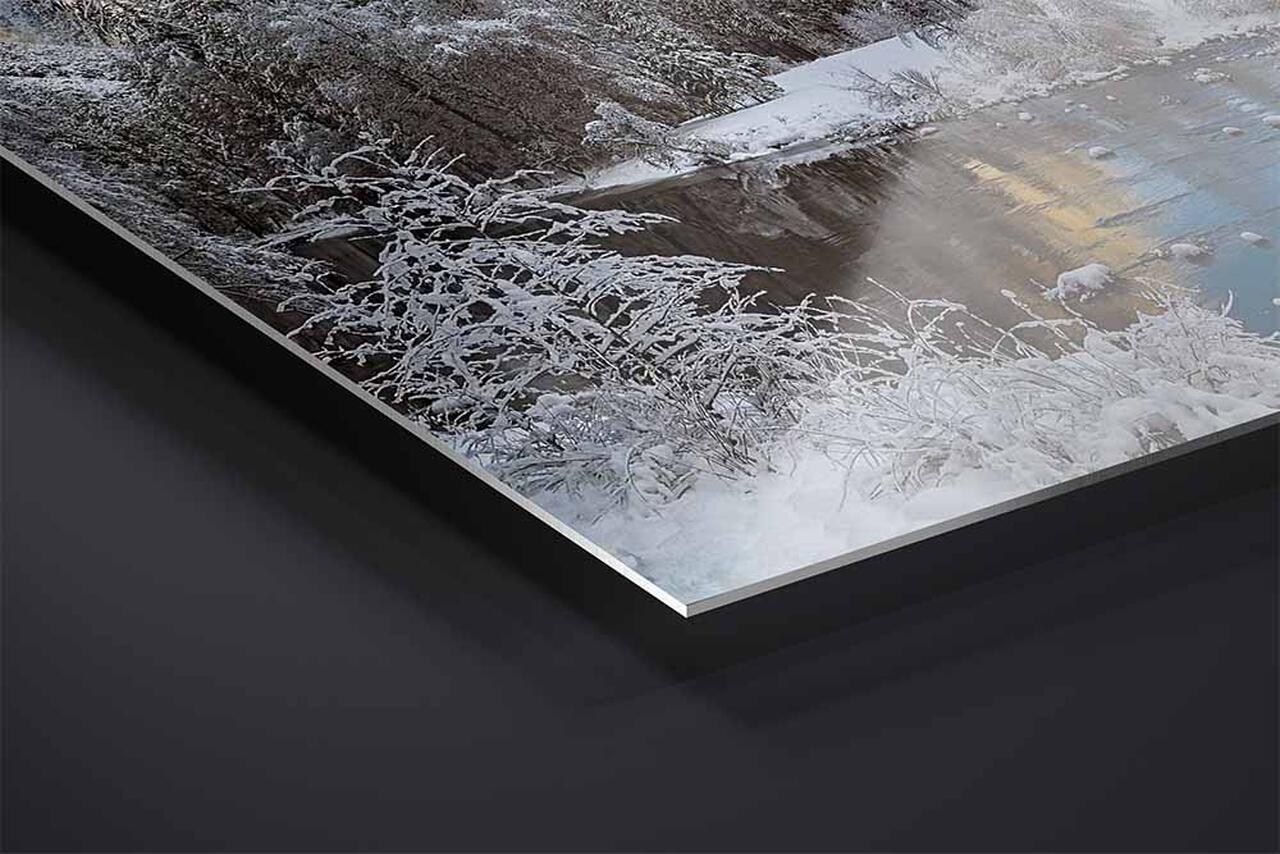
This crop is 30 percent of the frame width, about 24 inches across on the 80 inch print. The reflected gold of El Capitan reads as a defined column with the river's own surface texture running through it, and the far bank comes back inverted beside it. Out in the water each snow-capped boulder stands as a separate mound with its own shadow, and along the near branches the snow lies one limb at a time with the bark visible beneath. Click to view at full size.
About This Photograph
Valley View, at the western end of Yosemite Valley, California, with El Capitan standing to the left and Cathedral Rocks to the right, on the morning after a three-day storm. Single frame. The Merced River crosses the foreground.
Everything in this valley has frozen except the river. Moving water resists forming a surface skin, because turbulence keeps folding the chilled top layer back down into a body that is still above freezing, and a river is fed continuously from upstream and from groundwater arriving warmer than the air above it. The snow caps sitting on the boulders mark where the water has stopped reaching. Every one of those rocks was under it at a higher flow.
Winters Respite
Steve Austinhttps://www.steveaustinphotography.com/
Location
Valley View, Yosemite National Park, California, United States
Subject
El Capitan · Merced River · winter snowfall
Capture
Single frame, winter
Format
Photograph · horizontal panorama, 2:1
Sizes
40 × 20 in · 60 × 30 in · 80 × 40 in
Print Media
TruLife Acrylic · ChromaLuxe Metal · Baryta paper
Edition
Limited, 25 / 50 / 100 by presentation
What it Does in a Room
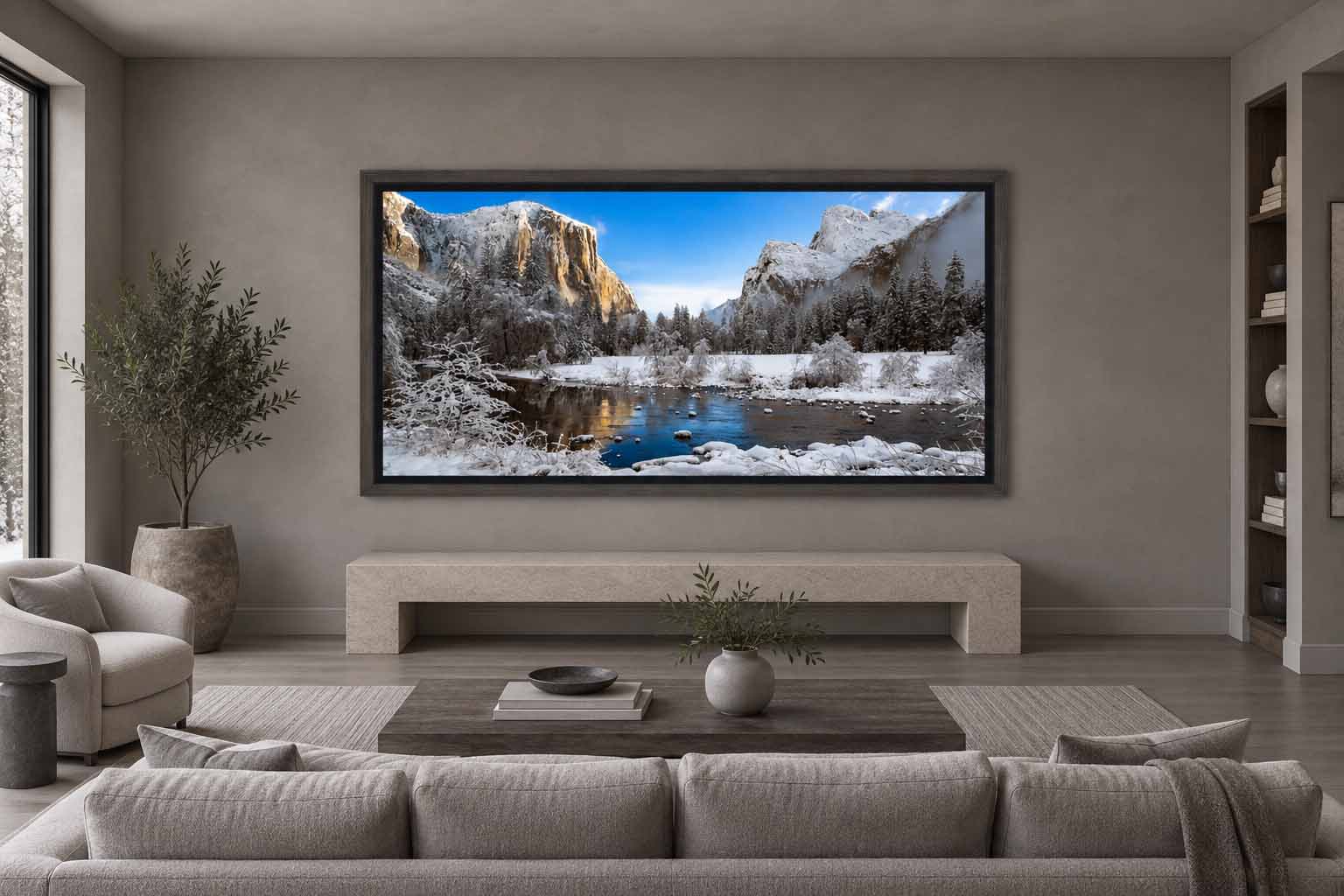
Alone among the work here, this photograph is brightest along its bottom edge. Every other picture in this collection is darker at its base than at its top, which is what a photograph of the world usually looks like, and it makes a print appear to rest on something. Here the snow in the immediate foreground is the lightest part of the whole perimeter, so the picture has no weight at the bottom and appears to float rather than sit. That changes what belongs beneath it. A dark console under this one reads as a heavy line the picture is hovering above. A pale console, a light stone bench, or nothing at all lets the base continue downward and the piece settles.
It also produces more apparent depth than a flat wall usually allows. Read in horizontal strips from top to bottom, its brightness runs bright, bright, bright, then falls sharply at the treeline, rises again across the meadow, falls again at the river, and rises to its brightest at the near bank. Five alternations, each one a plane at a different distance. The eye steps through them in order rather than sweeping across, the way it does through a picture built on a single gradient, and that stepping is what reads as recession. In a shallow room, where there is no long sightline to give the eye any real distance to work with, that effect is worth more than it would be in a large space.
And it will not change how bright the room feels. Its average tone and its middle tone sit within a point of each other, which means the picture carries as much mass above middle gray as below it, with no bias in either direction. That is rarer than it sounds. Most photographs lean light or dark and drag the apparent brightness of a wall with them, so a dark piece makes a room feel dimmer and a light one lifts it. This one does neither. It sits at the center of the scale and leaves the room's brightness exactly where it found it, which makes it the safest choice here for a space whose lighting is already settled.
Not sure which size the room calls for, or want dimensions not listed here? Sizes beyond 80 × 40 are available on request and ship crated by freight. That conversation is welcome before an order is placed. Start that conversation and I will answer within one business day.
How small is too small for a photograph this wide?
At the Intimate size the picture is forty inches across and twenty tall, and the valley holds. El Capitan holds, Cathedral Rocks holds, the river holds as a dark band, and the mass of white holds. What goes is the river. The snow caps standing on the boulders shrink to specks and stop reading as snow on rock, and with them goes the evidence that the water level has dropped since the storm. The reflected gold of El Capitan on the water narrows to a smear. The mist against the cliffs on the right flattens into the rock behind it. The Collected at sixty by thirty returns the boulder caps as caps. If you are weighing a size against a specific wall, choosing the right print size covers the measurements and the viewing distances in more detail.
What changes at the largest size?
At eighty by forty, working down and across the frame: the sunlit face of El Capitan shows its vertical fracture lines and the narrow ledges holding snow across them. On the right the mist separates from the rock behind it as a distinct layer with an edge rather than a haze. Along the far side of the meadow the treeline breaks into individual conifers standing apart from one another. In the foreground the bare branches show snow lying along their upper surfaces one limb at a time, with the bark visible underneath. Out in the river each snow-capped boulder becomes a separate mound with its own shadow on the water. And the reflection of the gold cliff face reads as a defined column of color rather than a smear, with the river's surface texture visible running through it. Why scale matters covers what happens perceptually when a photograph reaches the size where the eye has to cross it.
What kind of room does this photograph suit?
A long wall in a room that is already lit the way you want it. A living room, a dining room, a corridor, an office, a landing. Hang it at standard height with the center at about fifty-seven inches. On materials it wants cool and neutral company: pale gray plaster, limestone, concrete, blackened steel, and cool-toned upholstery all sit with it. Three things to avoid. Use neutral bulbs rather than warm ones, since a warm lamp turns the snow cream and the sunlit face of El Capitan is the only warm passage this picture is supposed to have. Keep warm timber and brass out of the immediate surround for the same reason. And do not hang it where a strong horizontal line runs near it, because the picture already contains several at different heights and a shelf or rail will read as one more. When your mind needs to rest takes the question further.
Every work ships insured and arrives with a signed certificate of authenticity.
If a piece is damaged in transit, the choice of replacement is always yours, and your edition number stays with you.
Production time runs 2 to 3 weeks for metal, 3 to 4 weeks for acrylic and paper, and 5 to 6 weeks for framed work.
Each print is made to order and takes its place in a numbered edition, so sales are final. Before you choose, I am glad to help: send a photo of your wall and I will show you this work in your room at true scale, at no charge. Start a conversation
Collector's Choice · TruLife ® Acrylic in Italian Frame
Collector Edition of 25· Lumachrome TruLife Acrylic · Handcrafted Italian Frame
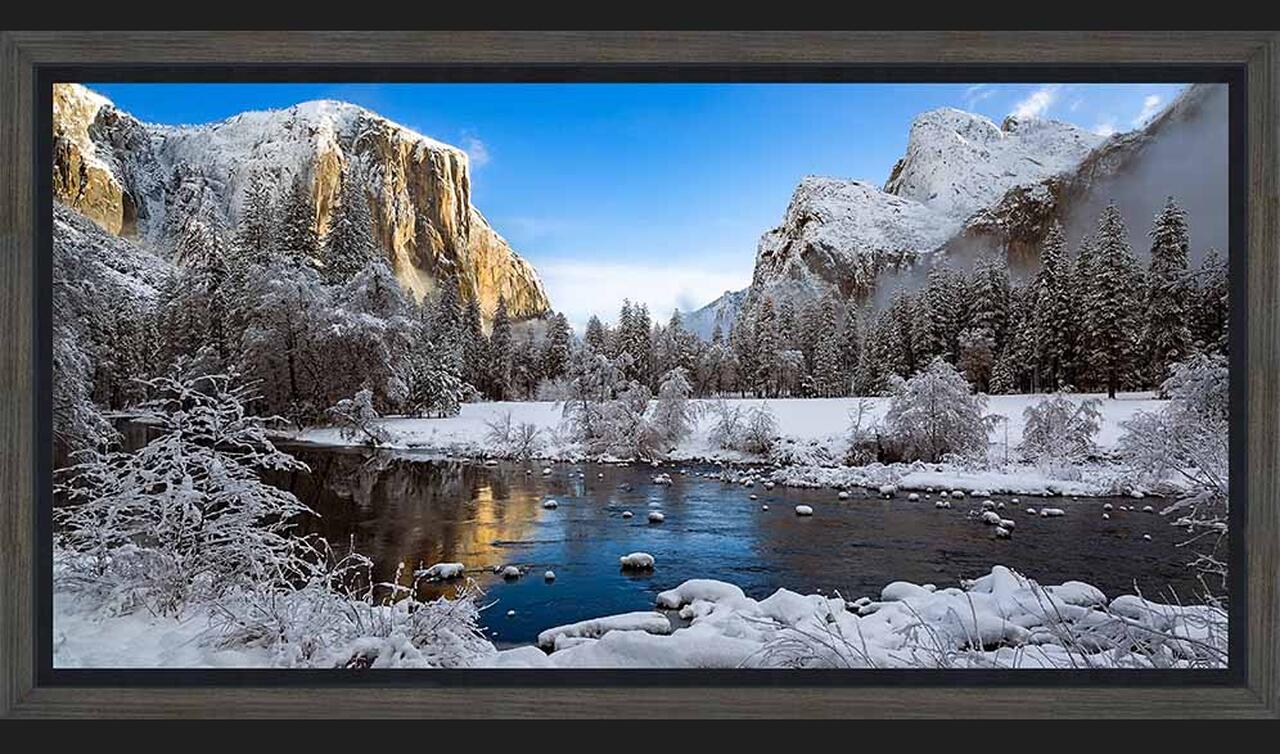
TruLife acrylic in a handcrafted Italian frame with a linen liner chosen for the image. Frame series, finish, and liner are settled with you after the order, and production begins from there. The frame and liner add about fourteen inches to the finished dimensions, worth allowing for when planning placement.
Signature Acrylic Edition of 50· Lumachrome TruLife · Gallery Float Mount
Face-mounted to TruLife acrylic and floated approximately one inch from the wall, with no frame to mediate between the image and the room. UV-resistant, anti-reflective, and scratch-resistant, with a lifetime guarantee against fading.
Signature Metal Edition of 50· ChromaLuxe Print · Gallery Float Mount
Color infused into the aluminum panel itself, floated from the wall on a concealed system. Where acrylic produces luminosity, metal produces clarity. Exceptional fade resistance with no glazing or coating required.
Fine Art Edition of 100· Hahnemühle Baryta Fine Art Paper
Printed without acrylic, so light meets the paper surface directly. Highlights stay luminous, shadows keep their nuance, and the surface has a tactile quality the other presentations approach differently. The understated choice, and the traditional one.
Complimentary shipping within the continental United States. International collector shipping available upon request.
Still deciding
Designing for Stillness
A guide to choosing art for restorative spaces
How to tell whether an image will still hold you in a year, how scale changes what a photograph does in a room, and how to match a piece to the work a room actually performs. It cites the research it draws on, and it is equally clear about where that research stops. About ten minutes to read.