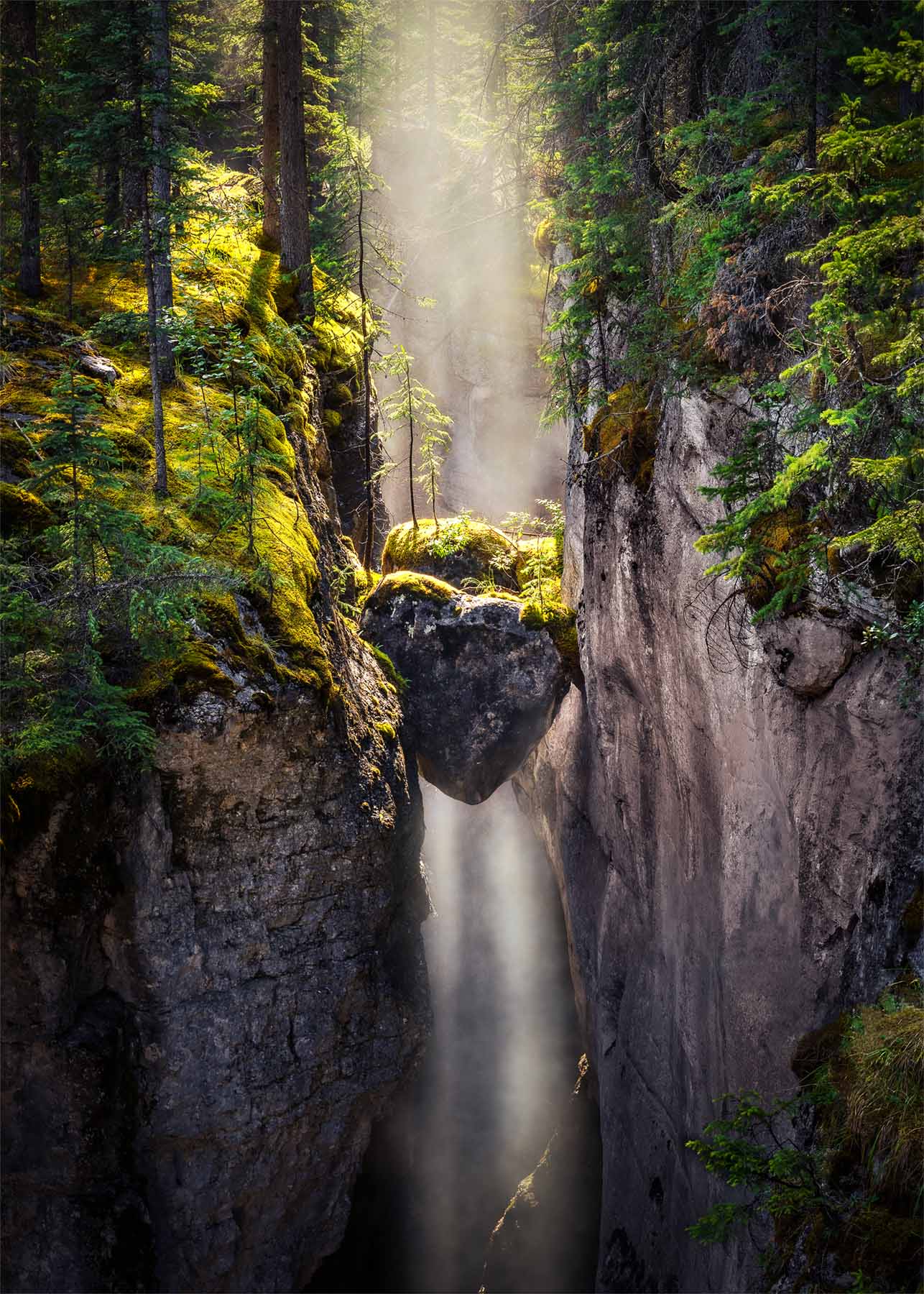
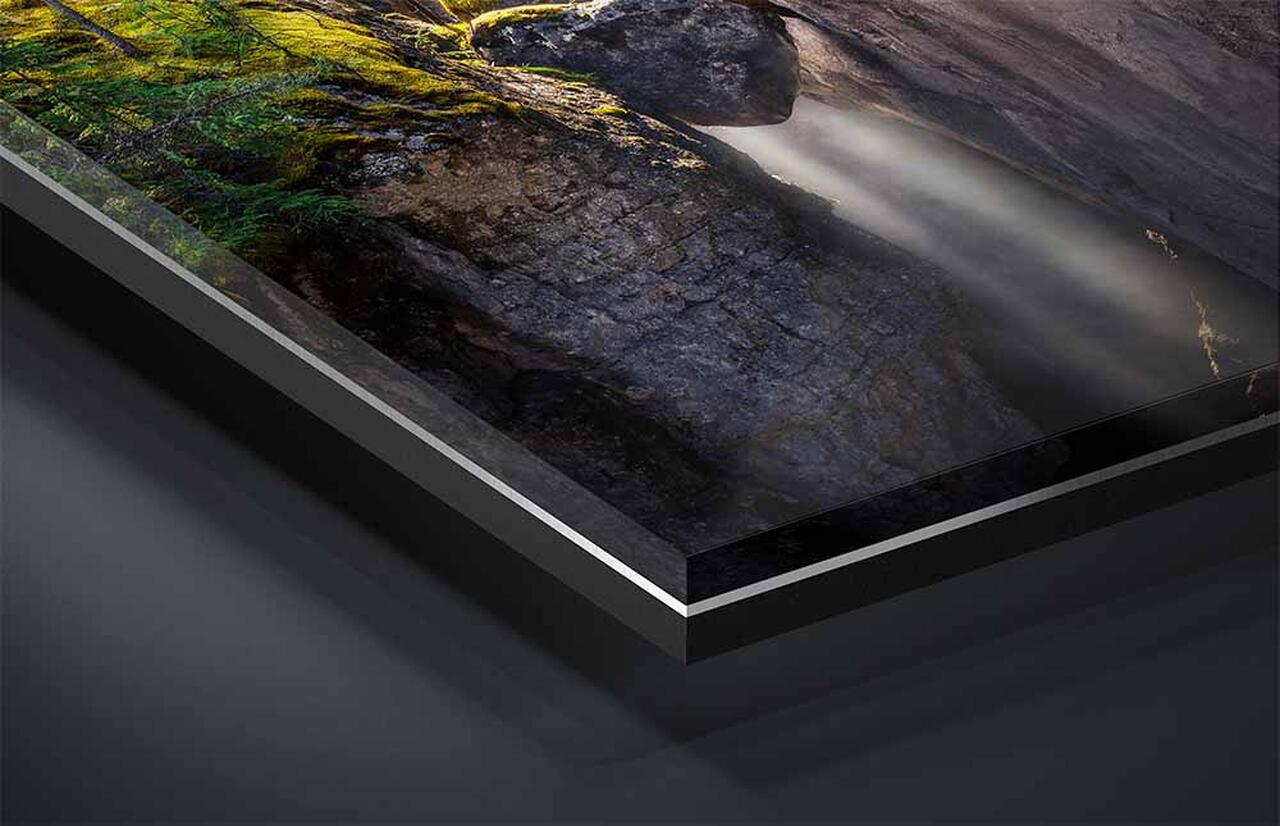
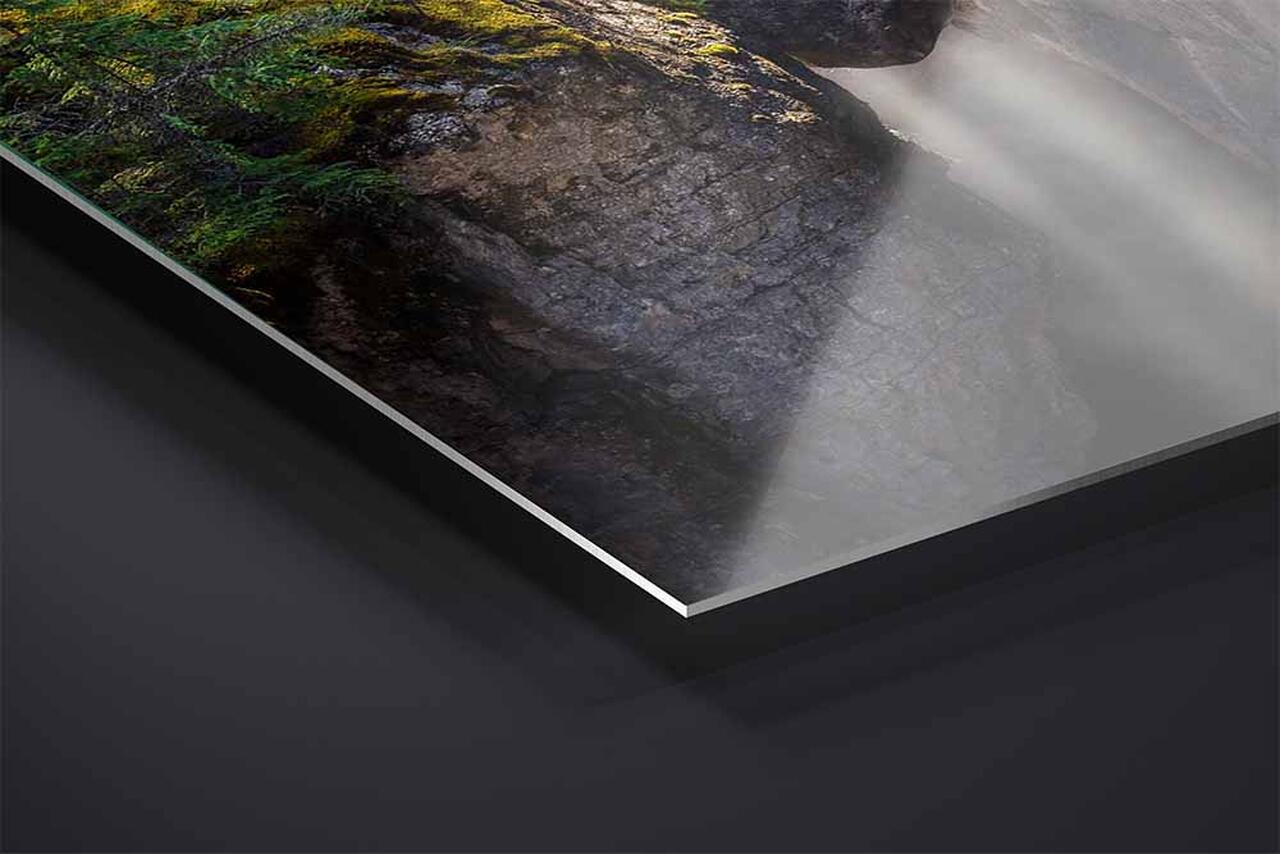
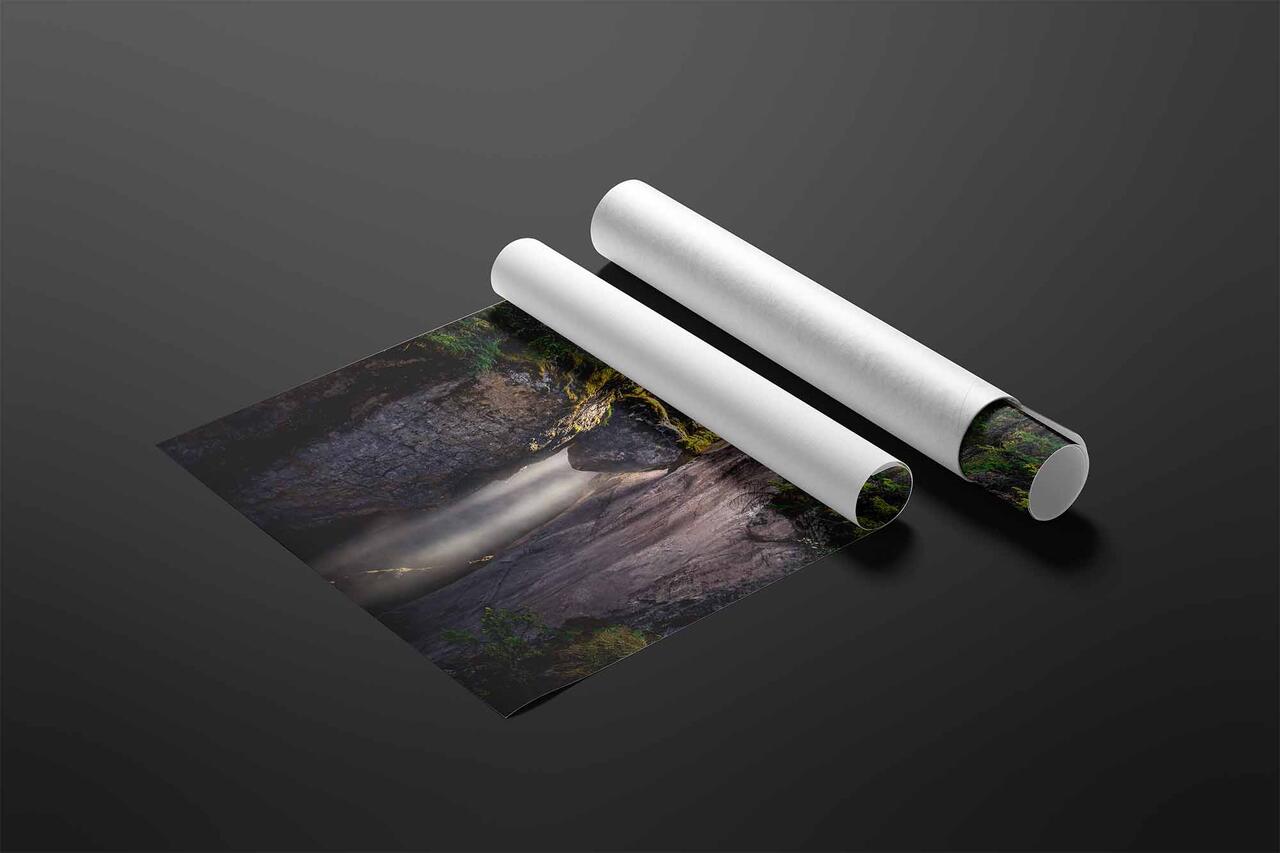
A 2:3 vertical photograph of a shaft of morning light falling into Maligne Canyon, Jasper National Park, available as a limited edition print in four sizes and four presentations.
Artist's Story
Maligne Canyon cuts down through the rock of Jasper National Park to more than fifty meters, and in places it is only about two meters across. A boulder sits wedged in the narrows overhead, dropped there and held, and the water falls past it into a dark that most of the daylight never reaches.
I first came across this place on an earlier trip, and returned the following summer for the few mornings each July when the sun clears the rim at the right angle and sends a single shaft straight down into the slot. I came back to this spot again and again across those mornings, waiting on that alignment and on the mist coming up off the water.
Most of what happens down there happens unseen. The water has been cutting that rock for far longer than anyone has been standing at the rim watching it, and it will keep cutting whether or not anyone comes. There is a specific relief in that for a mind that spends its days keeping track of things, checking, holding the thread. Here is a place that does not require your attention in order to continue. You can set that down for a while and simply look.
In July 2024 the fire came through this valley and took the forest that framed this place. The canyon is still there, older than all of it, closed now while the ground is made safe again.
Heart of the Forest is that one shaft of light reaching the bottom of a very old, very narrow place, on a morning when the forest above it was still standing.
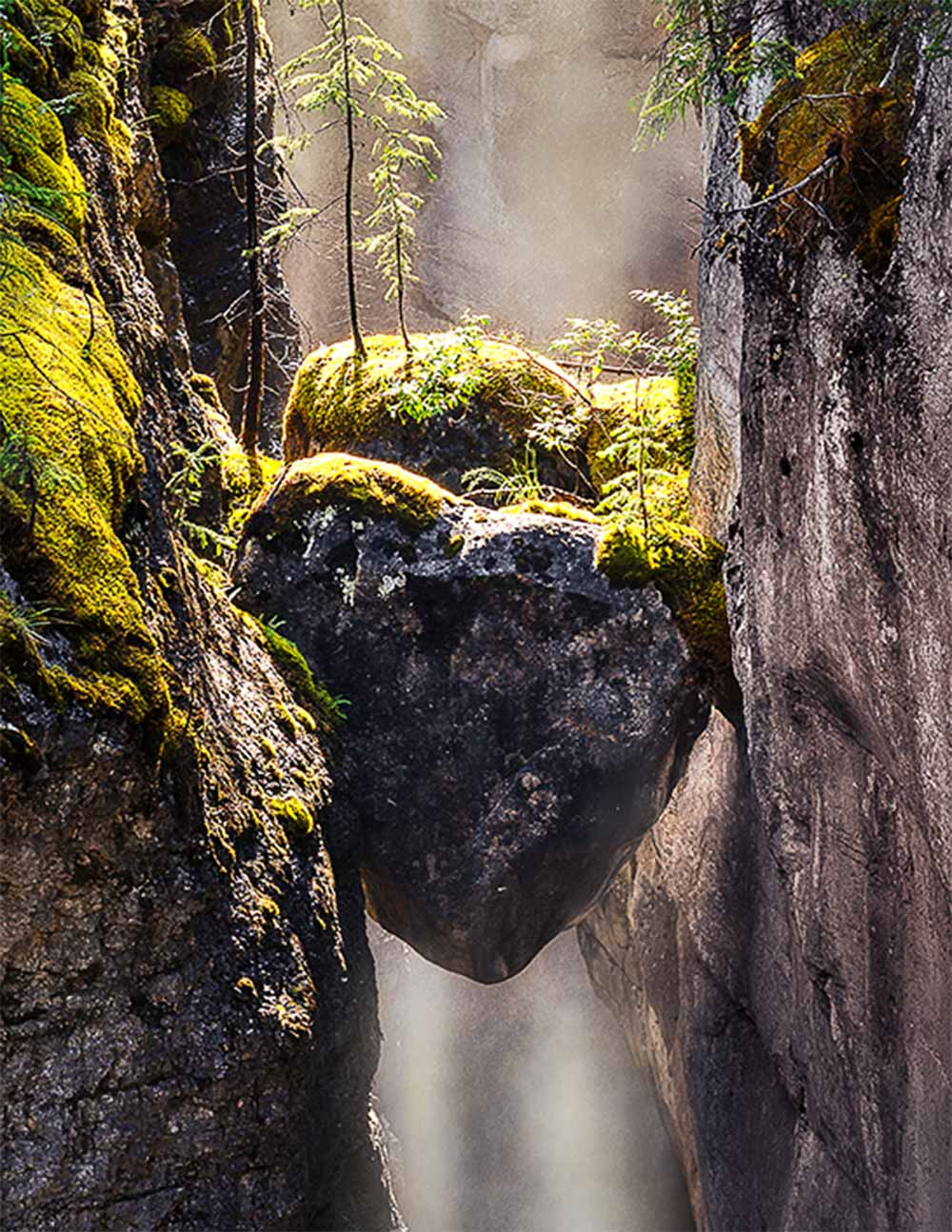
Detail at full resolution, roughly one fifth of the frame width. The boulder is wedged rather than resting, and small conifers have taken root in the moss on top of it. Click to view at full size.
About This Photograph
Maligne Canyon lies east of the Jasper townsite in Jasper National Park, Alberta. The frame looks down into the gorge from the rim, on a July morning shortly after sunrise, in a single exposure. The canyon is cut into Palliser Formation limestone, laid down on the floor of a shallow tropical sea roughly 365 million years ago by lime-secreting plankton, and worn by moving water to more than fifty meters deep and about two meters across at its narrowest.
The boulder suspended across the narrows is a chockstone, wedged between the walls as it fell rather than resting on anything below. Its form resembles two joined hearts, which is where the photograph takes its name. Below it the waterfall drops into the slot, and the mist rising off the water is what makes the shaft of light visible at all.
Heart of the Forest
Steve Austinhttps://www.steveaustinphotography.com/
Location
Maligne Canyon, Jasper National Park, Alberta
Subject
Heart-shaped chockstone · slot canyon · shaft of light
Capture
Single exposure, shortly after sunrise
Format
Photograph · vertical, 2:3
Sizes
16 × 24 in · 24 × 36 in · 32 × 48 in · 40 × 60 in
Media
TruLife Acrylic · ChromaLuxe Metal · Baryta paper
Edition
Limited, 25 / 50 / 100 by presentation
What it Does in a Room
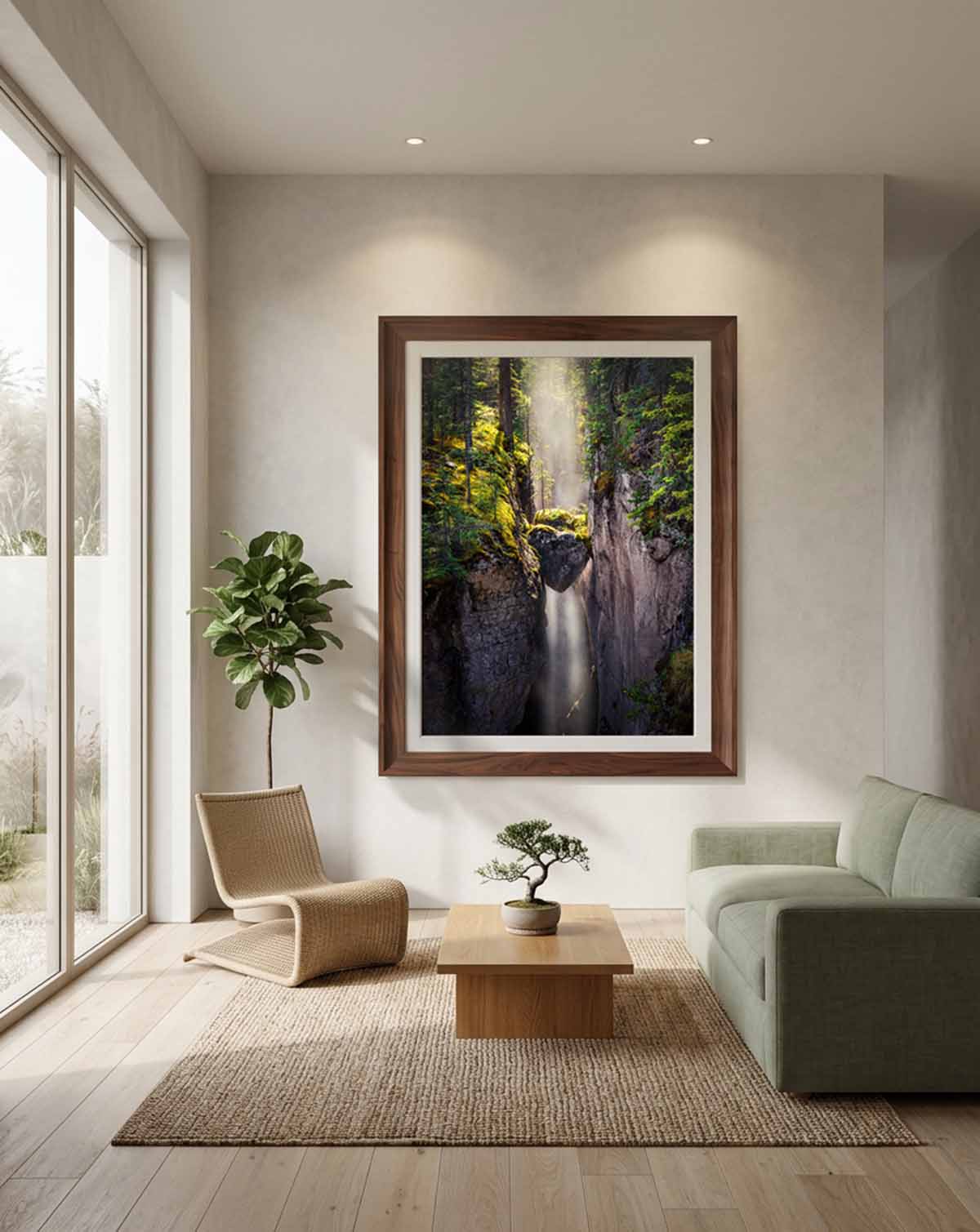
A vertical photograph does something a wide one cannot. It gives the eye somewhere to fall.
Most rooms are built on horizontals. Countertops, sofa backs, windowsills, the line where the wall meets the floor. A tall frame cuts across all of it, and that interruption is the point. At two to three the proportion is decidedly upright, taller in relation to its width than the four to five, and that changes what it does. It reads as a column rather than a panel. Where a wider vertical still holds a scene, this shape holds a descent, and it wants a wall with real height above the furniture rather than a wide run of it. A chimney breast, a stairwell, the pier between two windows, a tall entry.
Here the frame is a slot and the eye goes down it. Light enters at the top through the trees, the walls narrow, the boulder holds in the middle, and the water falls past it into a dark the picture does not resolve. There is no bottom to arrive at. That is unusual in a photograph and it is what gives this one its hold: the eye descends, finds the boulder, goes past it, and keeps going. In a room it works the way a window onto something deep works, drawing you toward it rather than sitting flat on the wall.
Not sure which size the room calls for, or want dimensions not listed here? Sizes beyond 40 × 60 are available on request and ship crated by freight. That conversation is welcome before an order is placed. Start that conversation and I will answer within one business day.
Heart of the Forest, limited edition printSteve Austin65011000USD15https://schema.org/InStock
Questions about this photograph
How small is too small for a photograph this tall?
At two to three, the Intimate size is sixteen inches across and twenty-four inches tall. That is a small piece, and it belongs where a small piece works: a narrow entry, a hallway, a spot beside a doorway, somewhere read from a few feet away rather than across a room. What it will not do is carry a wall on its own. The Collected at twenty-four by thirty-six is the first size that reads as a piece of art rather than as a framed picture. The Expansive and Statement sizes are where the frame starts to behave like an opening in the wall rather than an object on it, and at two to three that shift happens more decisively than in a squarer proportion, because the height is doing the work. If you are weighing a size against a specific wall, choosing the right print size covers the measurements and the viewing distances in more detail.
What changes at the largest size?
Depth is the answer here, and it is not only about resolution. This photograph is built on a long recession from the moss at the top of the frame down through the canyon to water that never fully resolves, and how much of that distance you can actually travel depends on size. At sixteen by twenty-four the canyon reads as a scene. You take it in at once and you are finished with it. At forty by sixty the frame is taller than your own field of view at normal viewing distance, so the eye has to move through it rather than take it in, and the descent becomes something you do instead of something you look at. The detail follows the same curve. The moss on the upper walls separates into individual clumps and the wet limestone shows its bedding. But the real change is that the picture stops being a rectangle on a wall and starts behaving like a gap in it. Why scale matters covers what happens perceptually when a landscape reaches the size where the eye has to travel across it.
What kind of room does this photograph suit?
The color here is almost entirely green, running from bright moss where the light lands to deep shadow on the canyon walls, with warm gray stone through the lower half and no other hue anywhere in the frame. That makes it easier to place than a multicolored image, since there is only one direction to work with. Warm neutrals are the natural home. Plaster, limestone, oak, walnut, linen, jute. Wood in particular picks up the warmth in the moss without competing with it.
The value structure is dark, with real weight in the rock and a bright passage only where the shaft of light enters. That gives it presence in a well-lit room and lets it hold together in a dimmer one, since the shaft functions as an internal light source. It will not brighten a room, but it will not go flat either.
The one thing it asks for is height. It is a tall frame built on a descent, and it wants a wall that lets that descent happen rather than one where the piece sits tight above furniture. A wall you can see from a seated position, from across the room, is where it does the most.
Every work ships insured and arrives with a signed certificate of authenticity.
If a piece is damaged in transit, the choice of replacement is always yours, and your edition number stays with you.
Production time runs 2 to 3 weeks for metal, 3 to 4 weeks for acrylic and paper, and 5 to 6 weeks for framed work.
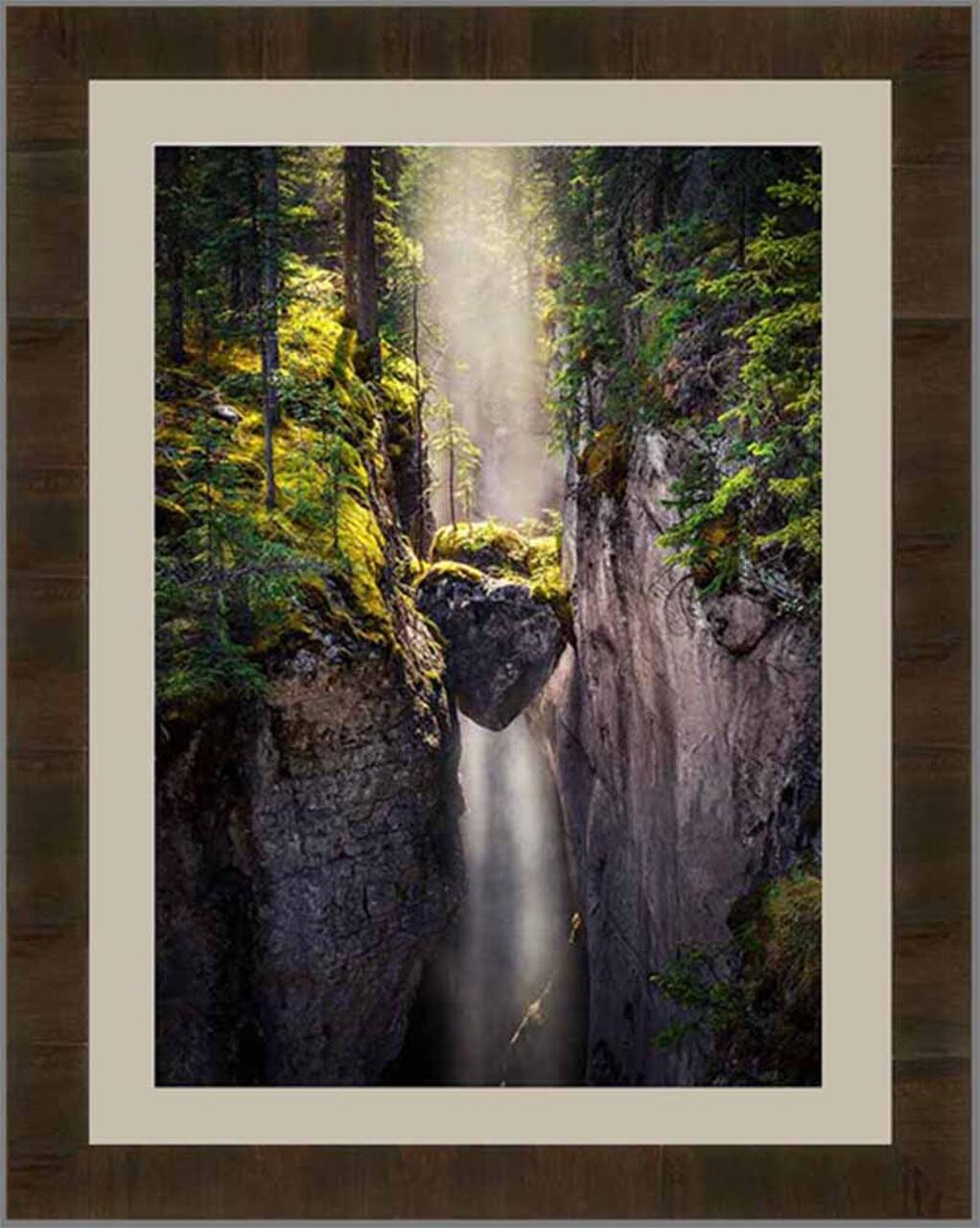
Collector's Choice · TruLife ® Acrylic in Italian Frame
Collector Edition of 25· Lumachrome TruLife Acrylic · Handcrafted Italian Frame
TruLife acrylic in a handcrafted Italian frame with a linen liner chosen for the image. Frame series, finish, and liner are settled with you after the order, and production begins from there. The frame and liner add about fourteen inches to the finished dimensions, worth allowing for when planning placement.
Signature Edition · TruLife ® Acrylic, Float Mount
Signature Edition of 50· Lumachrome TruLife Acrylic · Gallery Float Mount
Face-mounted to TruLife acrylic and floated approximately one inch from the wall, with no frame to mediate between the image and the room. UV-resistant, anti-reflective, and scratch-resistant, with a lifetime guarantee against fading.
Signature Edition of 50· ChromaLuxe Metal Print · Gallery Float Mount
Color infused into the aluminum panel itself, floated from the wall on a concealed system. Where acrylic produces luminosity, metal produces clarity. Exceptional fade resistance with no glazing or coating required.
Fine Art Edition of 100· Hahnemühle Baryta Fine Art Paper
Printed without acrylic, so light meets the paper surface directly. Highlights stay luminous, shadows keep their nuance, and the surface has a tactile quality the other presentations approach differently. The understated choice, and the traditional one.
Complimentary shipping within the continental United States. International collector shipping available upon request.
Still deciding
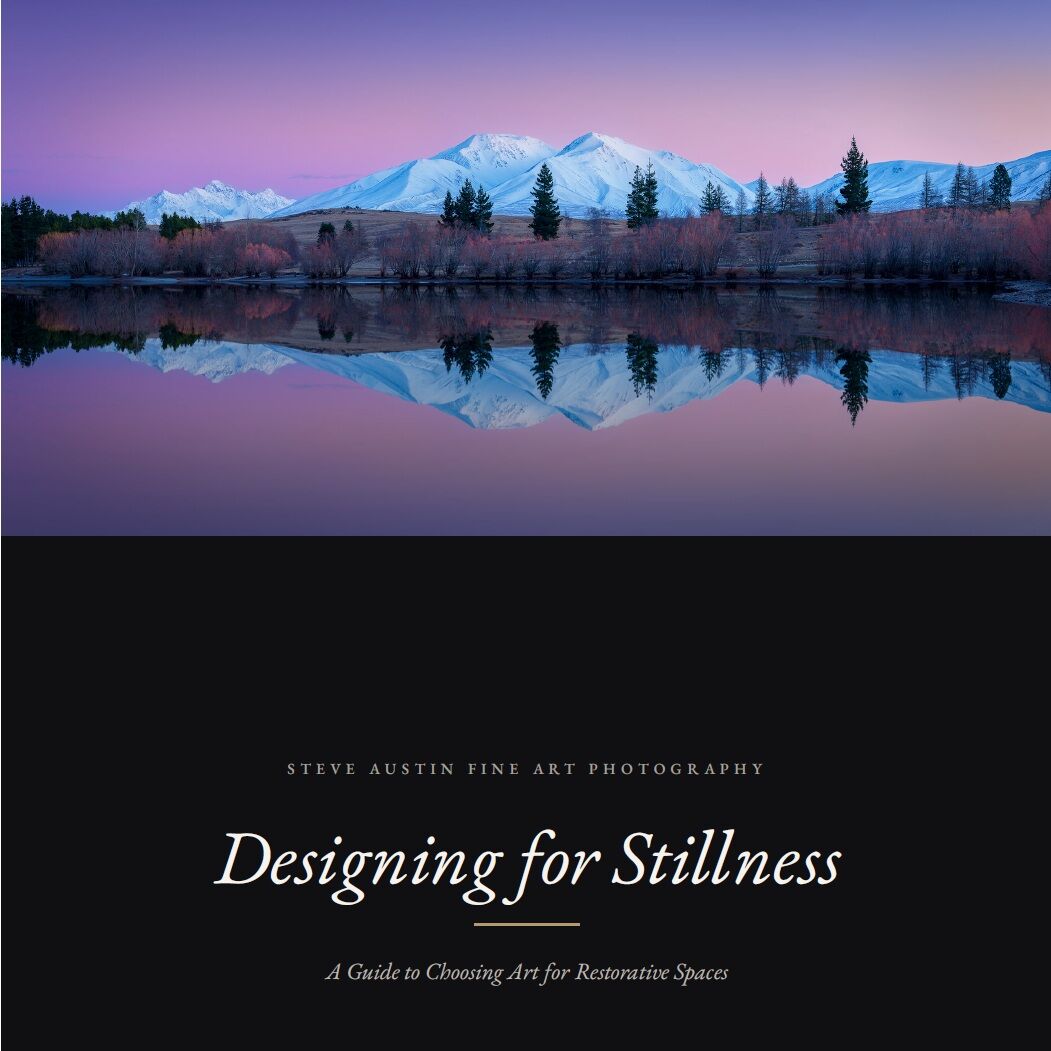
Designing for Stillness
A guide to choosing art for restorative spaces
How to tell whether an image will still hold you in a year, how scale changes what a photograph does in a room, and how to match a piece to the work a room actually performs. It cites the research it draws on, and it is equally clear about where that research stops. About ten minutes to read.