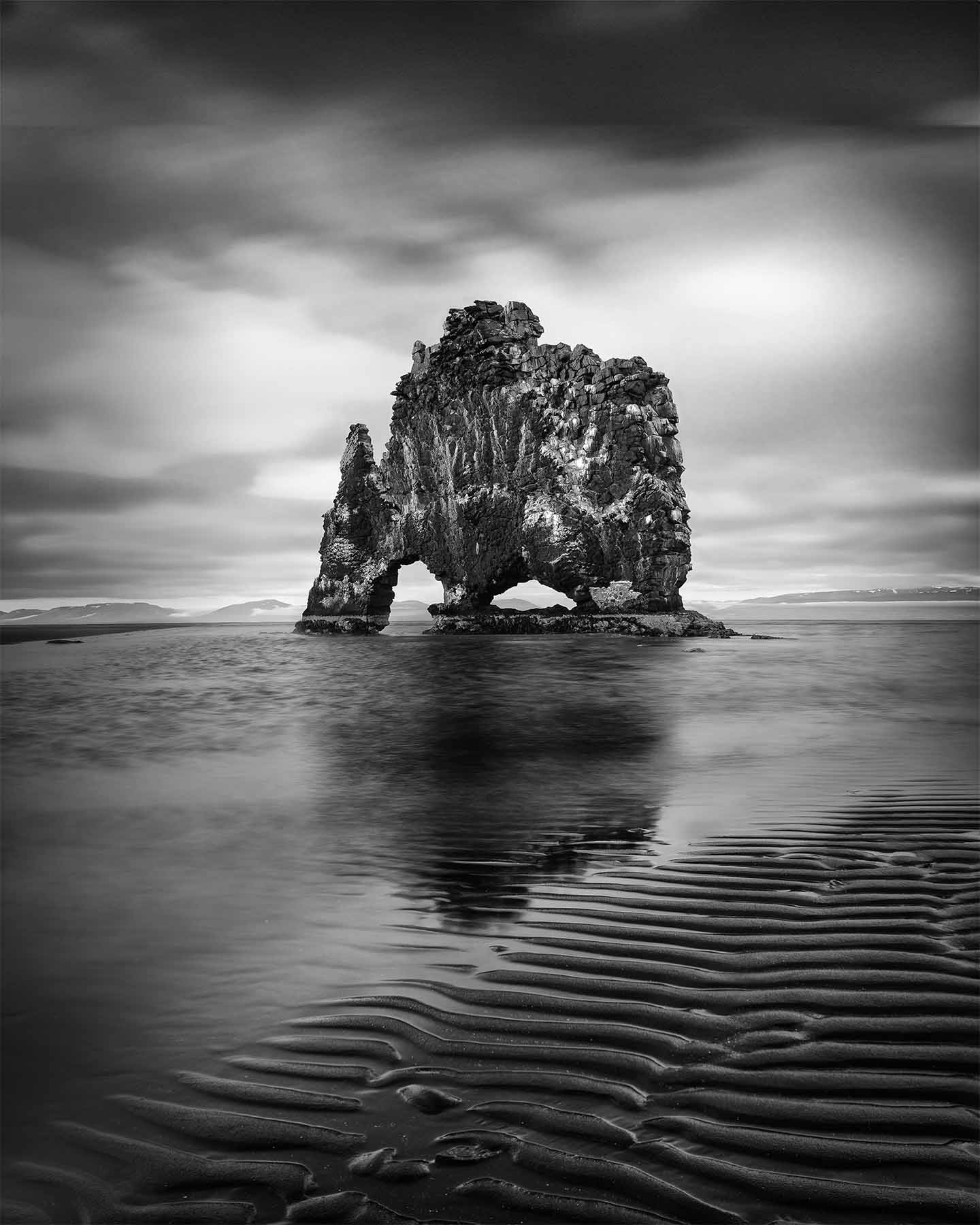
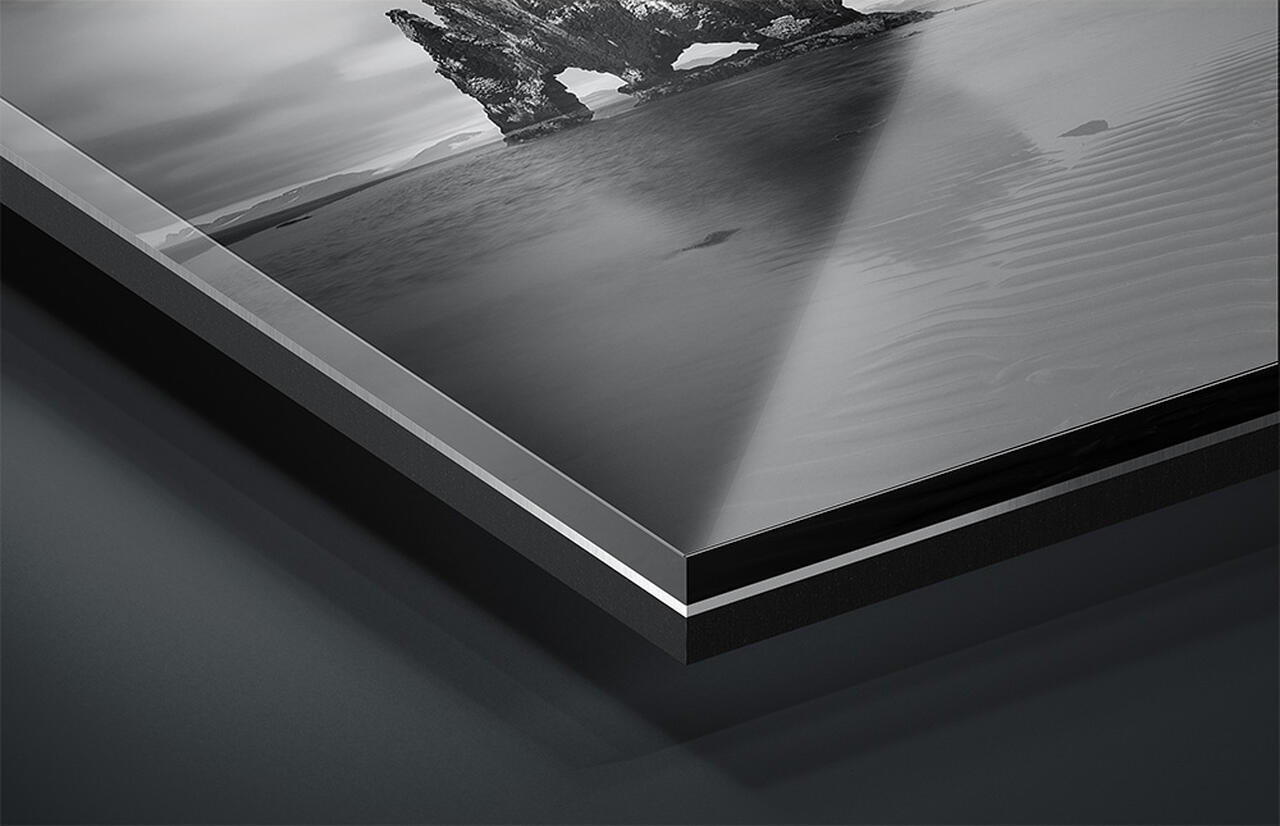
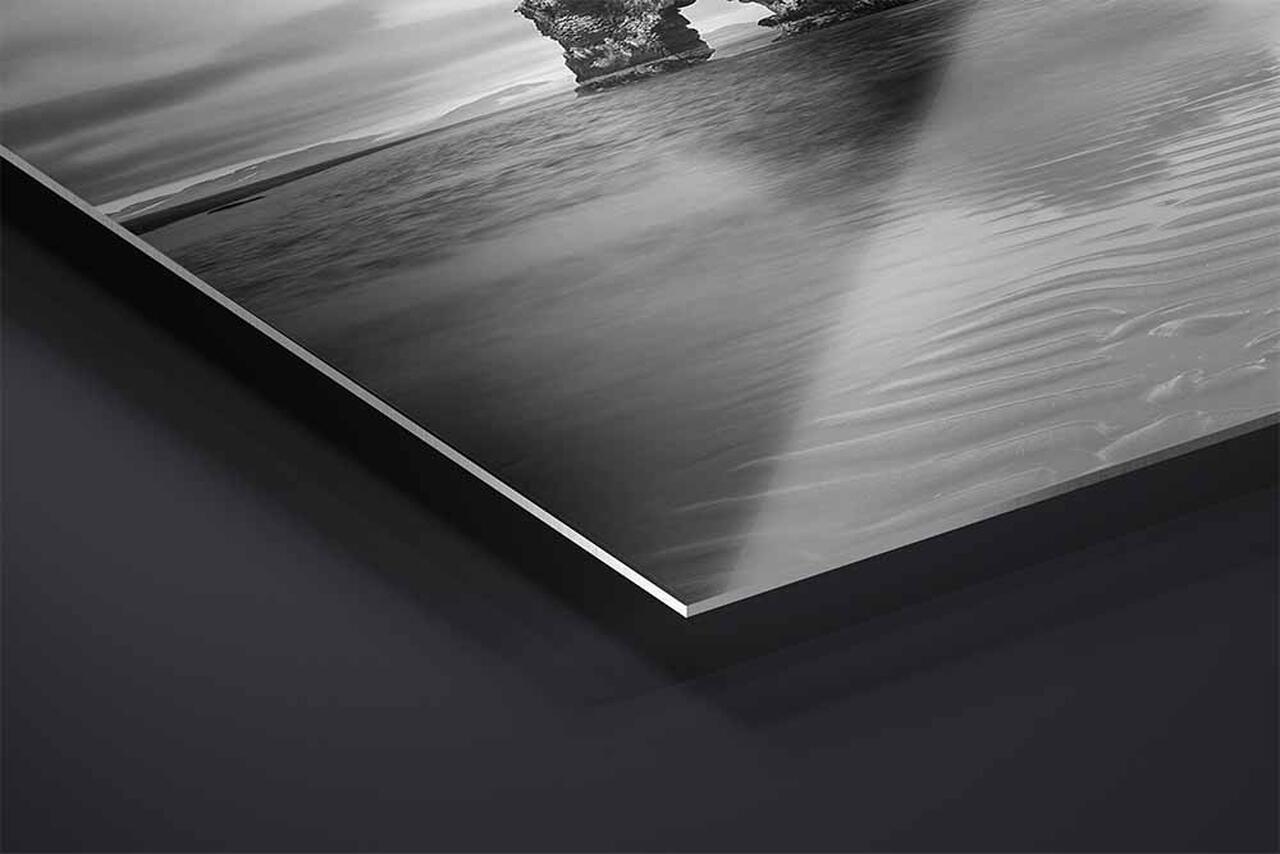
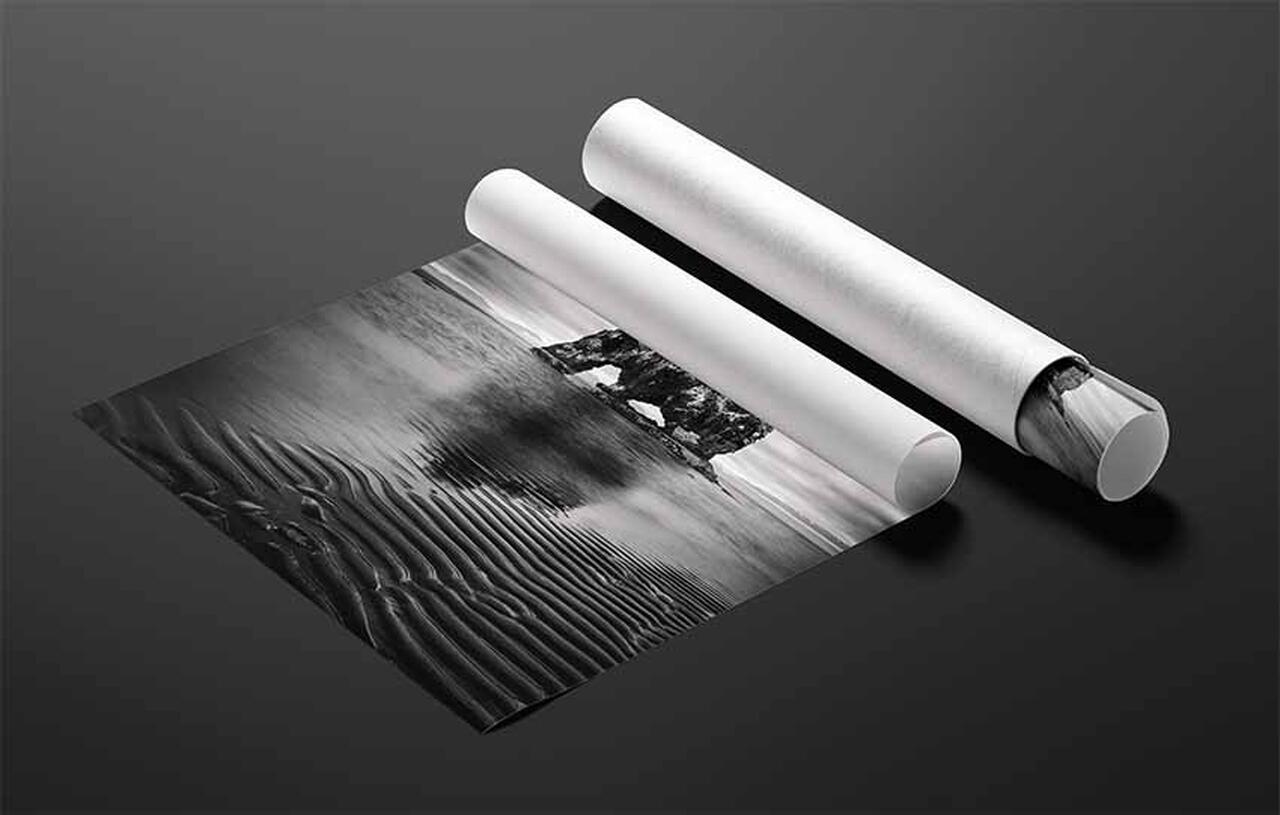
A 4:5 vertical photograph of the Hvítserkur sea stack at low tide in black and white, Vatnsnes peninsula, northwest Iceland, available as a limited edition print in four sizes.
Artist's Story
Hvítserkur stands about fifty meters off the eastern shore of the Vatnsnes peninsula in northwest Iceland, fifteen meters of basalt left behind when the sea took away everything around it. It is an eroded volcanic dyke, and the holes worn through its base are why people see an elephant, or a rhino, or a dragon bending to drink. The name is more prosaic. Hvítserkur means white shirt, for the guano of the gulls and fulmars that nest on top of it.
I had wanted to photograph it for years. I found it first from the cliff above, then climbed down and worked from the sand as the tide went out.
Here is the part I learned later. In the 1950s the people who live here grew worried it would fall, and reinforced its base with concrete. It has been standing partly on that ever since.
I find I do not mind knowing. A rock like this reads as self-sufficient, standing whether or not anyone came, asking nothing of anybody. This one is a slight exception. It is here because the sea has not finished with it, and because a few farmers seventy years ago decided it was worth keeping.
Lone Guardian is that rock at low tide, holding its position with rather more help than it appears to need.
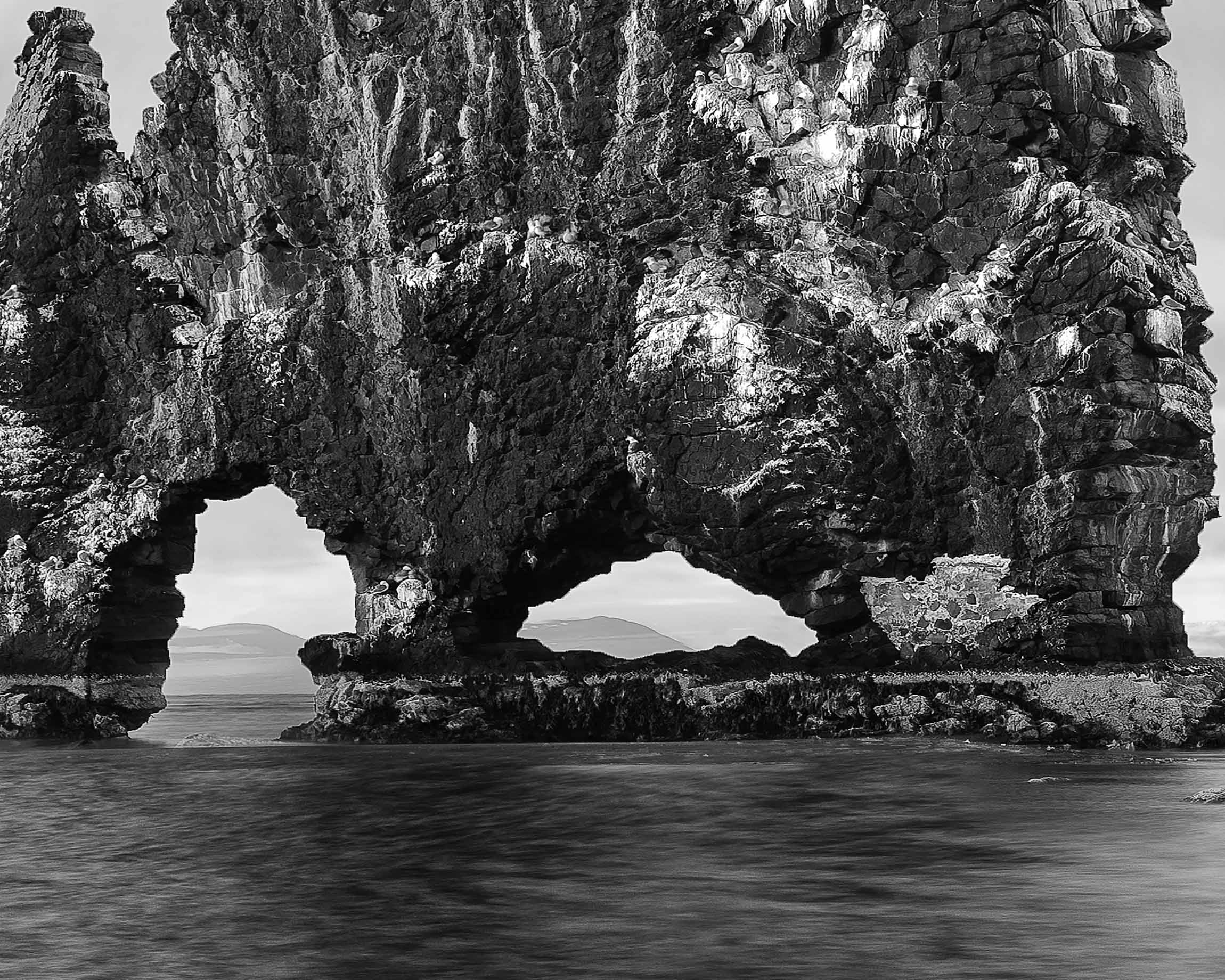
This crop is 50 percent of the frame width, about 20 inches across on the 40 inch print. Both openings carry their own interior shading, and the far shore shows through them as a band of light with a distant ridge behind the right-hand arch. Birds are visible in the fissures across the upper rock, with the pale streaking running down from where they sit. To the right of the second arch, the patch of blocky mortared stone is the concrete the farmers set into the base in the 1950s. Click to view at full size.
About This Photograph
Hvítserkur, on the eastern shore of the Vatnsnes peninsula in Húnaflói bay, northwest Iceland, at low tide under overcast sky. Single frame, rendered in black and white. Local tradition holds the stack to be a troll caught by the rising sun while trying to bring down the bells of the monastery at Þingeyrar.
A sea stack is a stage rather than a permanent form. Waves cut caves into a headland from both sides, the caves meet and become an arch, the arch roof falls, and what stands alone is the hardest rock in the original mass. Hvítserkur is paused partway through, with two openings punched through the base and the basalt above them still carrying the weight.
Measured across the frame, saturation is zero at every pixel and the three color channels agree to the decimal, making this a true monochrome rather than a toned conversion. Tones run from twelve to two hundred and forty-six.
Lone Guardian
Steve Austinhttps://www.steveaustinphotography.com/
Location
Hvítserkur, Vatnsnes Peninsula, Iceland
Subject
Hvítserkur sea stack · basalt arch · low tide
Capture
Single frame, low tide
Format
Photograph · vertical, 4:5
Sizes
16 × 20 in · 24 × 30 in · 32 × 40 in · 40 × 50 in
Print Media
TruLife Acrylic · ChromaLuxe Metal · Baryta paper
Edition
Limited, 25 / 50 / 100 by presentation
What it Does in a Room
This is the only photograph in the collection with no color at all. Saturation measures zero at every pixel and the three channels agree to the decimal, and that has a consequence most black and white prints do not have. An image carrying its own color defends itself against a room. This one has nothing to defend with, so it borrows. Hang it beside warm oak and the grays turn faintly blue. Hang it beside cool gray stone and the same grays warm up. The effect is real and it is not in the print. It is the eye compensating for the color it can see nearby and pushing the neutral the other way. Choose what goes next to it deliberately, because whatever you choose will tint it.
It also has the widest tonal range here, which makes it the piece that reports on a room's light. Tones run from twelve to two hundred and forty-six, with a small amount of true black in the sand and true white in the break of cloud, and the spread between them is half again what most of this collection carries. A picture with references at both ends will show you when the light is poor. Under a dim or badly placed lamp the whites gray down and the blacks lift toward the middle, and because you can see where they should be, you can see them fail. A mid-range image cannot tell you that, because it has no reference to lose.
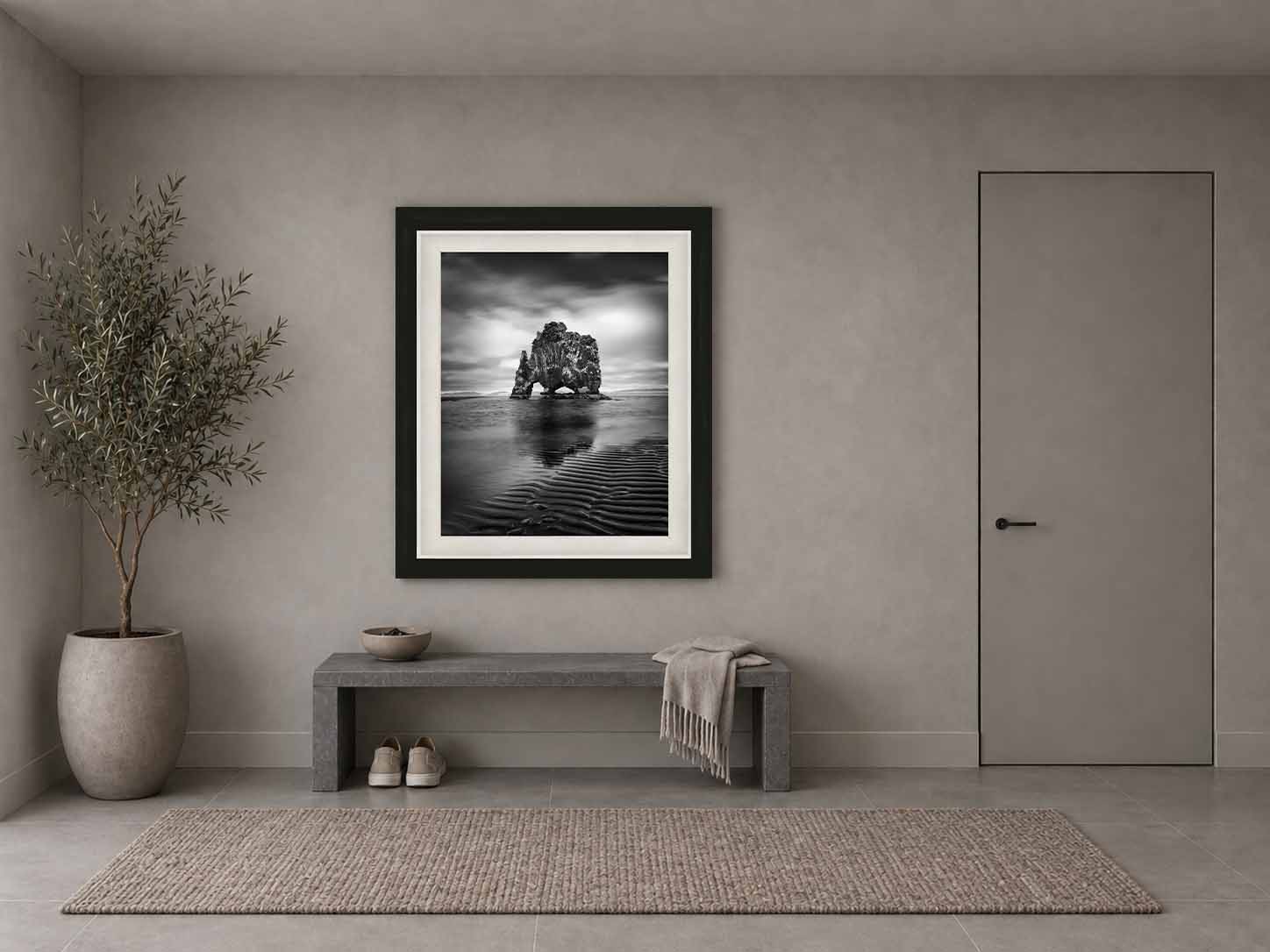
Being vertical changes the arithmetic of choosing a size. On a horizontal print the limit is usually the width of the wall, and most walls have more width available than people expect. Here the limit is height, and there is far less of it. At the Statement size this print stands fifty inches tall, and it needs that fifty inches clear between whatever sits below it and whatever line runs above. Above a thirty inch console in a room with a nine foot ceiling, that is most of the wall gone. Measure the vertical run before the horizontal one on this photograph, and expect the answer to push you a size down from where you would land with a panorama.
Not sure which size the room calls for, or want dimensions not listed here? Sizes beyond 40 × 50 are available on request and ship crated by freight. That conversation is welcome before an order is placed. Start that conversation and I will answer within one business day.
How small is too small for a photograph like this?
At the Intimate size the picture is sixteen inches across and twenty tall, and the shape survives, because the whole subject is one dark mass against a bright sky. The two arches stay open at this size, which matters, since they are what makes the rock read as an animal rather than as a lump. What goes is everything the eye would want to walk into. The sand ripples across the bottom third collapse into a soft gradient with no crests in them, and that lower third is nearly half the picture. The pale streaking on the rock face merges into the wet basalt around it. The snow-topped mountains along the far horizon disappear. The Collected at twenty-four by thirty brings the ripples back as ripples. The Expansive at thirty-two by forty is where the rock face starts reading as fractured blocks rather than as texture. If you are weighing a size against a specific wall, choosing the right print size covers the measurements and the viewing distances in more detail.
What changes at the largest size?
At forty by fifty, working down the frame: the cloud separates into distinct streaked bands with soft edges rather than reading as one moving mass, and the bright break at upper right holds its shape against the darker cloud around it. The summit of the stack resolves into individual fractured blocks with shadow between them, so the top reads as broken rock rather than as a jagged outline. The pale guano streaking separates cleanly from the wet basalt beneath it and follows the vertical fissures down the face. Through both arches the far shore becomes visible as a distinct band of light, and the inner surfaces of the openings pick up their own shading. Along the horizon the distant mountains separate into individual snow-topped ridges. In the foreground the sand ripples resolve into separate crests with grain texture visible along their tops. Why scale matters covers what happens perceptually when a photograph reaches the size where the eye has to cross it.
What kind of room does this photograph suit?
Tall wall, narrow wall. The places a vertical belongs and a panorama cannot go: a pier between two windows, an entry, a stair wall, the end of a hallway, a chimney breast. Hang it lower than feels natural, with the center at about fifty-four inches, because the rock sits in the upper half of the frame and hanging to the frame's center puts the subject above sightline. On materials it will live with almost any palette, since it has no hue of its own to clash with anything. Three things to avoid. Do not put tall furniture beneath it, because the vertical run is the scarce dimension here and a bookcase or a highboy takes it. Do not hang it in a row with horizontal pieces, since a vertical in a line of landscapes reads as an error rather than a choice. And keep it off a patterned or heavily textured wall, because the sand across the lower third is already a fine repeating pattern and a textured surface will double it. When your mind needs to rest takes the question further.
Every work ships insured and arrives with a signed certificate of authenticity.
If a piece is damaged in transit, the choice of replacement is always yours, and your edition number stays with you.
Production time runs 2 to 3 weeks for metal, 3 to 4 weeks for acrylic and paper, and 5 to 6 weeks for framed work.
Each print is made to order and takes its place in a numbered edition, so sales are final. Before you choose, I am glad to help: send a photo of your wall and I will show you this work in your room at true scale, at no charge. Start a conversation
Collector's Choice · TruLife ® Acrylic in Italian Frame
Collector Edition of 25· Lumachrome TruLife Acrylic · Handcrafted Italian Frame
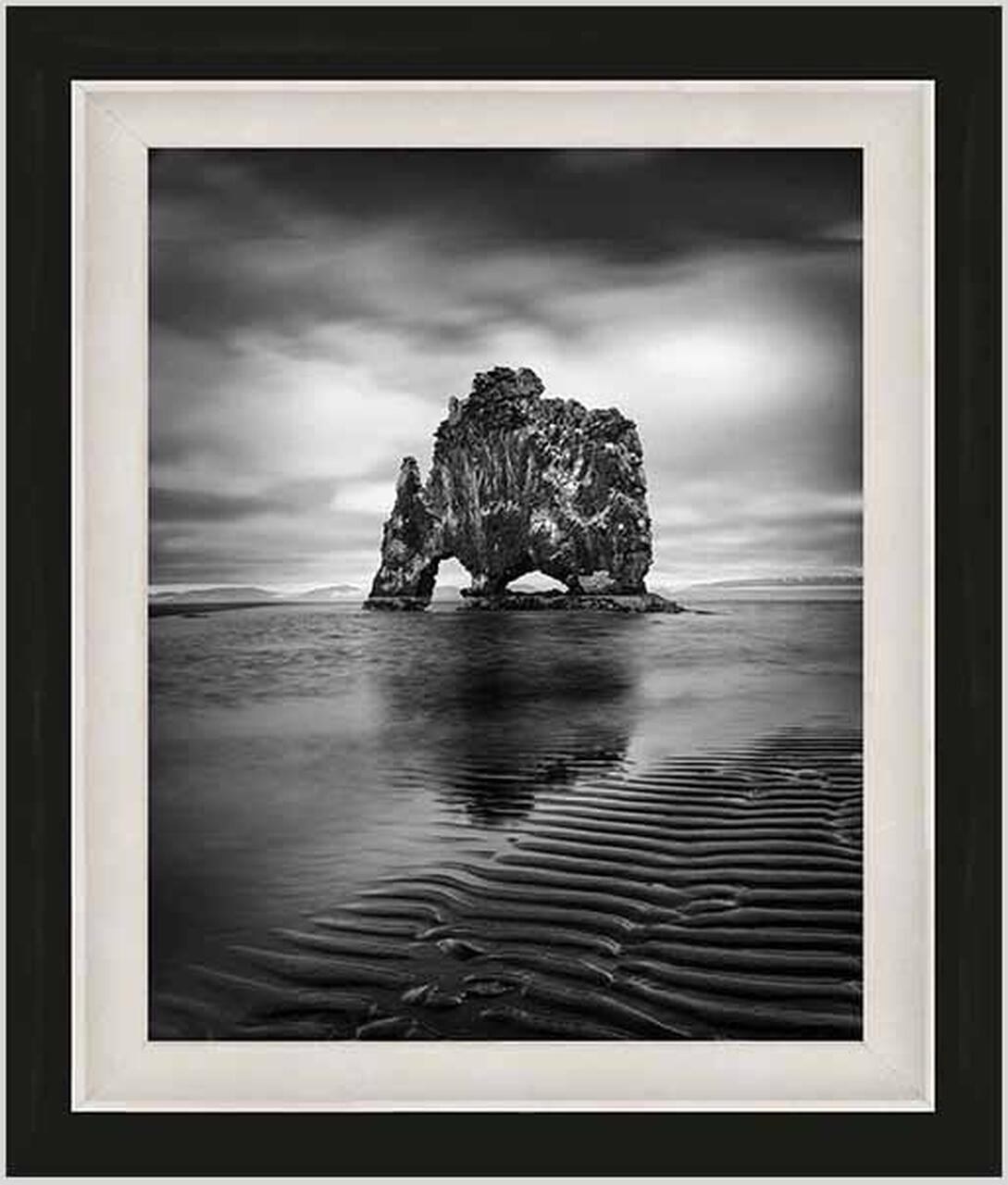
TruLife acrylic in a handcrafted Italian frame with a linen liner chosen for the image. Frame series, finish, and liner are settled with you after the order, and production begins from there. The frame and liner add about fourteen inches to the finished dimensions, worth allowing for when planning placement.
Signature Acrylic Edition of 50· Lumachrome TruLife · Gallery Float Mount
Face-mounted to TruLife acrylic and floated approximately one inch from the wall, with no frame to mediate between the image and the room. UV-resistant, anti-reflective, and scratch-resistant, with a lifetime guarantee against fading.
Signature Metal Edition of 50· ChromaLuxe Print · Gallery Float Mount
Color infused into the aluminum panel itself, floated from the wall on a concealed system. Where acrylic produces luminosity, metal produces clarity. Exceptional fade resistance with no glazing or coating required.
Fine Art Edition of 100· Hahnemühle Baryta Fine Art Paper
Printed without acrylic, so light meets the paper surface directly. Highlights stay luminous, shadows keep their nuance, and the surface has a tactile quality the other presentations approach differently. The understated choice, and the traditional one.
Complimentary shipping within the continental United States. International collector shipping available upon request.
Still deciding
Designing for Stillness
A guide to choosing art for restorative spaces
How to tell whether an image will still hold you in a year, how scale changes what a photograph does in a room, and how to match a piece to the work a room actually performs. It cites the research it draws on, and it is equally clear about where that research stops. About ten minutes to read.