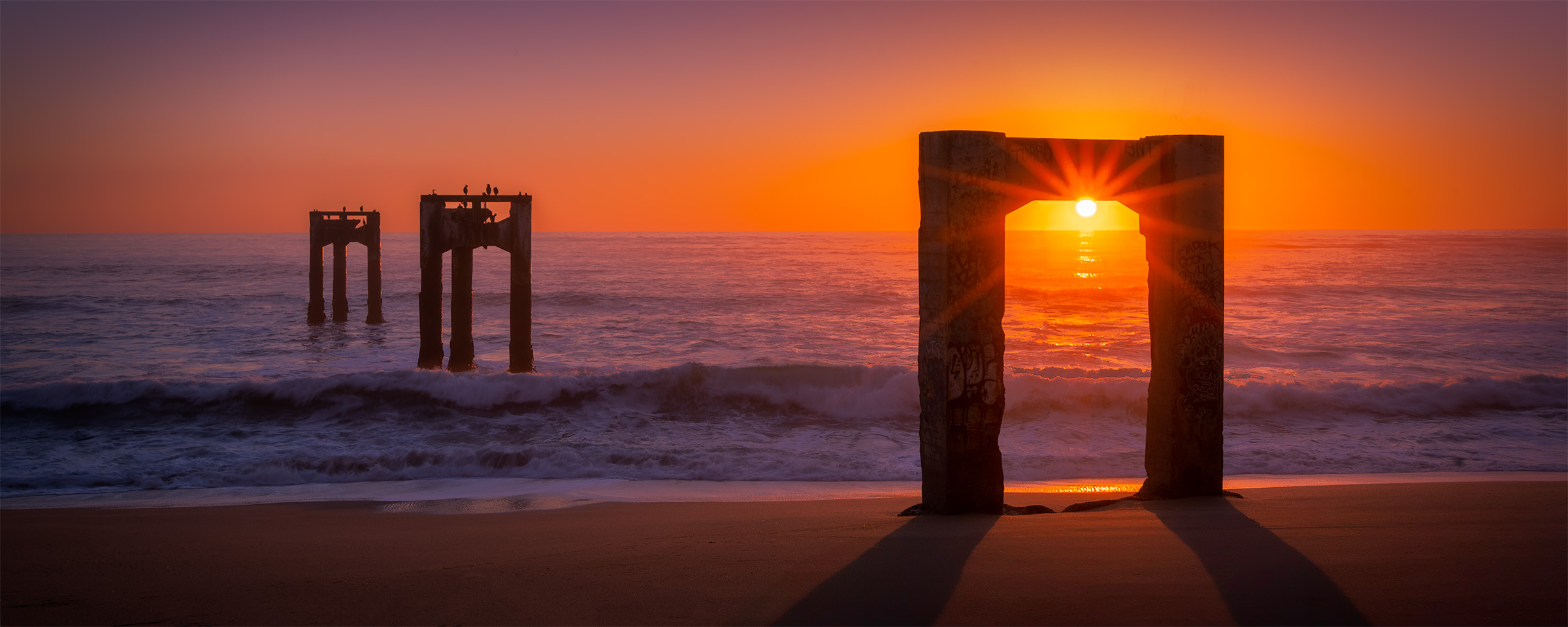
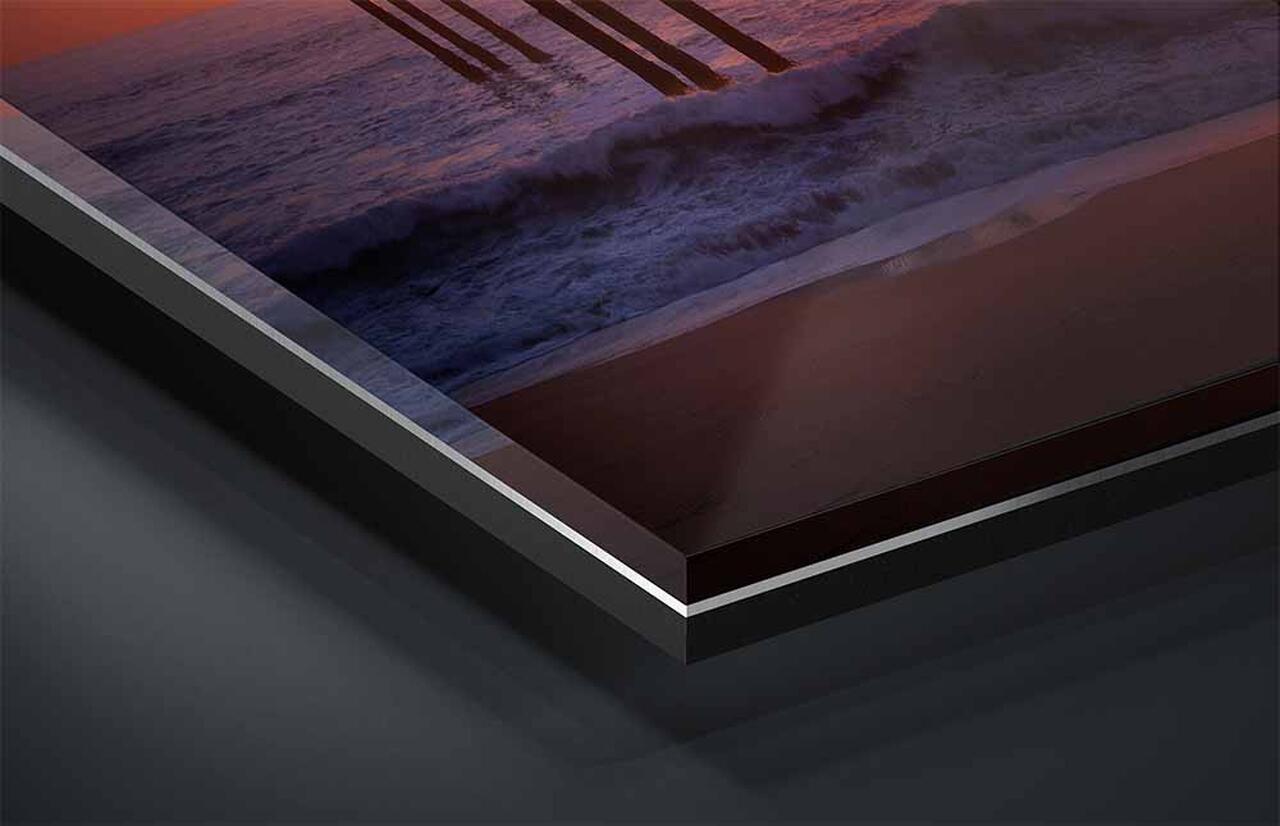
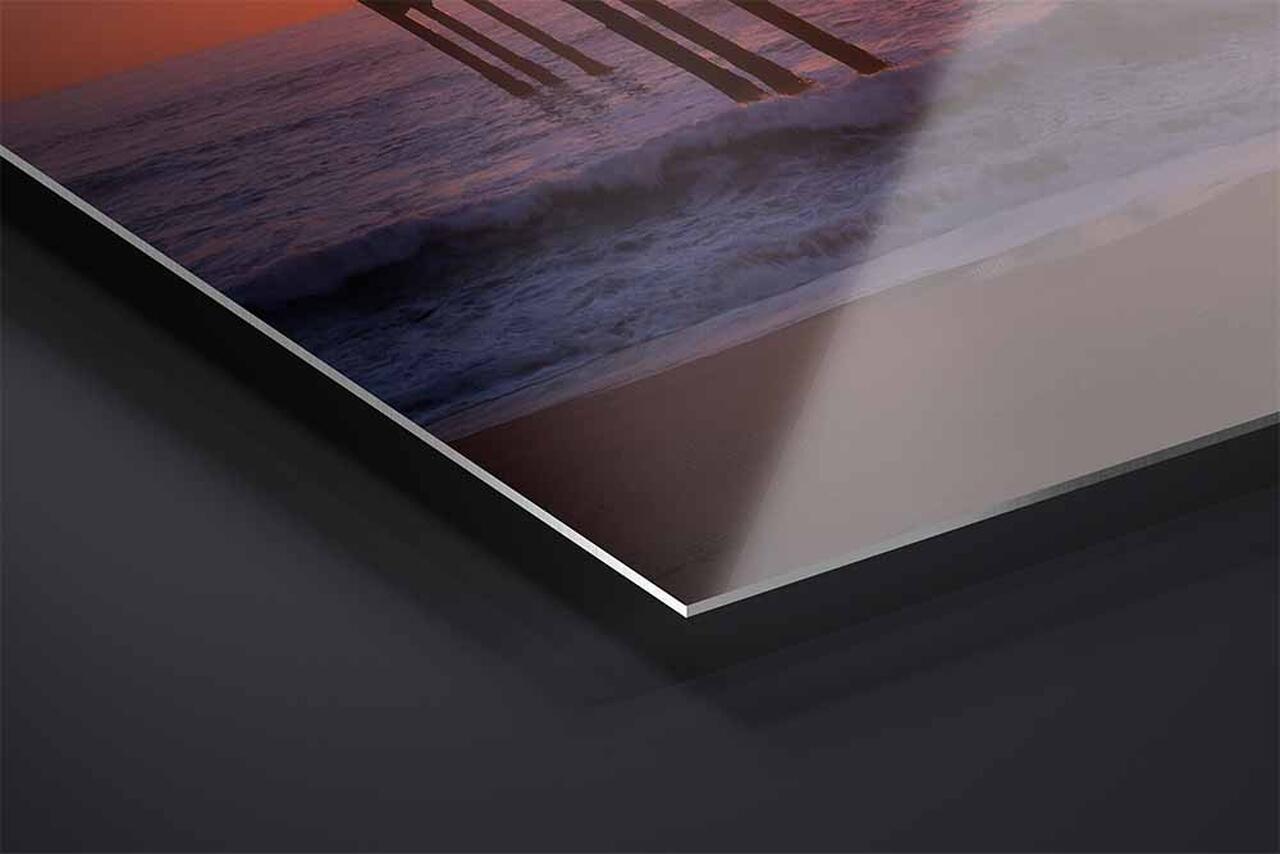
A 5:2 panoramic photograph of the Davenport Pier concrete ruins at sunset, Santa Cruz County, California, United States, available as a limited edition print in three sizes.
Artist's Story
I came down the cliff to the beach at Davenport in the evening and set up where the sun would drop through the gap in the near structure. It was the only place on that beach where the two lined up.
The pier here was built in 1934 by the Santa Cruz Portland Cement Company and ran two thousand three hundred and twenty-seven feet out into the Pacific. Its job was loading cement onto ships. The plant behind it made the material that rebuilt San Francisco after the 1906 earthquake, and later supplied the Golden Gate Bridge and the O'Shaughnessy Dam. The plant shut down in 2010.
What is left is concrete, and concrete in seawater fails from the inside. Seawater carries chloride ions, which work through the concrete until they reach the steel reinforcement running inside it. Chloride strips away the thin oxide film that normally keeps that steel from corroding, and once the film is gone the steel begins to rust. Rust occupies several times the volume of the metal it came from, so the reinforcement swells inside a material that cannot stretch, and the concrete splits outward along the line of its own skeleton. The surf then takes what has already been opened.
I went back to this beach in the summer. The furthest of the three, the small one standing out past the others on the left of this frame, is not there any more.
Phantom Wharf is a pier built to ship the material it was made of, coming apart in the water it was built into.
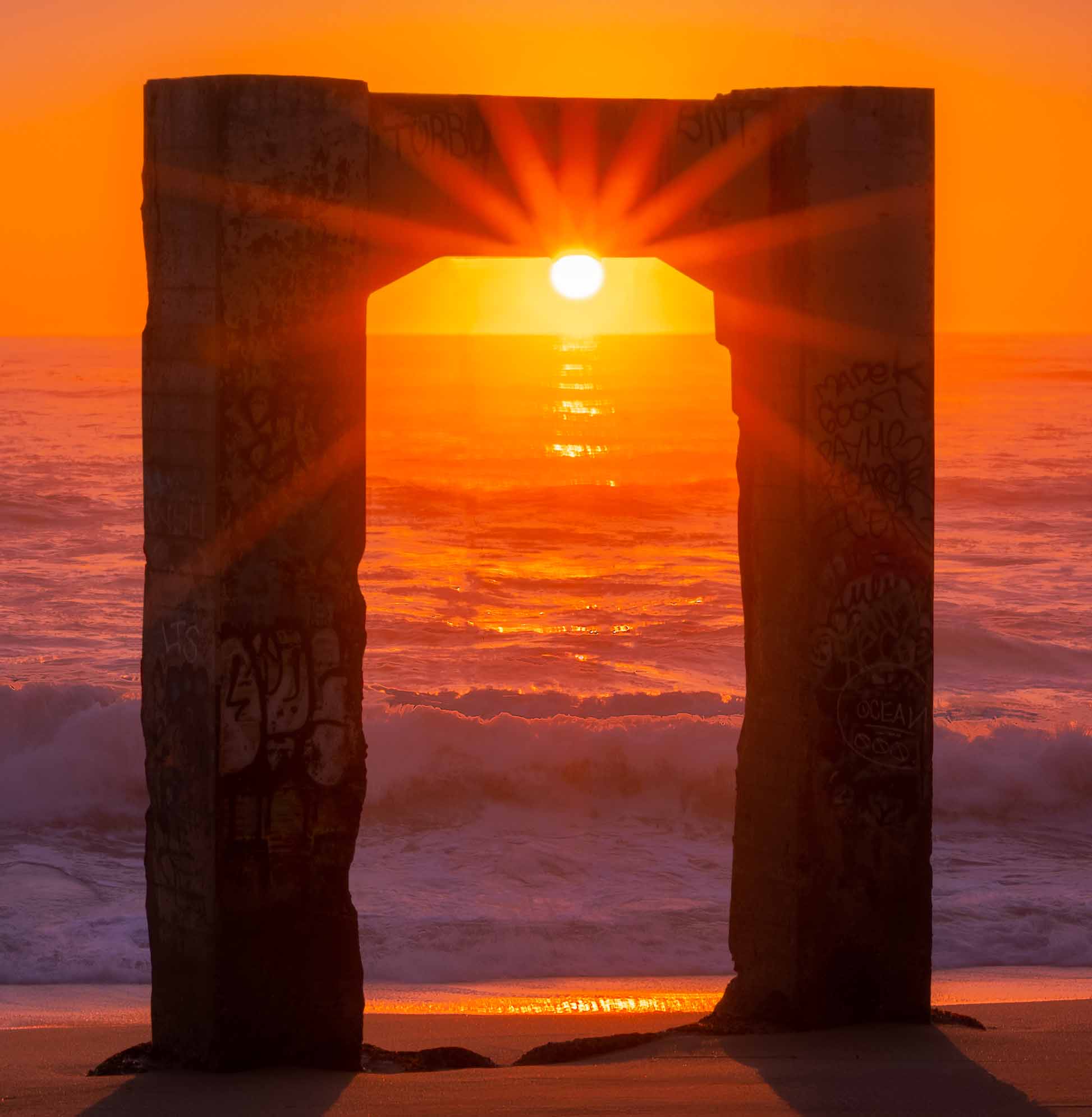
This crop is 32 percent of the frame width, about 26 inches across on the 80 inch print. The rays coming off the sun hold as discrete spikes rather than a single flare. The graffiti on both columns resolves into legible lettering, and the concrete around it shows spalling and exposed aggregate where the surface has broken away. On the wet sand below, the reflected sun reads as a distinct band. Click to view at full size.
About This Photograph
Davenport, on the Santa Cruz County coast in Northern California, at sunset, photographed from the beach below the bluff. Single frame. The pier was completed in 1934 and ran 2,327 feet from shore.
What is still standing is a selection rather than an accident. A pier's deck and beams span between supports and work in tension. Its columns are short and work in compression. Concrete is strong under compression and weak under tension, which is the reason it is reinforced with steel at all, and the tension members are the first to go once that steel fails. Every piece upright in this frame was carrying its load in compression.
Measured across the frame, this is the warmest and most saturated photograph in the collection by a wide margin, running seventy-one points red on the red-blue axis where nothing else here clears twenty-seven.
Phantom Wharf
Steve Austinhttps://www.steveaustinphotography.com/
Location
Davenport, Santa Cruz County, California, United States
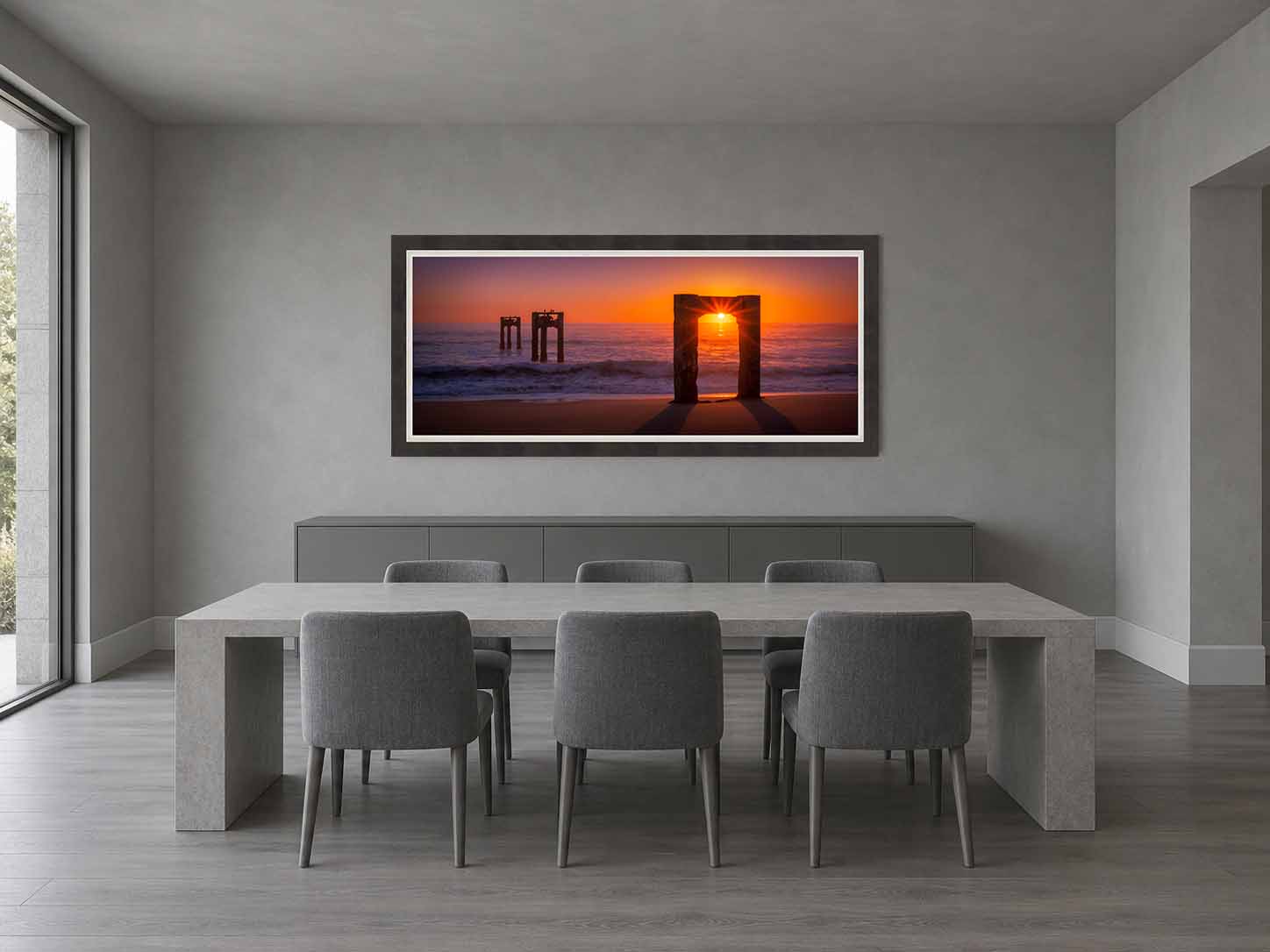
From across a room this reads as a color before it reads as a photograph. The red channel averages a hundred and twenty-two while green sits at sixty-three and blue at fifty-one, which means the picture is running on one channel and the other two are along for the ride. An image built that way behaves at distance the way a painted panel does: the eye registers a large saturated rectangle first and only resolves it into a pier, a sun and a sea on approach. That makes hanging it a decision about the room's color rather than about its pictures. At eighty inches wide this is the largest single block of orange most rooms will ever contain, and it should be chosen as that first.
It also has no tonal reserve to fall back on. The spread between its lightest and darkest passages is the narrowest of any photograph here, forty points against sixty-six for the widest, and nothing in it reaches white or black. Most pictures survive poor light because their shapes carry them: knock the color about and a high-contrast image still reads. This one is doing almost all of its work with hue and very little with tone, so anything that degrades the color takes the picture with it. Warm bulbs push an already saturated orange further and flatten the separation between the sky, the water and the sand, which are distinguished more by hue here than by brightness.
And it changes the room after you stop looking at it. Spend a minute in front of a large field of one saturated color and the eye adapts to it, reducing its sensitivity to that hue. Turn away and the room's neutrals swing the other way for a few seconds, so gray walls read faintly blue and warm timber reads muted. The effect is brief and entirely normal, and it is stronger with this photograph than with anything else in the collection because nothing else here concentrates this much chroma across this much area. Worth knowing before hanging it somewhere color gets judged, a kitchen, a dressing room, a studio.
Not sure which size the room calls for, or want dimensions not listed here? Sizes beyond 80 × 32 are available on request and ship crated by freight. That conversation is welcome before an order is placed. Start that conversation and I will answer within one business day.
How small is too small for a photograph this wide?
At the Intimate size the picture is forty inches across and sixteen tall, and the shape of it holds. The near bents hold as a doorway, the sun holds, the horizon holds, and the color holds completely, since color is the last thing reduction touches. What goes is the evidence. The graffiti covering both near columns becomes texture rather than lettering, which matters because that graffiti is a large part of what makes these ruins read as recent rather than ancient. The birds standing on the offshore structures disappear. The wave faces flatten into a single band. The Collected at sixty by twenty-four brings the birds back and starts to separate the graffiti into marks. If you are weighing a size against a specific wall, choosing the right print size covers the measurements and the viewing distances in more detail.
What changes at the largest size?
At eighty by thirty-two, working from the far side of the frame inward: the two offshore groups separate into individual columns with their cross-members visible between them, and the birds standing along the top become countable as separate birds rather than a dark ridge. The rays coming off the sun hold as discrete spikes instead of a single flare. On the near columns the graffiti resolves into legible tags and lettering, and the concrete around it shows spalling, exposed aggregate, and the pitting left where the surface has broken away. The wave breaking across the middle separates into individual lines of foam. On the wet sand the reflected sun reads as a distinct band, and the two long shadows running toward the bottom of the frame show clean edges. Why scale matters covers what happens perceptually when a photograph reaches the size where the eye has to cross it.
What kind of room does this photograph suit?
Rooms used in the evening, and rooms with plain surfaces. A den, a bar, a dining room, a long hall. Hang it at standard height with the center at about fifty-seven inches. On materials the instinct is to answer orange with warmth, and that is the wrong instinct here: at seventy-one points red this photograph will overwhelm terracotta, brick, and warm timber rather than complement them, and the room ends up looking muddy while the picture looks garish. Give it neutral or cool company instead, pale gray plaster, concrete, blackened steel, and let it be the only warm thing in view. Three things to avoid. Do not hang another sunset or warm-toned image in the same sightline, since the two will cancel each other's effect. Use neutral bulbs rather than warm ones. And keep it away from a mirror or a glass door facing it, because a saturated field reflected puts the same color into the room twice. When your mind needs to rest takes the question further.
Every work ships insured and arrives with a signed certificate of authenticity.
If a piece is damaged in transit, the choice of replacement is always yours, and your edition number stays with you.
Production time runs 2 to 3 weeks for metal, 3 to 4 weeks for acrylic and paper, and 5 to 6 weeks for framed work.
Each print is made to order and takes its place in a numbered edition, so sales are final. Before you choose, I am glad to help: send a photo of your wall and I will show you this work in your room at true scale, at no charge. Start a conversation
Collector's Choice · TruLife ® Acrylic in Italian Frame
Collector Edition of 25· Lumachrome TruLife Acrylic · Handcrafted Italian Frame
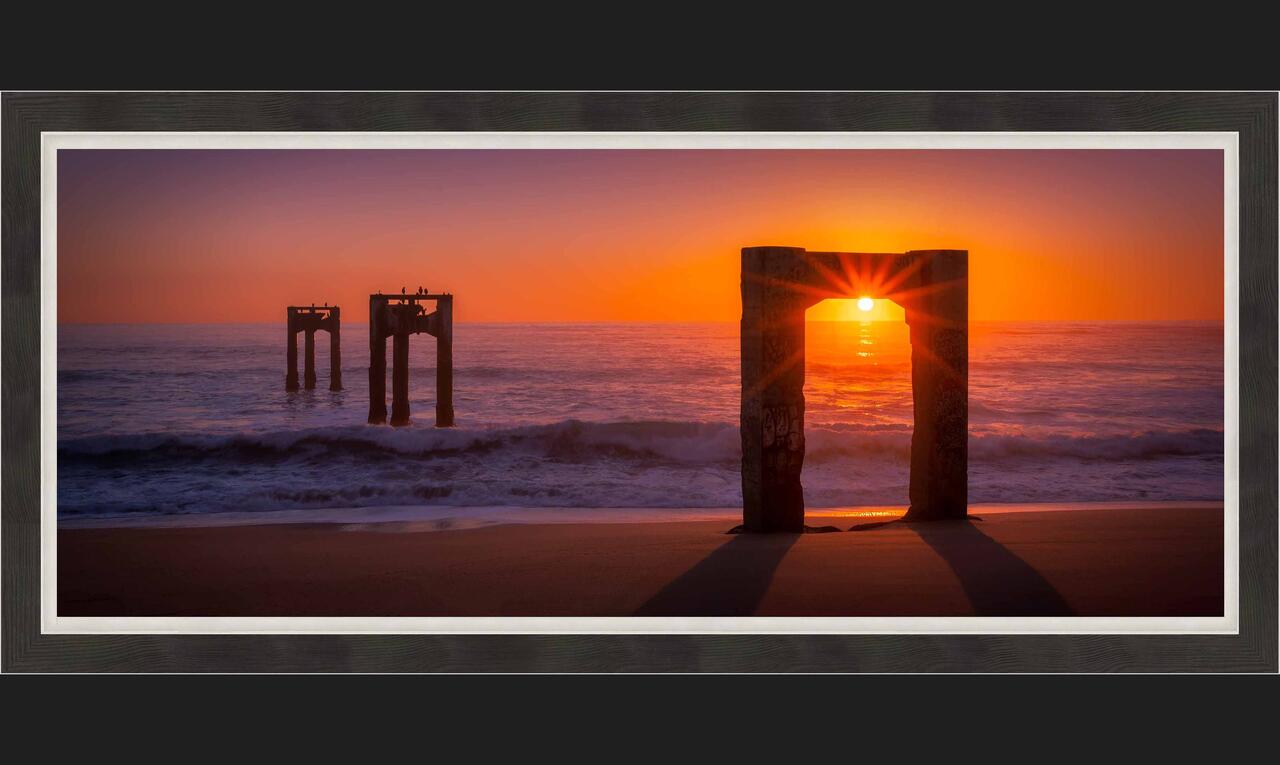
TruLife acrylic in a handcrafted Italian frame with a linen liner chosen for the image. Frame series, finish, and liner are settled with you after the order, and production begins from there. The frame and liner add about fourteen inches to the finished dimensions, worth allowing for when planning placement.
Signature Acrylic Edition of 50· Lumachrome TruLife · Gallery Float Mount
Face-mounted to TruLife acrylic and floated approximately one inch from the wall, with no frame to mediate between the image and the room. UV-resistant, anti-reflective, and scratch-resistant, with a lifetime guarantee against fading.
Signature Metal Edition of 50· ChromaLuxe Print · Gallery Float Mount
Color infused into the aluminum panel itself, floated from the wall on a concealed system. Where acrylic produces luminosity, metal produces clarity. Exceptional fade resistance with no glazing or coating required.
Complimentary shipping within the continental United States. International collector shipping available upon request.
Still deciding
Designing for Stillness
A guide to choosing art for restorative spaces
How to tell whether an image will still hold you in a year, how scale changes what a photograph does in a room, and how to match a piece to the work a room actually performs. It cites the research it draws on, and it is equally clear about where that research stops. About ten minutes to read.