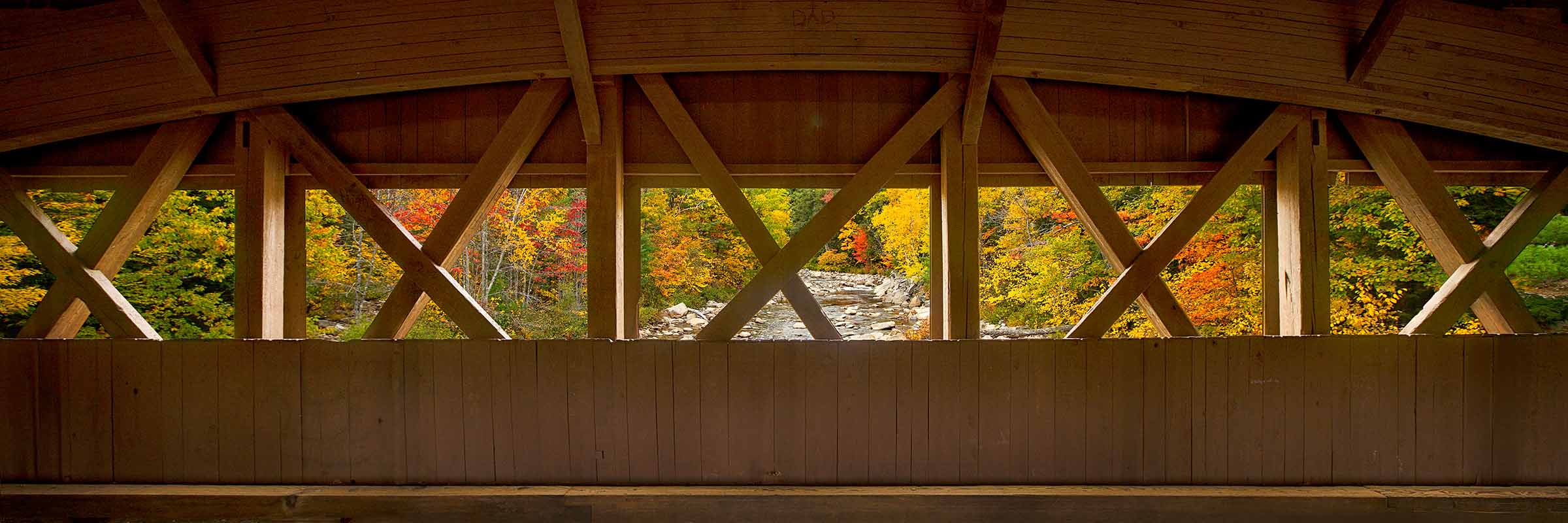
A 3:1 panoramic photograph inside the Albany Covered Bridge, New Hampshire, with autumn beyond the truss, available as a limited edition print in three sizes.
Artist's Story
Albany Covered Bridge crosses the Swift River in the White Mountains of New Hampshire, and it is roofed for a reason that has nothing to do with the view. A covered bridge is covered to keep rain off its timbers. Left open, a wooden truss rots inside twenty years. Sheltered, it stands for well over a century. This one has stood since 1858. The truss is a Paddleford, developed by a millwright from Littleton who never bothered to patent it, and only about twenty-two of them are left.
I stopped in the middle and turned to face the side wall.
Environmental psychology has a name for what happens next. Prospect and refuge. People reliably prefer a place that offers both an outlook and something solid at their back, a preference old enough that it is usually explained by what an animal needs in order to see without being seen. A covered bridge delivers both at once and in unusual purity. You stand in a dark timber room, fully enclosed, and the autumn arrives through a row of openings, brighter for the dimness you are standing in. Neither half does much alone. A room with no window is a box, and a field with no shelter is exposure. It is the pairing the nervous system answers to.
Sheltered View is that pairing, in a structure built for none of it.
The preference this photograph works on is older than architecture, and it turns up wherever people choose where to stand. I wrote about where it comes from in Why We Are Wired to Need the Natural World.
One bay of the truss, about one quarter of the frame width. The brace, the boarding below it, and the autumn and the Swift River beyond. Click to view at full size.
About This Photograph
Photographed inside the Albany Covered Bridge, which carries Dugway Road over the Swift River in Albany, New Hampshire, within the White Mountain National Forest just off the Kancamagus Highway, in autumn. This is a single frame image in color. The bridge is also known as the Passaconaway Bridge and as the White Mountain National Forest Bridge. It was built in 1858 by Amzi Russell and Leandre Morton for about $1,300, replacing an earlier bridge lost to a windstorm, and runs 120 feet in a single span. Its Paddleford truss, seen here from inside, is one of roughly twenty-two that survive, most of them in northern New Hampshire. The bridge was renovated in 1970, and the Forest Service replaced its wooden floor timbers with steel in 1981 and 1982 to carry modern loads. Beyond the openings between the truss members are autumn hardwoods and the rocky bed of the Swift River. Presented as a horizontal panorama, offered as an archival limited edition from 36 by 12 inches to 90 by 30 inches on acrylic, metal, or archival paper.
Sheltered View
Steve Austinhttps://www.steveaustinphotography.com/
Location
Albany Covered Bridge, Albany, New Hampshire
Subject
The Paddleford truss from inside the bridge, with autumn beyond
Capture
Single frame
Format
Photograph · horizontal panorama, 3:1
Sizes
36 × 12 in · 60 × 20 in · 90 × 30 in
Print Media
TruLife Acrylic · ChromaLuxe Metal · Baryta paper
Edition
Limited, 25 / 50 / 100 by presentation
What it Does in a Room
A photograph three times as wide as it is tall stops being a picture on a wall. It becomes part of the wall.
Three to one is the widest proportion in the collection, and it behaves differently from everything else. A two to one panorama still reads as a scene you are looking at. At three to one the frame passes beyond what the eye takes in at once, so you read it the way you read a room, by turning your head. That changes what it does to a space. It draws the horizontal line of the wall out and holds it, which makes a room feel longer and lower and calmer, and it settles above a long sofa, a run of cabinetry, a credenza, or a headboard in a way no other shape manages. It asks for a run of wall rather than height, and very little of that height. A band twelve to thirty inches tall will do, which is why this proportion often works above furniture where nothing else fits.
Here the shape is not a choice about the wall, it is what the subject is. The truss runs the full length of the bridge and the openings between its members repeat down the frame, so the width is the structure rather than a crop of it. That repetition is what makes the picture restful. There is no single focal point competing for attention, only a rhythm of dark timber and bright autumn, and the eye moves along it without being asked to settle anywhere. It is also the darkest photograph in the collection, weighted heavily toward the low end with the color concentrated in a narrow band across the middle. A print like that reads as depth rather than as an image on a surface, and at these widths the effect is closer to an opening cut in the wall than to a picture hung on it.
The color is where this one asks for some thought. It runs warm and saturated end to end, gold and rust and oxblood against deep brown timber, with no cool note anywhere in it. That makes warm rooms its natural home. Oak, walnut, leather, brick, wool, unbleached linen, aged plaster. Against those the photograph belongs to the room rather than interrupting it. It also holds its own in a cool or gray space, where it becomes the single warm thing in the room and behaves like a source of heat, though the two palettes stay separate rather than merging. What it rewards most is a wall with some quiet around it and a lamp nearby, since a dark print gives back more in the evening than most people expect.
Not sure which size the room calls for, or want dimensions not listed here? Sizes beyond 90 × 30 are available on request and ship crated by freight. That conversation is welcome before an order is placed. Start that conversation and I will answer within one business day.
How small is too small for a photograph this wide?
At three to one, the Intimate size is thirty-six inches across and twelve inches tall. Twelve inches is not much height, and it is worth knowing what that means before choosing it. The rhythm of the truss holds, and the band of autumn beyond it still reads as color and light. What compresses is everything inside the openings, so the individual leaves, the branches, and the river stones become suggestion rather than detail. A thirty-six by twelve print works beautifully in a narrow run of wall, above a doorway, along a stair, in a galley kitchen, or as the one piece on a hallway wall where nothing taller would fit. The Collected at sixty by twenty is where the openings start to behave like windows rather than like gaps, and the Statement at ninety by thirty is where they become the size of real ones. If you are weighing a size against a specific wall, choosing the right print size covers the measurements and the viewing distances in more detail.
What changes at the largest size?
The view through the openings, and it is not a small difference. At thirty-six by twelve the autumn beyond the truss is a band of color. At ninety by thirty it separates into individual trees and then individual leaves, with the white trunks of the birches standing clear, a single orange maple holding its own against the gold, and the rocky bed of the Swift River legible below, down to the shallow water running between the stones. The timber stays what it is at every size, a dark frame holding steady, which is the point of it. So enlarging this photograph does not make both halves louder. It widens the gap between them, and that gap is the whole subject. Why scale matters covers what happens perceptually when a landscape reaches the size where the eye has to travel across it.
What kind of room does this photograph suit?
Warm rooms first, and after that more rooms than the palette suggests. The frame runs gold and rust and oxblood against deep brown timber, with no cool note anywhere in it, and it is the darkest photograph in the collection by a wide margin. Against oak, walnut, leather, brick, wool, unbleached linen, or aged plaster it belongs to the room rather than sitting on top of it. In a cool or gray space it becomes the single warm thing present and behaves like a source of heat, which is a different effect and a good one. The darkness is worth understanding rather than worrying about. A print weighted this low reads as depth, so at these widths it looks less like a picture hung on the wall than like an opening cut through it, and that reading gets stronger as the room gets quieter. What it rewards most is a lamp nearby. Dark prints give back more in the evening than most people expect, and this one comes alive under warm light in a way it never quite does at midday.
Every work ships insured and arrives with a signed certificate of authenticity.
If a piece is damaged in transit, the choice of replacement is always yours, and your edition number stays with you.
Production time runs 2 to 3 weeks for metal, 3 to 4 weeks for acrylic and paper, and 5 to 6 weeks for framed work.
Collector's Choice · TruLife ® Acrylic in Italian Frame
Collector Edition of 25· Lumachrome TruLife Acrylic · Handcrafted Italian Frame
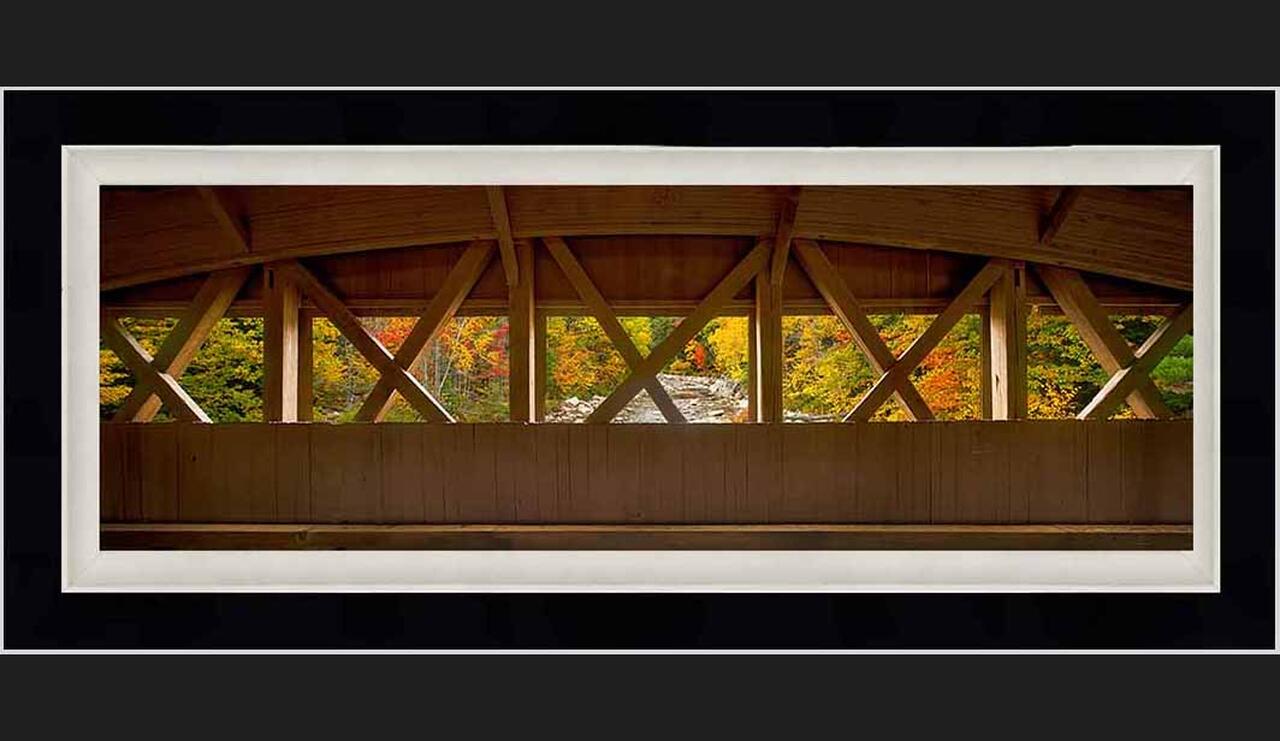
TruLife acrylic in a handcrafted Italian frame with a linen liner chosen for the image. Frame series, finish, and liner are settled with you after the order, and production begins from there. The frame and liner add about fourteen inches to the finished dimensions, worth allowing for when planning placement.
Signature Edition · TruLife ® Acrylic, Float Mount
Signature Edition of 50· Lumachrome TruLife Acrylic · Gallery Float Mount
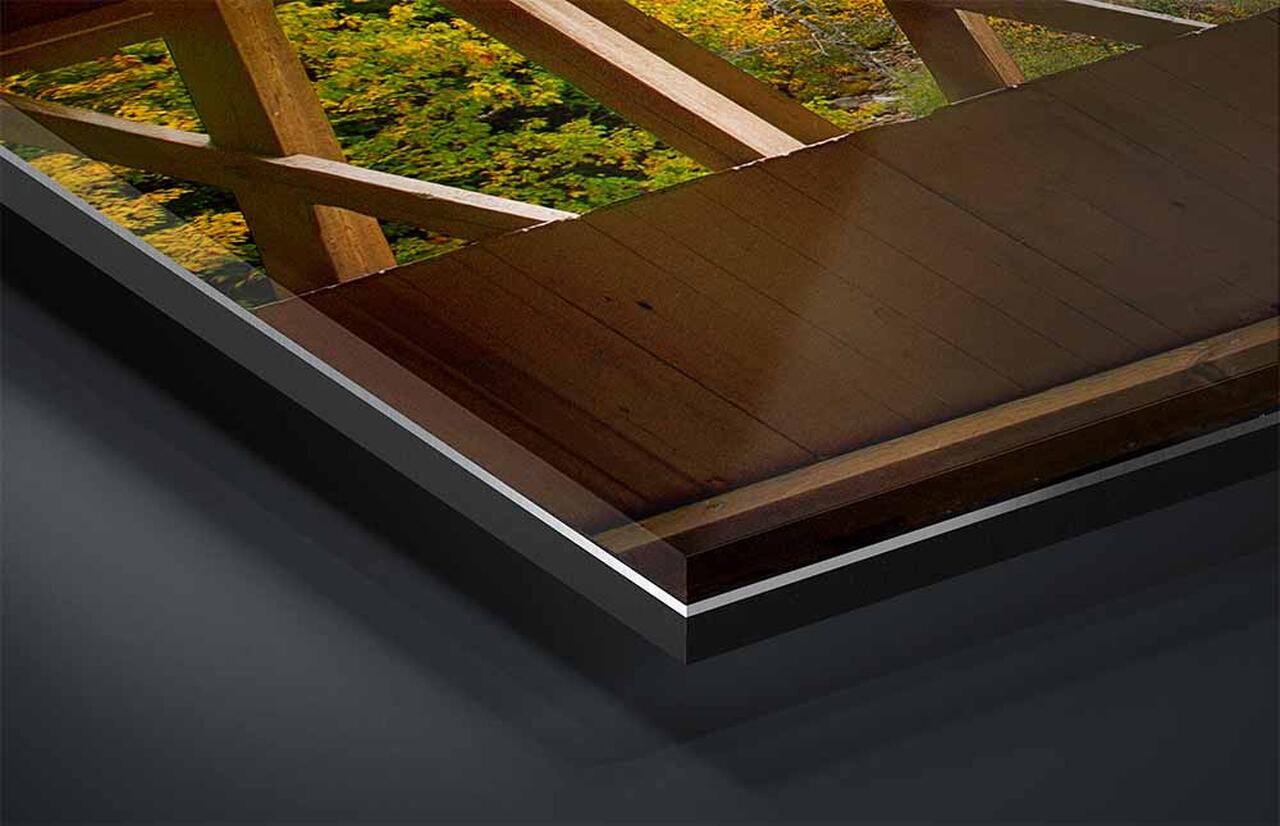
Face-mounted to TruLife acrylic and floated approximately one inch from the wall, with no frame to mediate between the image and the room. UV-resistant, anti-reflective, and scratch-resistant, with a lifetime guarantee against fading.
Signature Edition of 50· ChromaLuxe Metal Print · Gallery Float Mount
Color infused into the aluminum panel itself, floated from the wall on a concealed system. Where acrylic produces luminosity, metal produces clarity. Exceptional fade resistance with no glazing or coating required.
Fine Art Edition of 100· Hahnemühle Baryta Fine Art Paper
Printed without acrylic, so light meets the paper surface directly. Highlights stay luminous, shadows keep their nuance, and the surface has a tactile quality the other presentations approach differently. The understated choice, and the traditional one.
Complimentary shipping within the continental United States. International collector shipping available upon request.
Still deciding
Designing for Stillness
A guide to choosing art for restorative spaces
How to tell whether an image will still hold you in a year, how scale changes what a photograph does in a room, and how to match a piece to the work a room actually performs. It cites the research it draws on, and it is equally clear about where that research stops. About ten minutes to read.