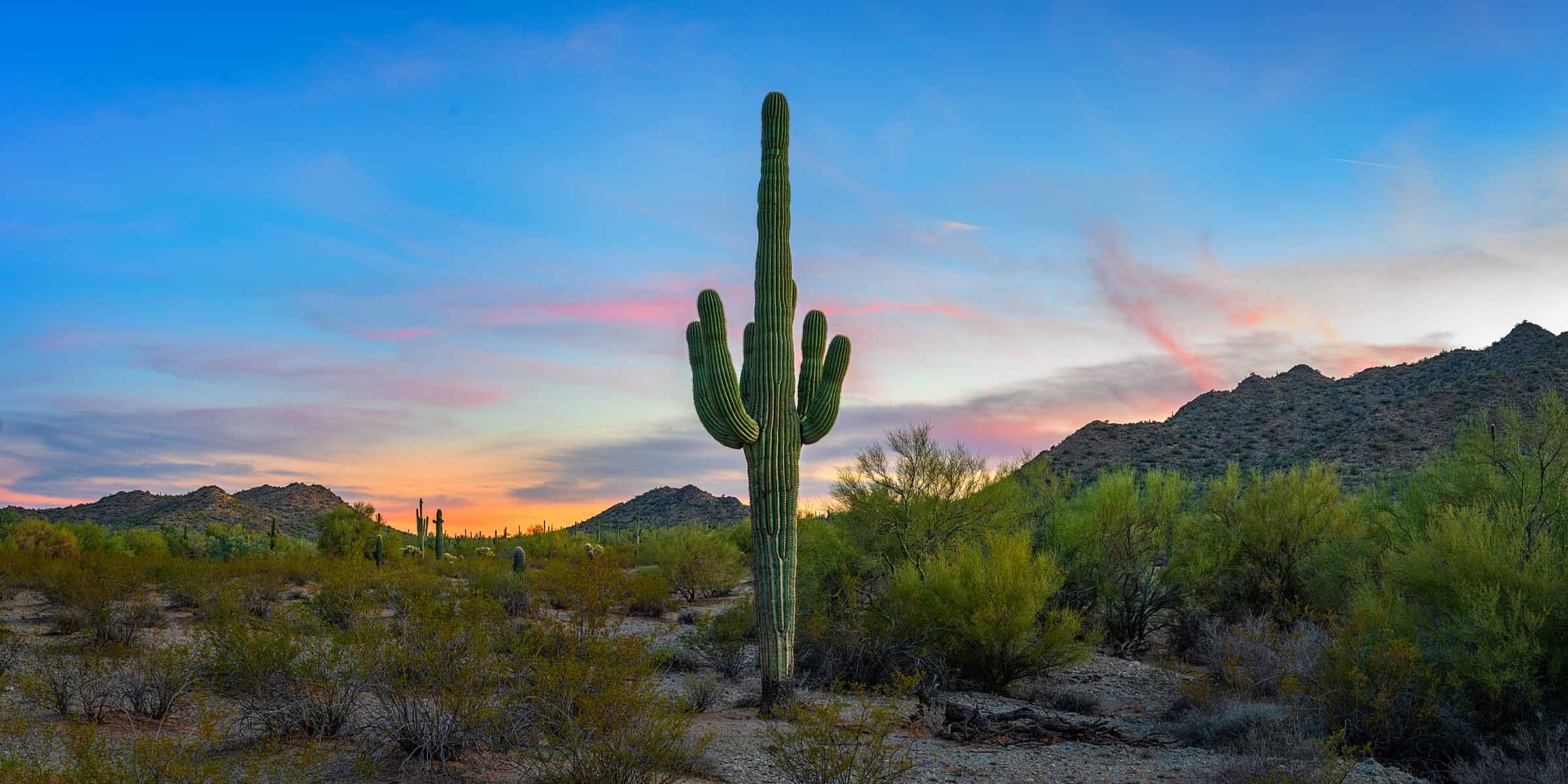
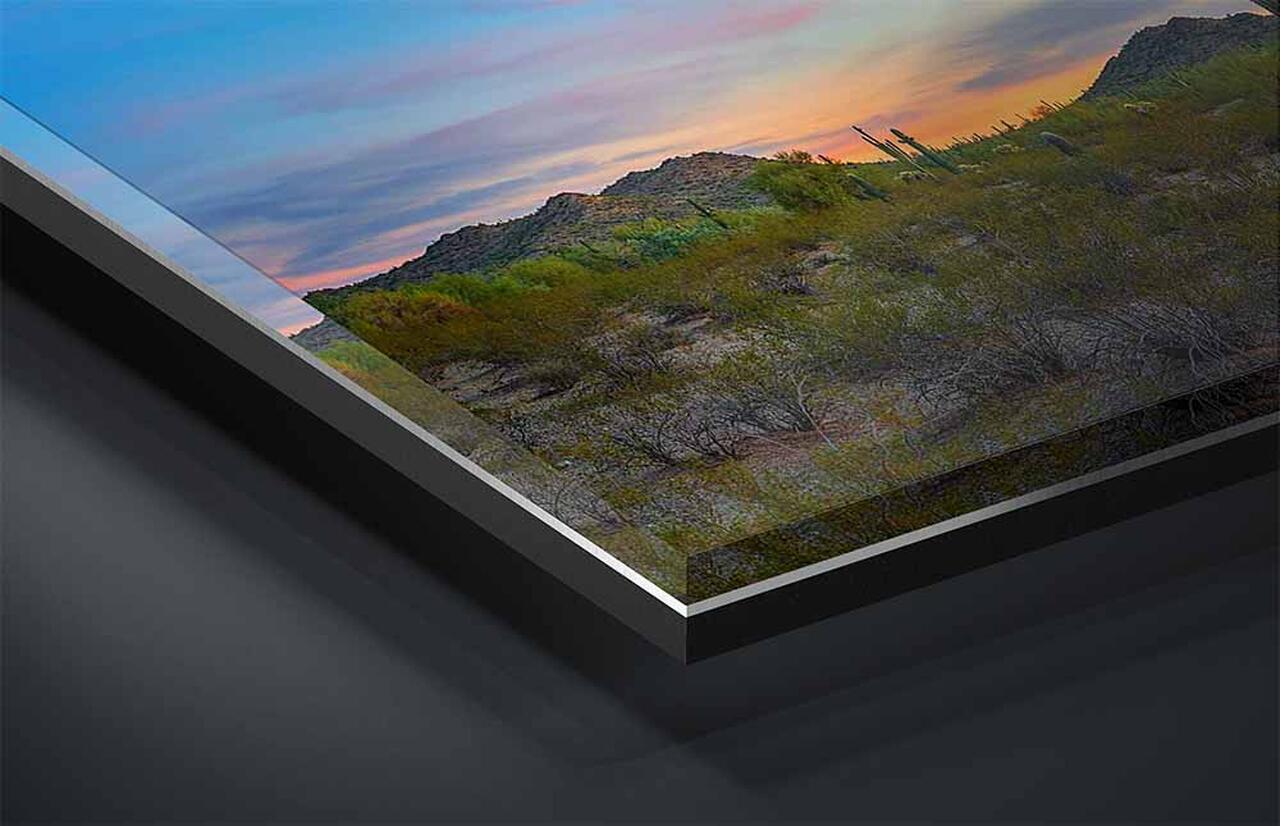
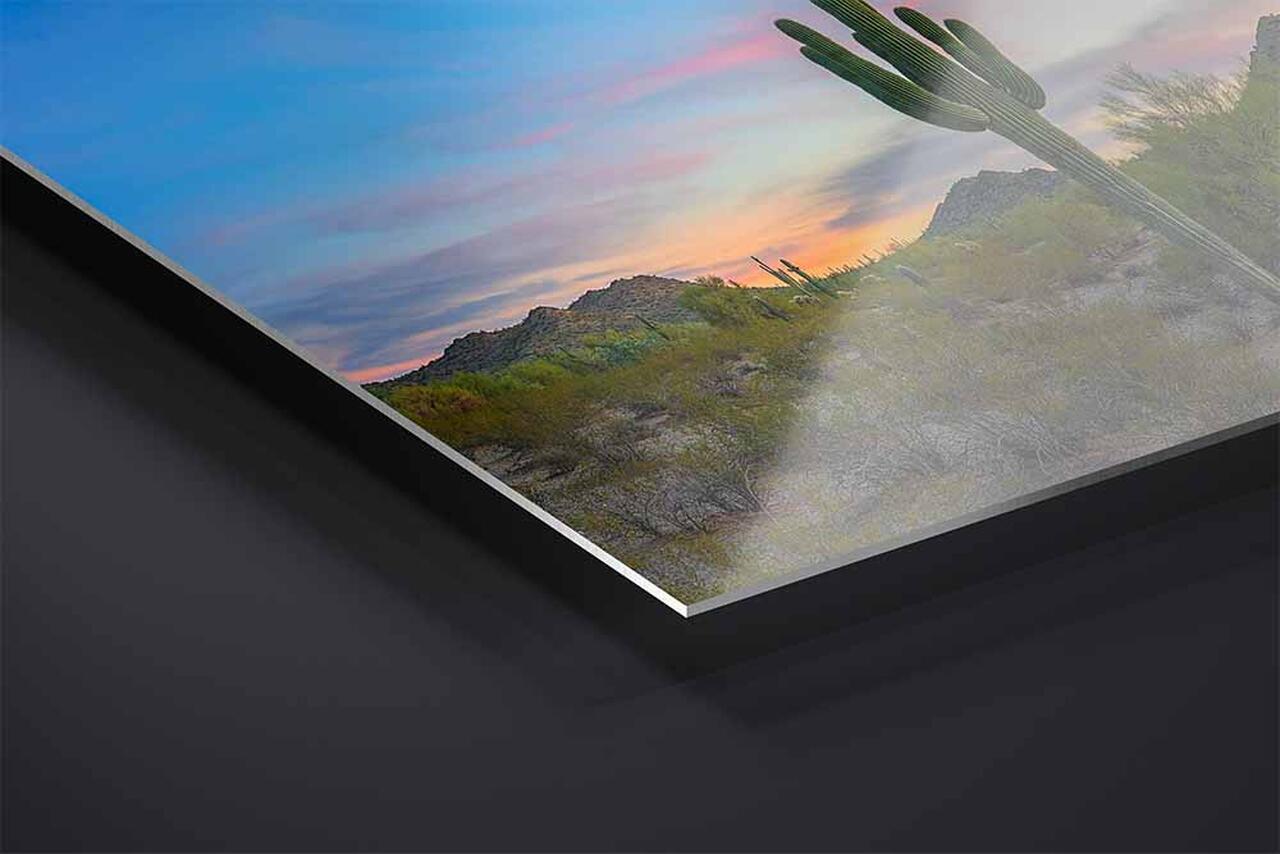
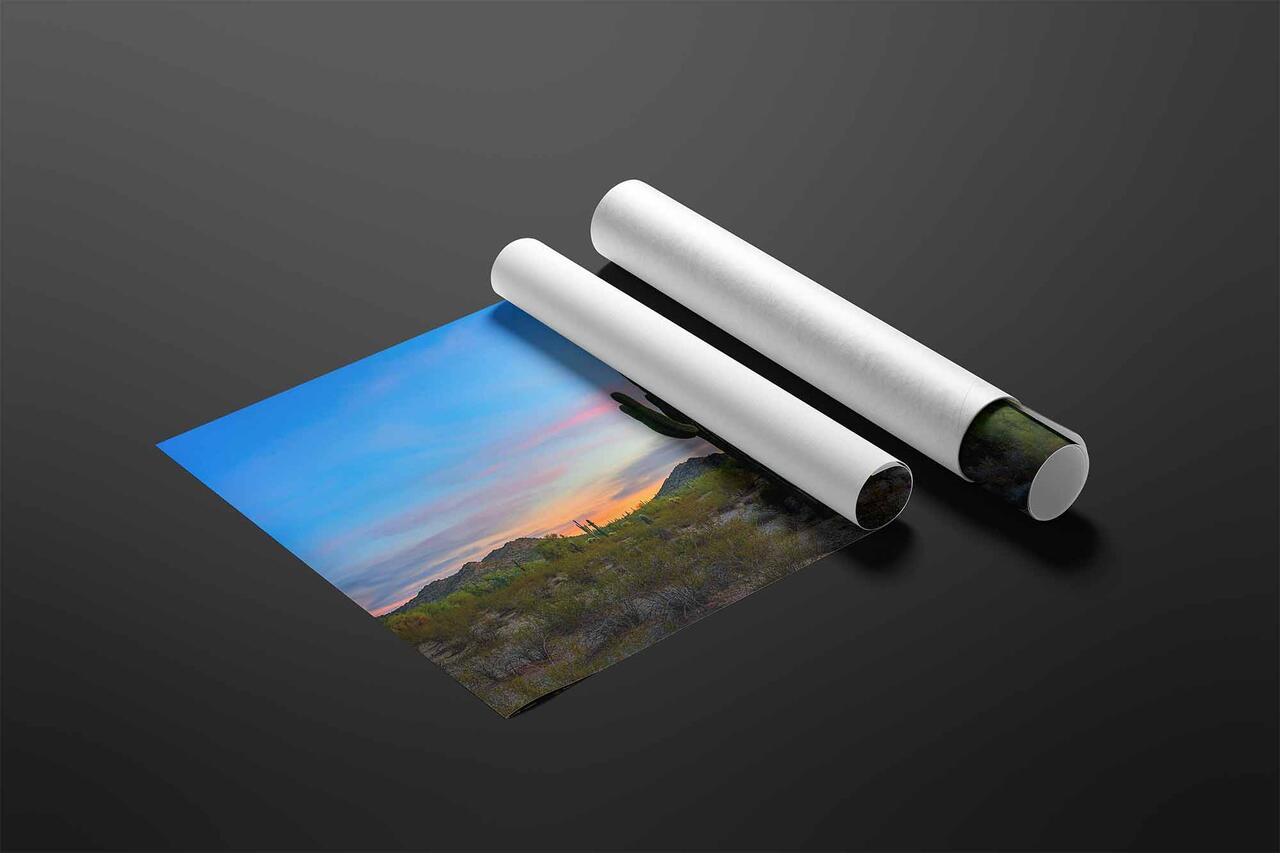
A 2:1 panoramic photograph of a saguaro at twilight in San Tan Mountain Regional Park, Arizona, available as a limited edition print in three sizes.
Artist's Story
A saguaro cannot start its life in the open.
The seed is smaller than a grain of pepper and the seedling that comes from it is under an inch tall after eight years. In full sun it cooks, and in a cold snap it freezes, and anything passing by can eat it. So the ones that live are the ones that came up underneath something else. A palo verde, a mesquite, an ironwood. The shade holds the temperature down, the litter holds the moisture in, and the branches keep the seedling out of sight. Botanists call it a nurse tree.
Then the arrangement turns. The saguaro's roots run wide and shallow, a few inches down and out as far as the plant is tall, and once it is large enough it takes the water first. The tree that sheltered it thins out, drops limbs, and often dies where it stands while the cactus it raised goes on for another hundred years.
There is a palo verde standing a few feet to the right of this saguaro. It may be the one. It may be a later arrival that came up in the same good ground. There is no way to tell by looking, which is most of what I like about it.
Simply Present is the saguaro at the center, the palo verde beside it, the San Tan range low behind, and the sky going through blue and pink and amber above all of it while the desert underneath stays green from the winter rain.
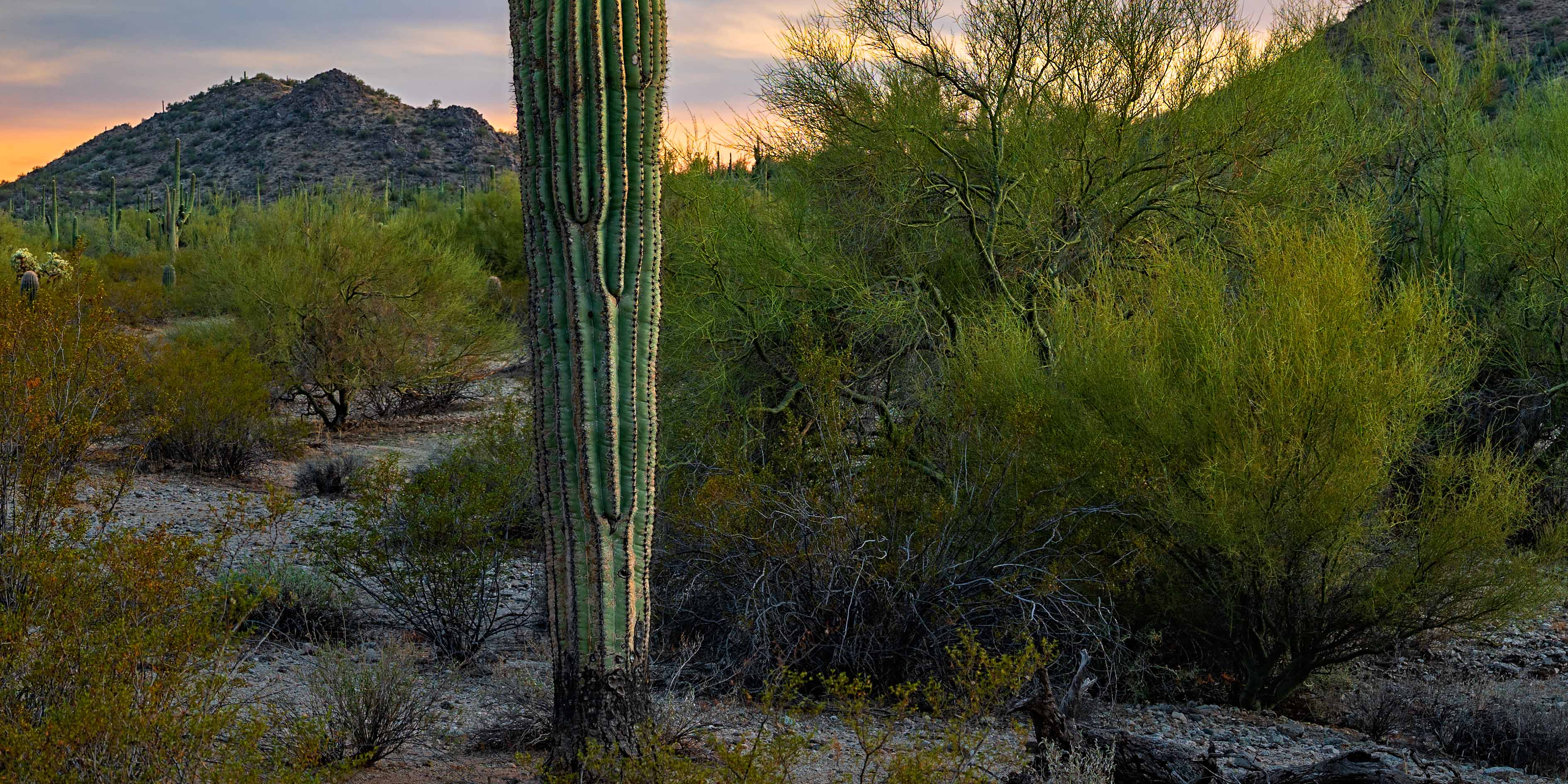
The trunk and the palo verde at about a third of the frame width. On an eighty inch print this section runs roughly twenty-six inches across. The ribs and their spine clusters resolve on the trunk, the palo verde separates into individual green twigs, and the saguaros on the far slope come apart into a scattered population at different ages. Click to view at full size.
About This Photograph
In San Tan Mountain Regional Park, in Pinal County about thirty miles southeast of Phoenix, Arizona, at twilight. This is a single frame image. The frame holds one mature saguaro at the center of the composition, a palo verde beside it, low desert scrub across the flat, and the San Tan range along the horizon.
Saguaros produce their first arm between fifty and seventy years of age, later where rainfall is thin. The arms on this one are short and newly formed, which places it somewhere between seventy-five and a hundred years old.
The park covers more than ten thousand acres of lower Sonoran Desert, ranging from about 1,400 to 2,500 feet, with vegetation shifting from creosote flats to dense saguaro forest as the ground rises. It is administered by Maricopa County Parks although it lies outside that county.
Simply Present
Steve Austinhttps://www.steveaustinphotography.com/
Location
San Tan Mountain Regional Park, Arizona
Subject
Saguaro cactus · Sonoran Desert · twilight
Capture
Single frame at twilight
Format
Photograph · horizontal panorama, 2:1
Sizes
40 × 20 in · 60 × 30 in · 80 × 40 in
Print Media
TruLife Acrylic · ChromaLuxe Metal · Baryta paper
Edition
Limited, 25 / 50 / 100 by presentation
What it Does in a Room
This is a cool photograph with one warm band running through it. Measured across the frame, only about a fifth of the pixels are warm at all, and nearly all of them sit in the narrow stripe of pink and amber along the horizon. That is a useful thing to hang, because the picture will settle into a cool room without fighting it and still put a single note of warmth on the wall. Against gray, slate, steel, or pale stone the horizon line is the only warm thing in the room, and it carries more weight than its size suggests.
The two halves of the picture behave differently at different distances. Above the skyline it is almost entirely gradient, sky moving smoothly from blue through pink to amber, and a gradient looks the same from six feet as it does from six inches because there is nothing in it to resolve. Below the skyline it is all detail, ribs and thorns and branch structure and gravel. So the top half works across a room and the bottom half rewards walking up to it, which means the piece gives you something at both distances rather than resolving all at once.
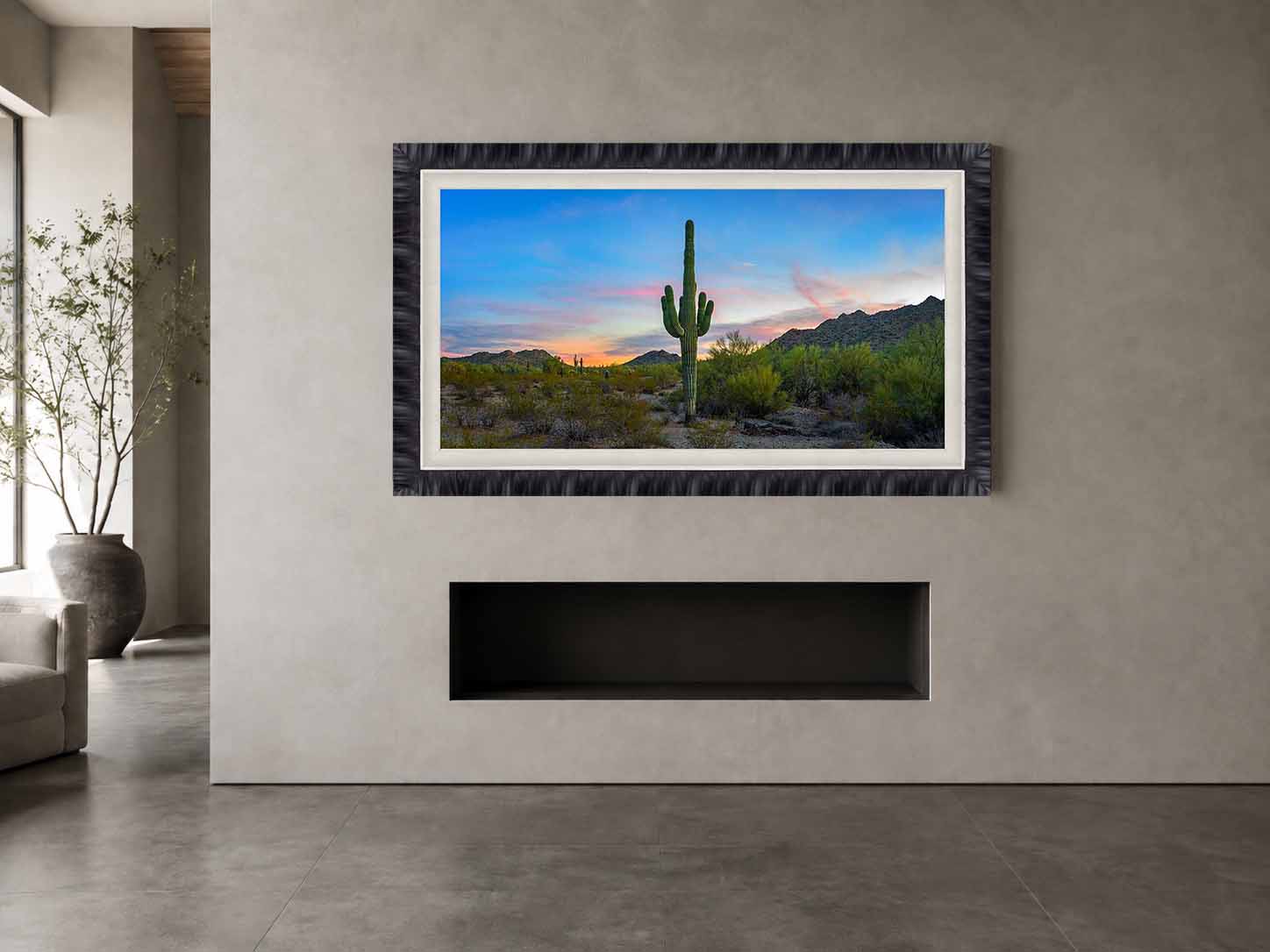
The saguaro stands at almost exactly the center of the frame, within two percent of the middle. That makes this a symmetrical picture in a way most landscapes are not, and symmetry hangs differently. It wants to be centered on its wall rather than offset, and it sits comfortably above something centered below it. Hung off-center it will look wrong in a way that is hard to name until you move it.
Not sure which size the room calls for, or want dimensions not listed here? Sizes beyond 80 × 40 are available on request and ship crated by freight. That conversation is welcome before an order is placed. Start that conversation and I will answer within one business day.
How small is too small for a photograph this wide?
At two to one, the Intimate size is forty inches across and twenty inches tall. That is a comfortable proportion, wide enough to read as a panorama with enough height that it still behaves like a picture rather than a band, and of the panoramic families it is the one that holds up best small. This photograph does well there because its structure is simple and centered: one vertical in the middle, a horizon two thirds down, and a graded sky above. What goes at that size is the desert floor. At forty by twenty the scrub reads as a single green mass and the ribs on the saguaro flatten into a smooth column, so the picture becomes a silhouette against a colored sky, which is a real photograph and a quiet one. The Collected at sixty by thirty is where the ribs come back and the scrub separates into individual plants. If you are weighing a size against a specific wall, choosing the right print size covers the measurements and the viewing distances in more detail.
What changes at the largest size?
The desert floor stops being ground cover and becomes plants. At the Statement size, eighty by forty, the ribs on the saguaro resolve with their spine clusters, and the seams where each new arm emerged from the trunk become visible as joints rather than shading. The palo verde beside it separates into its own green branch structure, fine enough to see individual twigs against the sky. Across the flat, creosote, bursage, and cholla become distinguishable from one another rather than a green field, and the gravel between them opens up. Further out, the small saguaros scattered along the mid-ground, which read as marks at smaller sizes, resolve into a scattered population of plants at different ages. The sky changes least, because a gradient has nothing to give up. Why scale matters covers what happens perceptually when a landscape reaches the size where the eye has to cross it.
What kind of room does this photograph suit?
Cool rooms, and walls it can have to itself. The picture runs blue and green with one warm line through it, so it belongs against gray, slate, steel, plaster, and pale stone, and it will stay cool in a room that leans that way rather than pulling against it. Against oak, walnut, and leather it becomes the one cool element present, which works when that is what the room is missing. Because the composition is centered and symmetrical it does best on a wall where it can be the middle of something, over a console, a bed, or a fireplace, rather than off to one side of a longer run. It also suits a room used in the evening, since the light in the photograph is the light at that hour and the two agree. You are not buying scenery takes the question further.
Every work ships insured and arrives with a signed certificate of authenticity.
If a piece is damaged in transit, the choice of replacement is always yours, and your edition number stays with you.
Production time runs 2 to 3 weeks for metal, 3 to 4 weeks for acrylic and paper, and 5 to 6 weeks for framed work.
Each print is made to order and takes its place in a numbered edition, so sales are final. Before you choose, I am glad to help: send a photo of your wall and I will show you this work in your room at true scale, at no charge. Start a conversation
Collector's Choice · TruLife ® Acrylic in Italian Frame
Collector Edition of 25· Lumachrome TruLife Acrylic · Handcrafted Italian Frame
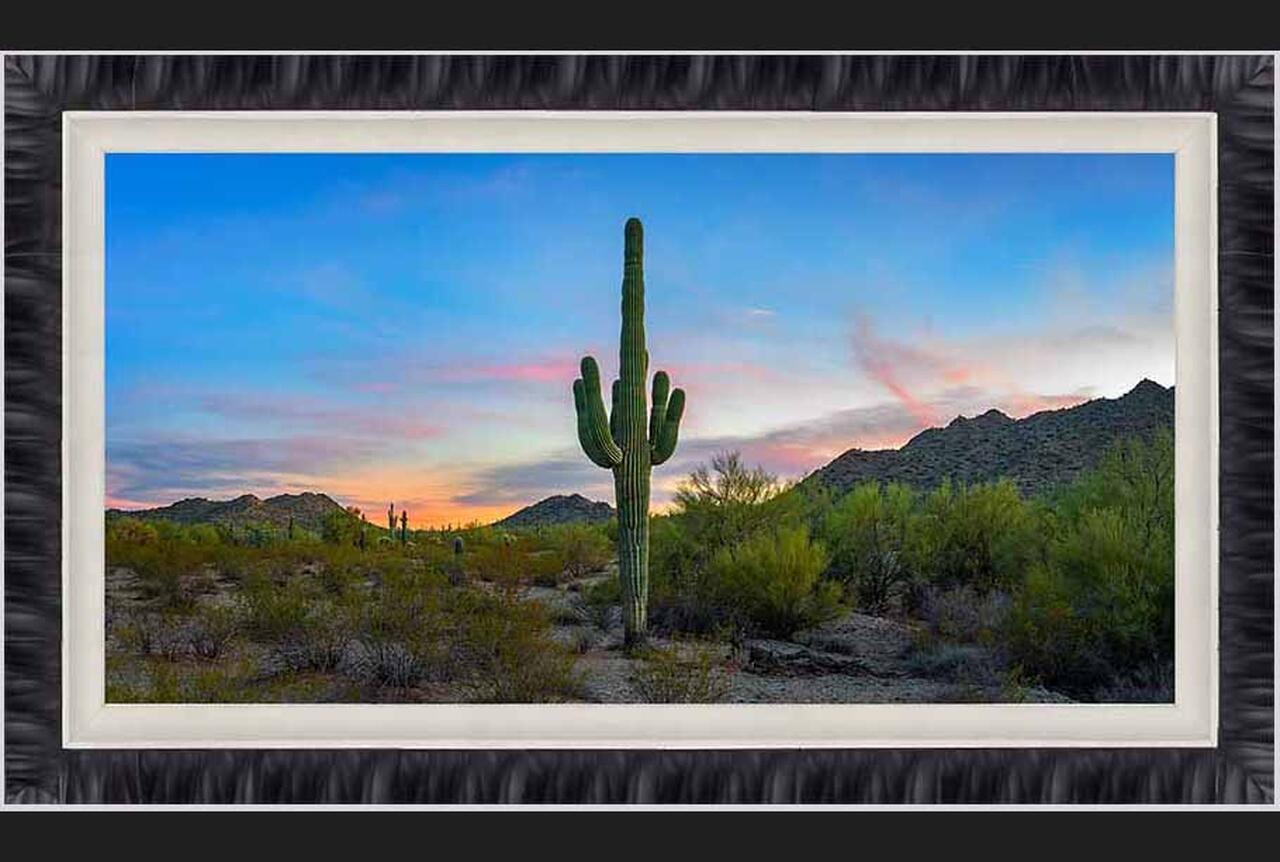
TruLife acrylic in a handcrafted Italian frame with a linen liner chosen for the image. Frame series, finish, and liner are settled with you after the order, and production begins from there. The frame and liner add about fourteen inches to the finished dimensions, worth allowing for when planning placement.
Signature Acrylic Edition of 50· Lumachrome TruLife · Gallery Float Mount
Face-mounted to TruLife acrylic and floated approximately one inch from the wall, with no frame to mediate between the image and the room. UV-resistant, anti-reflective, and scratch-resistant, with a lifetime guarantee against fading.
Signature Metal Edition of 50· ChromaLuxe Print · Gallery Float Mount
Color infused into the aluminum panel itself, floated from the wall on a concealed system. Where acrylic produces luminosity, metal produces clarity. Exceptional fade resistance with no glazing or coating required.
Fine Art Edition of 100· Hahnemühle Baryta Fine Art Paper
Printed without acrylic, so light meets the paper surface directly. Highlights stay luminous, shadows keep their nuance, and the surface has a tactile quality the other presentations approach differently. The understated choice, and the traditional one.
Complimentary shipping within the continental United States. International collector shipping available upon request.
Still deciding
Designing for Stillness
A guide to choosing art for restorative spaces
How to tell whether an image will still hold you in a year, how scale changes what a photograph does in a room, and how to match a piece to the work a room actually performs. It cites the research it draws on, and it is equally clear about where that research stops. About ten minutes to read.