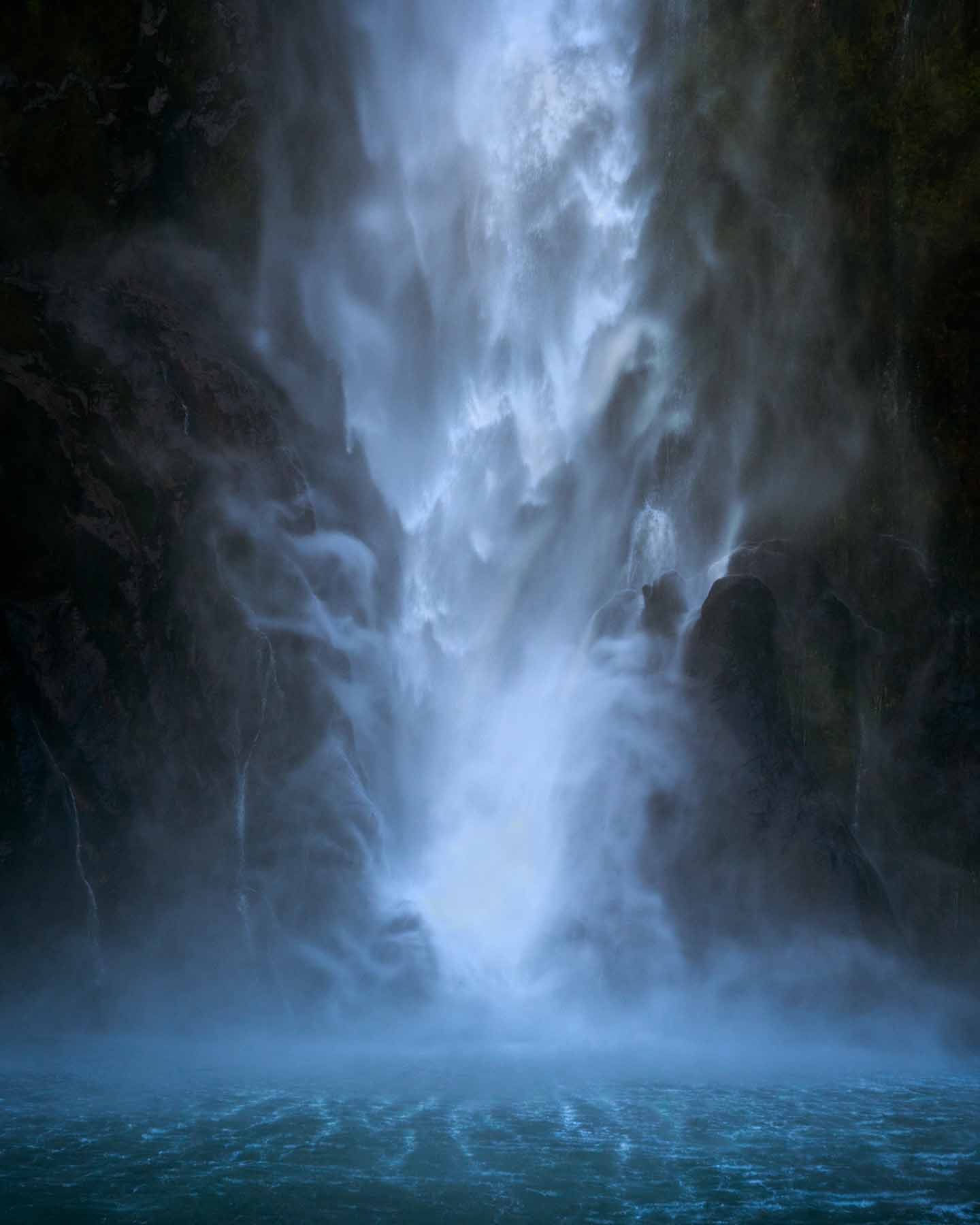
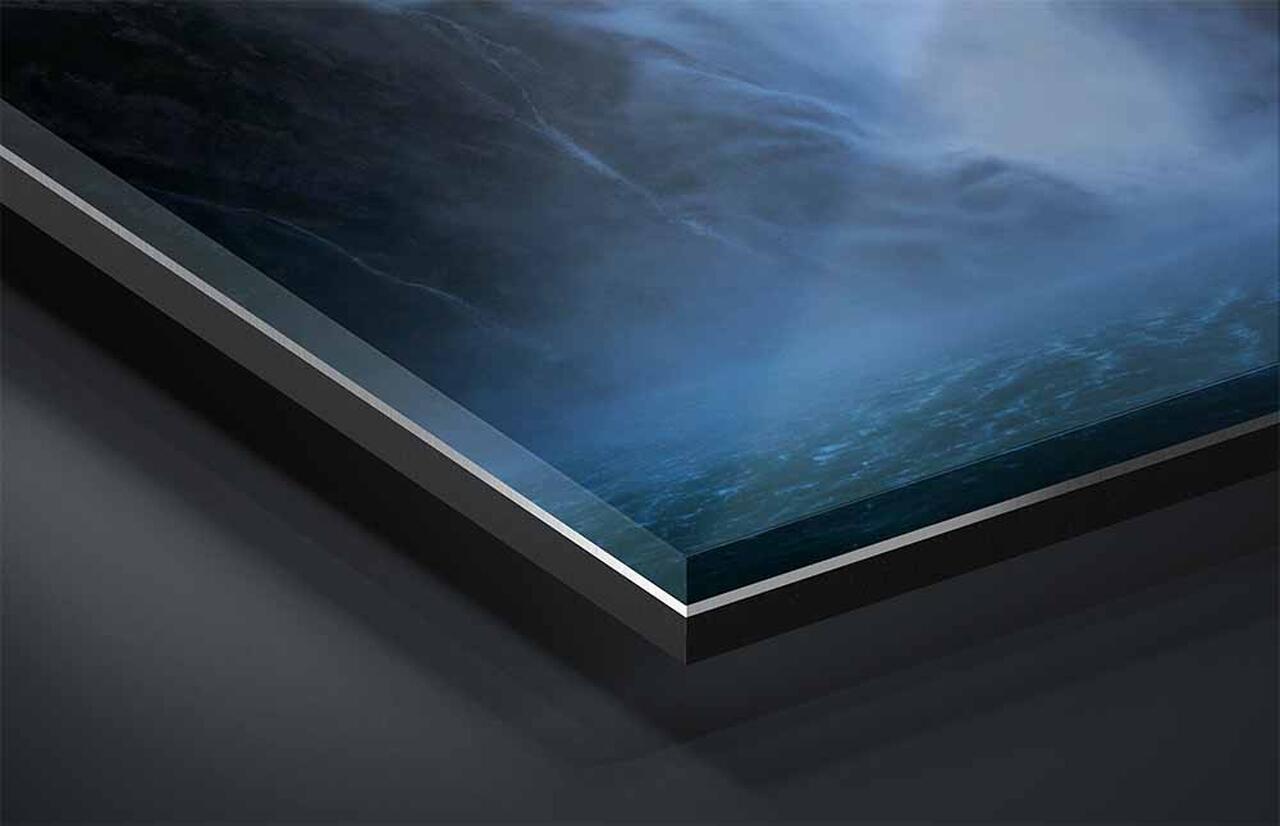
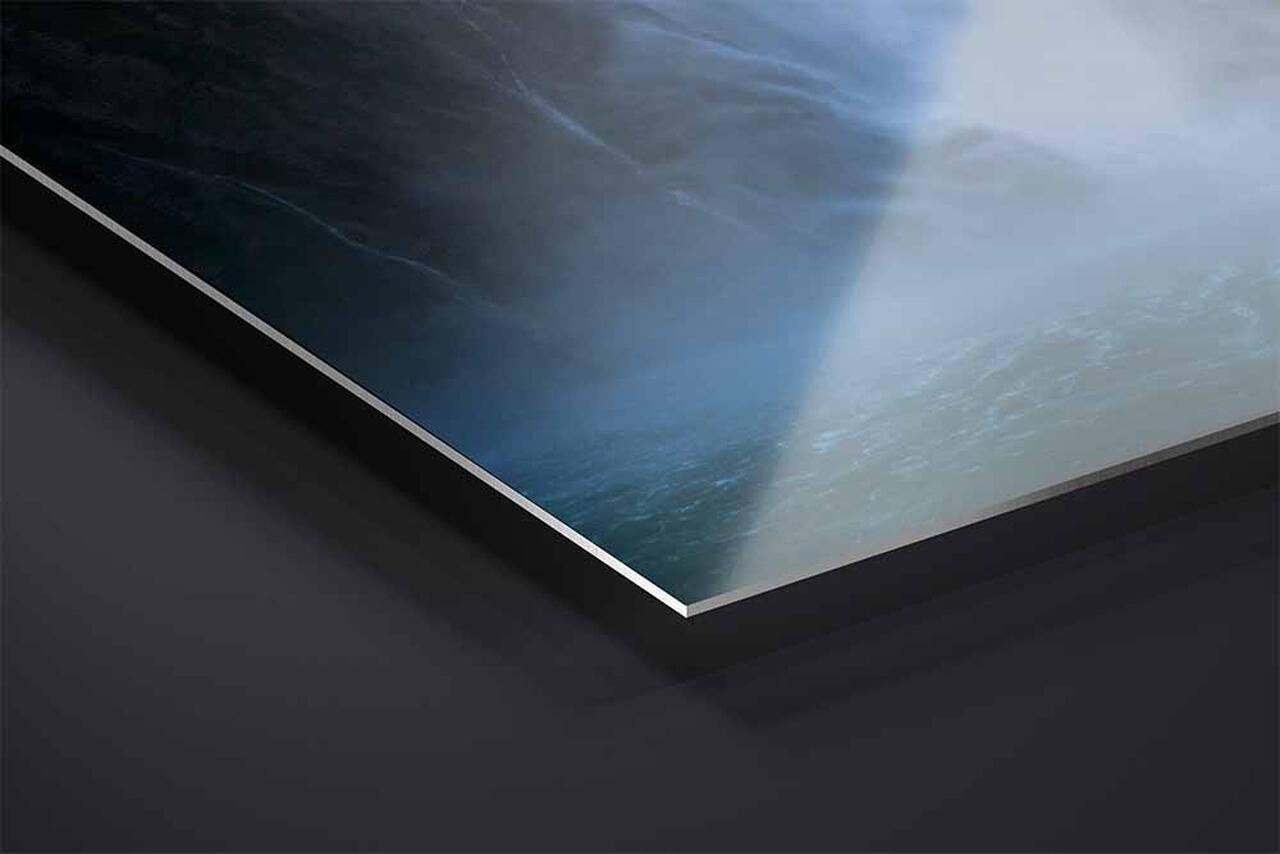
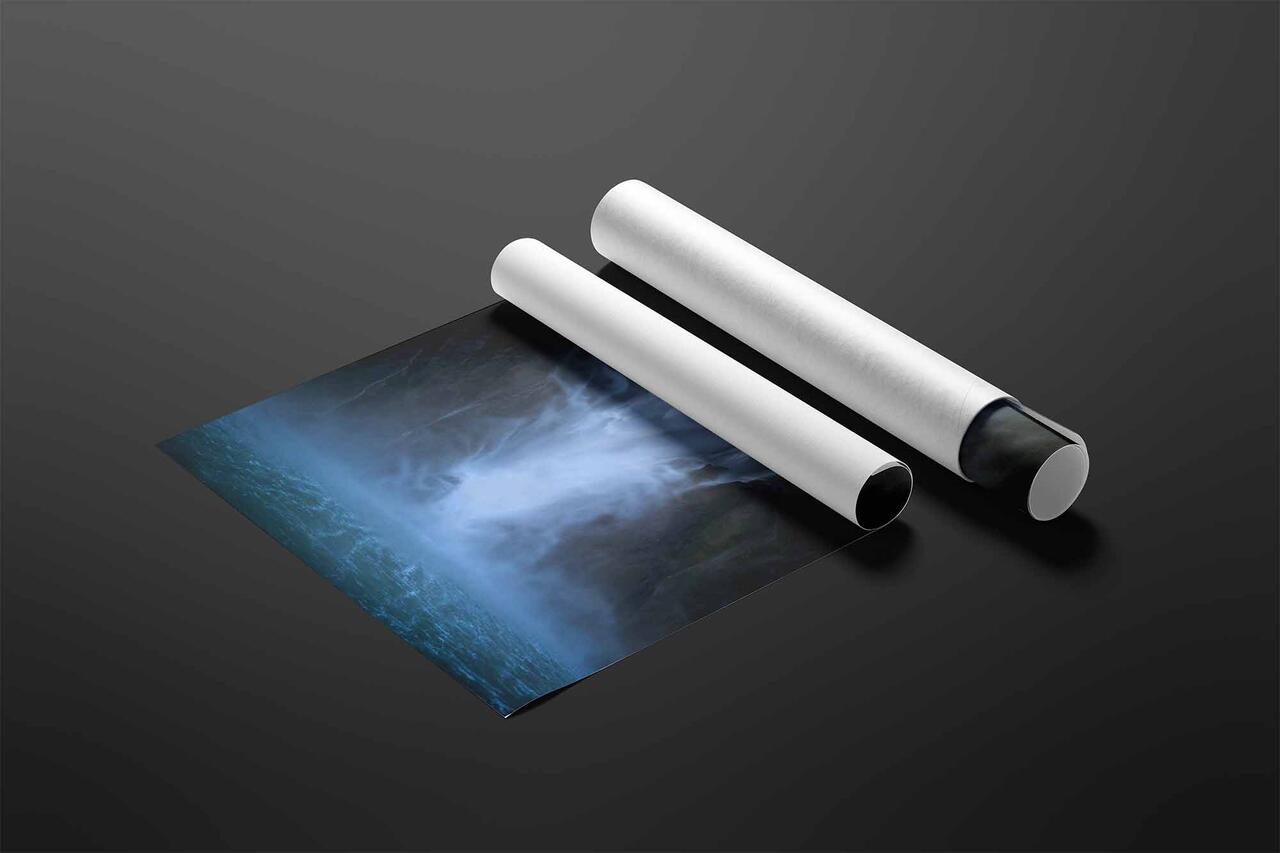
A 4:5 vertical photograph of the impact zone at the base of Stirling Falls, Milford Sound, New Zealand, available as a limited edition print.
Artist's Story
At the base of Stirling Falls, in Milford Sound in the Fiordland mountains of New Zealand's South Island, the cruise boats push right in under the water. A storm had come through overnight, the falls were running as hard as I had ever seen, and the air at the bottom was more spray than air.
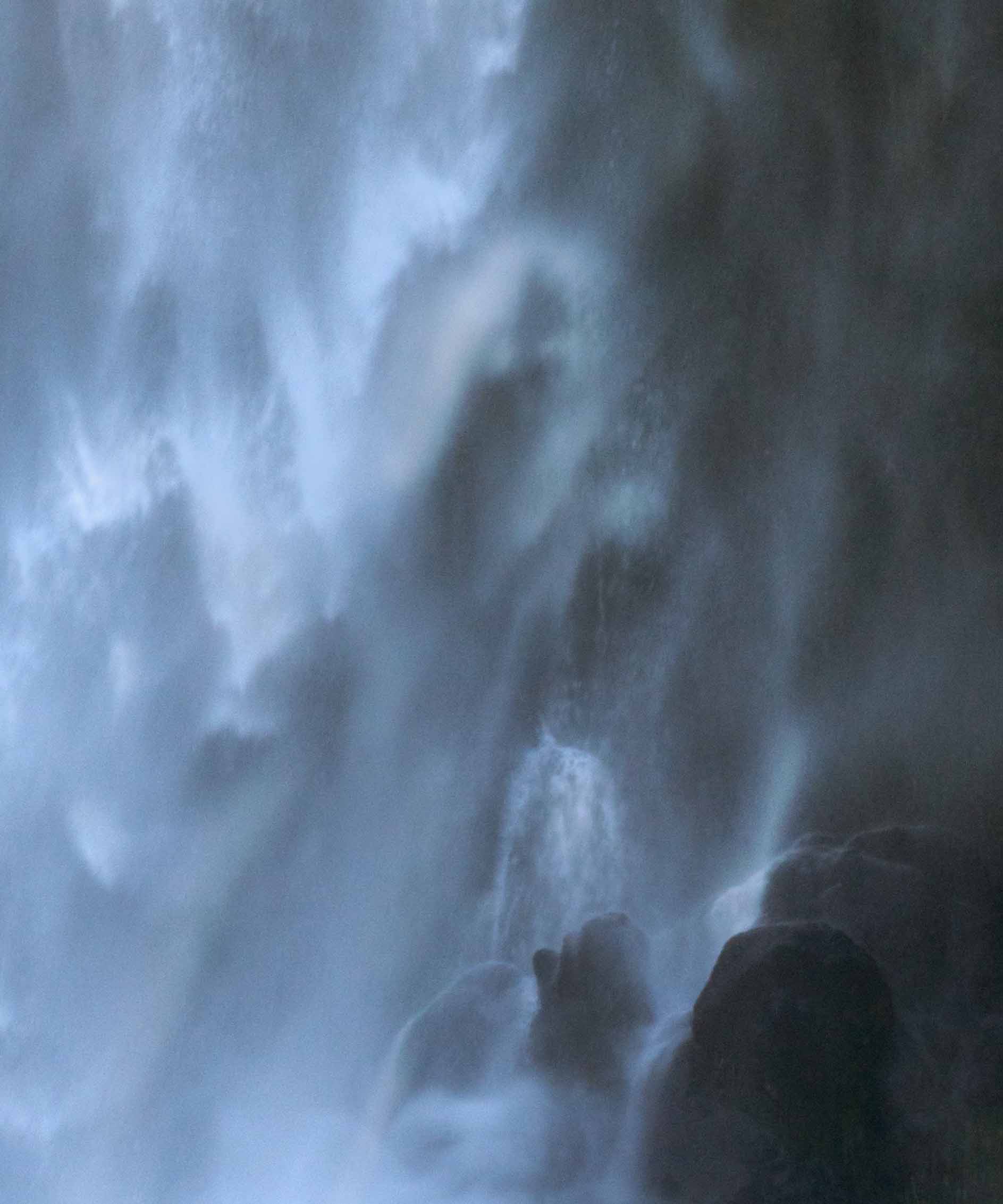
I shot into it more or less blind, the lens wet, the boat moving, with a slow enough shutter to hold the chaos still. It was only later, on a screen, that I saw the figure. Centered in the cascade, arms out, unmistakable.
Here is the honest part. It was never there. Not the way a rock or a tree is there. The water in that impact zone was pure turbulence, a different shape every fraction of a second, and no single instant of it looked like a figure. What the long exposure did was average all those instants together, and the average, smoothed and blurred, is what resolved into a form. My visual system, tuned as everyone's is to find a human shape faster than almost anything else, did the rest. Nothing was added and nothing was combined; this is one frame, and the figure arrived in it on its own. The apparition is real in the photograph and was never real in the falls. A machine that sees time differently than an eye went into a place too violent to look at directly, and this is what it brought back.
The Apparition is that figure, assembled out of several seconds of falling water by an exposure long enough to see what no glance could.
A long exposure averages what moves, and the average is not always what was there. I made another photograph of water that turns on the same idea, where the averaging produced a shape the creek had spent twelve thousand years cutting. That one is Finding the Way.
The figure, about two fifths of the frame width. The head sits just right of center under a pale arc of spray, with the shoulders falling away on either side. Closer in you can also see the separate veils of water passing through it. Click to view at full size.
About This Photograph
Photographed at the base of Stirling Falls in Milford Sound, in Fiordland National Park on the South Island of New Zealand, after heavy overnight rain. This is a single frame long exposure, with no compositing and no elements added or removed. The subject is the impact zone, where the cascade meets the fiord in spray and turbulence, photographed from a cruise boat nosed into the base. Stirling Falls, also known as Waimanu Falls, drops about 155 meters and is one of only two permanent waterfalls in Milford Sound. The long exposure renders the moving water and mist as a smooth continuous form.
The Apparition
Steve Austinhttps://www.steveaustinphotography.com/
Location
Stirling Falls, Milford Sound, New Zealand
Subject
The impact zone at the base of the falls, in spray and turbulence
Capture
Single frame, long exposure from a boat, no compositing
Format
Photograph · vertical, 4:5
Sizes
16 × 20 in · 24 × 30 in · 32 × 40 in · 40 × 50 in
Print Media
TruLife Acrylic · ChromaLuxe Metal · Baryta paper
Edition
Limited, 25 / 50 / 100 by presentation
What it Does in a Room
A photograph that keeps resolving into a figure does something no landscape can. It looks back.
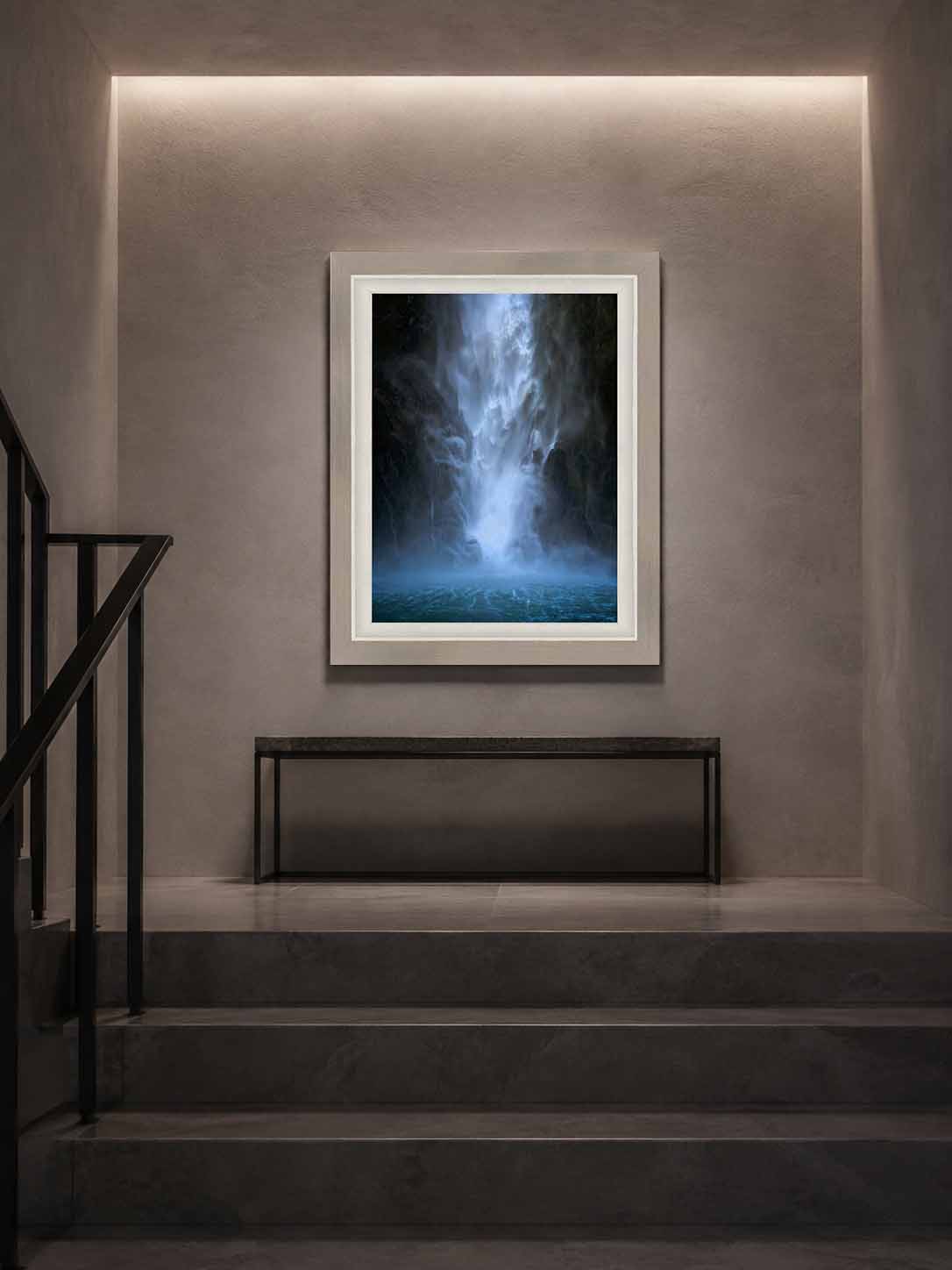
Four to five is an upright proportion without being narrow. Most rooms are built on horizontals: countertops, sofa backs, windowsills, the line where the wall meets the floor. A tall frame cuts across all of it, and that interruption is the point. Where a panorama settles into a room and extends it sideways, a vertical stops the eye and sends it up or down the length of the frame. At four to five the shape still has width enough to hold a scene rather than a sliver of one. Practically, it is the shape that fits where a wide piece will not: a chimney breast, the wall between two windows, a stairwell, a narrow entry. It does not need a long run of wall. It needs height.
Here the frame is a fall, and the eye goes down it. The water enters at the top, opens out through the middle, and lands in the dark fiord across the bottom. Hung at standing height that descent happens in front of you rather than on a wall. But this photograph does something else that matters more for a room. The figure is not always visible. Depending on the light, the distance, and how long you have been in the room, it appears and then stops appearing, and it never settles into being simply present or simply absent. That is a rare quality in a print. Most photographs are the same object every day. This one is not, and a piece that changes is a piece you keep looking at.
It is the coolest and one of the darkest photographs in the collection, running from near black in the rock walls through blue-grey spray to deep teal in the water below, with nothing in it approaching white. That makes it unusual to place. It will not brighten a room and it does not warm one. Against gray, slate, steel, plaster, and pale stone it belongs immediately and reads as depth in the wall. Against warm oak and walnut it becomes the one cool thing in the space, which works if that is what the room is missing and fights if it is not. What it rewards most is a light aimed at it and a room that is not bright, because there is no highlight in this picture to catch the sun and everything worth seeing sits in the middle and lower range.
Not sure which size the room calls for, or want dimensions not listed here? Sizes beyond 40 × 50 are available on request and ship crated by freight. That conversation is welcome before an order is placed. Start that conversation and I will answer within one business day.
The Apparition, limited edition printSteve Austin5509800USD15https://schema.org/InStock
Questions about this photograph
How small is too small for this photograph?
At four to five, the Intimate size is sixteen inches across and twenty inches tall. That is a small piece, and it works where a small piece belongs: a narrow entry, a bookshelf wall, a spot read from a few feet away rather than across a room. The figure holds at that size, which is the thing that matters, because it is made of large soft shapes rather than fine detail. What compresses is everything around it. The rock walls close in and lose their form, the individual threads of falling water blur into a single mass, and the churn on the fiord below becomes a flat band. The Collected at twenty-four by thirty is where the walls open back up. The Statement at thirty-two by forty and the Expansive at forty by fifty are where the fall regains its height, and at those sizes the figure stands closer to life size, which changes what the photograph is. If you are weighing a size against a specific wall, choosing the right print size covers the measurements and the viewing distances in more detail.
What changes at the largest size?
The evidence, which on this photograph is the whole question. At sixteen by twenty you take the story on trust. At forty by fifty you can check it. The spray resolves into separate streams and veils moving at different speeds, some of them crossing in front of others, and you can see that the figure is not an object in the water but a place where several of those veils happen to overlap. Follow any one of them and it passes straight through where an arm or a shoulder appeared to be. The rock behind resolves at the same time, wet and fissured, with moss holding on where the spray does not scour it. And the fiord along the bottom becomes visible as water taking a beating rather than as a dark band. The largest sizes do not make the apparition more convincing. They show you how it was made, and it is more interesting once you can see that. Why scale matters covers what happens perceptually when a landscape reaches the size where the eye has to travel across it.
What kind of room does this photograph suit?
Cool rooms, and quiet ones. This is the coolest photograph in the collection, running from near black rock through blue-grey spray to deep teal water, with nothing in it approaching white. Against gray, slate, steel, plaster, and pale stone it belongs immediately and reads as depth in the wall rather than as an object on it. Against warm oak and walnut it becomes the one cool element in the room, which works if that is what the space is missing. It will not brighten a room and it does not warm one, so this is a piece for somewhere already calm rather than somewhere that needs calming. What it rewards most is a light aimed at it, since there is no highlight here to catch daylight and everything worth seeing sits in the middle and lower range. It also rewards a wall people stand close to, because the figure comes and goes with distance and the closer view is where it stops being certain.
Every work ships insured and arrives with a signed certificate of authenticity.
If a piece is damaged in transit, the choice of replacement is always yours, and your edition number stays with you.
Production time runs 2 to 3 weeks for metal, 3 to 4 weeks for acrylic and paper, and 5 to 6 weeks for framed work.
Collector's Choice · TruLife ® Acrylic in Italian Frame
Collector Edition of 25· Lumachrome TruLife Acrylic · Handcrafted Italian Frame
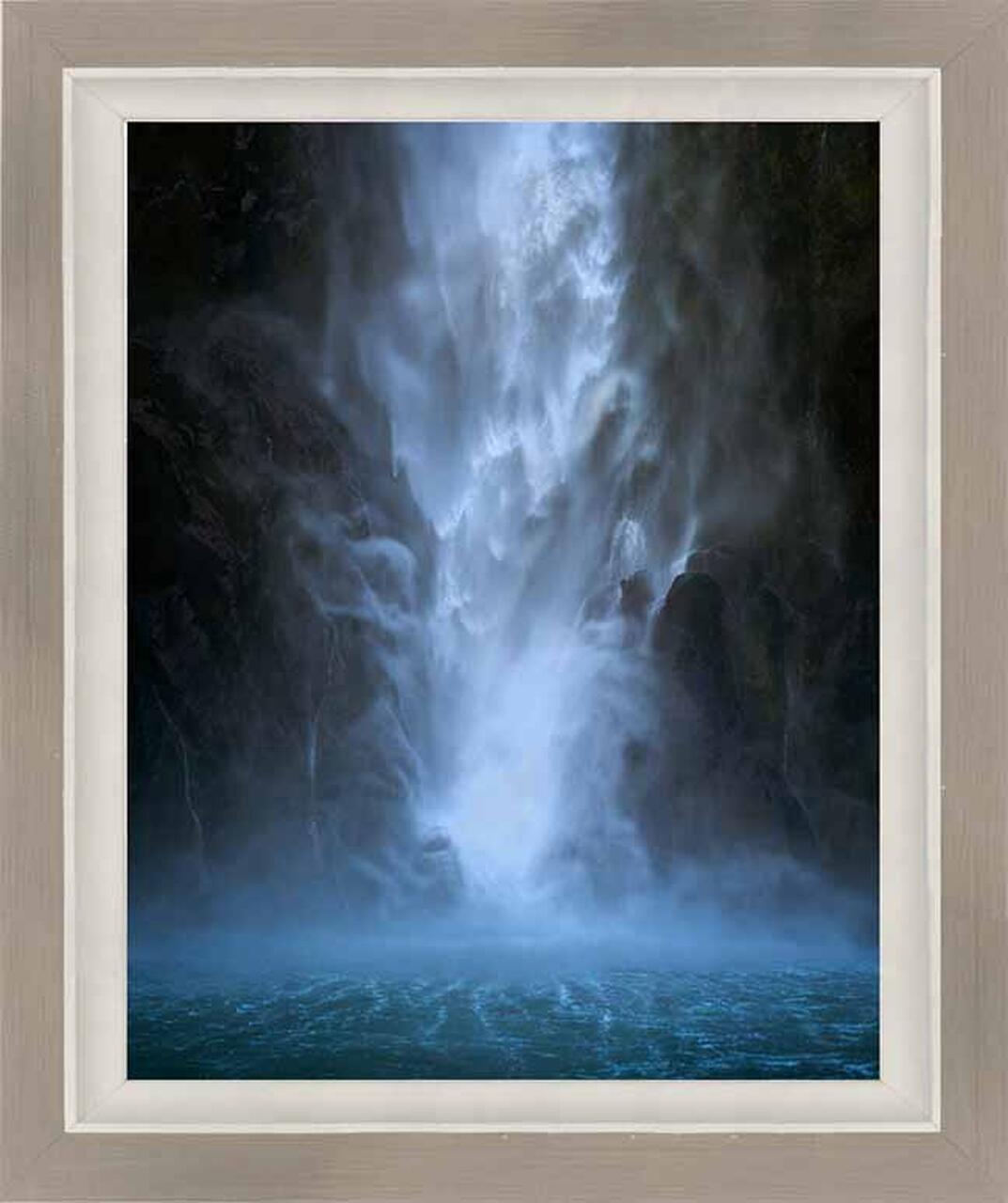
TruLife acrylic in a handcrafted Italian frame with a linen liner chosen for the image. Frame series, finish, and liner are settled with you after the order, and production begins from there. The frame and liner add about fourteen inches to the finished dimensions, worth allowing for when planning placement.
Signature Edition · TruLife ® Acrylic, Float Mount
Signature Edition of 50· Lumachrome TruLife Acrylic · Gallery Float Mount
Face-mounted to TruLife acrylic and floated approximately one inch from the wall, with no frame to mediate between the image and the room. UV-resistant, anti-reflective, and scratch-resistant, with a lifetime guarantee against fading.
Signature Edition of 50· ChromaLuxe Metal Print · Gallery Float Mount
Color infused into the aluminum panel itself, floated from the wall on a concealed system. Where acrylic produces luminosity, metal produces clarity. Exceptional fade resistance with no glazing or coating required.
Fine Art Edition of 100· Hahnemühle Baryta Fine Art Paper
Printed without acrylic, so light meets the paper surface directly. Highlights stay luminous, shadows keep their nuance, and the surface has a tactile quality the other presentations approach differently. The understated choice, and the traditional one.
Complimentary shipping within the continental United States. International collector shipping available upon request.
Still deciding
Designing for Stillness
A guide to choosing art for restorative spaces
How to tell whether an image will still hold you in a year, how scale changes what a photograph does in a room, and how to match a piece to the work a room actually performs. It cites the research it draws on, and it is equally clear about where that research stops. About ten minutes to read.