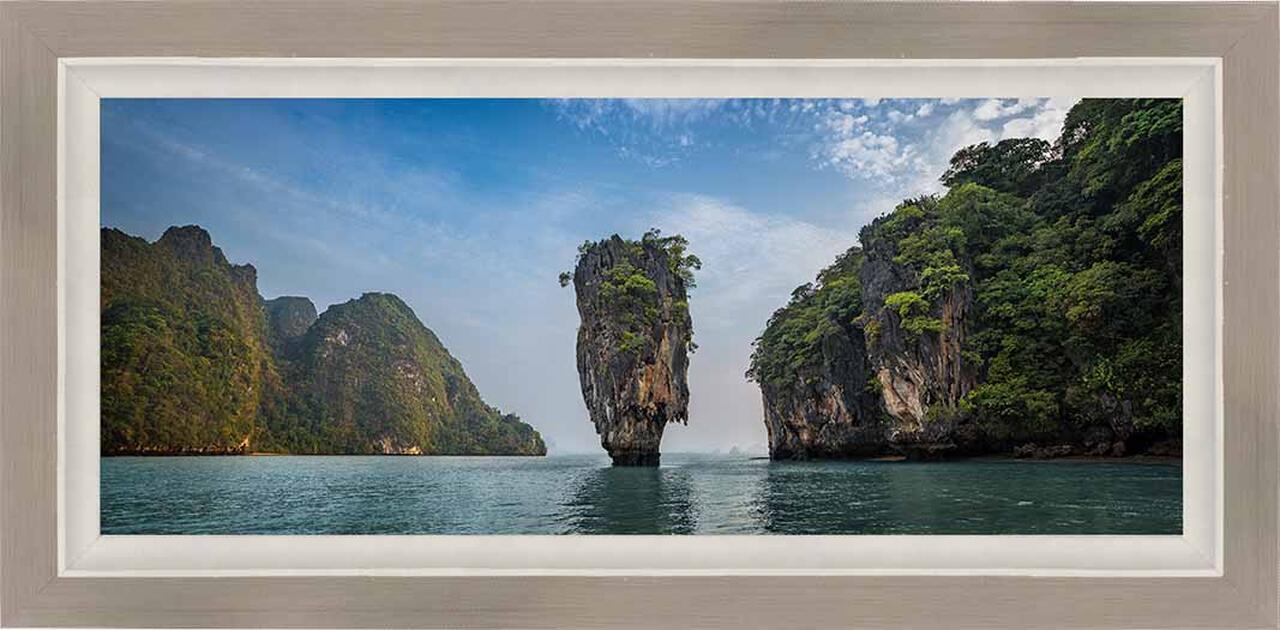
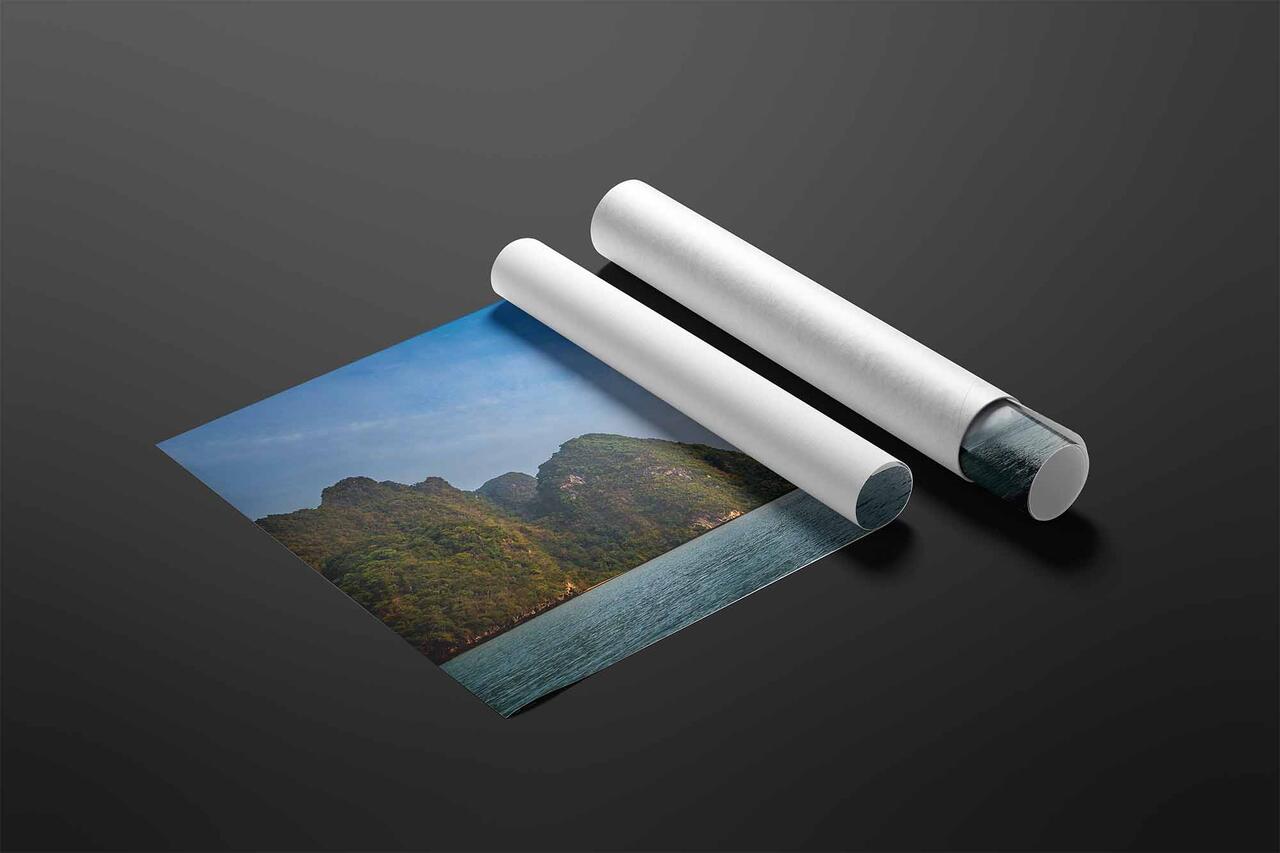
A 5:2 panoramic photograph of a limestone sea stack in morning light, Ko Tapu, Phang Nga Bay, Thailand, available as a limited edition print in three sizes and four presentations.
Artist's Story
In Phang Nga Bay, on the Andaman coast of southern Thailand, a limestone tower called Ko Tapu stands alone in open water, wider at its crown than at its base. That narrowing is the newest thing about it. The rock is Permian, laid down as reef long before anything walked on land, and it was cut into a tower by rainwater over tens of millions of years while all of this was still dry ground. The sea has only been here for ten thousand years. In that time it has undercut the base, season after season, offering every reason to surrender. And still it stands.
I photographed it from the water in the morning, the bay quiet, small trees holding on in the crown where nothing should be able to root. What struck me was not its drama, though the drama is undeniable. It was the quality of its presence. Unhurried. Unconcerned. Simply here.
There is something the mind does in the presence of things that have endured. It quiets. It recalibrates. It finds, briefly, a steadiness that the pace of modern life rarely offers.
Unbroken is an invitation to borrow that steadiness for a moment.
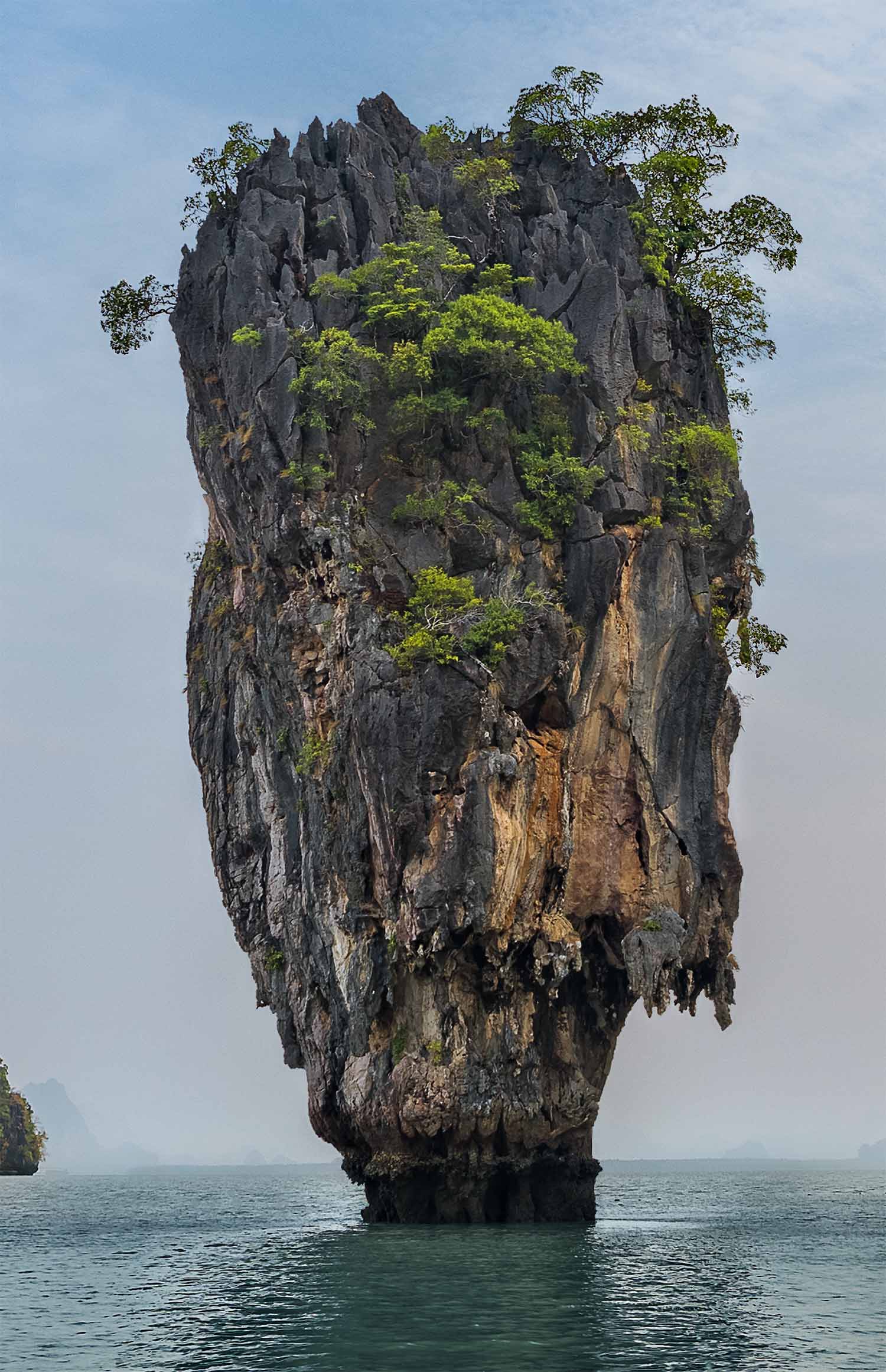
Detail at roughly one tenth of the frame width. The tide has cut into the base until the mass above it overhangs, and small trees have rooted in the crown and in the fissures below it. Click to view at full size.
About This Photograph
Photographed at Ko Tapu in Phang Nga Bay, Phang Nga Province, on the Andaman coast of southern Thailand, from a boat on the water in the middle of the morning. Made in a single frame.
The subject is Ko Tapu, nail island in Thai, a limestone sea stack roughly 20 meters tall standing about 40 meters off the shore of Khao Phing Kan. It narrows from about 8 meters across at the crown to about 4 meters at the waterline, where tidal erosion has undercut it. The rock is Permian limestone, originally reef, uplifted and then carved into a tower by rainwater over tens of millions of years before rising seas flooded the surrounding lowland roughly ten thousand years ago and made it an island.
Ko Tapu lies within Ao Phang Nga National Park, established in 1981. Neighboring Khao Phing Kan has been widely known as James Bond Island since it appeared in a 1974 film.
Unbroken
Steve Austinhttps://www.steveaustinphotography.com/
Location
Ko Tapu, Phang Nga Bay, Thailand
Subject
The Ko Tapu sea stack
Capture
Single frame in morning light
Format
Photograph · horizontal panorama, 5:2
Sizes
40 × 16 in · 60 × 24 in · 80 × 32 in
Print Media
TruLife Acrylic · ChromaLuxe Metal · Baryta paper
Edition
Limited, 25 / 50 / 100 by presentation
What it Does in a Room
A panorama usually asks the eye to travel sideways. This one puts a vertical object at the center of a very wide frame and stops it.
That contradiction is the effect. The two karst headlands run inward from both edges, the water runs flat across the bottom, and everything horizontal in the composition leads to a tower that goes the other way. The eye arrives at the center and turns, which is a small thing to happen on a wall but it is the reason the photograph holds rather than scanning past.
It is also the calmest photograph in temperament. Blue sky, gray green water, dark green foliage, gray limestone, and nothing saturated or hard anywhere in it. The contrast is gentle throughout with no deep black and no bright highlight. That makes it easy to live with and easy to place, and it means the image will not compete with a room that already has a lot going on.
What it wants is a wall wide enough to let the horizontal run. At two and a half to one this is one of the longest frames in the collection, and squeezing it into a space where the ends nearly touch furniture or trim will collapse the openness the composition depends on. Given the run, it reads like a view.
Not sure which size the room calls for, or want dimensions not listed here? Sizes beyond 60 × 32 are available on request and ship crated by freight. That conversation is welcome before an order is placed. Start that conversation and I will answer within one business day.
How small is too small for a photograph this wide?
At two to five, the Intimate size is forty inches across and sixteen inches tall. That is a gentler proportion than a true three to one, so it holds together better in a smaller space, but it is still a wide piece and it still asks for a wall that can give it room. On most walls the Intimate reads as a horizontal accent rather than a focal point, which suits a hallway, a stairwell landing, or a space above a low console. The Collected and Statement sizes are where the width does the real work. If you are weighing a size against a specific wall, choosing the right print size covers the measurements and the viewing distances in more detail.
What changes at the largest size?
The base of the tower is the whole question. The page tells you Ko Tapu is wider at its crown than at its waterline, that the sea has been cutting into it for ten thousand years, and at sixteen inches tall you take that on trust. The rock meets the water and the meeting is a dark area. At thirty two inches tall you can see it. The notch where the tide has worked in is visible as an actual undercut, the mass above it clearly overhangs, and the stalactite forms hanging from the underside separate into individual shapes. The thing the photograph is arguing about stops being a claim and becomes something you can look at. The trees in the crown do the same at that size, resolving from a green mass into separate small trees rooted in stone. Why scale matters covers what happens perceptually when a landscape reaches the size where the eye has to travel across it.
What kind of room does this photograph suit?
This is one of the easier photographs in the collection to place. Blue sky, gray green water, gray limestone, and dark green foliage, all of it soft, none of it saturated, with no deep black and no bright highlight anywhere in the frame. It will not set a room's palette and it will not fight one. Against cool grays and whites it sits naturally. Against warm wood and linen the greens and grays cool the room slightly without arguing with it.
What it does need is width. At two and a half to one this is among the longest frames offered, and the composition depends on the two headlands having room to run in from the edges. On a wall where the ends sit close to a door frame or a cabinet, that openness closes up and the photograph reads as crowded rather than as a view. Given the run, it does the opposite.
Every work ships insured and arrives with a signed certificate of authenticity.
If a piece is damaged in transit, the choice of replacement is always yours, and your edition number stays with you.
Production time runs 2 to 3 weeks for metal, 3 to 4 weeks for acrylic and paper, and 5 to 6 weeks for framed work.
Each print is made to order and takes its place in a numbered edition, so sales are final. Before you choose, I am glad to help: send a photo of your wall and I will show you this work in your room at true scale, at no charge. Start a conversation
Collector's Choice · TruLife ® Acrylic in Italian Frame
Collector Edition of 25· Lumachrome TruLife Acrylic · Handcrafted Italian Frame
TruLife acrylic in a handcrafted Italian frame with a linen liner chosen for the image. Frame series, finish, and liner are settled with you after the order, and production begins from there. The frame and liner add about fourteen inches to the finished dimensions, worth allowing for when planning placement.
Signature Acrylic Edition of 50· Lumachrome TruLife · Gallery Float Mount
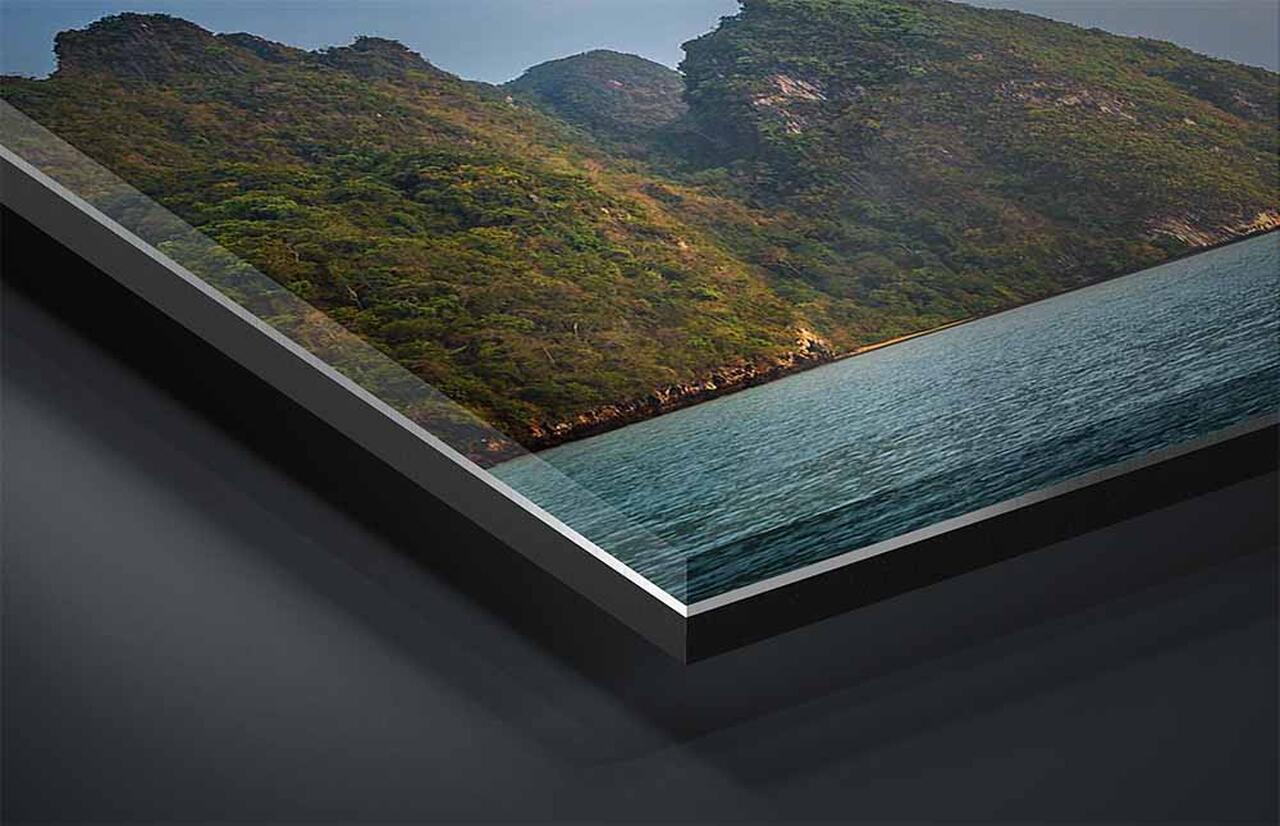
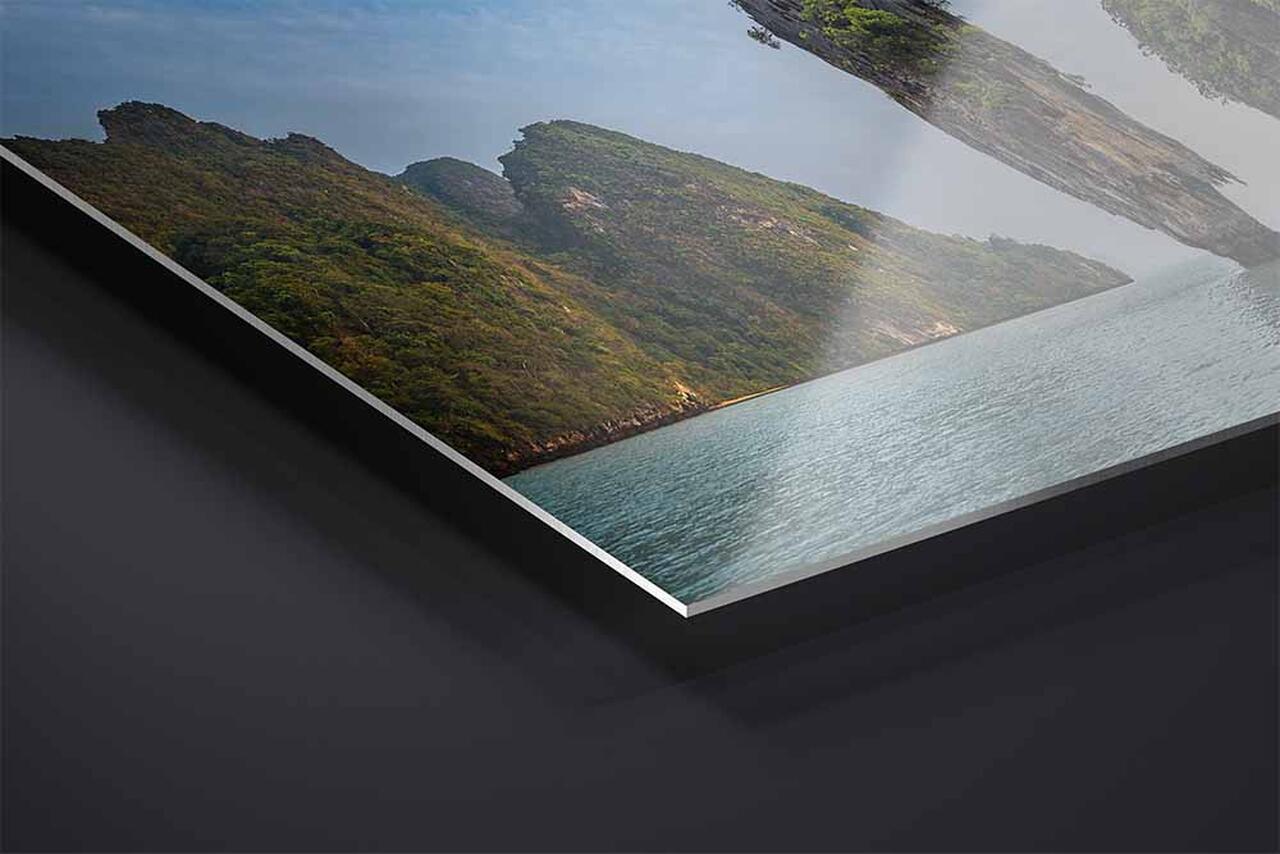
Face-mounted to TruLife acrylic and floated approximately one inch from the wall, with no frame to mediate between the image and the room. UV-resistant, anti-reflective, and scratch-resistant, with a lifetime guarantee against fading.
Signature Metal Edition of 50· ChromaLuxe Print · Gallery Float Mount
Color infused into the aluminum panel itself, floated from the wall on a concealed system. Where acrylic produces luminosity, metal produces clarity. Exceptional fade resistance with no glazing or coating required.
Fine Art Edition of 100· Hahnemühle Baryta Fine Art Paper
Printed without acrylic, so light meets the paper surface directly. Highlights stay luminous, shadows keep their nuance, and the surface has a tactile quality the other presentations approach differently. The understated choice, and the traditional one.
Complimentary shipping within the continental United States. International collector shipping available upon request.
Still deciding
Designing for Stillness
A guide to choosing art for restorative spaces
How to tell whether an image will still hold you in a year, how scale changes what a photograph does in a room, and how to match a piece to the work a room actually performs. It cites the research it draws on, and it is equally clear about where that research stops. About ten minutes to read.