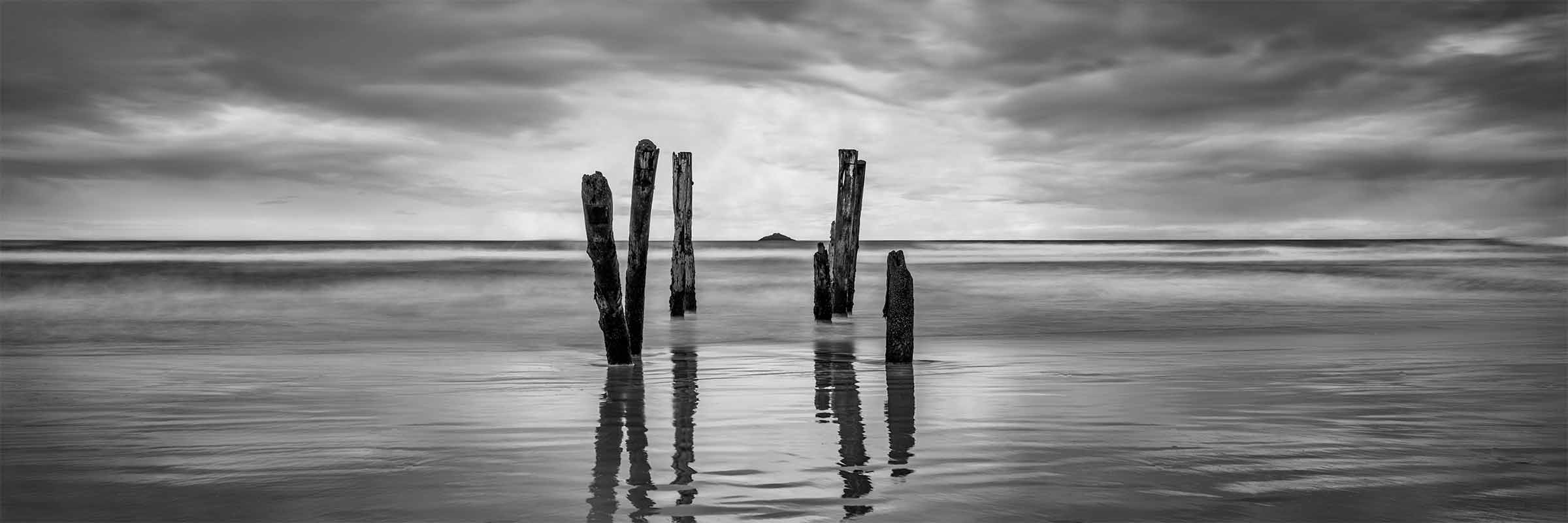
A 3:1 panoramic photograph of the St Clair Beach poles in black and white in Dunedin, New Zealand, available as a limited edition print in three sizes.
Artist's Story
At St Clair Beach in Dunedin, on the south coast of New Zealand's South Island, five weathered posts stand in the shallows with three shorter stumps between them. They are usually taken for the remains of an old pier. They are not. They are what is left of a groyne, driven into the sand in 1902.
I made this on a still gray morning, a long exposure smoothing the water to match the flat overcast, the horizon barely there.
A groyne does not hold the sea back. Waves arrive at an angle and carry sand along the beach as they break, and a line of piles set across that drift catches what the water is already moving. Sand banks up on one side. That is the whole design. These posts were never a wall. They were a comb.
It worked. St Clair stayed a wide beach for decades on the strength of it. What the timber could not survive was being left alone. By 1919 a government engineer was already complaining that nothing had been done to maintain the groynes, and not much was done after that either. The sea took them back one pole at a time over the following century, until heavy swells in June 2022 left a single post standing and July took that one too.
Color would have made this a specific gray morning in Dunedin. Without it the morning goes and the posts and the water stay, which is closer to what the picture is about.
What Remains is that line on a morning most of it was still up. A structure built to catch what the sea was carrying, photographed from inside the water that eventually carried it off.
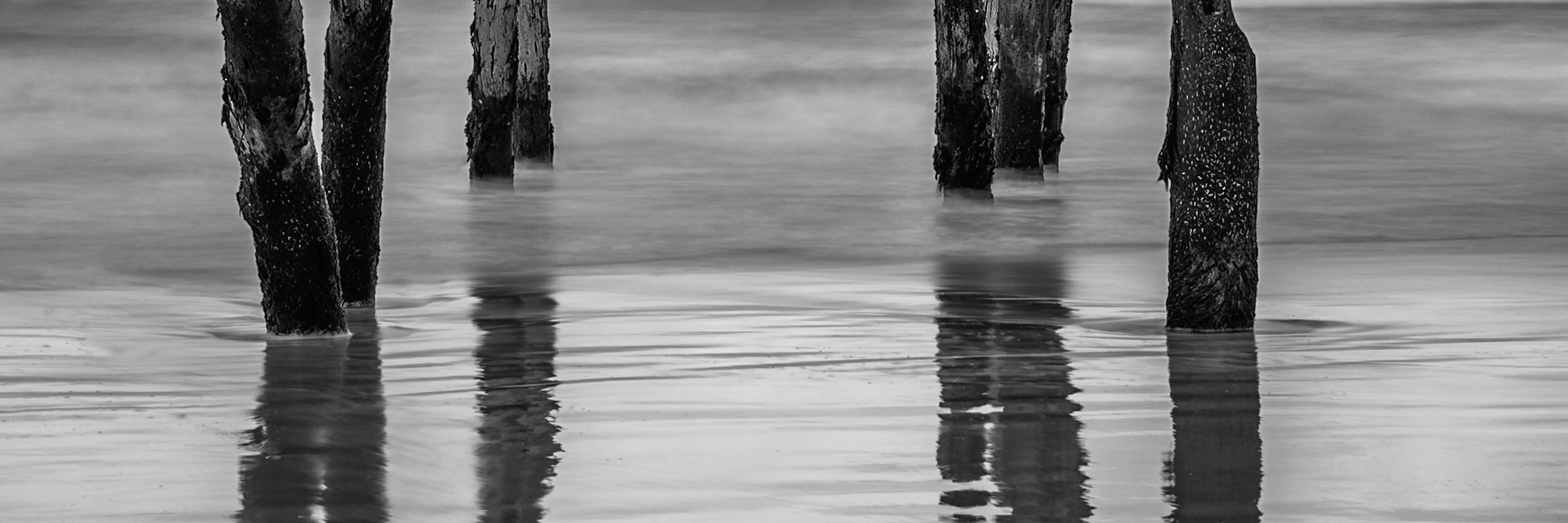
The waterline at about one third of the frame width. On a ninety inch print this section runs roughly twenty-eight inches across. The growth crusting the posts resolves into individual shells, the splits open along the grain, and the reflections separate from the water holding them. Click to view at full size.
About This Photograph
Photographed at St Clair Beach in Dunedin, on the Otago coast of New Zealand's South Island, on an overcast morning. This is a single frame long exposure, rendered in black and white. The subject is the remains of the St Clair groyne, a line of timber piles set across the beach to trap sand moving along the shore, commonly mistaken for an old pier.
White Island sits on the horizon between the poles. The long exposure smooths water and sky to a near-uniform tone and puts the horizon at just under half the frame height.
Groynes were introduced at St Clair in 1902, and the piles photographed here were erected between 1902 and 1906. Their effect on the beach has been argued over in Dunedin ever since. The line dwindled through the following century, and the last pole washed away in July 2022.
What Remains
Steve Austinhttps://www.steveaustinphotography.com/
Location
St Clair Beach, Dunedin, New Zealand
Subject
St Clair poles · groyne remains · White Island
Capture
Single frame long exposure
Format
Photograph · horizontal panorama, 3:1
Sizes
36 × 12 in · 60 × 20 in · 90 × 30 in
Print Media
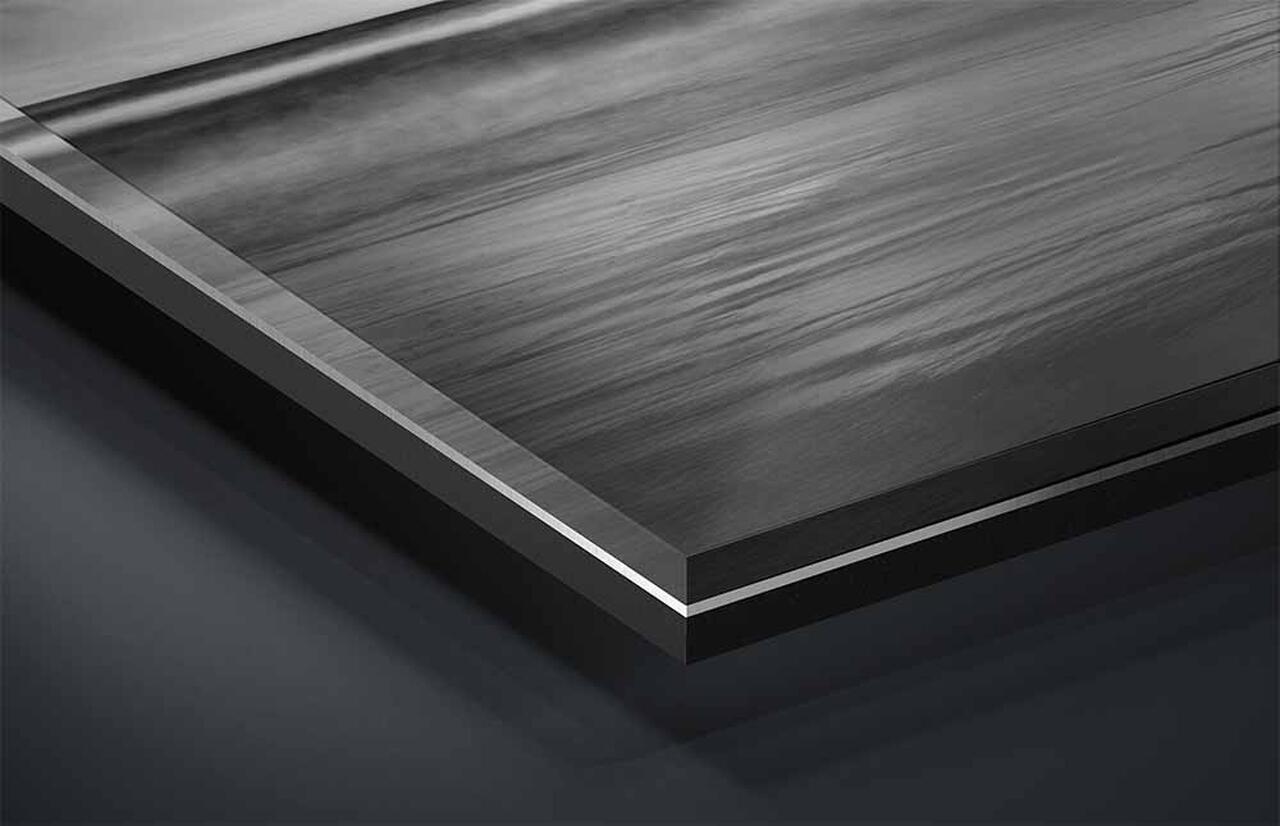
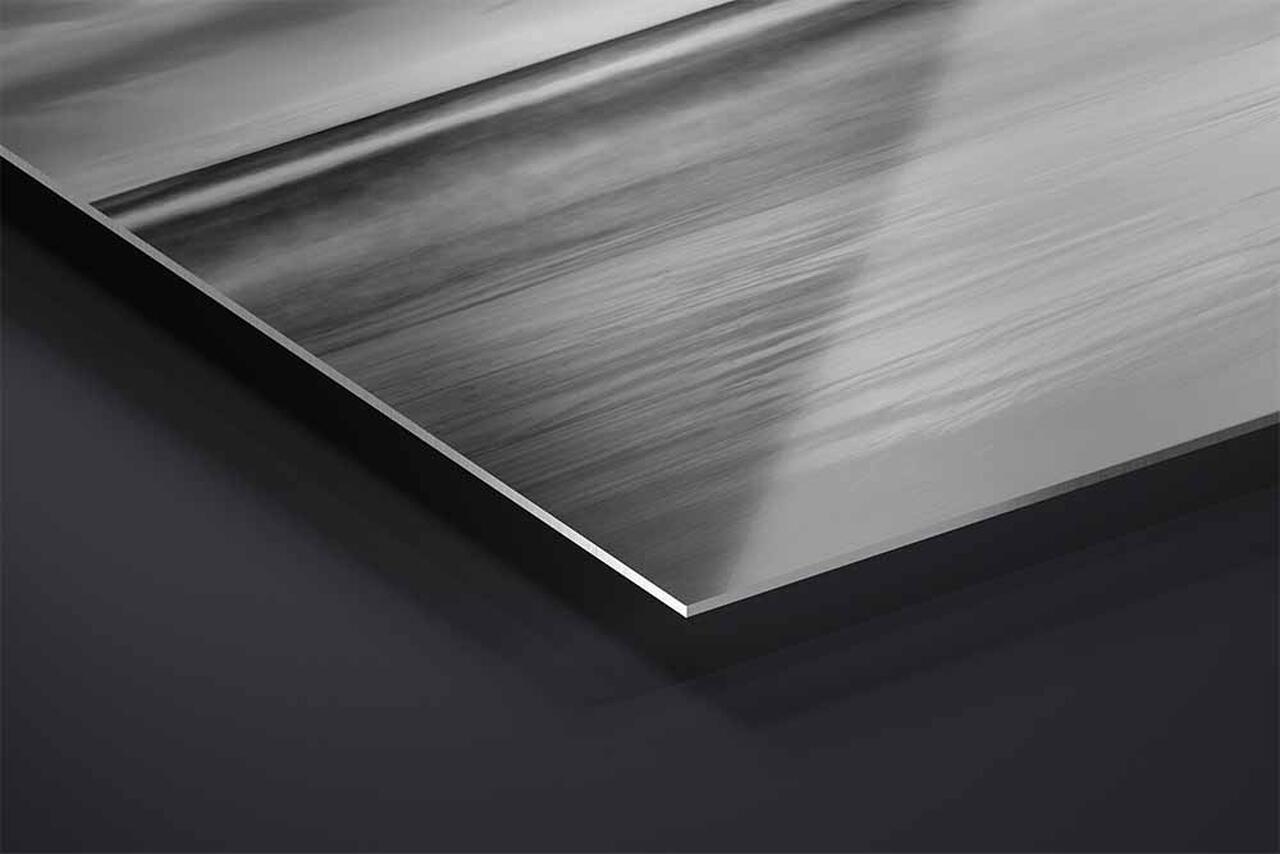
TruLife Acrylic · ChromaLuxe Metal · Baryta paper
Edition
Limited, 25 / 50 / 100 by presentation
What it Does in a Room
This image is neutral to the decimal. Red, green, and blue run identical through the whole range, with no split toning in the shadows or the highlights. That means the print has no temperature of its own and takes whatever the room gives it. Under warm lamps it reads warm gray. In north light it goes cool and slightly blue. The same print behaves like two different pictures in two different rooms, and both are worth seeing before it is hung for good.
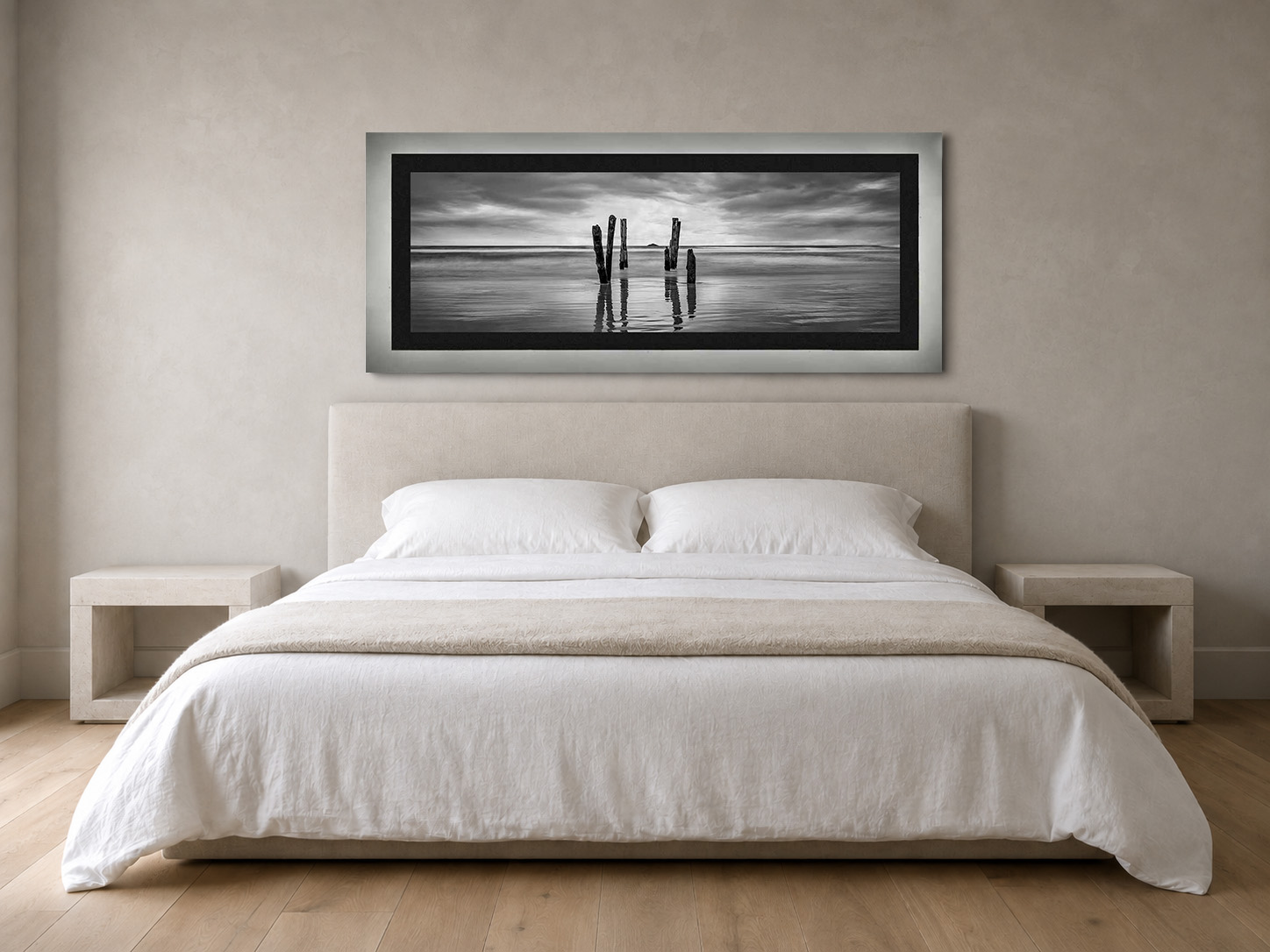
Most of the panel is empty. The posts occupy the middle fifth of the width and the rest is water, sand, and sky. On a large wall that emptiness is the point. Where a dense picture fills a wall, this one gives it somewhere to rest, and the wall reads as larger with the print on it than without. It works next to things rather than in place of them.
The tones sit in the middle. There is no heavy black and no blown highlight, so the picture holds together in low light instead of going muddy the way a dark print does. That suits a room used in the evening, and it means the piece does not need a light aimed at it to do its work.
Not sure which size the room calls for, or want dimensions not listed here? Sizes beyond 90 × 30 are available on request and ship crated by freight. That conversation is welcome before an order is placed. Start that conversation and I will answer within one business day.
What Remains, limited edition printSteve Austin70012900USD11https://schema.org/InStock
Questions about this photograph
How small is too small for a photograph this wide?
At three to one, the smallest size in this family is thirty-six inches across and twelve inches tall. This photograph survives that better than most, because it is built from tone rather than from detail. The horizon, the band of smoothed water, and the wet sand below it all read at any size. What gets small is the subject. The posts occupy the middle fifth of the width, so at thirty-six inches they span about seven inches and the tallest stands under four. They become marks on a horizon rather than timbers you could put a hand on, which is a real picture and a quiet one, and it suits a narrow wall, a stair, or a space above a doorway. At sixty by twenty the grain and the growth on the posts begin to arrive and they read as objects again. If you are weighing a size against a specific wall, choosing the right print size covers the measurements and the viewing distances in more detail.
What changes at the largest size?
The posts stop being shapes and become wood. At ninety by thirty the cluster runs about nineteen inches across and the tallest post stands close to nine, which is enough to see the splitting along the grain, the encrustation at the waterline where the tide has worked on them longest. The reflections in the wet sand resolve at the same width, from soft gray streaks into legible upside-down posts. The emptiness changes too, and this is the part that only happens at size. Thirty-seven percent of the frame lies to the left of the posts and forty-two percent to the right, so on a seven and a half foot panel there are close to three feet of open water on either side of the subject. The eye has to cross that distance, and crossing it is what makes the cluster read as far out rather than nearby. Why scale matters covers what happens perceptually when a landscape reaches the size where the eye has to cross it.
What kind of room does this photograph suit?
Almost any of them, and that is a function of the neutrality rather than a claim about the picture. With no color of its own it sits with gray, plaster, stone, and steel as easily as it sits with oak and walnut, and it will not fight a room that already has a palette. Where it does its clearest work is a room meant for rest. A bedroom, a study, a reading corner, a hallway between the two. The picture asks for nothing, holds still, and gives the eye somewhere flat to go, which is worth more in a space you occupy for an hour than in one you pass through in seconds. It also pairs well with a warm piece on an adjacent wall, since the two do opposite things and neither has to win. Where Attention Holds takes the question further.
Every work ships insured and arrives with a signed certificate of authenticity.
If a piece is damaged in transit, the choice of replacement is always yours, and your edition number stays with you.
Production time runs 2 to 3 weeks for metal, 3 to 4 weeks for acrylic and paper, and 5 to 6 weeks for framed work.
Each print is made to order and takes its place in a numbered edition, so sales are final. Before you choose, I am glad to help: send a photo of your wall and I will show you this work in your room at true scale, at no charge. Start a conversation
Collector's Choice · TruLife ® Acrylic in Italian Frame
Collector Edition of 25· Lumachrome TruLife Acrylic · Handcrafted Italian Frame
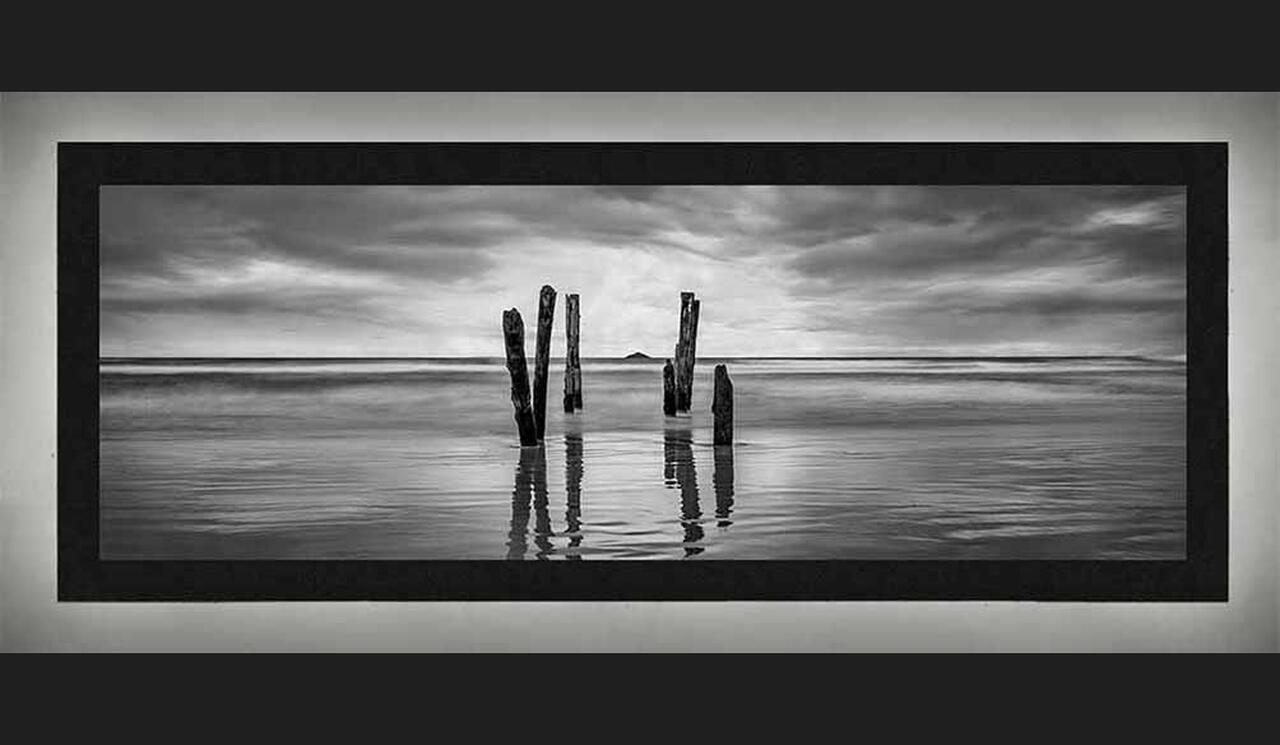
TruLife acrylic in a handcrafted Italian frame with a linen liner chosen for the image. Frame series, finish, and liner are settled with you after the order, and production begins from there. The frame and liner add about fourteen inches to the finished dimensions, worth allowing for when planning placement.
Signature Acrylic Edition of 50· Lumachrome TruLife · Gallery Float Mount
Face-mounted to TruLife acrylic and floated approximately one inch from the wall, with no frame to mediate between the image and the room. UV-resistant, anti-reflective, and scratch-resistant, with a lifetime guarantee against fading.
Signature Metal Edition of 50· ChromaLuxe Print · Gallery Float Mount
Color infused into the aluminum panel itself, floated from the wall on a concealed system. Where acrylic produces luminosity, metal produces clarity. Exceptional fade resistance with no glazing or coating required.
Fine Art Edition of 100· Hahnemühle Baryta Fine Art Paper
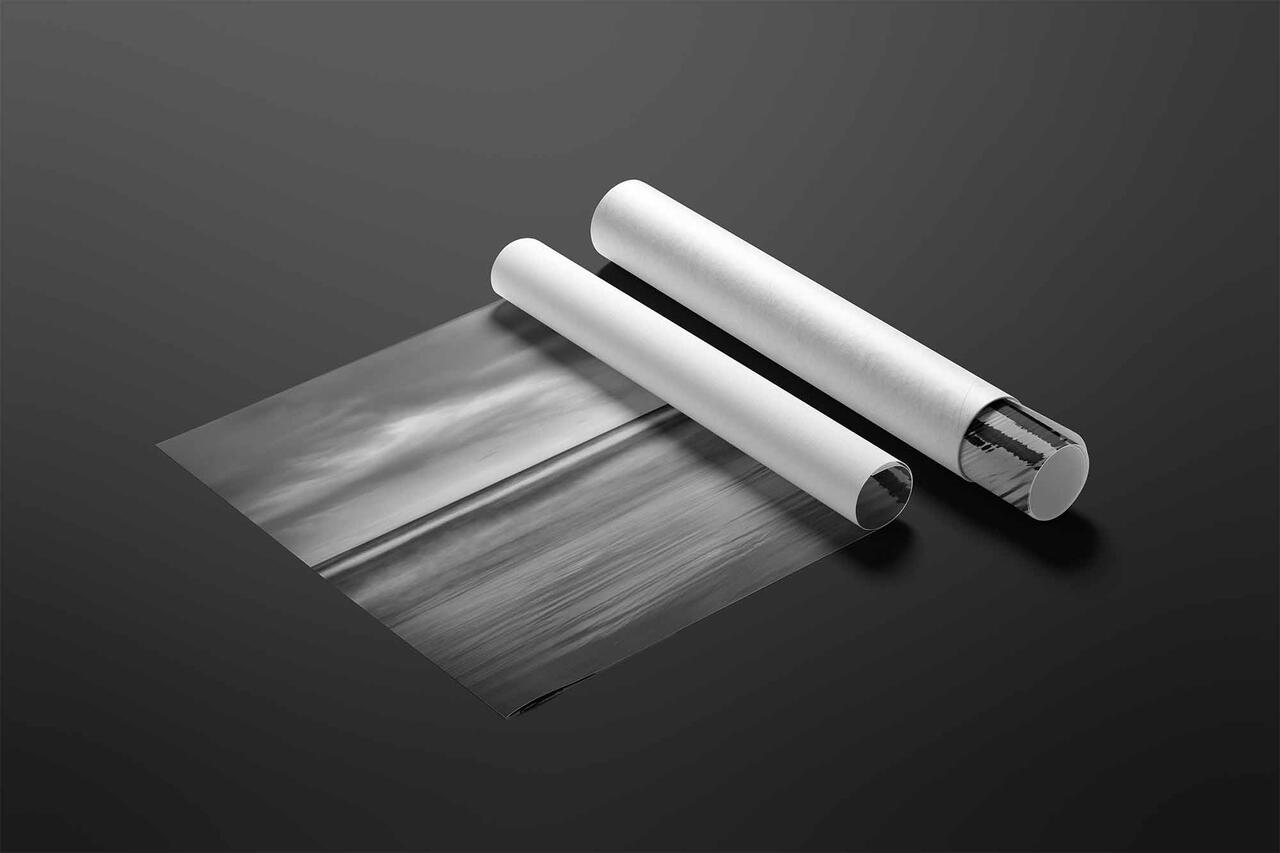
Printed without acrylic, so light meets the paper surface directly. Highlights stay luminous, shadows keep their nuance, and the surface has a tactile quality the other presentations approach differently. The understated choice, and the traditional one.
Complimentary shipping within the continental United States. International collector shipping available upon request.
Still deciding
Designing for Stillness
A guide to choosing art for restorative spaces
How to tell whether an image will still hold you in a year, how scale changes what a photograph does in a room, and how to match a piece to the work a room actually performs. It cites the research it draws on, and it is equally clear about where that research stops. About ten minutes to read.