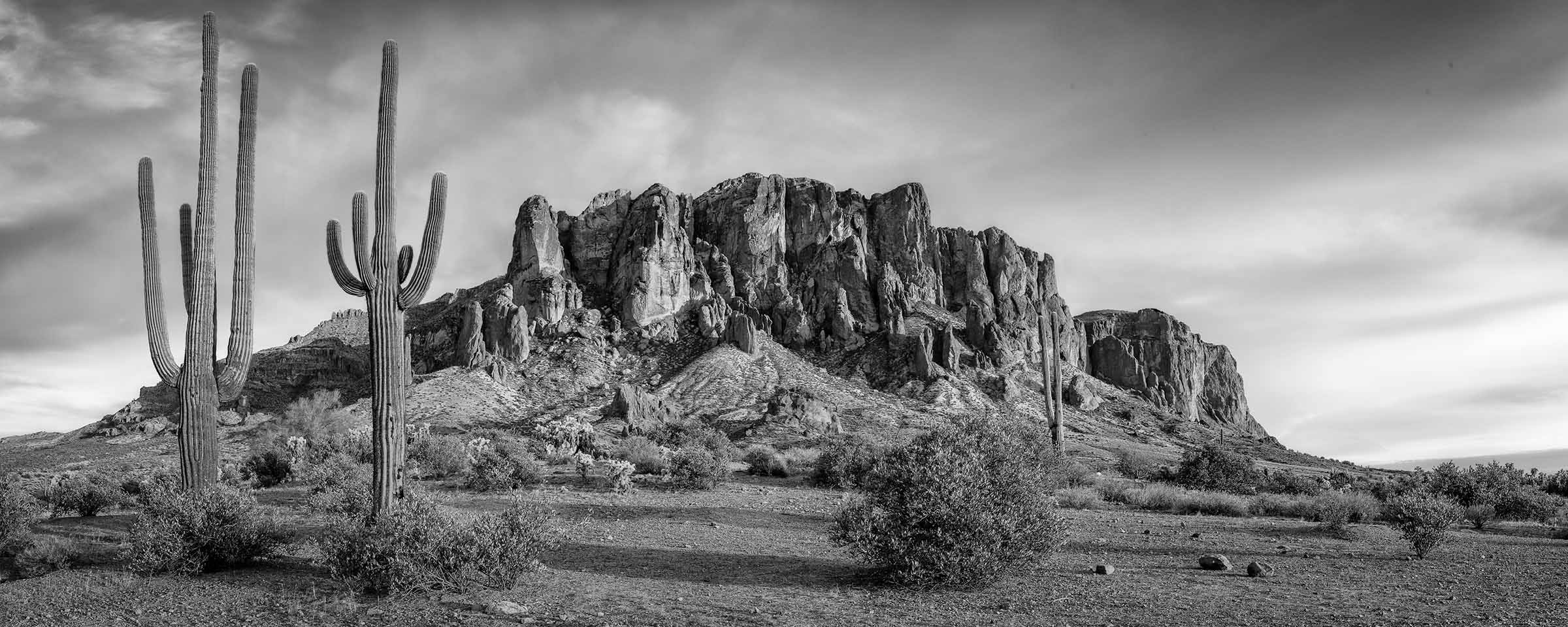
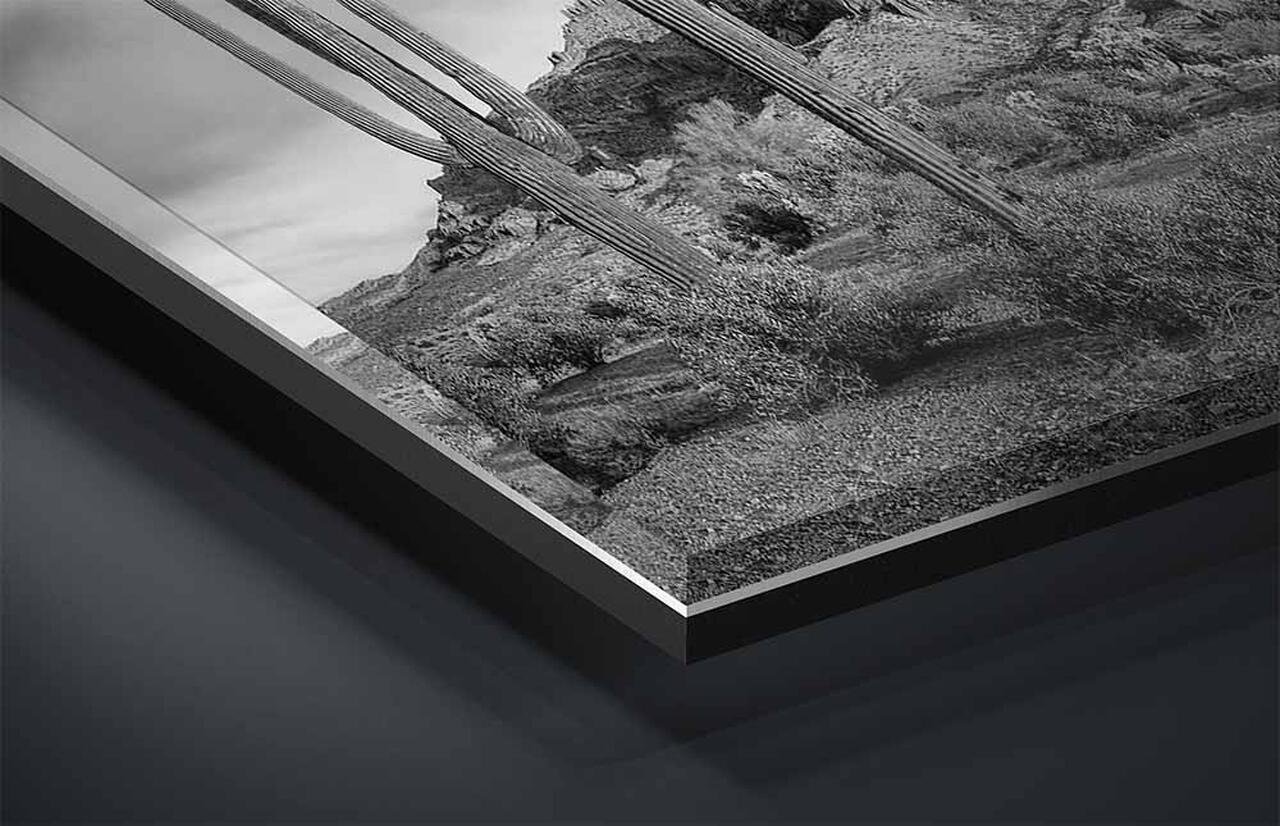
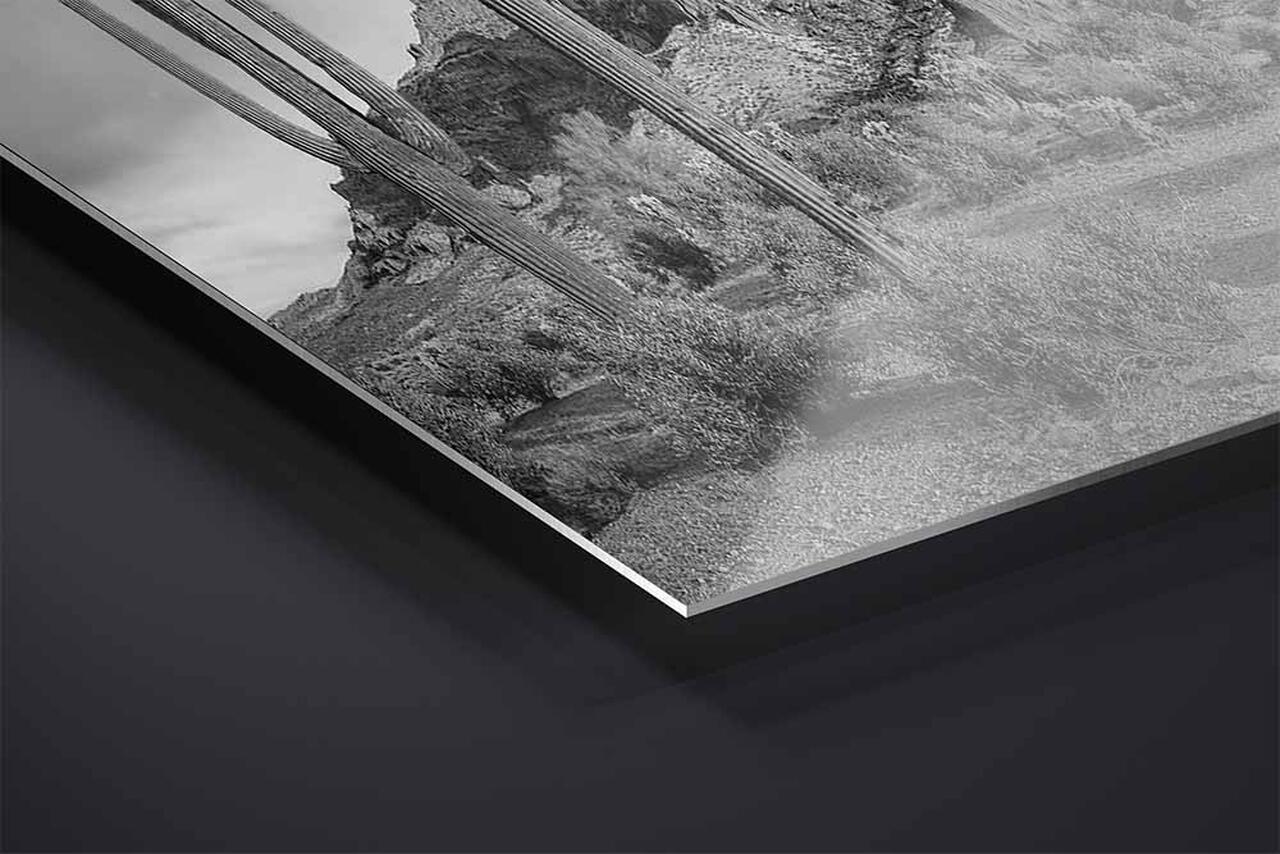
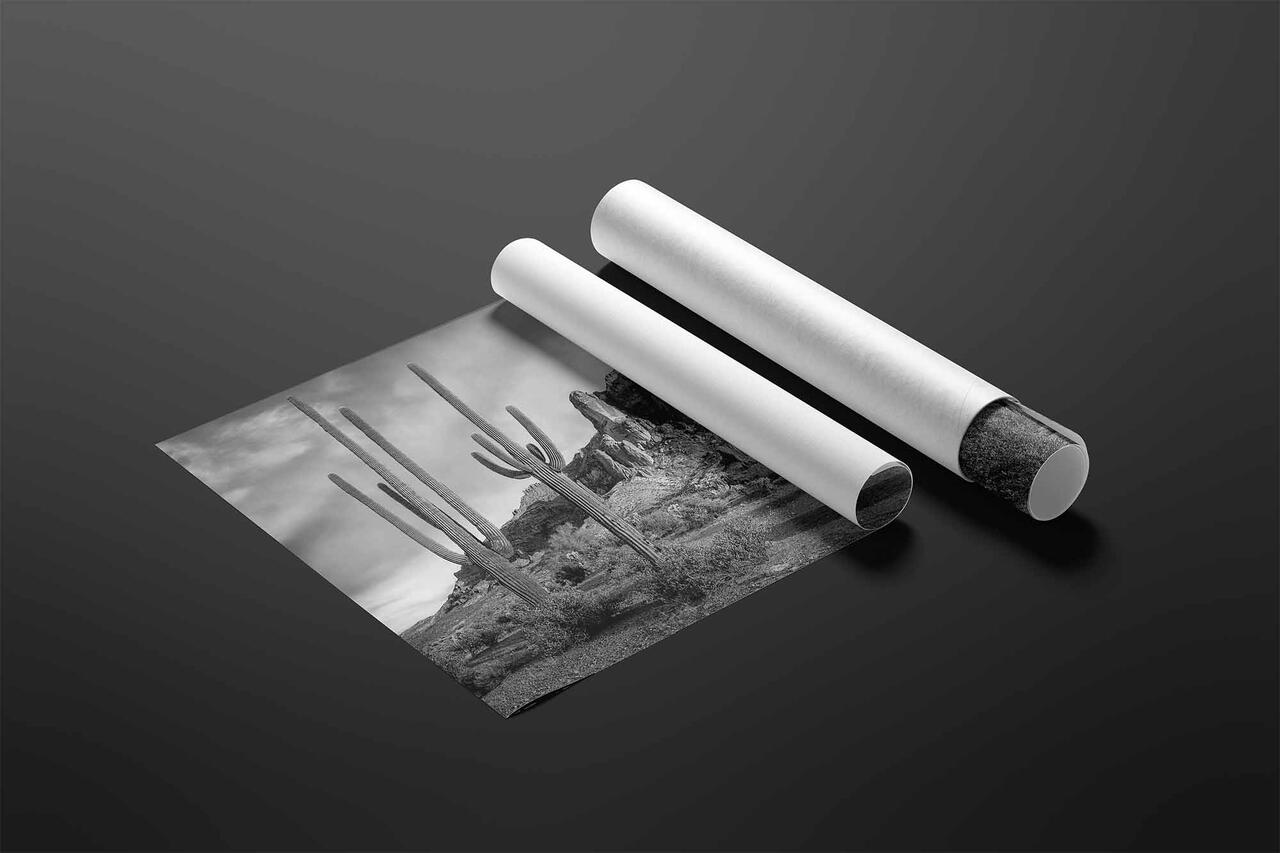
A 5:2 panoramic photograph of the Superstition Mountains in black and white near Phoenix, Arizona, available as a limited edition print in three sizes.
Artist's Story
They came looking for gold.
In the decades after the Civil War, prospectors moved into the Sonoran Desert with mules, hand drawn maps, and a particular kind of hope that the desert has never been especially kind to. The Superstition Mountains, rising abruptly from the flat east of Phoenix, were at the center of it. The legend of the Lost Dutchman's mine drew men in with the certainty that wealth was close, that the next canyon or the next ridge would show what everyone else had missed. Some of them found their way back out. Many did not.
The saguaros in the foreground were not here to watch it. A saguaro is about an inch tall at ten years old. It does not flower until it is thirty-five and does not put out its first arm until somewhere between fifty and seventy, later than that where the rain is thin. The ones standing here carry several arms each, which puts them past a century and a half and possibly close to two.
Do the arithmetic and it comes out the other way around from how it looks. When the prospectors were walking this ground, the largest of these was a young plant a few feet high with nothing on it, and the rest had not come up yet. Almost all of the growing you are looking at happened after the search was over.
This is black and white on purpose, and not for accuracy. The Southwest of that era was recorded on wet plate, glass negatives coated, exposed, and developed inside a few minutes in the back of a wagon before the collodion could dry. Color would place this picture firmly in the present. Without it, it sits nearer the decade the story belongs to.
Age Old Superstitions is the range, the flat in front of it, and a stand of saguaros that have outlasted everyone who came here to get rich. The mine has never been found.
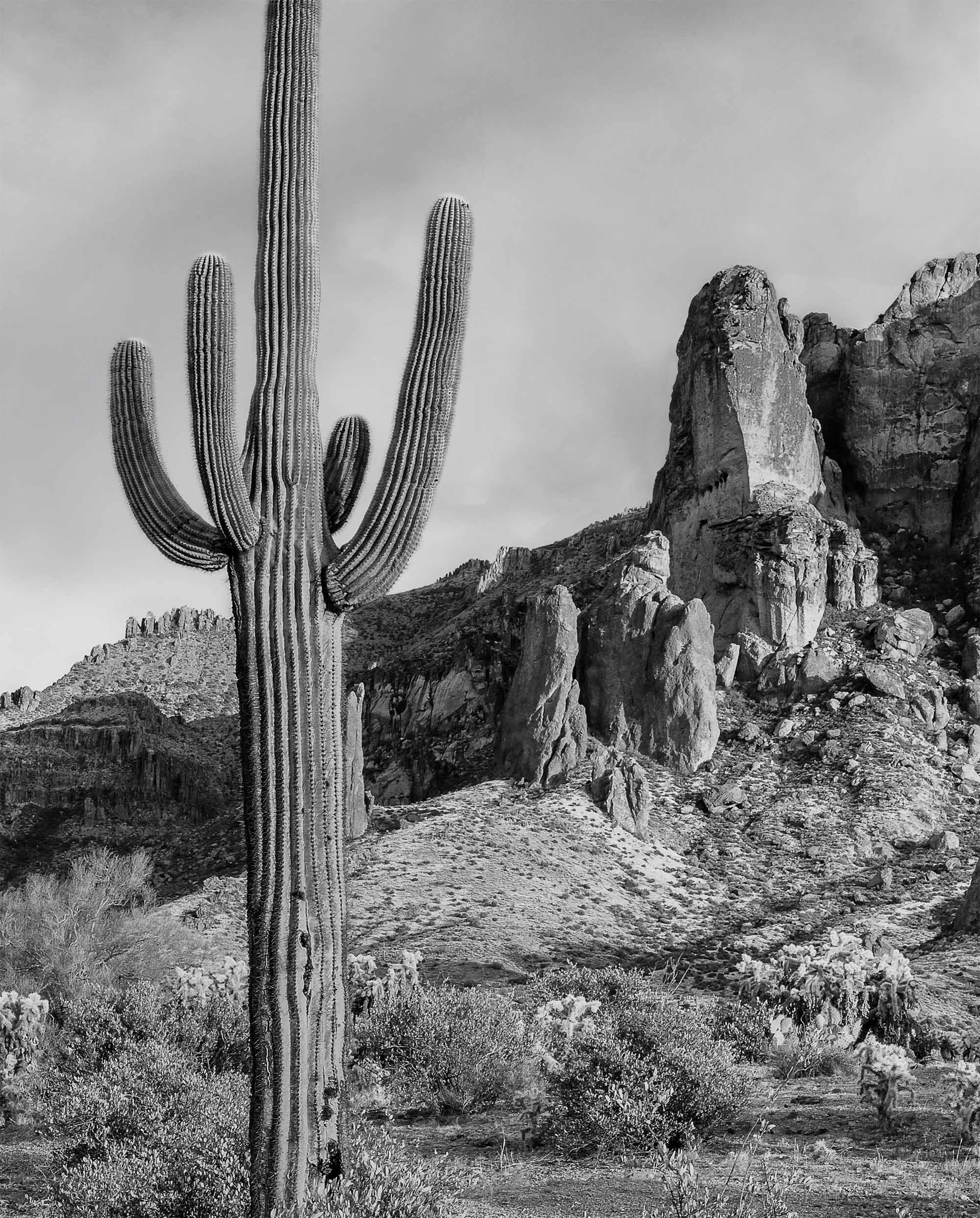
The near saguaro at about a fifth of the frame width. On an eighty inch print this section runs roughly seventeen inches across. The ribs run the length of the trunk with spine clusters ranged along them, the scarring low on the stem becomes damage rather than tone, and the range behind separates into individual columns with talus spilling from their feet. Click to view at full size.
About This Photograph
The Superstition Mountains seen from the Sonoran Desert floor to the west, near Apache Junction, Arizona, about forty miles east of Phoenix. This is a single frame image, rendered in black and white. The frame holds a stand of mature saguaros in the near ground, low desert scrub across the flat, and the west face of the range behind.
Saguaros grow about an inch a year, flower first at around thirty-five, and produce a first arm between fifty and seventy years of age. An adult is roughly a hundred and twenty-five years old, and a typical life runs a hundred and fifty to a hundred and seventy-five years, with some passing two hundred.
The range takes its name from settlers in the Salt River Valley in the 1860s. The Lost Dutchman legend attaches to Jacob Waltz, a German prospector who died in Phoenix in 1891 and was said to have kept the location of a rich gold mine to himself. No such mine has been found.
Age Old Superstitions
Steve Austinhttps://www.steveaustinphotography.com/
This is a bright photograph, which is unusual for black and white and changes where it can go. Half the frame is sky and the sky runs pale, so the picture puts light back into a room rather than absorbing it. On a dark wall it reads as an opening. In a north-facing room that never gets sun it does some of the work a window would, which is not something most monochrome landscapes can claim.
The file is neutral to the decimal, red, green, and blue identical through the whole range with no toning in either direction. That means it has no temperature of its own and adopts the room's. Under warm lamps the greys go warm and the print reads like an old photograph. Under daylight or cool bulbs it goes silver and reads modern. The same print can look forty years apart depending on what is lighting it.
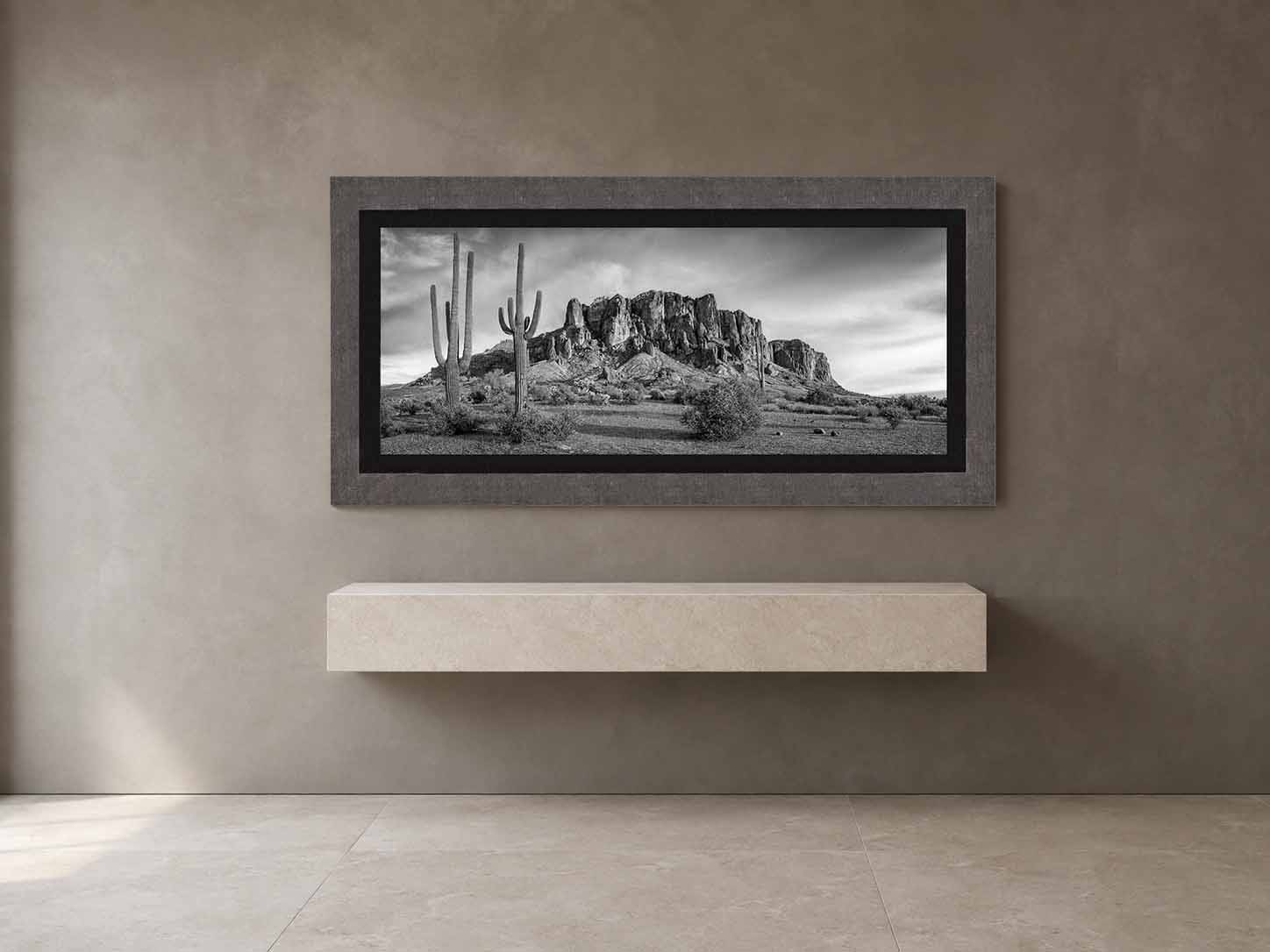
The composition is built in three horizontal bands: sky, then the rock face, then the desert floor. On a wall that gives it a stability most landscapes do not have, because there is no diagonal and nothing leading anywhere. It sits still. That makes it easy to hang above furniture with a strong horizontal of its own, a sideboard, a headboard, a long bookcase, because the picture and the furniture agree rather than argue.
Not sure which size the room calls for, or want dimensions not listed here? Sizes beyond 80 × 32 are available on request and ship crated by freight. That conversation is welcome before an order is placed. Start that conversation and I will answer within one business day.
Age Old Superstitions, limited edition printSteve Austin95012100USD11https://schema.org/InStock
Questions about this photograph
How small is too small for a photograph this wide?
At five to two, the Intimate size is forty inches across and sixteen inches tall. This picture takes that better than most because its structure is three horizontal bands and the saguaros are strong shapes against a pale sky, so the whole composition reads from anywhere in a room. What goes at that size is the mountain. At forty by sixteen the range is a mass with a broken top edge, and the columns, chimneys, and talus fans that make up its face collapse into texture. The saguaros keep their silhouettes but lose their ribs. That is a graphic photograph and a strong one, and it suits a narrow wall or a run above a doorway. The Collected at sixty by twenty-four is where the rock face separates into individual formations and you can see where one buttress ends and the next begins. If you are weighing a size against a specific wall, choosing the right print size covers the measurements and the viewing distances in more detail.
What changes at the largest size?
The saguaros become plants rather than shapes. At the Statement size, eighty by thirty-two, the vertical ribs that run the length of each trunk resolve, and so do the spine clusters ranged along them and the pleating where the flesh has drawn in during a dry year. The scarring near the base of the nearest one becomes legible as damage rather than tone. The mountain changes at the same width, from a mass into geology: separate columns of welded tuff, the gullies between them, the loose fans of rock spilling from their feet, and the pale streaking where water has run down the face. The desert floor opens into individual creosote and bursage with bare gravel between them. Nearly seven feet is also enough width that the range extends past the edge of what you take in at once, which is what makes it read as something standing in front of you rather than a picture of something. Why scale matters covers what happens perceptually when a landscape reaches the size where the eye has to cross it.
What kind of room does this photograph suit?
Rooms with strong horizontals and rooms that need light. Because the picture is bright and neutral it will lift a dim space and settle into almost any palette, so it belongs as easily against slate, steel, and pale stone as against oak, leather, and warm plaster. The three-band structure means it hangs comfortably over anything long and level, a sideboard, a headboard, a low run of cabinets, and it holds a wall on its own without needing a pair. It also suits a room where people talk rather than one where they concentrate, since there is no path to follow and nothing asking to be worked out, only a horizon and some very old plants in front of it. Why we are wired to need the natural world takes the question further.
Every work ships insured and arrives with a signed certificate of authenticity.
If a piece is damaged in transit, the choice of replacement is always yours, and your edition number stays with you.
Production time runs 2 to 3 weeks for metal, 3 to 4 weeks for acrylic and paper, and 5 to 6 weeks for framed work.
Each print is made to order and takes its place in a numbered edition, so sales are final. Before you choose, I am glad to help: send a photo of your wall and I will show you this work in your room at true scale, at no charge. Start a conversation
Collector's Choice · TruLife ® Acrylic in Italian Frame
Collector Edition of 25· Lumachrome TruLife Acrylic · Handcrafted Italian Frame
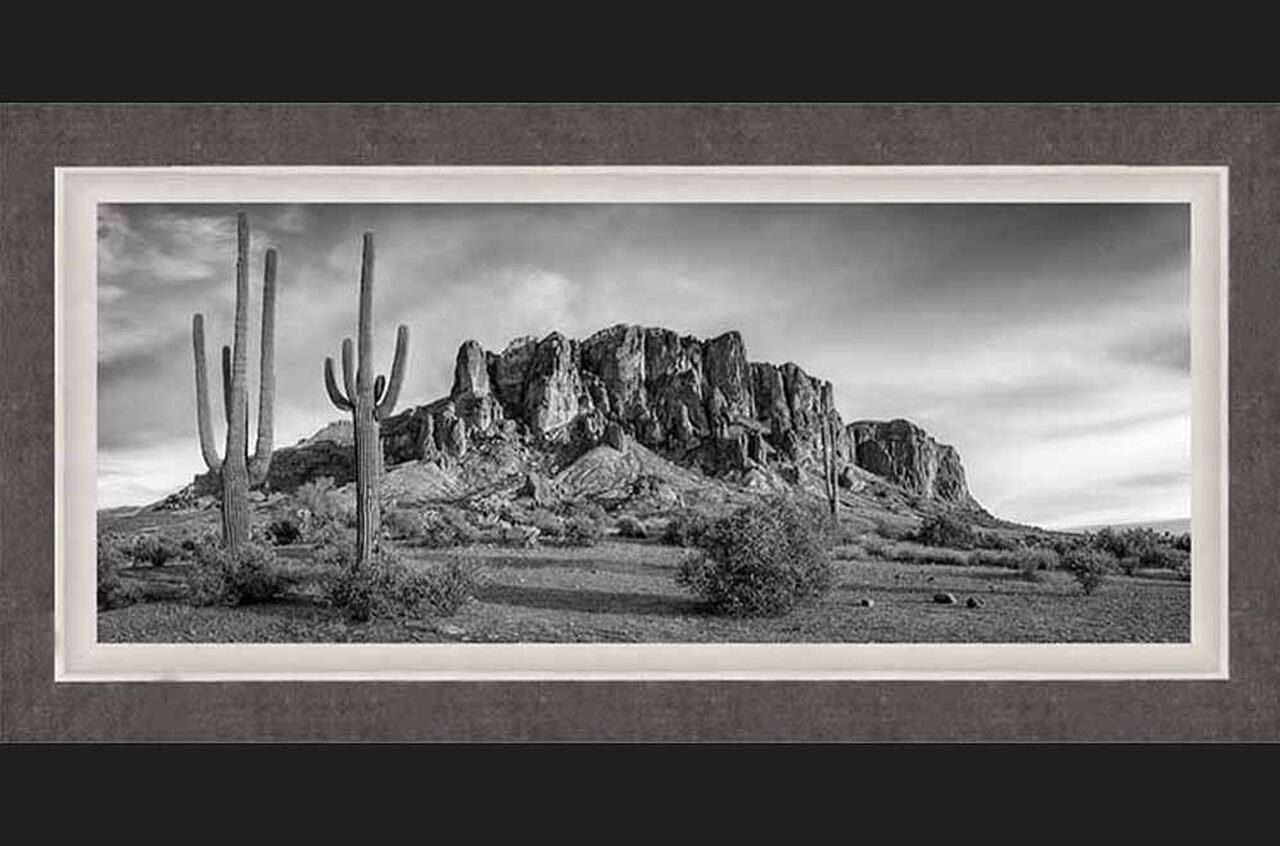
TruLife acrylic in a handcrafted Italian frame with a linen liner chosen for the image. Frame series, finish, and liner are settled with you after the order, and production begins from there. The frame and liner add about fourteen inches to the finished dimensions, worth allowing for when planning placement.
Signature Acrylic Edition of 50· Lumachrome TruLife · Gallery Float Mount
Face-mounted to TruLife acrylic and floated approximately one inch from the wall, with no frame to mediate between the image and the room. UV-resistant, anti-reflective, and scratch-resistant, with a lifetime guarantee against fading.
Signature Metal Edition of 50· ChromaLuxe Print · Gallery Float Mount
Color infused into the aluminum panel itself, floated from the wall on a concealed system. Where acrylic produces luminosity, metal produces clarity. Exceptional fade resistance with no glazing or coating required.
Fine Art Edition of 100· Hahnemühle Baryta Fine Art Paper
Printed without acrylic, so light meets the paper surface directly. Highlights stay luminous, shadows keep their nuance, and the surface has a tactile quality the other presentations approach differently. The understated choice, and the traditional one.
Complimentary shipping within the continental United States. International collector shipping available upon request.
Still deciding
Designing for Stillness
A guide to choosing art for restorative spaces
How to tell whether an image will still hold you in a year, how scale changes what a photograph does in a room, and how to match a piece to the work a room actually performs. It cites the research it draws on, and it is equally clear about where that research stops. About ten minutes to read.