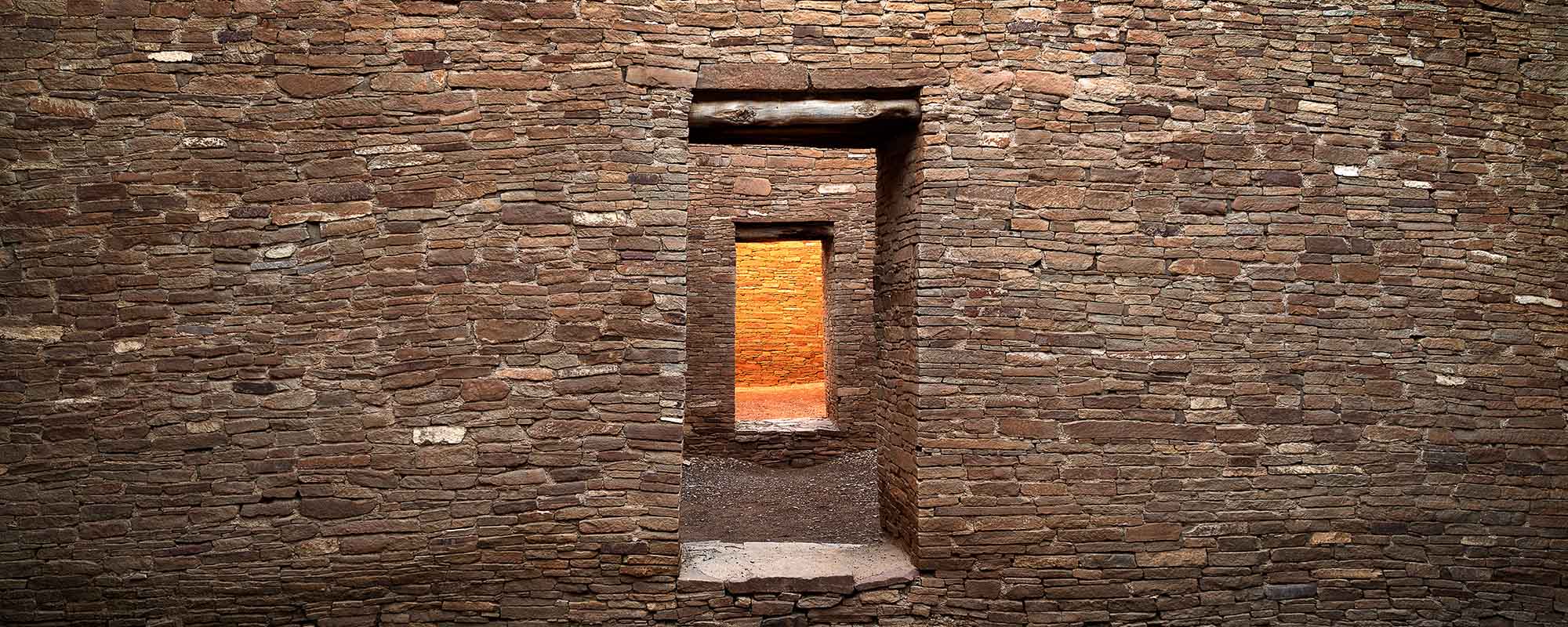
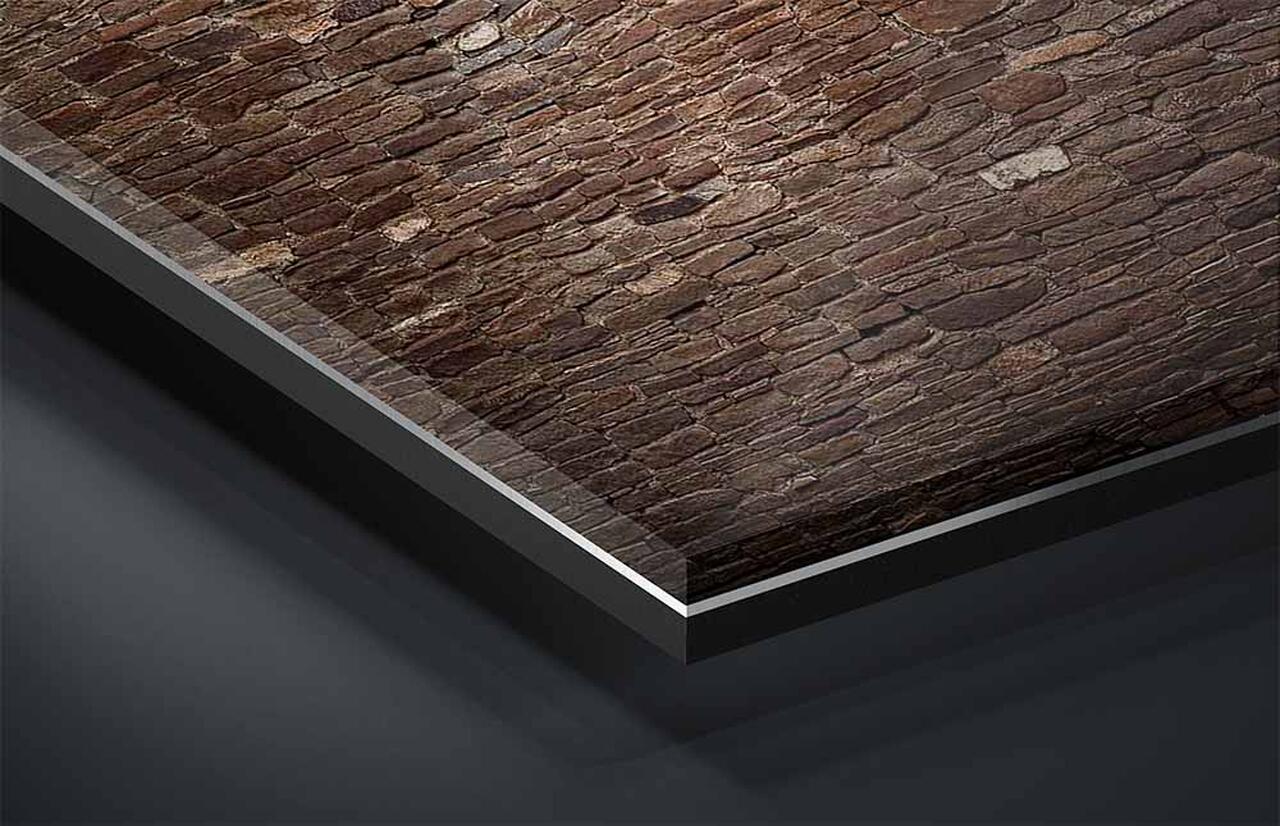
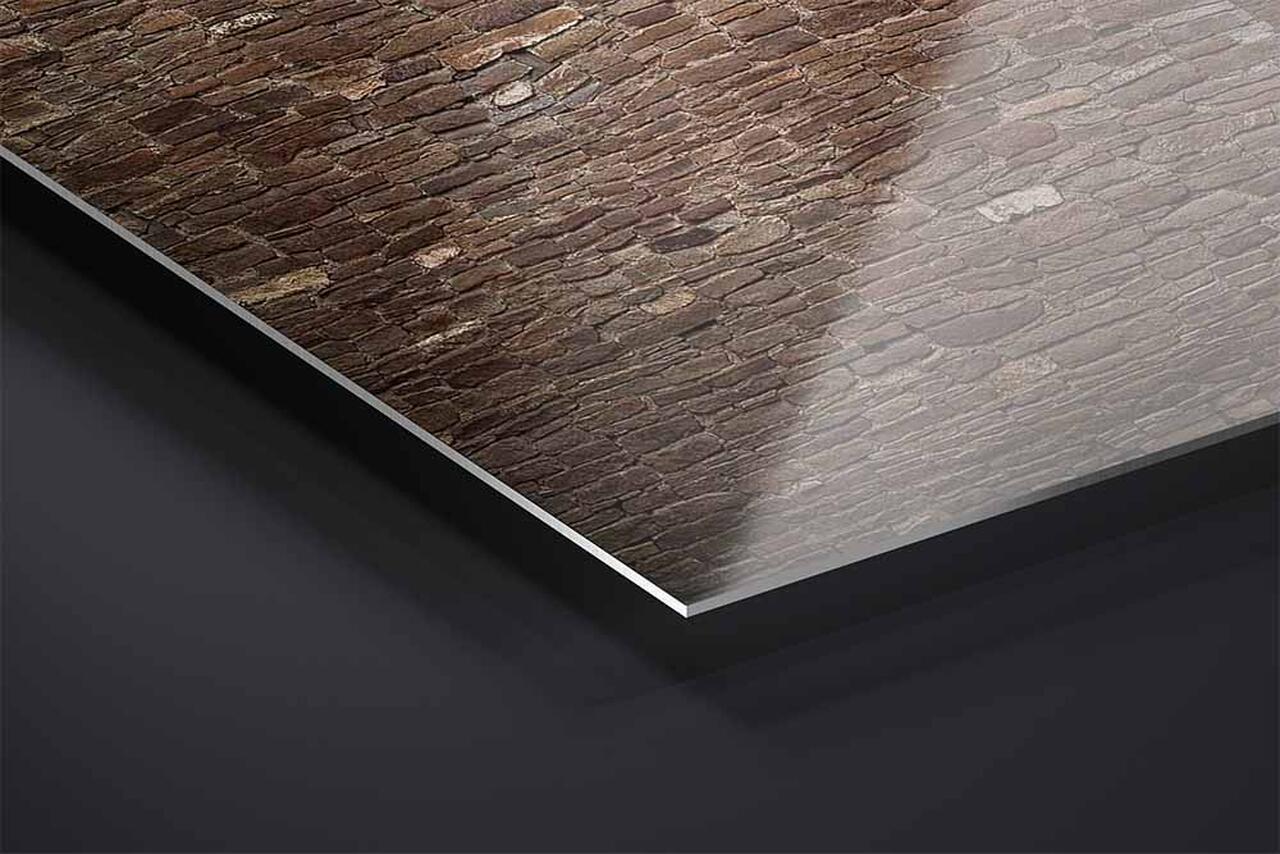
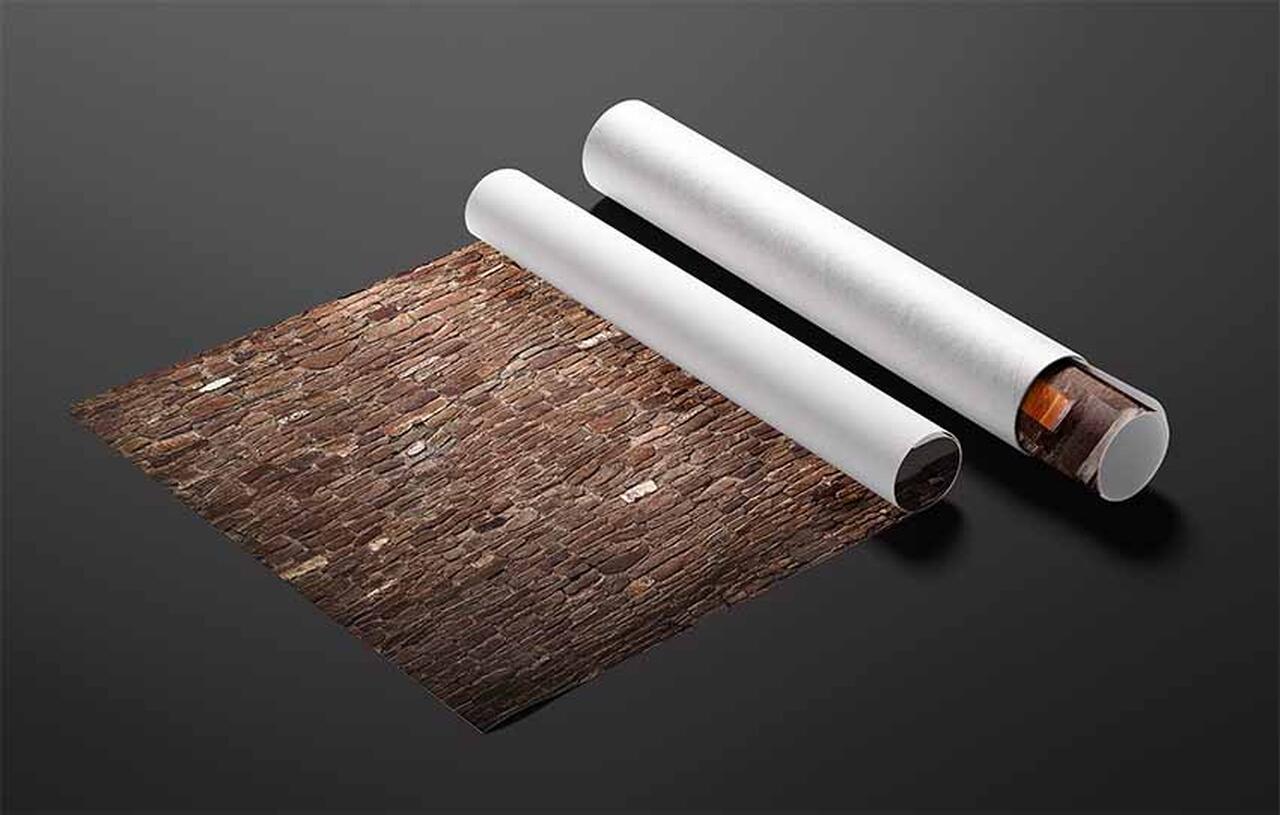
A 5:2 panoramic photograph of aligned stone doorways at Pueblo Bonito in Chaco Canyon, New Mexico, available as a limited edition print in three sizes.
Artist's Story
This is a wall at Pueblo Bonito, in Chaco Canyon in northwestern New Mexico. There is a doorway through it, and behind that doorway there is another one, and behind that a wall with light on it.
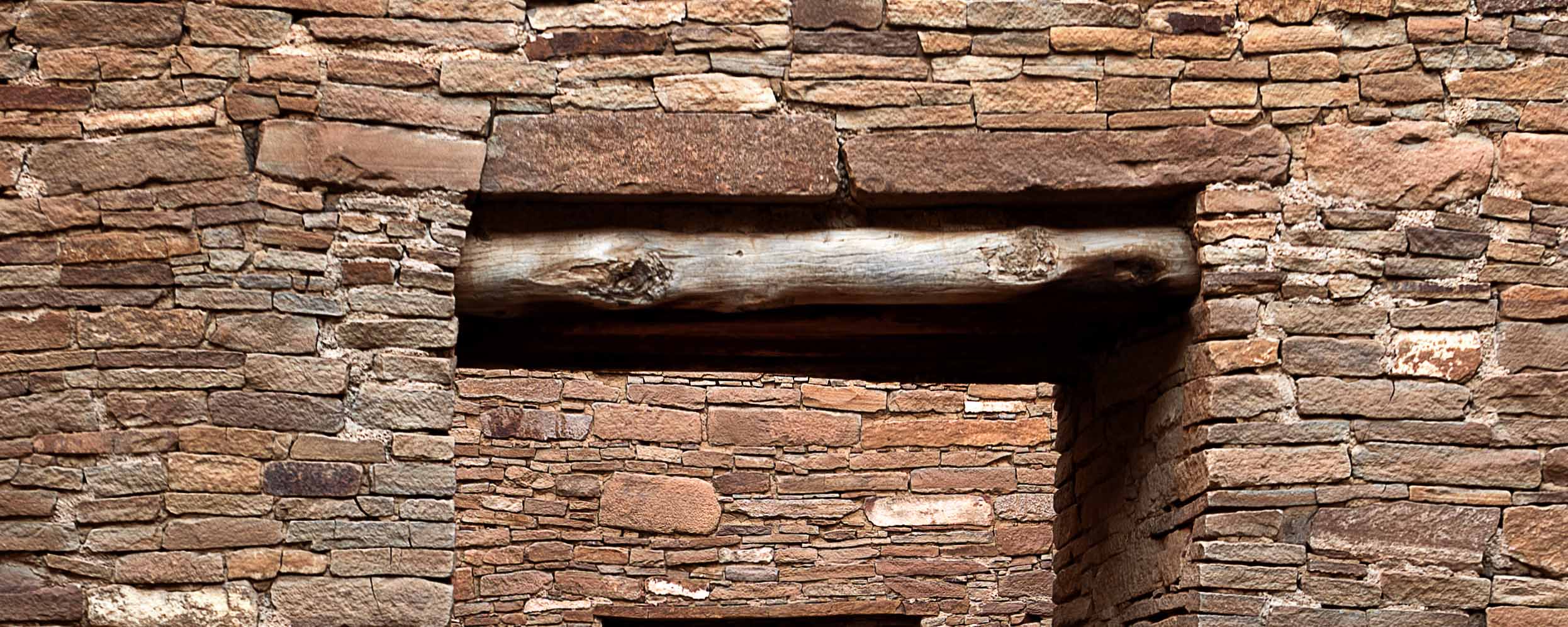
Everything in the frame is sandstone except one thing. Above the opening there is a beam.
There are no trees in Chaco Canyon of a size to make that beam. There were none then either. Between about AD 900 and 1150 the great houses here consumed more than two hundred thousand conifer timbers, and the canyon could not supply them. The primary beams average five meters long, twenty-two centimeters across, and two hundred and seventy-five kilograms. That is roughly six hundred pounds.
Better than a fifth of them came from mountaintops seventy-five to a hundred kilometers away. There were no draft animals in the Southwest and no wheels. Every one of those beams was carried.
We know where they came from because trees take up strontium from the ground they grow in, and the isotope ratio differs between mountain ranges. Beams from the great houses match the Chuska Mountains to the west and the San Mateo Mountains to the southeast, and not the San Pedro range, which is just as close. We know they were carried rather than dragged because the beams have no travel scars on them.
There is one detail I have not been able to stop thinking about. Timbers from both ranges, a hundred and sixty kilometers apart, turn up in the same room, cut in the same year.
Paths Laid Before Us is a doorway with another doorway behind it. The only part of it that had to travel is the piece of wood across the top.
The lintel at about two fifths of the frame width. The individual sandstone pieces separate with mortar visible between them, and the coursing changes across the face from wide flat slabs to bands of thin tabular stone. The beam resolves as a shaped log with its grain running along it and the stubs of two cut limbs still standing proud, seated on the masonry with the courses closed over it. At the right the jamb shows how the coursing was returned into the reveal. Click to view at full size.
About This Photograph
Pueblo Bonito, Chaco Culture National Historical Park, San Juan County, New Mexico. This is a single frame image, made looking square at an interior wall with the camera parallel to it. The far surface visible through the second opening is lit by sunlight arriving indirectly, having reflected off a wall outside the frame.
The masonry is core and veneer. Two faces of shaped sandstone are laid up with a core of rubble and mortar between them, and only the veneer is visible. The banding in that veneer changed over the two and a half centuries the great houses were built, enough that the coursing patterns are used to date construction phases. Several different patterns are present in this wall.
This is the most uniformly warm photograph in the collection. All four edges measure warm, red running between twenty-five and fifty-one points ahead of blue, and the whole frame comes out at forty-two. There is no cool region anywhere in it, and no second color.
Paths Laid Before Us
Steve Austinhttps://www.steveaustinphotography.com/
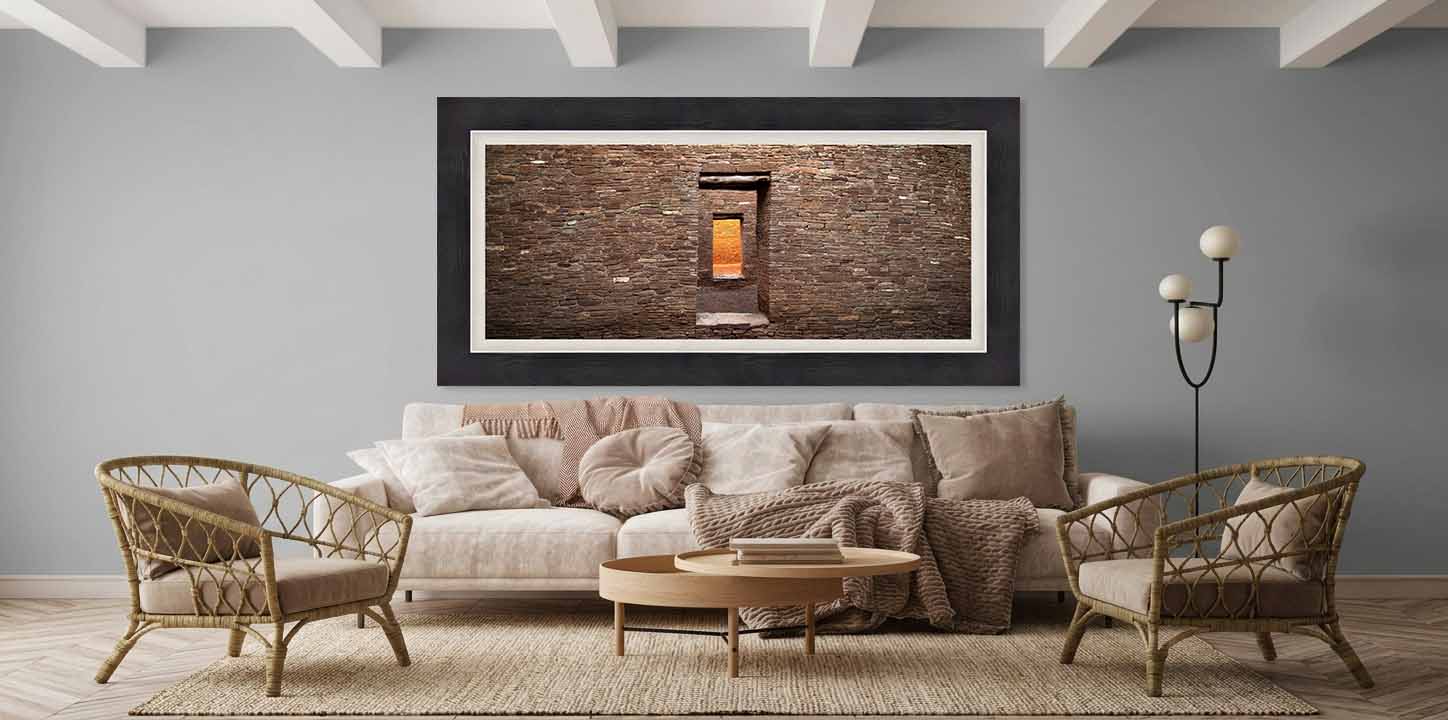
This is a photograph of a wall, hung on a wall, and that is a different proposition from a landscape. A landscape on a wall is understood as a view, a hole through the plaster onto somewhere else. This one is not a view. It is a flat vertical surface photographed square on, with the camera parallel to it, so it lands on a wall as another wall rather than as a window. The only depth in it is the small opening at the center, and because everything around that opening is masonry read straight on, the opening behaves like a real aperture in the room rather than like distance in a picture. Placed at the end of a room, it will read as a door someone could walk to.
It is also a single hue and nothing else. Every edge of the frame measures warm and there is no cool region anywhere in it, which makes it the most uniformly warm photograph in the collection. What that produces on a wall is closer to a material than to a picture. It agrees with brick, terracotta, unglazed tile, raw plaster, leather, and unfinished timber, in the way two warm materials in a room agree, and it argues with cool gray, blue-toned stone, and anything with a green cast. There is no second color in it to bridge the gap.
The third thing is that nothing in it is bright. Its brightest sustained passage measures a hundred and seventy-five out of two hundred and fifty-five, the lowest in the collection, and there is no highlight anywhere to catch an eye from across a room. A piece with a bright passage announces itself and gets looked at from the doorway. This one does not, and it will go unnoticed by anyone who does not walk up to it. That is a real limitation on a wall meant to make a first impression, and a real advantage on a wall someone sits beside every day.
Not sure which size the room calls for, or want dimensions not listed here? Sizes beyond 80 × 32 are available on request and ship crated by freight. That conversation is welcome before an order is placed. Start that conversation and I will answer within one business day.
Paths Laid Before Us, limited edition printSteve Austin95012100USD11https://schema.org/InStock
Questions about this photograph
How small is too small for a photograph this wide?
At the Intimate size the picture is forty inches across and sixteen inches tall. The composition survives that entirely, since it is one large simple shape, a dark rectangle in a light field, and it reads from any distance. What goes is the masonry. This wall is built from thousands of individually shaped sandstone pieces in courses that vary from wide flat slabs to bands of thin tablets, and at sixteen inches tall those courses compress into a texture rather than reading as separate stones set by hand. The beam over the doorway also stops being a beam and becomes a dark horizontal band. Since the beam is what this photograph is about, that matters more here than on most pieces. The Collected at sixty by twenty-four is where the coursing separates and the lintel becomes a log. If you are weighing a size against a specific wall, choosing the right print size covers the measurements and the viewing distances in more detail.
What changes at the largest size?
The wall becomes handwork. At eighty by thirty-two the individual sandstone pieces separate with mortar visible between them, and the different coursing patterns become distinguishable from one another across the face, wide slabs in one band and thin tabular pieces in another. The beam resolves as a shaped log with its cut end showing and the grain running along it, seated on the masonry rather than built into it. Around the opening the jambs show how the courses were returned into the reveal. Through the second doorway the far wall separates into its own coursing, and along the threshold the wear on the sill stones becomes visible as smoothing rather than as shadow. Why scale matters covers what happens perceptually when a photograph reaches the size where the eye has to cross it.
What kind of room does this photograph suit?
Rooms with warm materials and rooms people sit in. A study, a library, a sitting room, a bedroom, anywhere someone spends an hour rather than four seconds. Hang it low enough that the doorway in the picture sits near standing eye level, since the composition assumes a viewer facing a wall rather than looking out at a landscape. Three things to avoid. Keep it away from exposed brick or stone, because a photograph of masonry hung on masonry reads as a sample rather than as a picture. Do not put it on a cool gray or blue-toned wall, since it has no cool tone anywhere to meet one. And give it a wall without a real doorway close beside it, because the opening in the picture and the opening in the room will compete to be read as the way through. When your mind needs to rest takes the question further.
Every work ships insured and arrives with a signed certificate of authenticity.
If a piece is damaged in transit, the choice of replacement is always yours, and your edition number stays with you.
Production time runs 2 to 3 weeks for metal, 3 to 4 weeks for acrylic and paper, and 5 to 6 weeks for framed work.
Each print is made to order and takes its place in a numbered edition, so sales are final. Before you choose, I am glad to help: send a photo of your wall and I will show you this work in your room at true scale, at no charge. Start a conversation
Collector's Choice · TruLife ® Acrylic in Italian Frame
Collector Edition of 25· Lumachrome TruLife Acrylic · Handcrafted Italian Frame
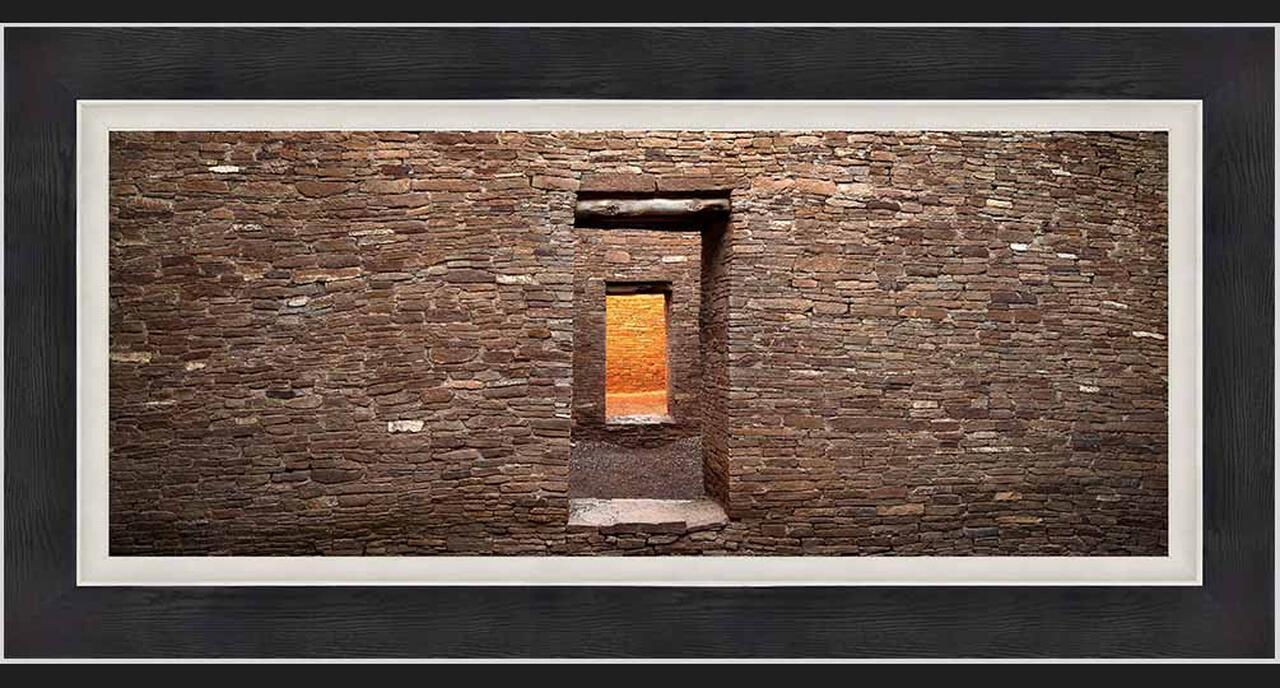
TruLife acrylic in a handcrafted Italian frame with a linen liner chosen for the image. Frame series, finish, and liner are settled with you after the order, and production begins from there. The frame and liner add about fourteen inches to the finished dimensions, worth allowing for when planning placement.
Signature Acrylic Edition of 50· Lumachrome TruLife · Gallery Float Mount
Face-mounted to TruLife acrylic and floated approximately one inch from the wall, with no frame to mediate between the image and the room. UV-resistant, anti-reflective, and scratch-resistant, with a lifetime guarantee against fading.
Signature Metal Edition of 50· ChromaLuxe Print · Gallery Float Mount
Color infused into the aluminum panel itself, floated from the wall on a concealed system. Where acrylic produces luminosity, metal produces clarity. Exceptional fade resistance with no glazing or coating required.
Fine Art Edition of 100· Hahnemühle Baryta Fine Art Paper
Printed without acrylic, so light meets the paper surface directly. Highlights stay luminous, shadows keep their nuance, and the surface has a tactile quality the other presentations approach differently. The understated choice, and the traditional one.
Complimentary shipping within the continental United States. International collector shipping available upon request.
Still deciding
Designing for Stillness
A guide to choosing art for restorative spaces
How to tell whether an image will still hold you in a year, how scale changes what a photograph does in a room, and how to match a piece to the work a room actually performs. It cites the research it draws on, and it is equally clear about where that research stops. About ten minutes to read.