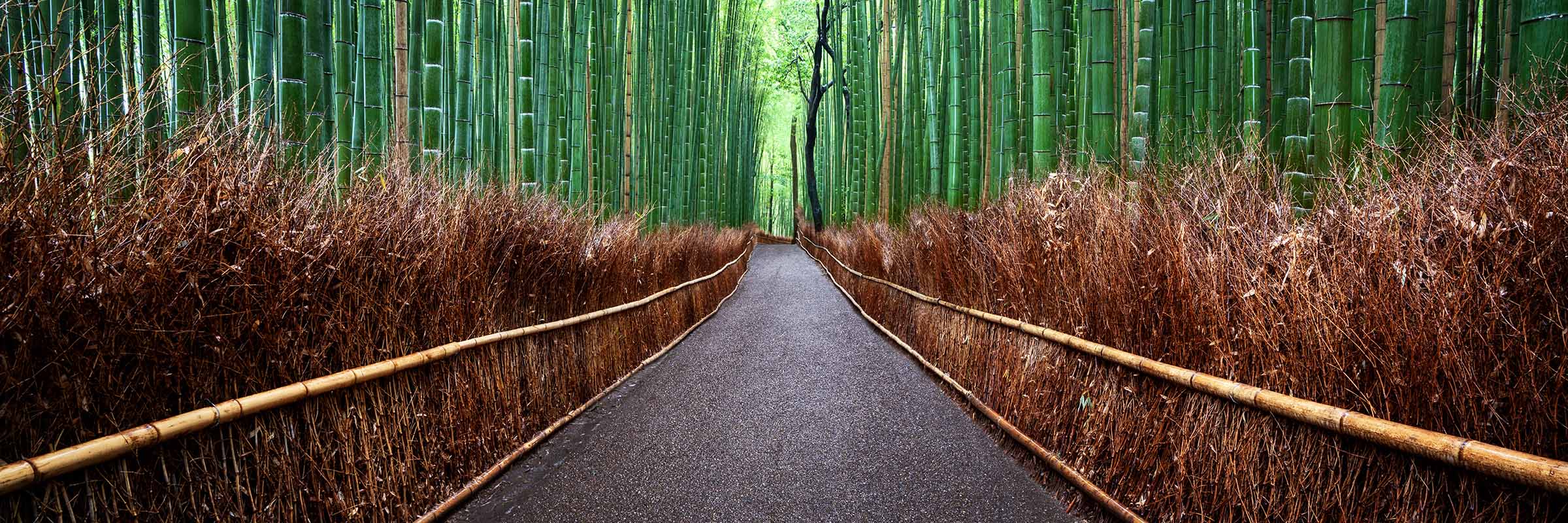
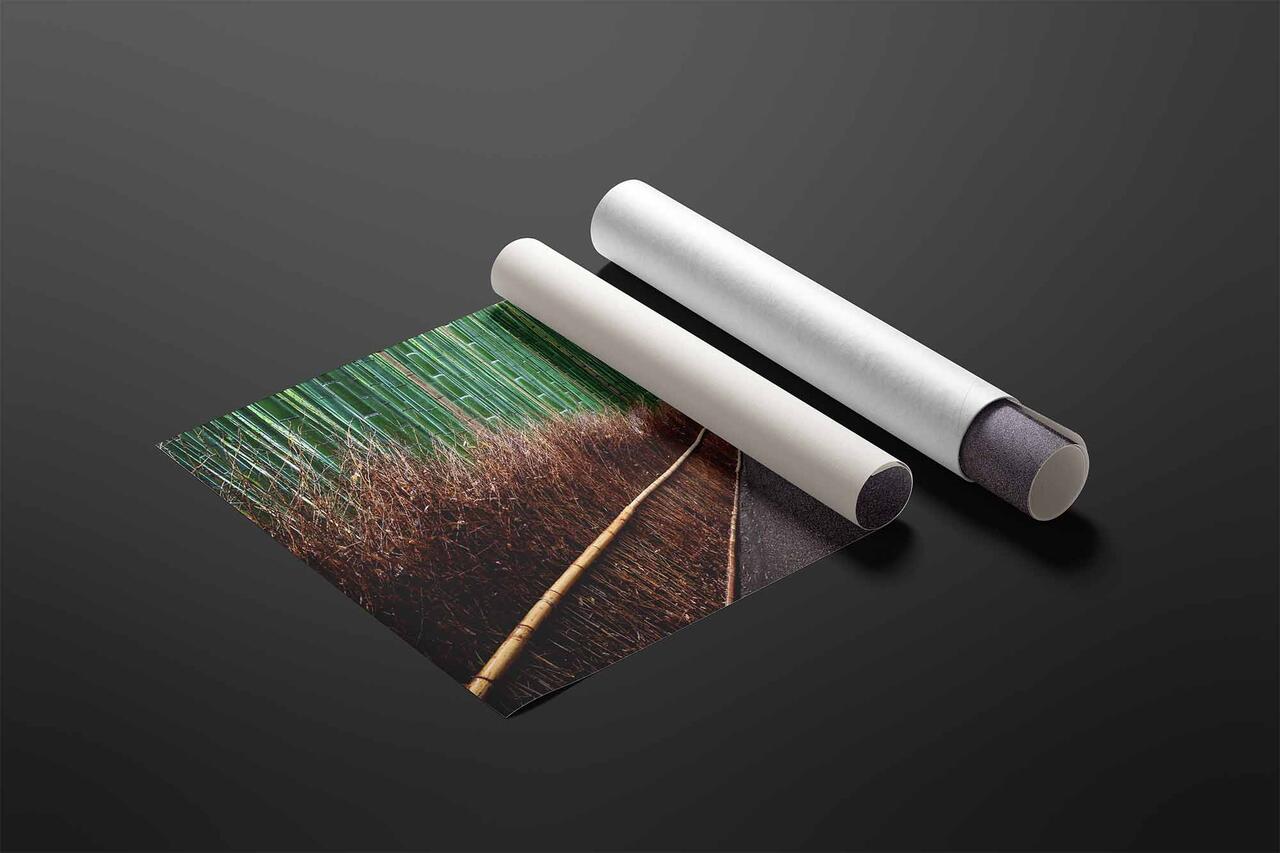
A 3:1 panoramic photograph of the bamboo grove path at Arashiyama in Kyoto, Japan, available as a limited edition print in three sizes.
Artist's Story
The bamboo grove at Arashiyama, on the western edge of Kyoto, is on a list of sounds. Japan keeps an official register of soundscapes worth protecting, the way other countries protect buildings and views, and the noise this grove makes is one of the hundred.
It is not wind whistling through the stalks. Wind pushes the leaves at the top, thirty meters up, and the weight of that sets the whole grove swaying. The stalks are hollow tubes, and as they move they knock against one another. What you hear is wood on wood, a low creak with a run of clicks inside it, and all of it is coming from above your head.
I walked it early, before the crowds, when the light came down even between the stalks and a single bare tree stood among the green, the one still and leafless thing in all that color.
A loud sound does not add to a quiet one. It replaces it. Stand on this path at midday with two hundred people on it and the grove sounds like two hundred people. Come at seven and nothing has changed except that the loud thing is gone, and the knocking overhead turns out to have been there the whole time.
Still Passage is the path between the two walls, the brush fence made from the grove's own bamboo, and the one bare tree standing among the green. The sound is the part a photograph cannot carry.
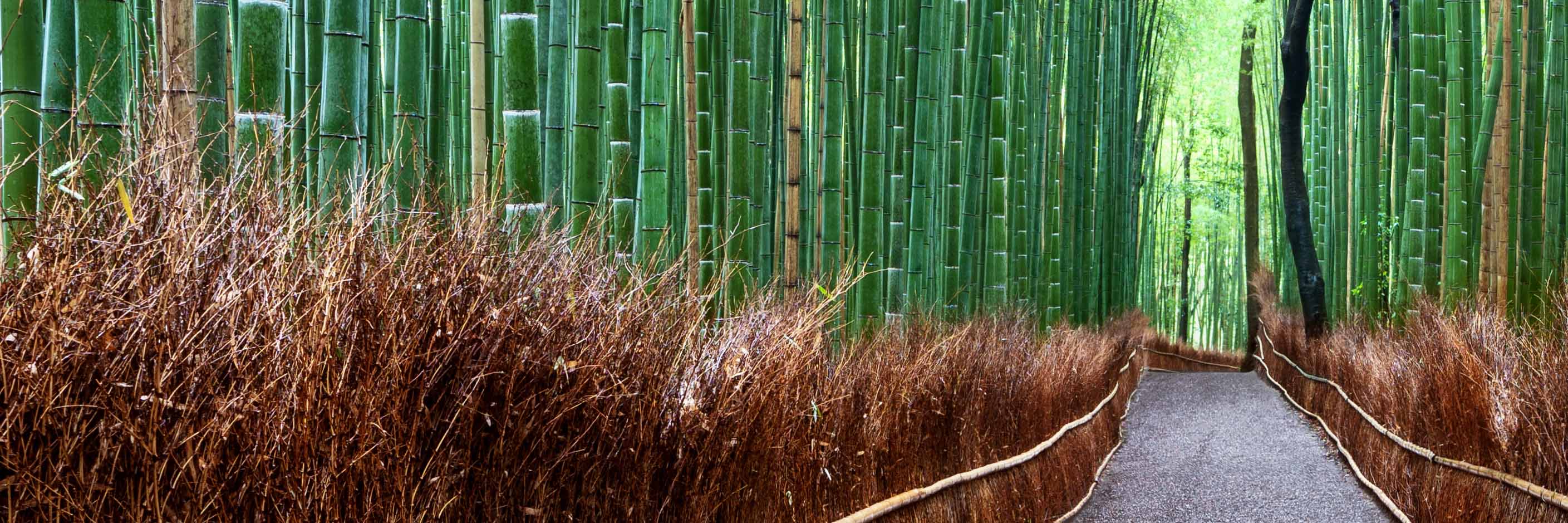
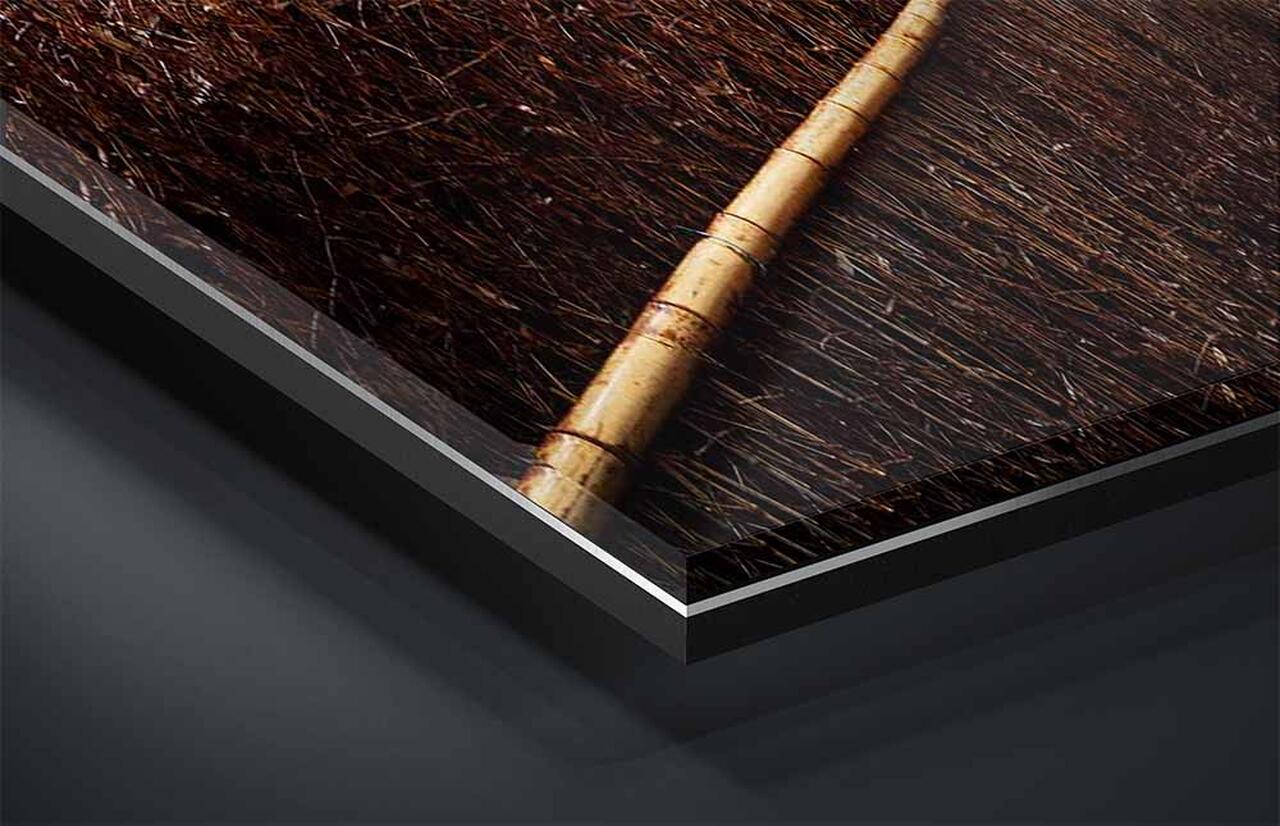
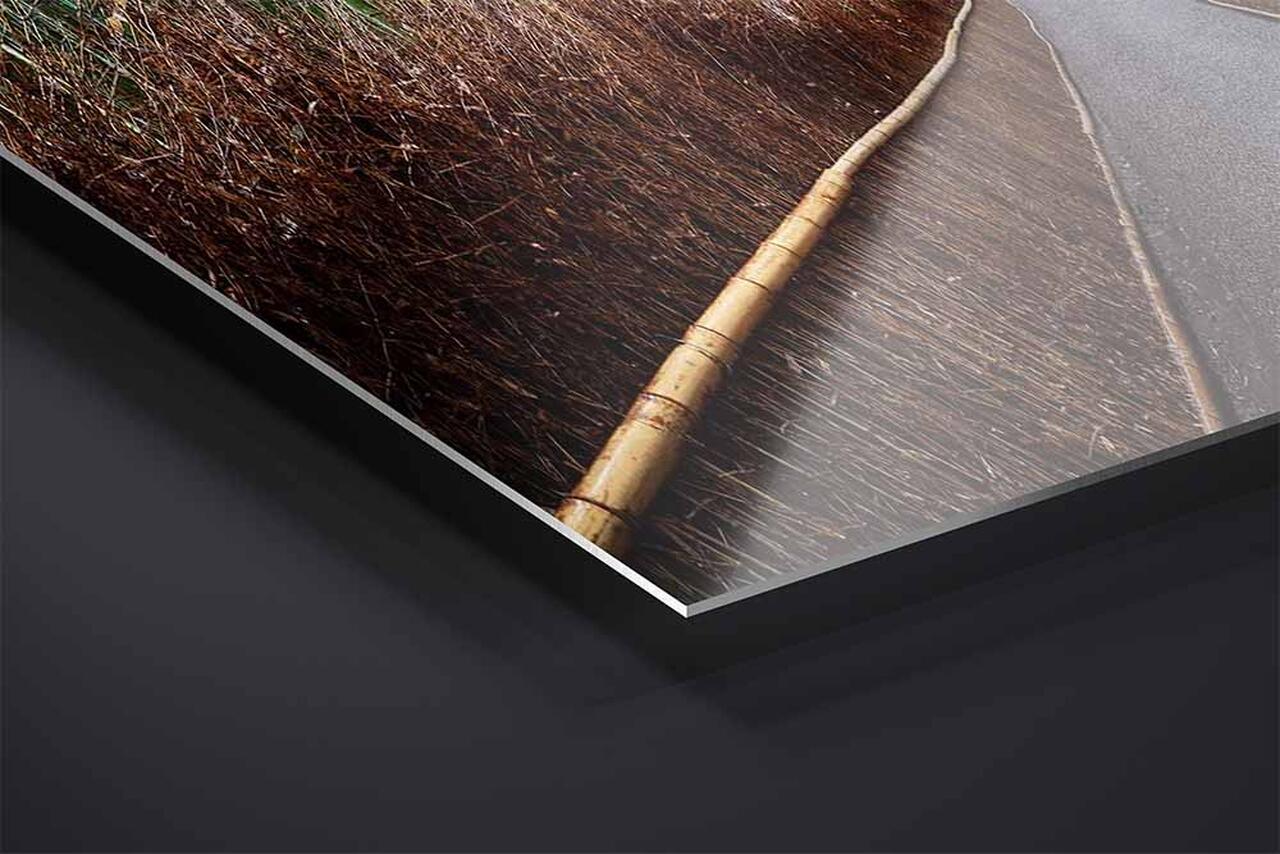
The west wall at about a third of the frame width. On a ninety inch print this section runs roughly thirty-three inches across. The joint rings that divide each stalk resolve at this scale, the pale bloom on the newer culms separates from the harder green of the older ones, and the brush fence breaks into individual dried stems. Click to view at full size.
About This Photograph
On the pedestrian path through the Arashiyama bamboo grove, also called the Sagano grove, in the Ukyo ward on the western edge of Kyoto, Japan, early in the morning before the crowds. This is a single frame image. The frame looks along the path between two walls of moso bamboo, with a low fence of dried brush and a bamboo rail on either side, and a single bare tree standing among the green just left of center.
The green occupies only the top third of the frame. Below it, the brush and rails hold more of the picture than the bamboo does.
More than ten thousand moso stalks stand here, rising to between ten and thirty meters and capable of growing close to a meter in a day. The grove was a managed crop for centuries, cut for tea utensils, baskets, fencing, and temple interiors, and the fences along this path are made from it. In 1996 the sound of wind in the grove was named one of the 100 Soundscapes of Japan by the Ministry of the Environment.
Still Passage
Steve Austinhttps://www.steveaustinphotography.com/
Location
Arashiyama Bamboo Grove, Kyoto, Japan
Subject
Bamboo grove · moso bamboo · Sagano path
Capture
Single frame, early morning
Format
Photograph · horizontal panorama, 3:1
Sizes
36 × 12 in · 60 × 20 in · 90 × 30 in
Print Media
TruLife Acrylic · ChromaLuxe Metal · Baryta paper
Edition
Limited, 25 / 50 / 100 by presentation
What it Does in a Room
Green is the easiest color for a person to look at, and that is a fact about the eye rather than a matter of taste. Human vision peaks in sensitivity right in the middle of the green band, so a green photograph delivers more detail for less work than the same photograph would in any other hue. On a wall that shows up as a picture you can keep looking at without the looking costing anything. It holds attention rather than demanding it.
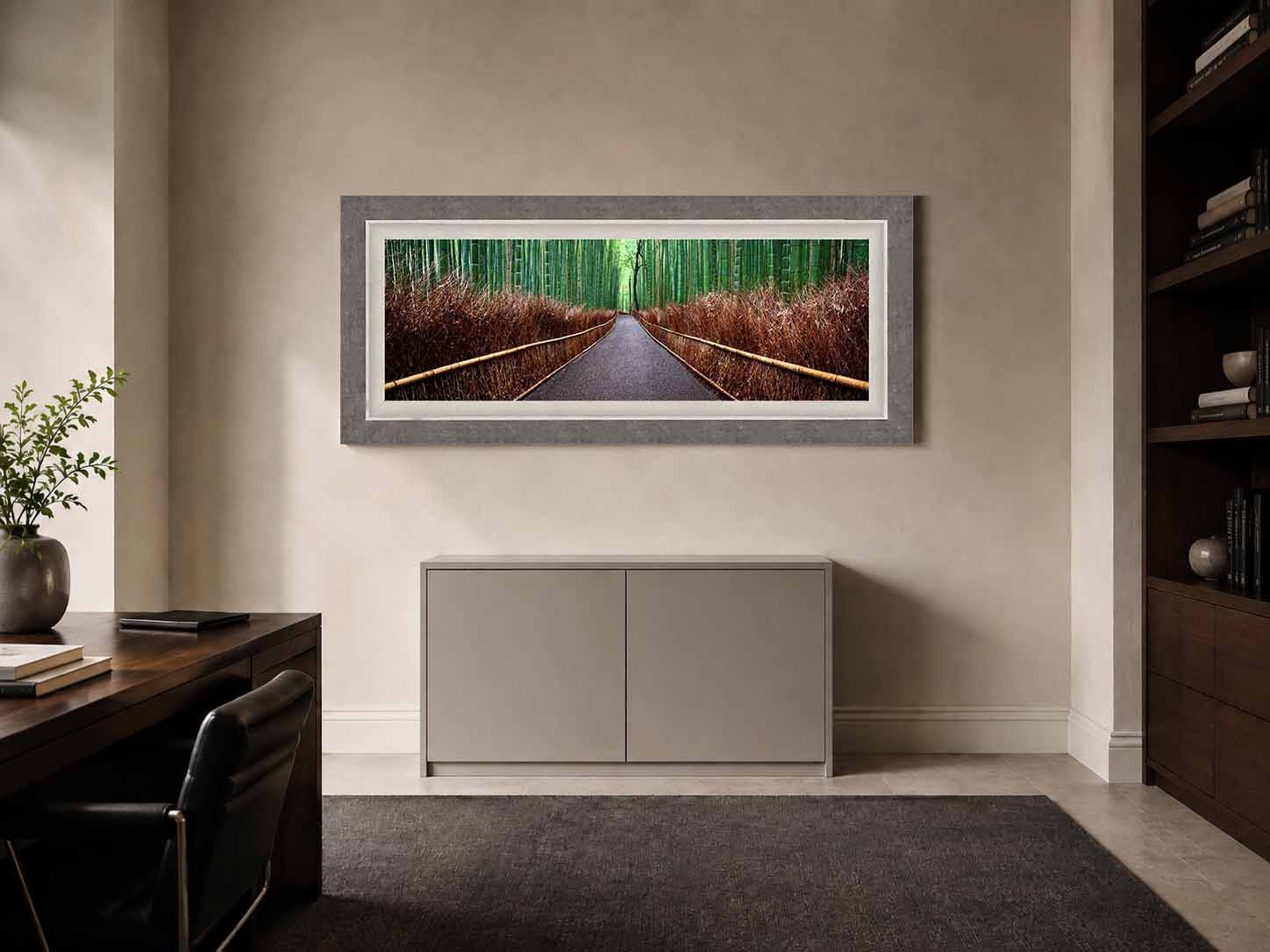
It also supplies both temperatures on its own. The upper third is cool green and everything below it is rust and dry straw, so the picture already contains a warm note and a cool one in roughly equal measure. That makes it unusually easy to place. It will sit with cool grays and pale stone without going cold, and with oak, leather, and terracotta without going hot, because whichever the room leans toward, the photograph has already answered it.
From across a room the hundreds of near-parallel stalks stop reading as objects and start reading as a woven surface, closer to a textile than to a landscape. That is worth knowing when you are choosing where it goes, because it means the piece works on a wall that also has to carry fabric, rugs, or upholstery nearby without the two competing. Walk up to it and the surface resolves back into individual stalks.
Not sure which size the room calls for, or want dimensions not listed here? Sizes beyond 90 × 30 are available on request and ship crated by freight. That conversation is welcome before an order is placed. Start that conversation and I will answer within one business day.
Still Passage, limited edition printSteve Austin70012900USD11https://schema.org/InStock
Questions about this photograph
How small is too small for a photograph this wide?
At three to one, the Intimate size is thirty-six inches across and twelve inches tall. The picture holds together there because its structure is simple: a green band across the top, a rust band below it, and the path running down the middle. All three read from any distance. What goes at that size is the bamboo itself. At thirty-six by twelve the stalks are thin vertical strokes, the joints that break them into segments disappear, and the dried brush becomes a solid rust-colored mass rather than thousands of separate stems. The bare tree is a dark mark. That is a graphic photograph and a calm one, and it suits a narrow wall or a run above a doorway. The Collected at sixty by twenty is where the joints come back and the near stalks read as bamboo rather than as lines. If you are weighing a size against a specific wall, choosing the right print size covers the measurements and the viewing distances in more detail.
What changes at the largest size?
The grove stops being a texture and becomes plants. At the Statement size, ninety by thirty, the nearest stalks stand several inches across and their joints, the pale rings that divide each culm into segments, run the full height of the frame. The waxy bloom on the newer stalks separates from the harder green of the older ones. The brush fence resolves from a rust-colored mass into individual dried stems packed side by side, and the bamboo rail running along it shows its own joints and the wire that binds it. The path underfoot opens into wet asphalt with visible aggregate. The bare tree becomes a tree, with branch structure you can follow. Seven and a half feet is also wide enough that the two walls reach past the edge of what you take in at once, which is what makes the grove read as something around you rather than in front of you. Why scale matters covers what happens perceptually when a landscape reaches the size where the eye has to cross it.
What kind of room does this photograph suit?
Rooms where people stay a while. This is a quiet photograph with a lot to look at, which is a combination that rewards long occupancy rather than a passing glance, so it does its best work in a living room, a study, a bedroom, or anywhere with a chair facing it. Because the picture carries its own warm and cool it will settle against almost any palette, and pale walls give it the most room: white, bone, warm plaster, pale stone. It also holds up in a room that already has a lot of texture, since it reads as a woven surface from a distance and joins that conversation rather than interrupting it. If the room has a window onto anything green, the two will answer each other. The quiet power of a green view takes the question further.
Every work ships insured and arrives with a signed certificate of authenticity.
If a piece is damaged in transit, the choice of replacement is always yours, and your edition number stays with you.
Production time runs 2 to 3 weeks for metal, 3 to 4 weeks for acrylic and paper, and 5 to 6 weeks for framed work.
Each print is made to order and takes its place in a numbered edition, so sales are final. Before you choose, I am glad to help: send a photo of your wall and I will show you this work in your room at true scale, at no charge. Start a conversation
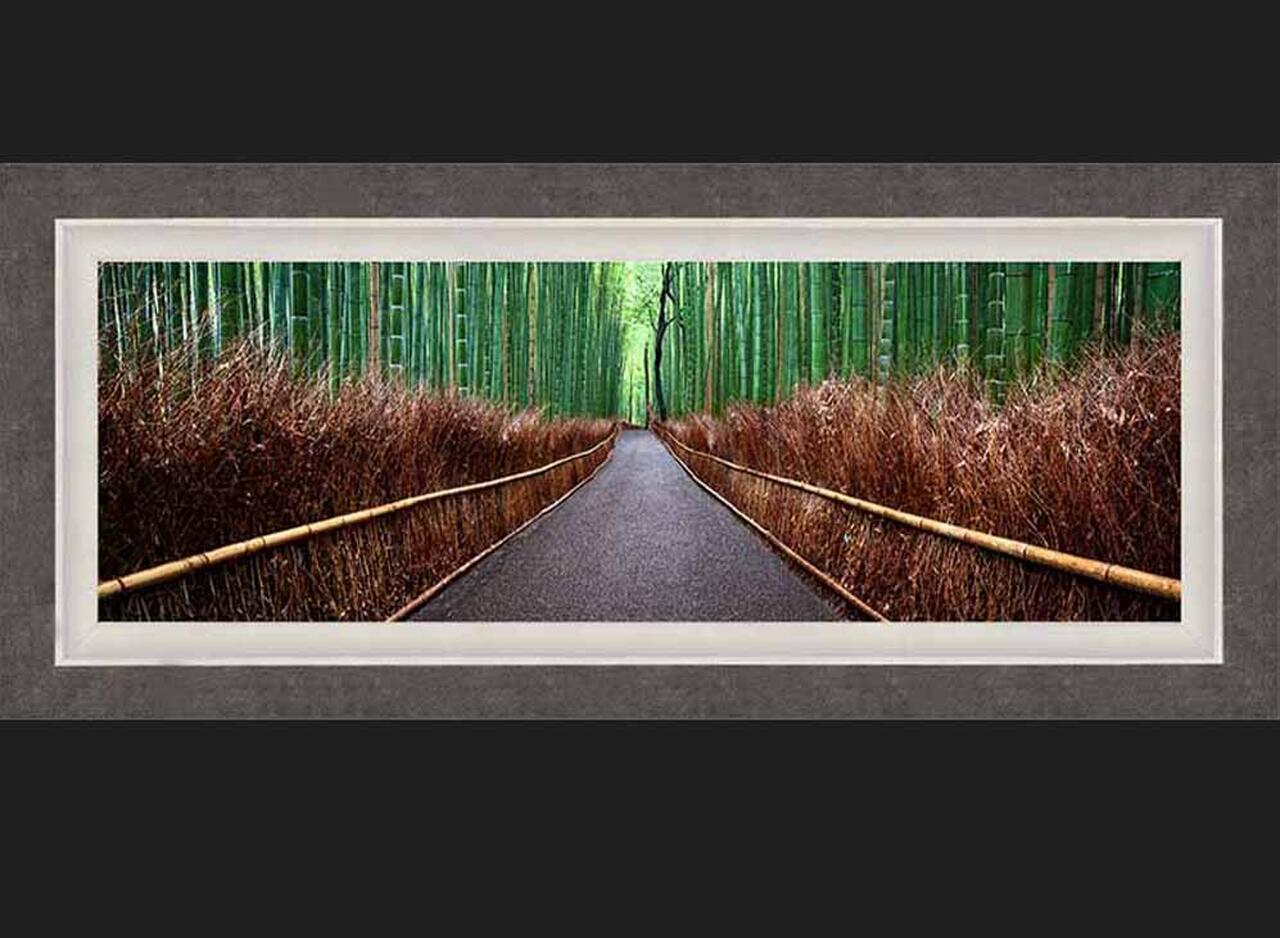
Collector's Choice · TruLife ® Acrylic in Italian Frame
Collector Edition of 25· Lumachrome TruLife Acrylic · Handcrafted Italian Frame
TruLife acrylic in a handcrafted Italian frame with a linen liner chosen for the image. Frame series, finish, and liner are settled with you after the order, and production begins from there. The frame and liner add about fourteen inches to the finished dimensions, worth allowing for when planning placement.
Signature Acrylic Edition of 50· Lumachrome TruLife · Gallery Float Mount
Face-mounted to TruLife acrylic and floated approximately one inch from the wall, with no frame to mediate between the image and the room. UV-resistant, anti-reflective, and scratch-resistant, with a lifetime guarantee against fading.
Signature Metal Edition of 50· ChromaLuxe Print · Gallery Float Mount
Color infused into the aluminum panel itself, floated from the wall on a concealed system. Where acrylic produces luminosity, metal produces clarity. Exceptional fade resistance with no glazing or coating required.
Fine Art Edition of 100· Hahnemühle Baryta Fine Art Paper
Printed without acrylic, so light meets the paper surface directly. Highlights stay luminous, shadows keep their nuance, and the surface has a tactile quality the other presentations approach differently. The understated choice, and the traditional one.
Complimentary shipping within the continental United States. International collector shipping available upon request.
Still deciding
Designing for Stillness
A guide to choosing art for restorative spaces
How to tell whether an image will still hold you in a year, how scale changes what a photograph does in a room, and how to match a piece to the work a room actually performs. It cites the research it draws on, and it is equally clear about where that research stops. About ten minutes to read.