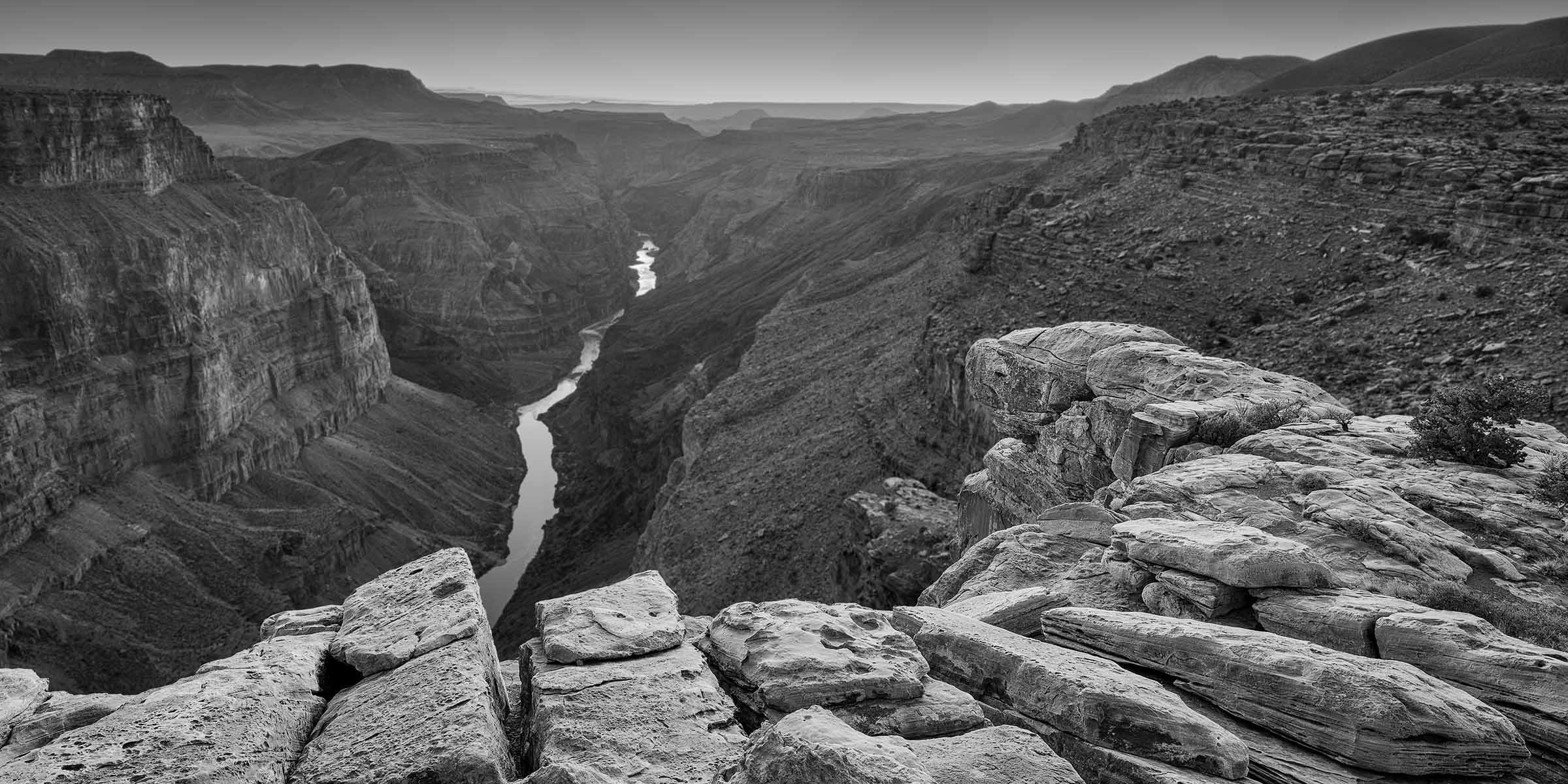
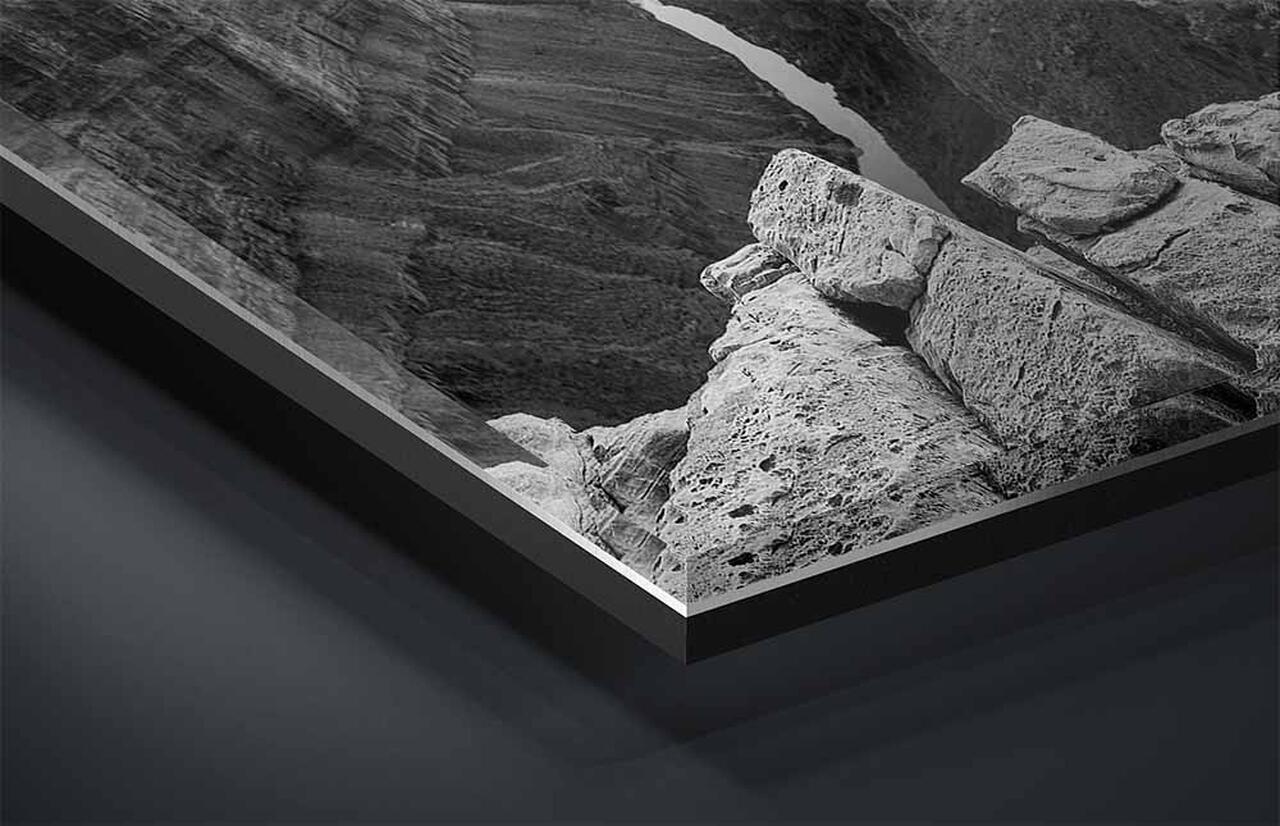
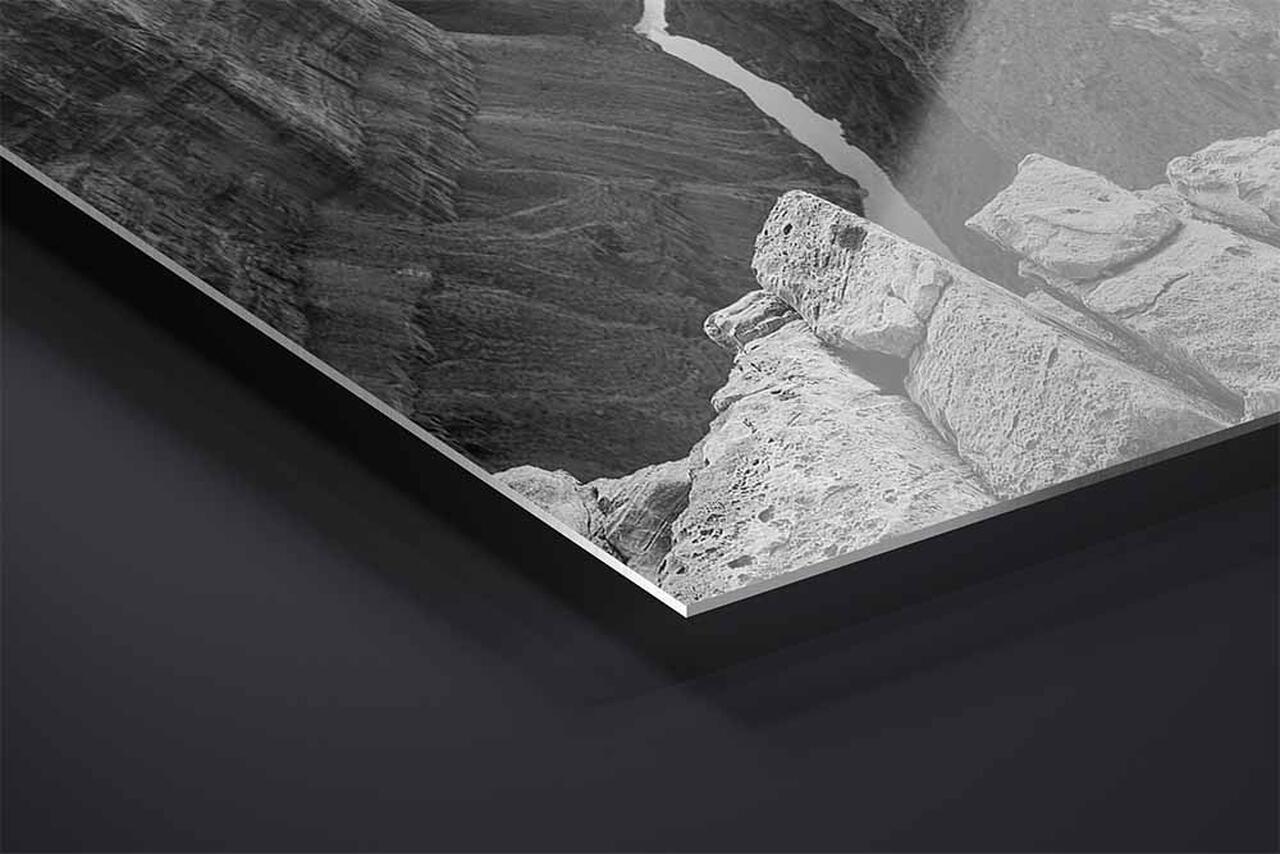
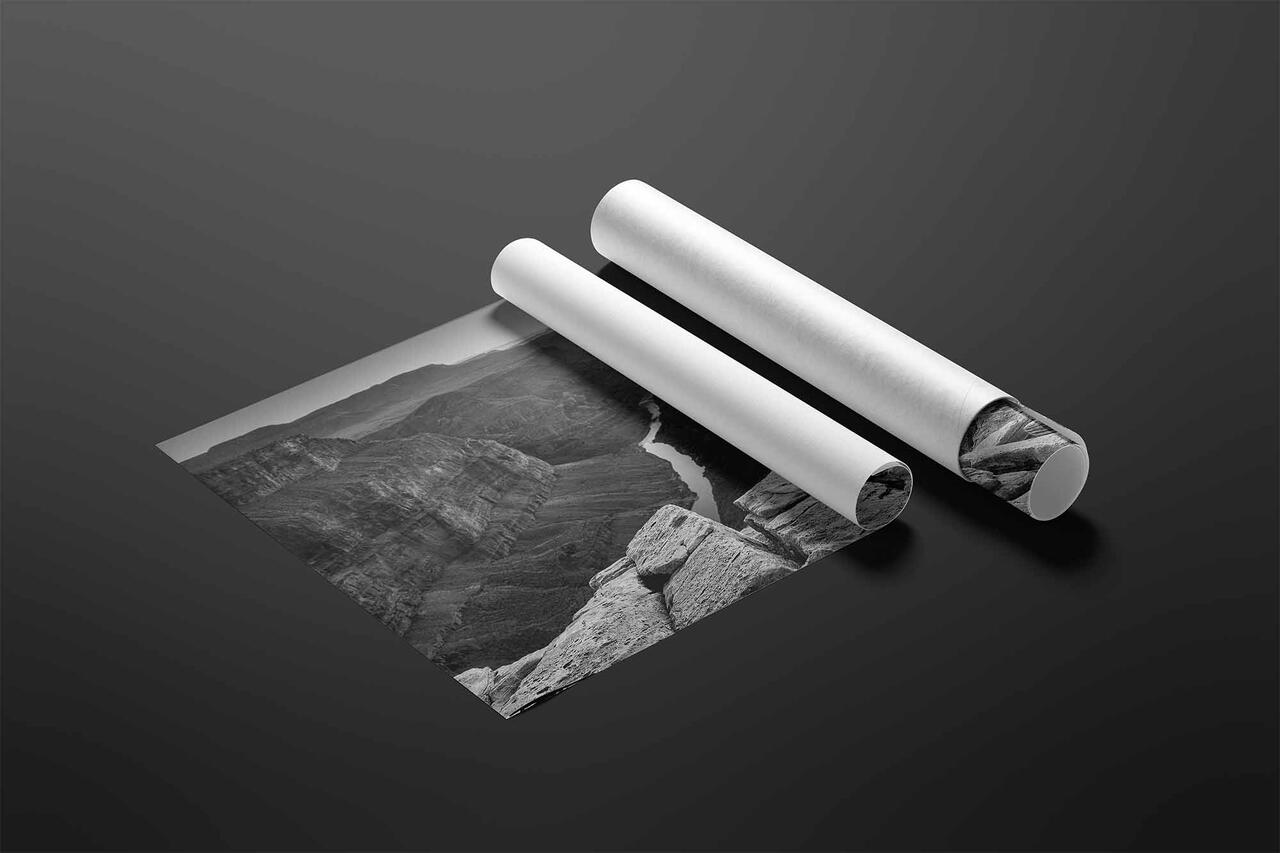
A 2:1 panoramic photograph of the Grand Canyon from Toroweap Overlook in Arizona, available as a limited edition print in three sizes and four presentations.
Artist's Story
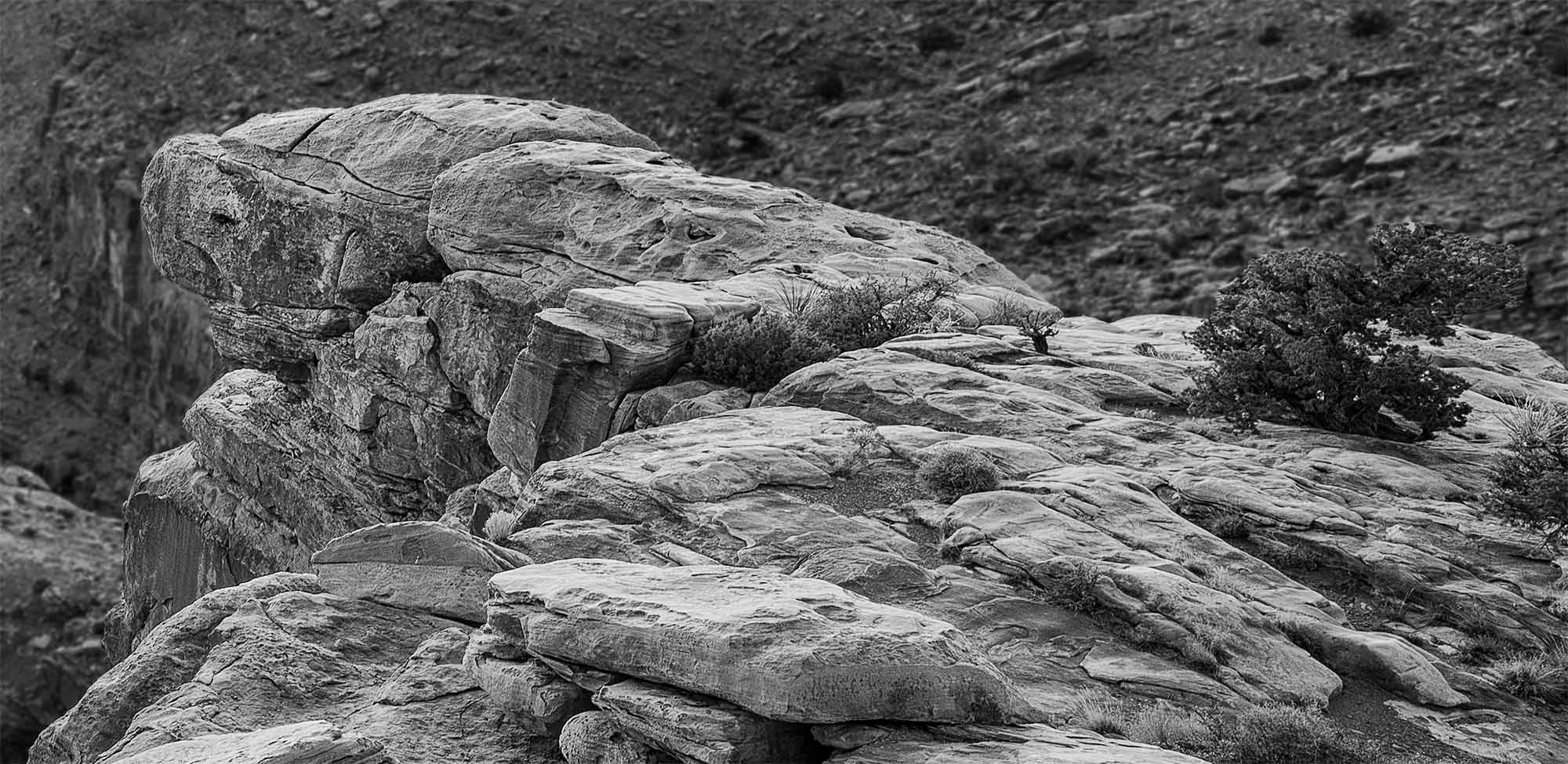
At Toroweap, on the remote North Rim of the Grand Canyon, a block of sandstone at the rim resolves into a head. Raised, blunt-nosed, turned out over the gorge. Nothing placed it there and nothing intended it. Wind and frost and rain have been working this rim for a very long time, and this is one of the shapes that came out of the work.
I had been working along the rim looking for a composition when the shape came together and I stopped where I stood. I made the frame from that spot.
The mind has no real choice in the matter. The visual system carries machinery tuned to find faces, and to find where a gaze is pointed, set at a very low threshold, because for most of our history the cost of missing a real watcher was far higher than the cost of inventing one. So the rock becomes a head, the head acquires an orientation, and something in the body registers being in the presence of attention. Knowing exactly why that happens does not dissolve it. I know what this rock is. I still felt watched.
The Serpent's Watch is that insistence: a shape the canyon never meant, which the mind declines to give up, holding its position above a river that has been cutting this rock for five or six million years and is not finished.
Detail at roughly one fifth of the frame width. Stratified sandstone, bedded and pitted and fractured, weathered into the shape the title borrows. Click to view at full size.
About This Photograph
Photographed at Toroweap Overlook, also known as Tuweep, on the remote western North Rim of Grand Canyon National Park in northern Arizona, from the rim above the inner gorge in the late afternoon. Made in a single frame and rendered in black and white.
The subject is a weathered sandstone block at the rim whose profile resembles a raised serpent's head, above the Colorado River in the gorge below. The river is generally understood to have carved the Grand Canyon over roughly the past five to six million years, cutting through strata far older than the canyon itself, though the precise timing remains debated among geologists.
The Serpent's Watch
Steve Austinhttps://www.steveaustinphotography.com/
Location
Toroweap Overlook, Grand Canyon National Park, Arizona
Subject
Sandstone formation above the Colorado River
Capture
Single frame in late afternoon
Format
Photograph · horizontal panorama, 2:1
Sizes
40 × 20 in · 60 × 30 in · 80 × 40 in
Print Media
TruLife Acrylic · ChromaLuxe Metal · Baryta paper
Edition
Limited, 25 / 50 / 100 by presentation
What it Does in a Room
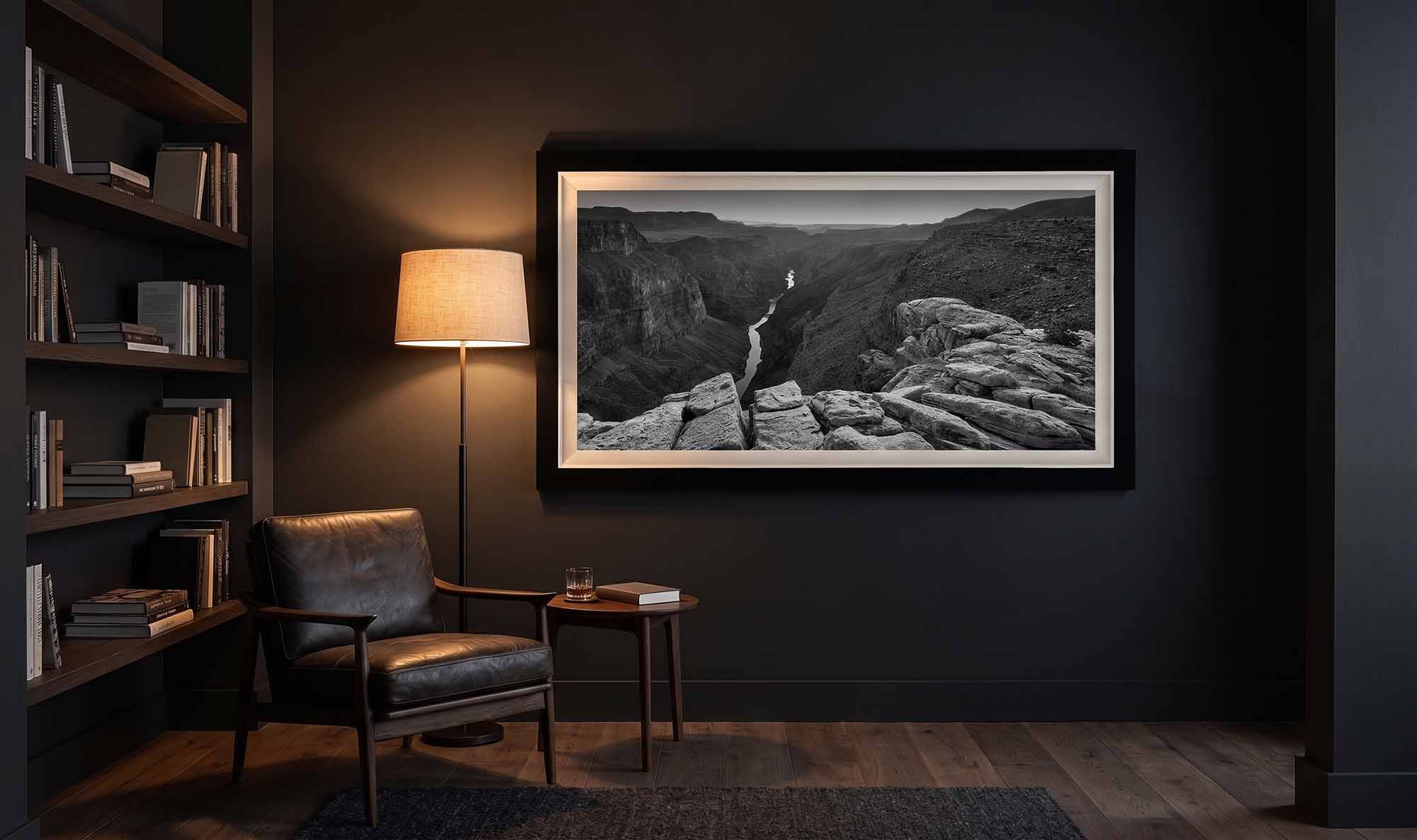
This photograph has no color in it at all, and that changes what it does on a wall. Among the pieces in the collection, this is one of the easiest to place.
Color is the first thing a room negotiates with. A saturated image sets a palette, an image with a dominant hue has to be placed against it, and most decisions about where a photograph goes come down to whether it agrees with what is already there. This one skips that entirely. It has nothing to agree or disagree with, so it will hang anywhere without adjustment, beside anything, in a room of any color.
What replaces color is structure. Without hue, the eye reads the frame as pure arrangement: the dark canyon wall on the left, the river running from the top down through the middle, the pale rock shelf across the foreground. The composition is legible from across a room precisely because there is nothing else to process. That is the quality that makes monochrome work in a busy space where a color image would add to the noise.
It is also the quietest photograph here. Not the emptiest, since the frame is full of detail, but the least insistent. It asks nothing, holds still, and gives the eye somewhere to rest without giving it anything to resolve.
The one thing it needs is a wall that is not fighting it. Against a strong patterned wallpaper or a busy gallery arrangement it will disappear, because the thing that lets it sit anywhere also means it will not push back.
Not sure which size the room calls for, or want dimensions not listed here? Sizes beyond 80 × 40 are available on request and ship crated by freight. That conversation is welcome before an order is placed. Start that conversation and I will answer within one business day.
The Serpent's Watch, limited edition printSteve Austin112513400USD12https://schema.org/InStock
Questions about this photograph
How small is too small for a photograph this wide?
At one to two, the Intimate size is forty inches across and twenty inches tall. That is a comfortable proportion, wide enough to read as a panorama but with enough height that it still behaves like a picture rather than a band. Of the panoramic families this is the one that holds up best at its smallest size, and a twenty by forty print will anchor a modest wall on its own. Where it starts to feel small is on a large open wall or above a full-length sofa, where the surrounding space overwhelms it. The Collected and Statement sizes are where the depth does the work. If you are weighing a size against a specific wall, choosing the right print size covers the measurements and the viewing distances in more detail.
What changes at the largest size?
The river answers this. It enters the frame near the top as a thin bright thread and runs down through the middle to the bottom of the gorge, and at twenty inches tall it is exactly that: a line, a graphic element telling you water is down there. At forty inches tall it becomes a river. You can see it has two banks, that the surface breaks into rapids in places and lies flat in others, that it is wider at the bottom of the frame than at the top because it is closer. Once that happens the whole photograph reorganizes around it, because a line on a wall has no depth and a river a thousand feet below you does. The rest follows the same curve. The layered strata in the canyon walls separate into individual beds, and the pale rock in the foreground shows its fractures and pitting. Why scale matters covers what happens perceptually when a landscape reaches the size where the eye has to travel across it.
What kind of room does this photograph suit?
Nearly any of them, and that is the practical advantage of a photograph with no color. It will not set a palette, will not clash with what is already on the wall or in the room, and needs no adjustment to sit beside warm wood, cool gray, white, or anything else. Of everything in the collection this is the easiest piece to place.
What it does want is even light. The tonal range is wide, from the near black canyon wall on the left to the pale sky, and both ends need to stay open. Strong directional light across the surface will flatten the shadows, and a wall with no light at all will lose the foreground rock into the dark. Ordinary room light suits it, which is more than most photographs can say.
Every work ships insured and arrives with a signed certificate of authenticity.
If a piece is damaged in transit, the choice of replacement is always yours, and your edition number stays with you.
Production time runs 2 to 3 weeks for metal, 3 to 4 weeks for acrylic and paper, and 5 to 6 weeks for framed work.
Each print is made to order and takes its place in a numbered edition, so sales are final. Before you choose, I am glad to help: send a photo of your wall and I will show you this work in your room at true scale, at no charge. Start a conversation
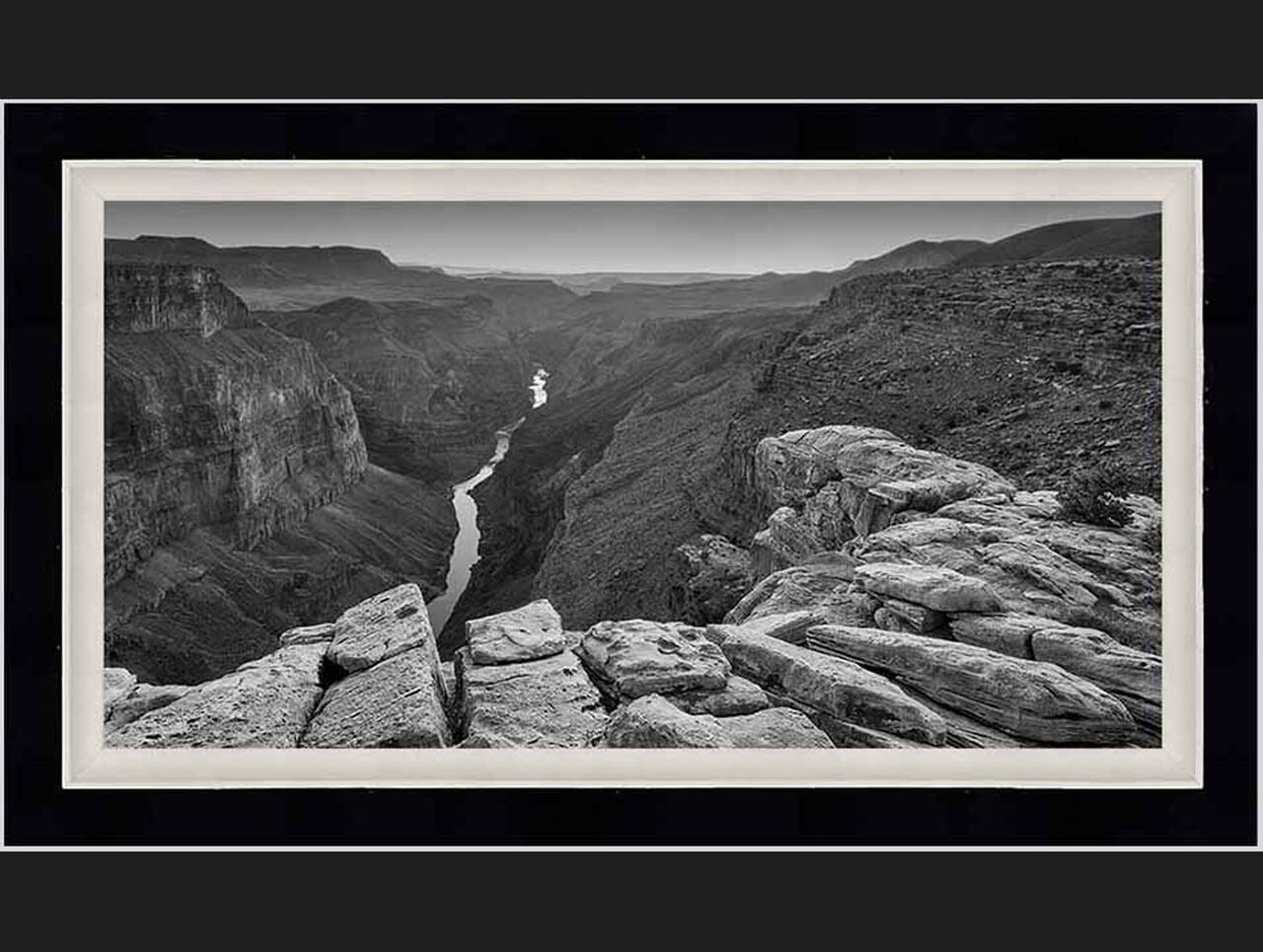
Collector's Choice · TruLife ® Acrylic in Italian Frame
Collector Edition of 25· Lumachrome TruLife Acrylic · Handcrafted Italian Frame
TruLife acrylic in a handcrafted Italian frame with a linen liner chosen for the image. Frame series, finish, and liner are settled with you after the order, and production begins from there. The frame and liner add about fourteen inches to the finished dimensions, worth allowing for when planning placement.
Signature Acrylic Edition of 50· Lumachrome TruLife · Gallery Float Mount
Face-mounted to TruLife acrylic and floated approximately one inch from the wall, with no frame to mediate between the image and the room. UV-resistant, anti-reflective, and scratch-resistant, with a lifetime guarantee against fading.
Signature Metal Edition of 50· ChromaLuxe Print · Gallery Float Mount
Color infused into the aluminum panel itself, floated from the wall on a concealed system. Where acrylic produces luminosity, metal produces clarity. Exceptional fade resistance with no glazing or coating required.
Fine Art Edition of 100· Hahnemühle Baryta Fine Art Paper
Printed without acrylic, so light meets the paper surface directly. Highlights stay luminous, shadows keep their nuance, and the surface has a tactile quality the other presentations approach differently. The understated choice, and the traditional one.
Complimentary shipping within the continental United States. International collector shipping available upon request.
Still deciding
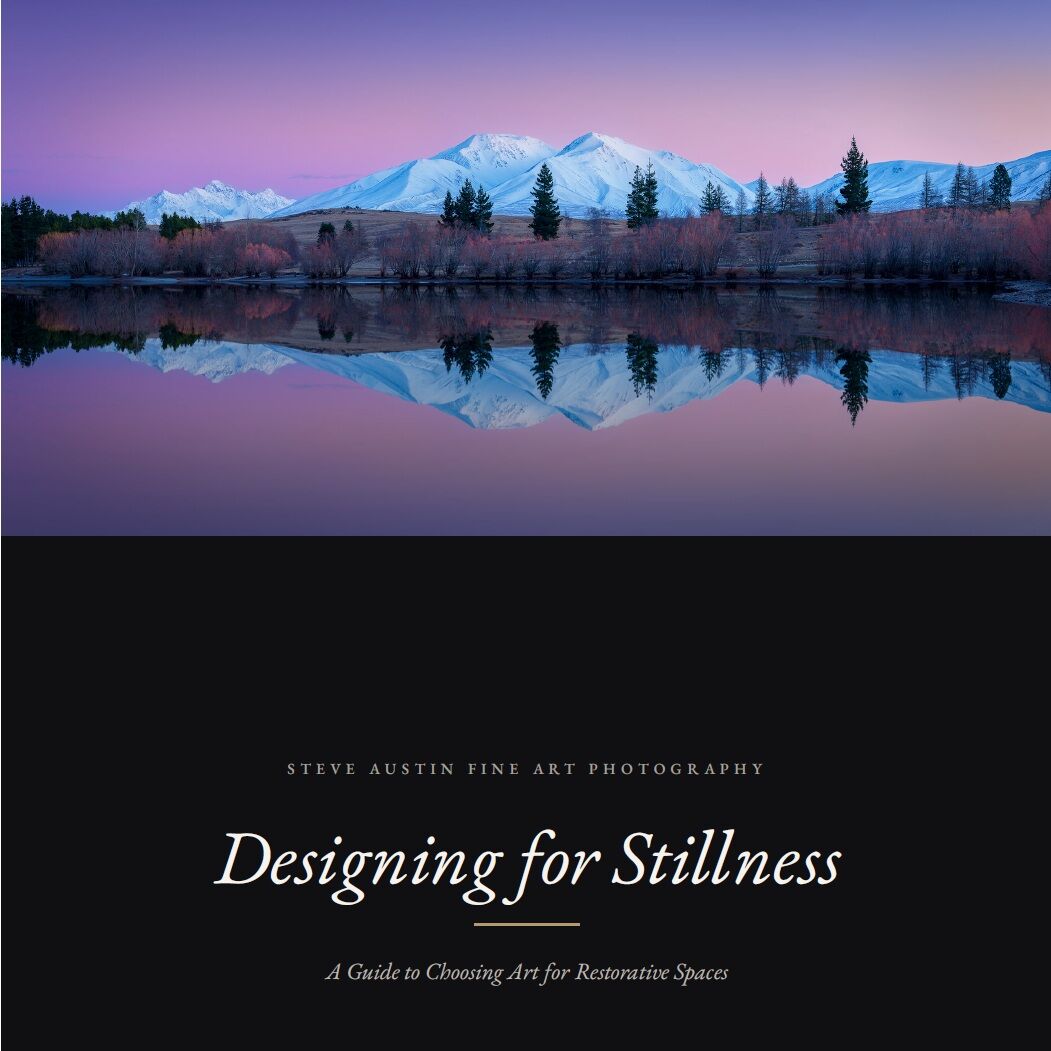
Designing for Stillness
A guide to choosing art for restorative spaces
How to tell whether an image will still hold you in a year, how scale changes what a photograph does in a room, and how to match a piece to the work a room actually performs. It cites the research it draws on, and it is equally clear about where that research stops. About ten minutes to read.