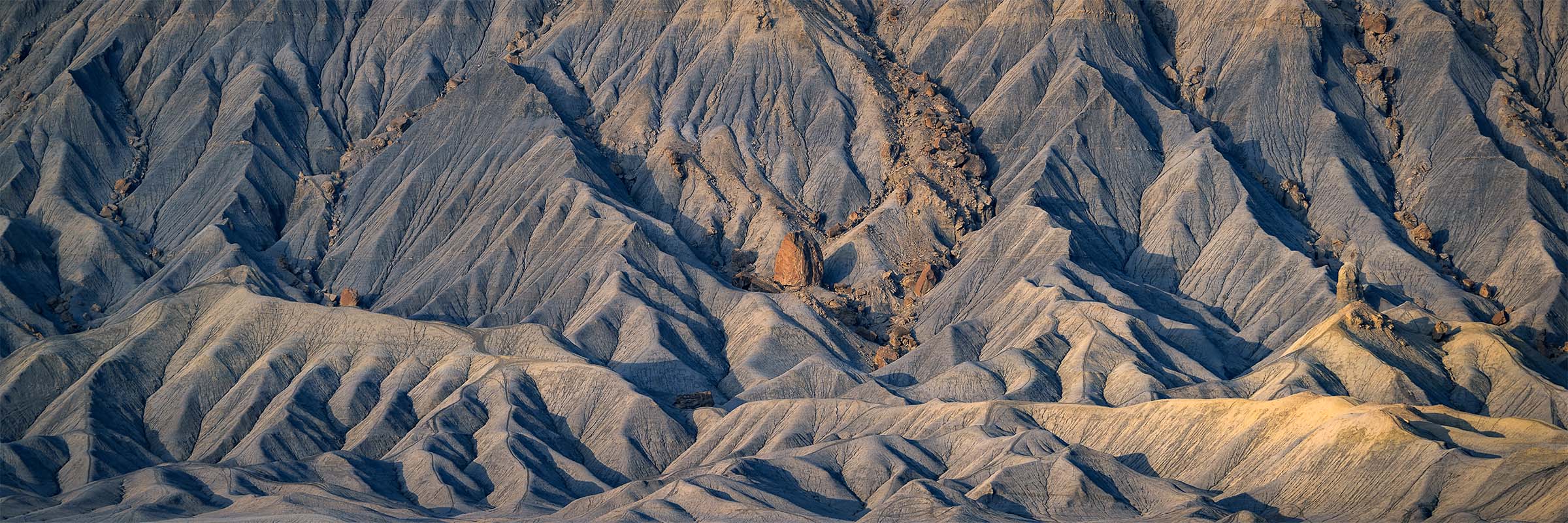
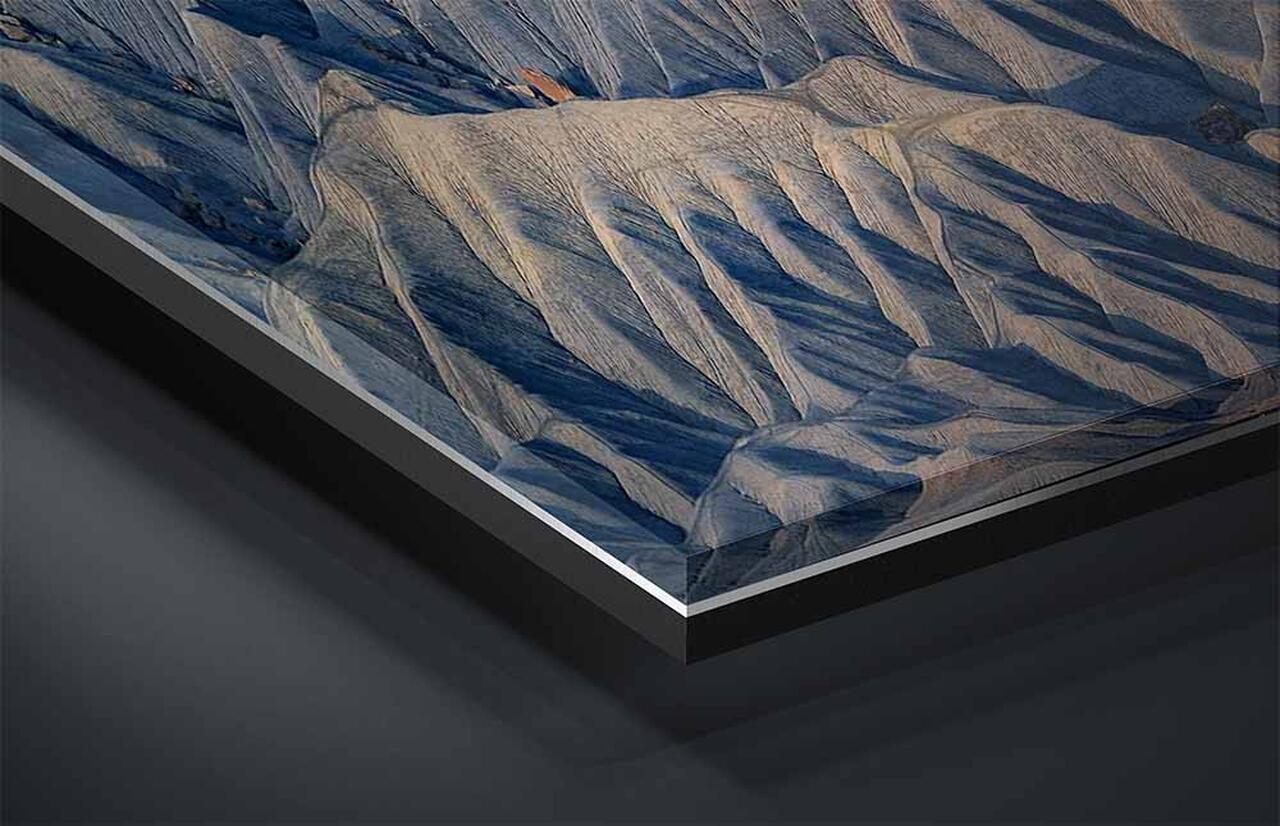
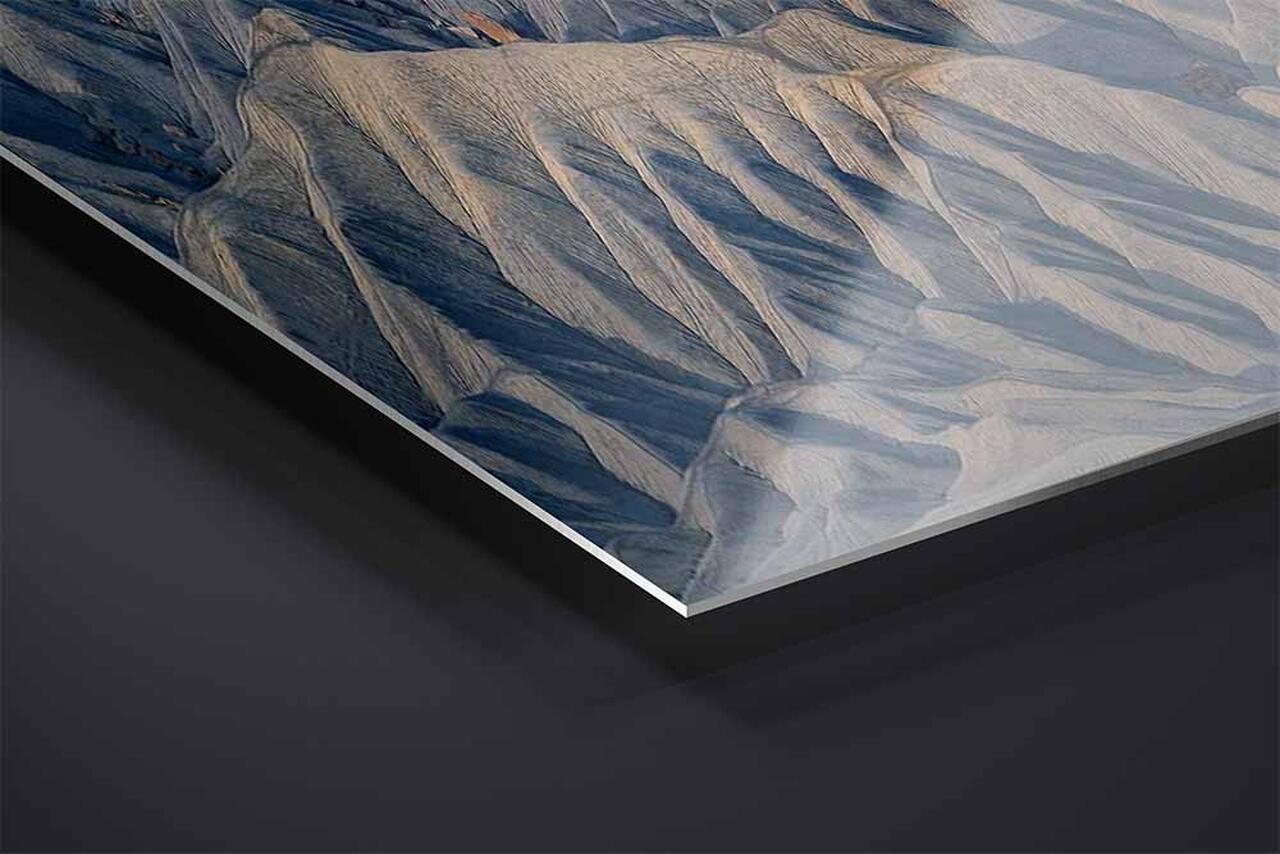
A 3:1 panoramic photograph of eroded blue-gray badlands at Factory Butte near Hanksville, Utah, available as a limited edition print in three sizes.
Artist's Story
This is the Blue Gate badlands at Factory Butte, west of Hanksville in Wayne County, Utah. There is no vegetation in the frame and no sky, and the whole picture is one material.
That material used to be the bottom of a sea. Ninety million years ago an inland ocean ran from the Gulf of Mexico to the Arctic and covered most of what is now Utah, and the fine mud that settled on its floor became this shale. These hills are seabed, brought up and set out in the sun.
Shale of that kind barely lets water in. Rain arrives and, instead of soaking away, it runs, and it has been running here for a long time.
Look at what that produced. Every one of those fine lines is a channel. Follow one downhill and it meets another, and the two together meet a third, and the pattern keeps going in the same branching shape all the way to the bottom of the frame. It is the shape a river system makes. The Mississippi and its tributaries draw the same figure across a third of a continent, and a slope eighteen inches wide draws it here, because the rule water follows does not care how much of it there is.
So this is not a picture of something falling apart. It is a picture of water finding its way, over and over, arriving at the same solution at every scale it is given.
The dark boulder near the center came down from a harder layer that once lay above all this, and it has been sitting where it sits for a very long while. Where it rests it shelters the ground beneath it, and if you look to the right of the frame you can see the same thing happening on a smaller stone, a little column of shale still standing because something has been keeping the rain off it.
Subtle Currents is a morning in a place with no plants and no water in it, entirely drawn by water.
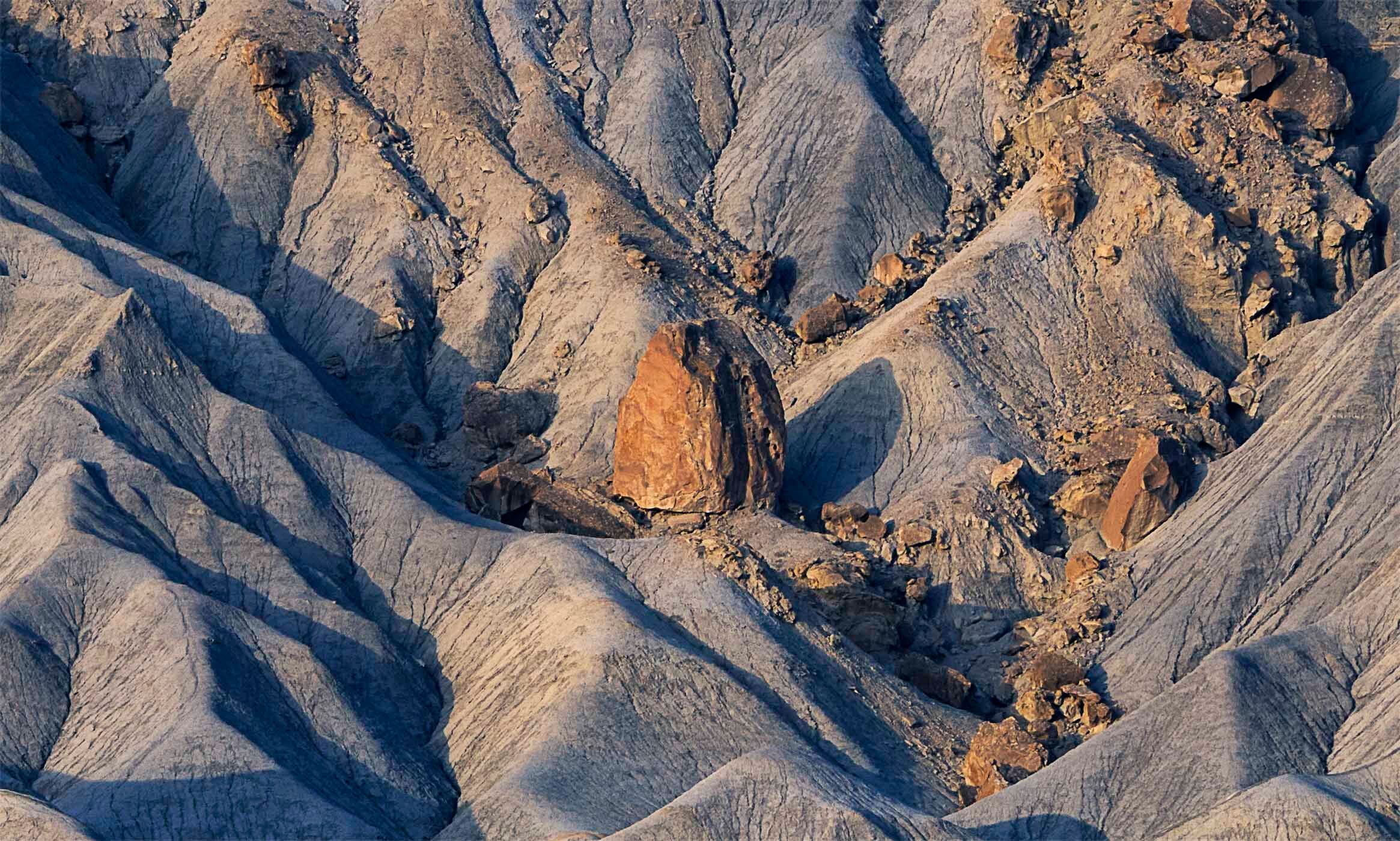
The boulder and the slopes around it, at about a third of the frame width. On a ninety inch print this section runs roughly thirty inches across. Individual rills separate from one another and can be followed from the top of a ridge down to where they meet a larger channel. The boulder resolves as a block with faces and edges, and the scatter of smaller stones below it separates into individual pieces. Across the slopes the horizontal banding in the shale becomes visible, running at an angle to the rills and showing the layers the sediment was laid down in. Click to view at full size.
About This Photograph
The Blue Gate badlands at Factory Butte, in the Upper Blue Hills of Wayne County, Utah, about twelve miles northwest of Hanksville. This is a single frame image made in early morning light. Factory Butte itself stands outside this frame, capped by a harder sandstone that has protected the shale beneath it.
This is a color photograph with almost no color in it. Measured across the whole frame, the three channels come out at a hundred and one, a hundred, and a hundred and one, within two points of each other, and the picture as a whole is within one point of neutral. Average saturation is twenty-eight percent, the second lowest in the collection.
It is also compressed. Nothing in it reaches pure white and effectively nothing reaches pure black, and the middle ninety percent of the picture sits between thirty and a hundred and sixty-nine on a scale of two hundred and fifty-five. Everything in the frame is a middle tone.
Subtle Currents
Steve Austinhttps://www.steveaustinphotography.com/
Location
Factory Butte, Hanksville, Utah
Subject
Badlands · eroded shale · desert abstract
Capture
Single frame in morning light
Format
Photograph · horizontal panorama, 3:1
Sizes
36 × 12 in · 60 × 20 in · 90 × 30 in
Print Media
TruLife Acrylic · ChromaLuxe Metal · Baryta paper
Edition
Limited, 25 / 50 / 100 by presentation
What it Does in a Room
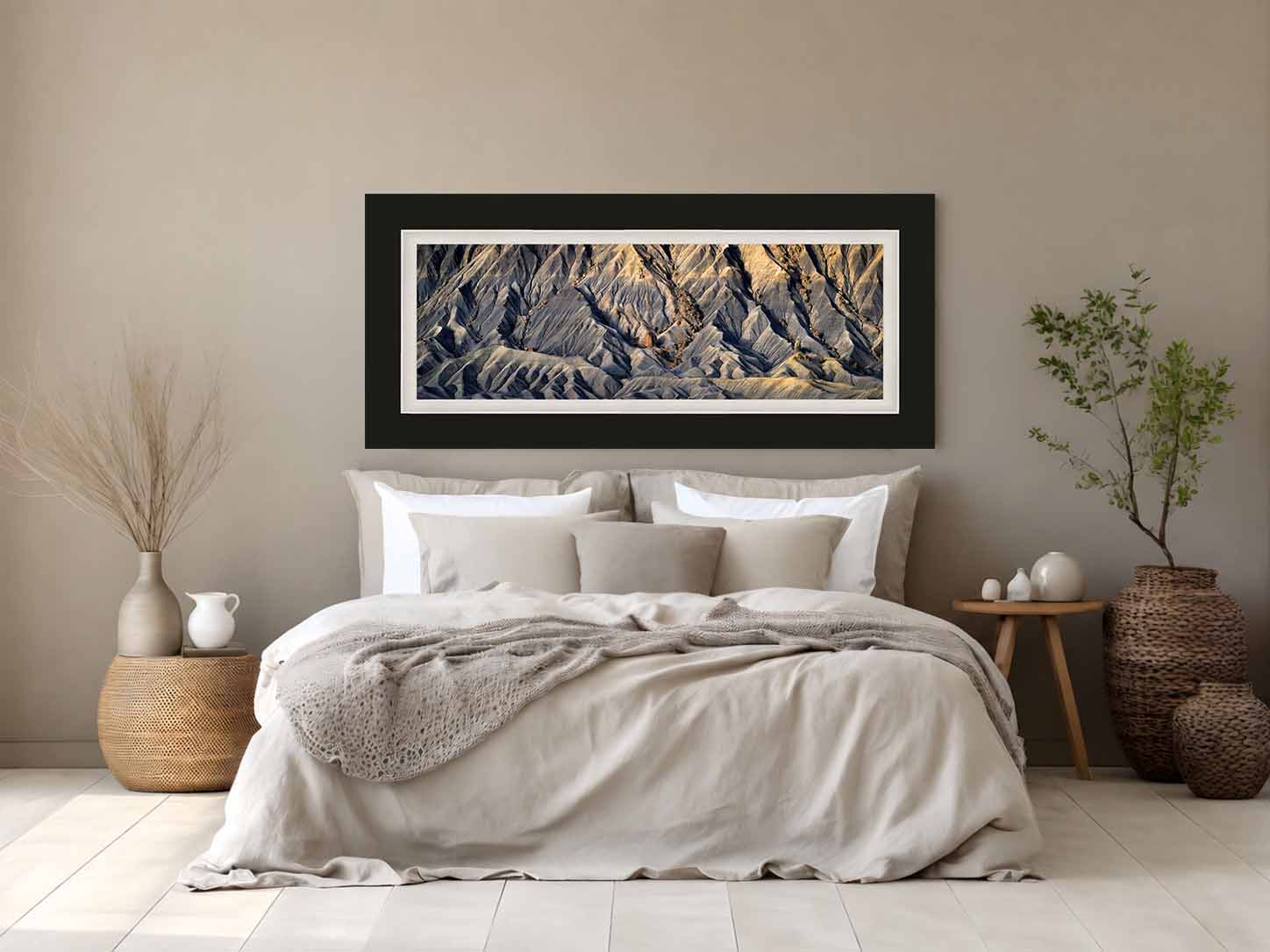
This photograph looks the same from every distance, which almost nothing does. The pattern in it repeats at every scale, so a viewer standing across the room and a viewer standing two feet away are looking at the same arrangement, larger or smaller. Most photographs reward being approached and lose something at a distance, and hanging them means choosing where a person will stand. This one removes that decision. It works at eighteen inches and it works at thirty feet, and it can go somewhere a viewer will only ever see it from one fixed spot without that spot being the wrong one.
It also asks less of a room than anything else offered here. Its three color channels are within two points of one another, its saturation is the second lowest in the collection, and nothing in it reaches either end of the tonal scale. There is no strong color to match, no bright passage to compete with a lamp, and no dark mass to open a hole in the plaster. That makes it the piece to reach for when the room is already doing something: a room with a view, with strong materials, with furniture that is the event. It fills a wall without entering the conversation.
The third thing is that it has no near and no far. Every part of the frame is the same material at roughly the same distance, so unlike a landscape it does not open depth into a wall. It reads as a panel rather than as a window. That matters in a room that already has real windows, where a second apparent opening competes with the actual view, and on any wall where puncturing the plane would be wrong. It gives a wall something to be rather than something to look through.
Not sure which size the room calls for, or want dimensions not listed here? Sizes beyond 90 × 30 are available on request and ship crated by freight. That conversation is welcome before an order is placed. Start that conversation and I will answer within one business day.
How small is too small for a photograph this wide?
At the Intimate size the picture is thirty-six inches across and twelve inches tall, and this photograph handles that unusually well because there is no subject to lose. The large ridgelines hold, the light and shadow across them hold, and the boulder near the center holds. What goes is the fineness of the drainage. Those rills run down to widths that are already at the edge of what a print can carry, and at twelve inches tall the smallest of them merge into a soft grain rather than staying as separate channels. Since the branching is the subject of this page, that costs something specific. The Collected at sixty by twenty is where the finest lines separate again. If you are weighing a size against a specific wall, choosing the right print size covers the measurements and the viewing distances in more detail.
What changes at the largest size?
The drainage becomes traceable. At ninety by thirty you can follow a single rill from the top of a ridge all the way down to where it joins a larger one, and then follow that one to its own junction, which is what turns a texture into a system. The horizontal banding in the shale becomes visible running across the slopes, cutting the rills at an angle and showing the layers the sediment was laid down in. The boulder resolves as a block with faces and edges, and the scatter of smaller stones around it separates into individual pieces. On the right the small capped column reads as a column with something sitting on top of it. In the lower slopes the surface shows a fine crust with a texture of its own between the channels. Why scale matters covers what happens perceptually when a landscape reaches the size where the eye has to cross it.
What kind of room does this photograph suit?
Almost any room, which is not something worth saying about most photographs. A guest room, a hallway, a sitting room, an office, a wall behind a sofa. It hangs at ordinary height and does not need a particular viewing distance. On materials it is the most forgiving piece in the collection, since it carries no color to clash and no strong tone to fight, and it sits equally well against warm plaster, cool concrete, and painted board. Two things to avoid. Keep it away from a large expanse of stone or textured plaster, because a photograph of a fine-grained surface hung beside a real one reads as a sample. And do not hang it beside another abstract, since a viewer needs one clear representational anchor in a room to read the abstract as a photograph rather than as pattern. When your mind needs to rest takes the question further.
Every work ships insured and arrives with a signed certificate of authenticity.
If a piece is damaged in transit, the choice of replacement is always yours, and your edition number stays with you.
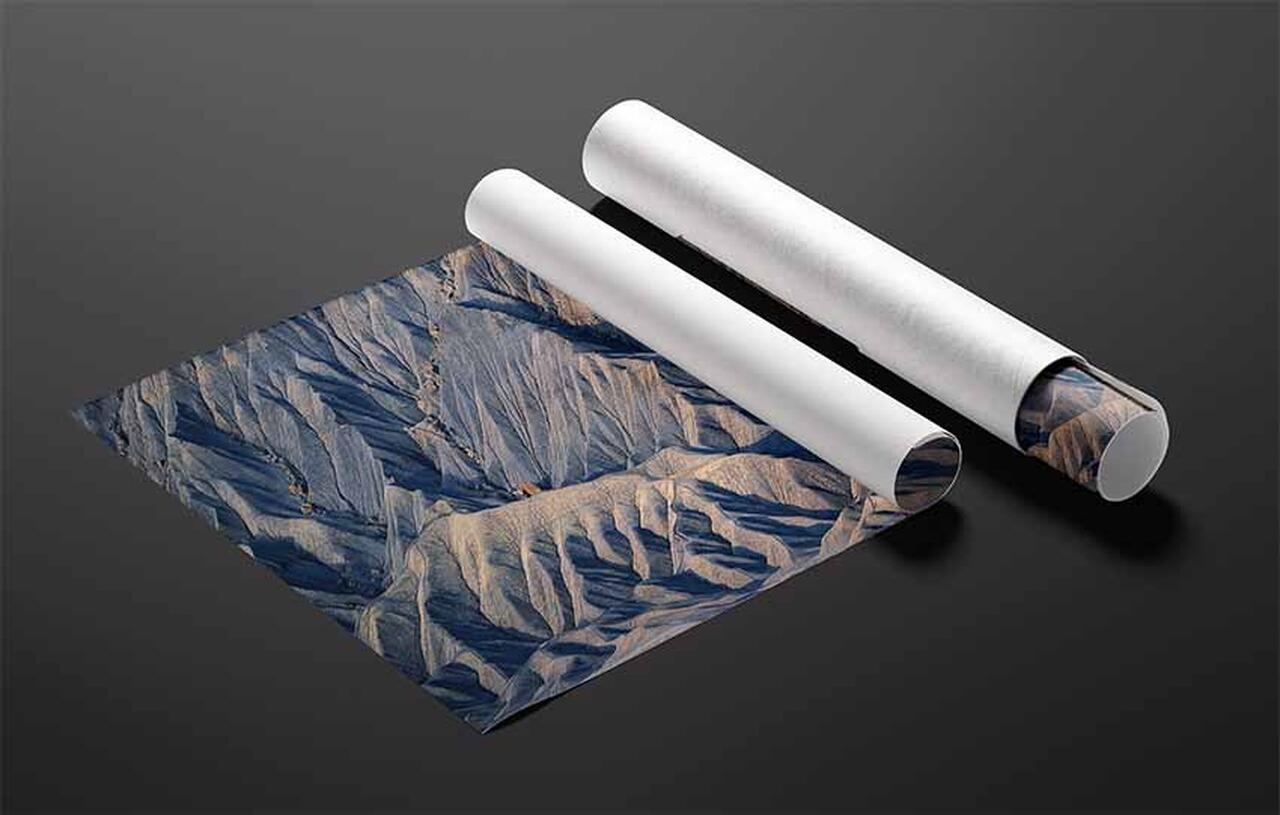
Production time runs 2 to 3 weeks for metal, 3 to 4 weeks for acrylic and paper, and 5 to 6 weeks for framed work.
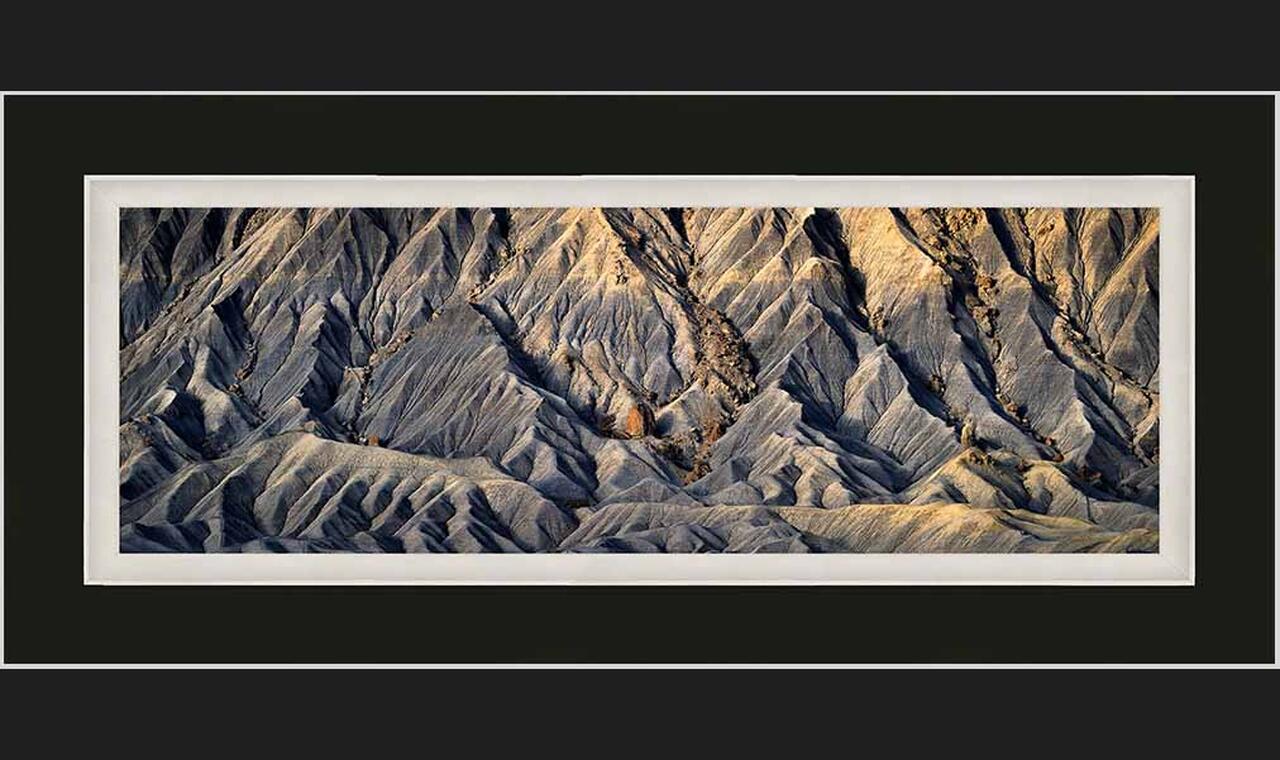
Collector's Choice · TruLife ® Acrylic in Italian Frame
Collector Edition of 25· Lumachrome TruLife Acrylic · Handcrafted Italian Frame
TruLife acrylic in a handcrafted Italian frame with a linen liner chosen for the image. Frame series, finish, and liner are settled with you after the order, and production begins from there. The frame and liner add about fourteen inches to the finished dimensions, worth allowing for when planning placement.
Signature Edition · TruLife ® Acrylic, Float Mount
Signature Edition of 50· Lumachrome TruLife Acrylic · Gallery Float Mount
Face-mounted to TruLife acrylic and floated approximately one inch from the wall, with no frame to mediate between the image and the room. UV-resistant, anti-reflective, and scratch-resistant, with a lifetime guarantee against fading.
Signature Edition of 50· ChromaLuxe Metal Print · Gallery Float Mount
Color infused into the aluminum panel itself, floated from the wall on a concealed system. Where acrylic produces luminosity, metal produces clarity. Exceptional fade resistance with no glazing or coating required.
Fine Art Edition of 100· Hahnemühle Baryta Fine Art Paper
Printed without acrylic, so light meets the paper surface directly. Highlights stay luminous, shadows keep their nuance, and the surface has a tactile quality the other presentations approach differently. The understated choice, and the traditional one.
Complimentary shipping within the continental United States. International collector shipping available upon request.
Still deciding
Designing for Stillness
A guide to choosing art for restorative spaces
How to tell whether an image will still hold you in a year, how scale changes what a photograph does in a room, and how to match a piece to the work a room actually performs. It cites the research it draws on, and it is equally clear about where that research stops. About ten minutes to read.