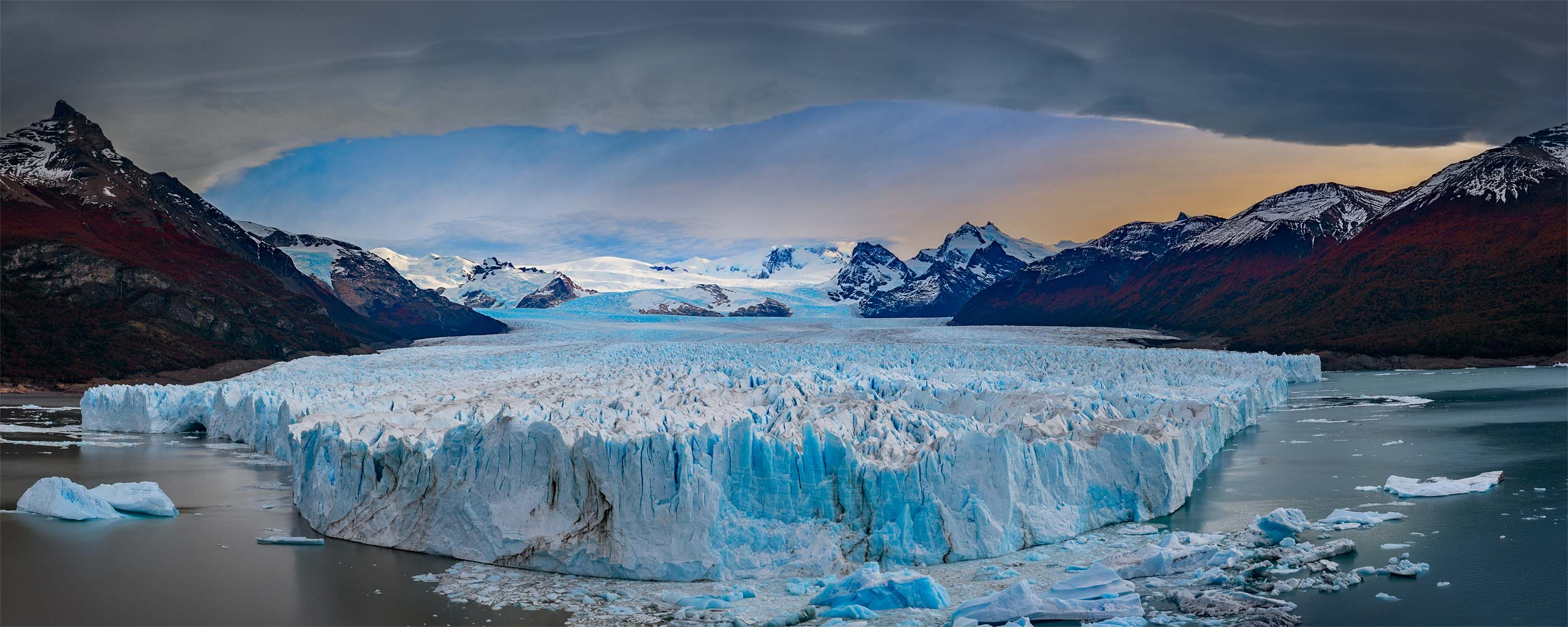
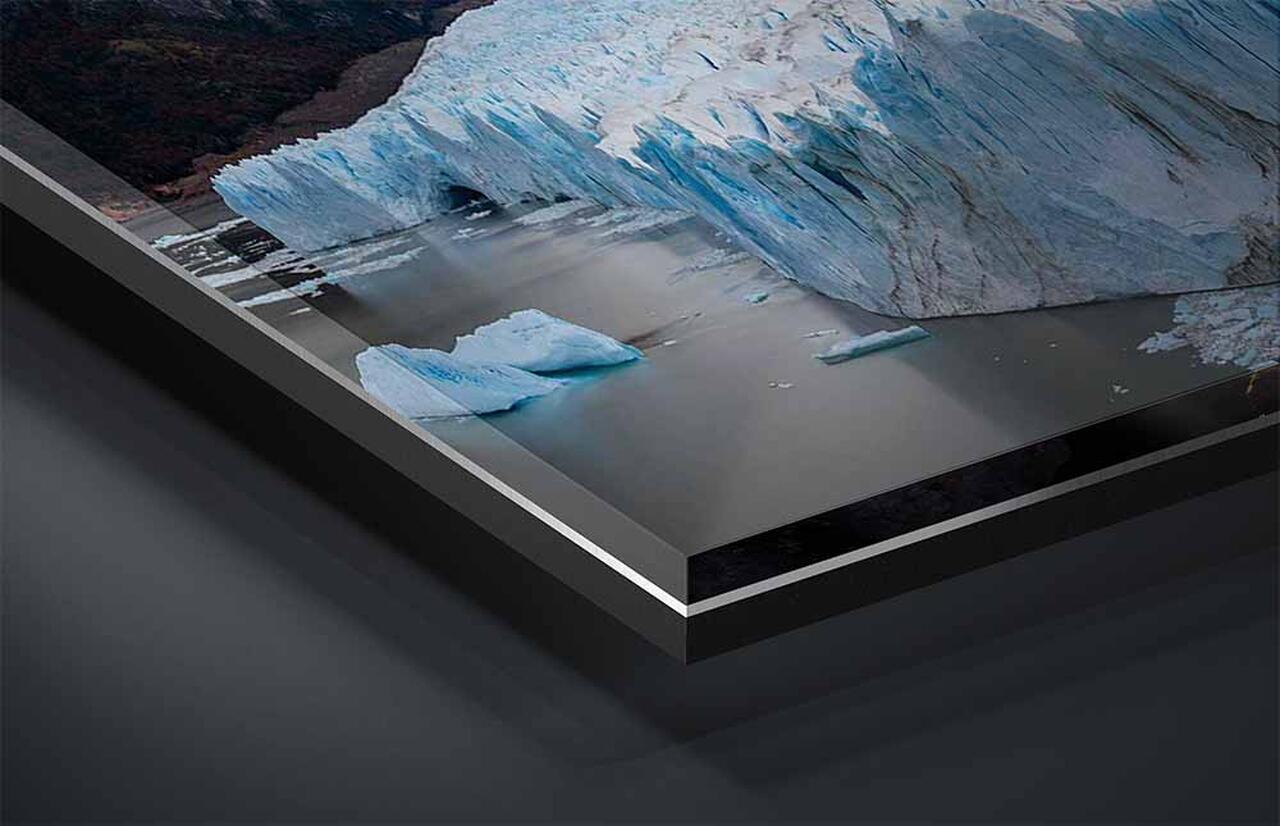
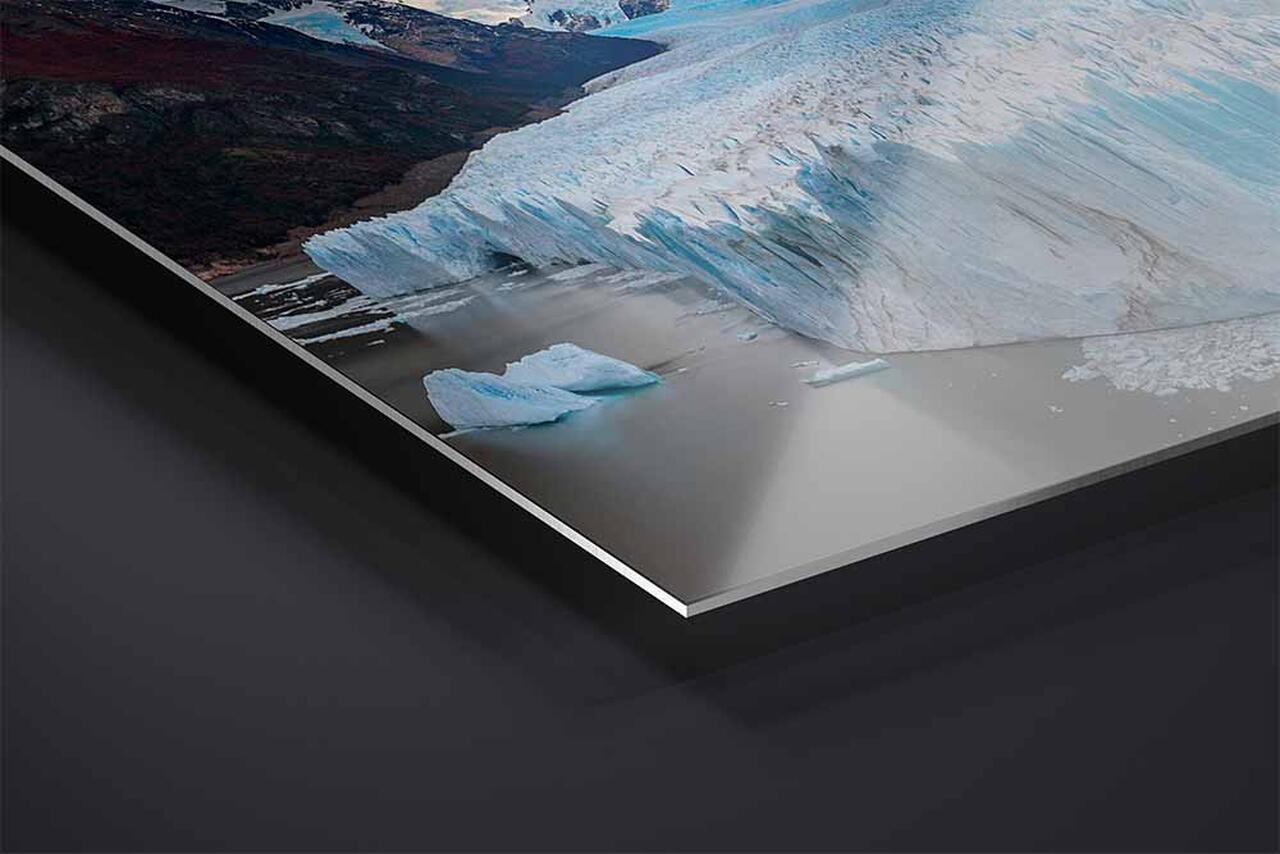
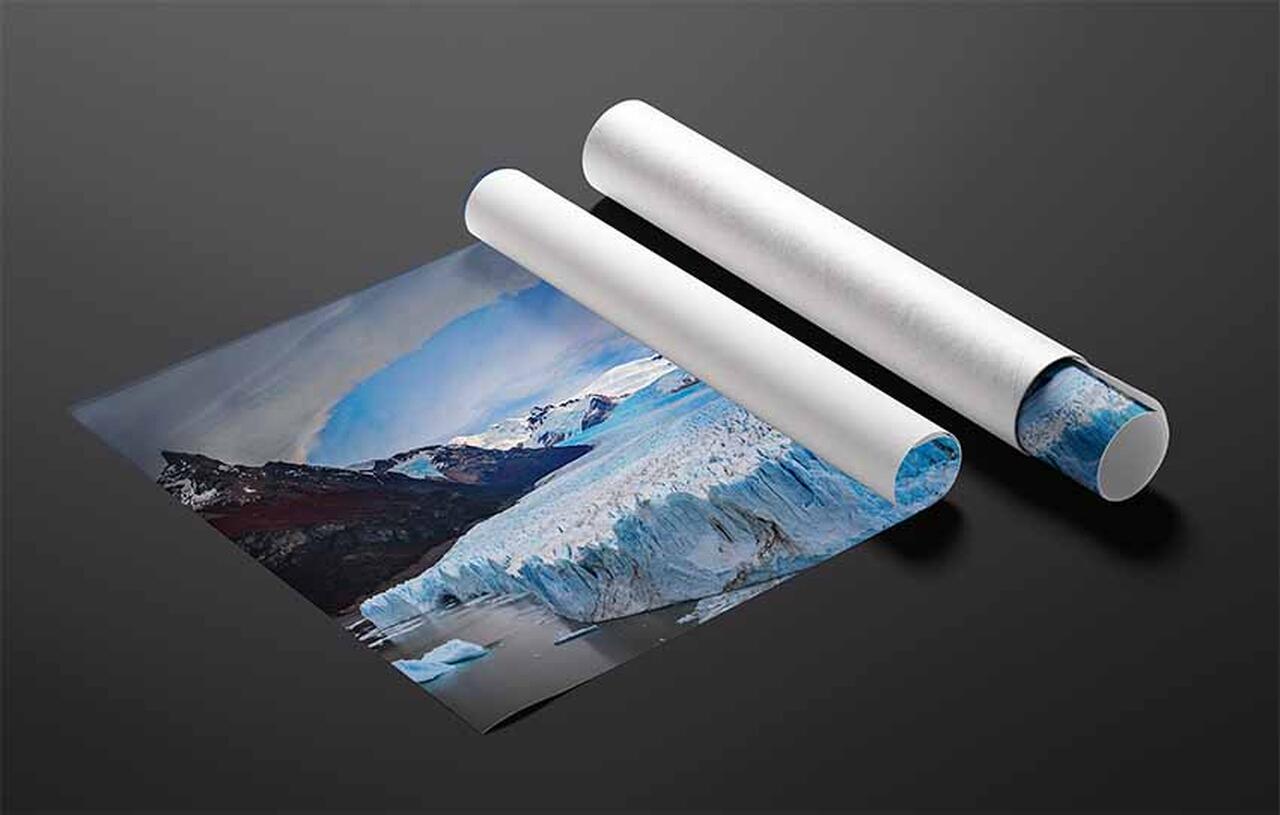
A 5:2 panoramic photograph of the Perito Moreno Glacier under a breaking sky in Los Glaciares National Park, Patagonia, Argentina, available as a limited edition print in three sizes.
Artist's Story
The Perito Moreno Glacier ends in a wall of ice about five kilometers wide standing in the water of Lago Argentino, in southern Patagonia. I stood in front of it under a lid of cloud that covered the whole sky, and then the lid opened along a line.
Not a gap that drifted across. An edge, hard and clean, that stayed where it was.
That edge is a piece of weather with a name and a shape. Air comes off the Pacific carrying a great deal of water. The Andes stand in its way, so it has to climb them, and climbing cools it, and cooling makes it let the water go. It rains and snows on the Chilean side the whole way up. The cloud piles against the crest and spills a short distance over the top, and that is the dark lid across the upper part of this photograph.
Then it comes down the other side. Descending air is compressed, and compression warms it, and warm air will hold more water than cold air will. So as that air sinks toward the lake it warms past the point where it can keep its cloud, and the cloud simply stops existing from the bottom up.
That is the edge. It is the height at which the descending air has warmed enough to dissolve what it was carrying. It stays put because the mountains stay put, and the whole arrangement is called a foehn, which happens on the lee side of ranges everywhere and is particularly reliable here.
So the sky did not open. It was taken apart from underneath, by wind coming down off the Andes, and the light that reached the ice came through the hole that made.
Unveiled Heaven is a wall of ice under a lid of cloud with a clean edge cut out of it by the weather that made the cloud in the first place.
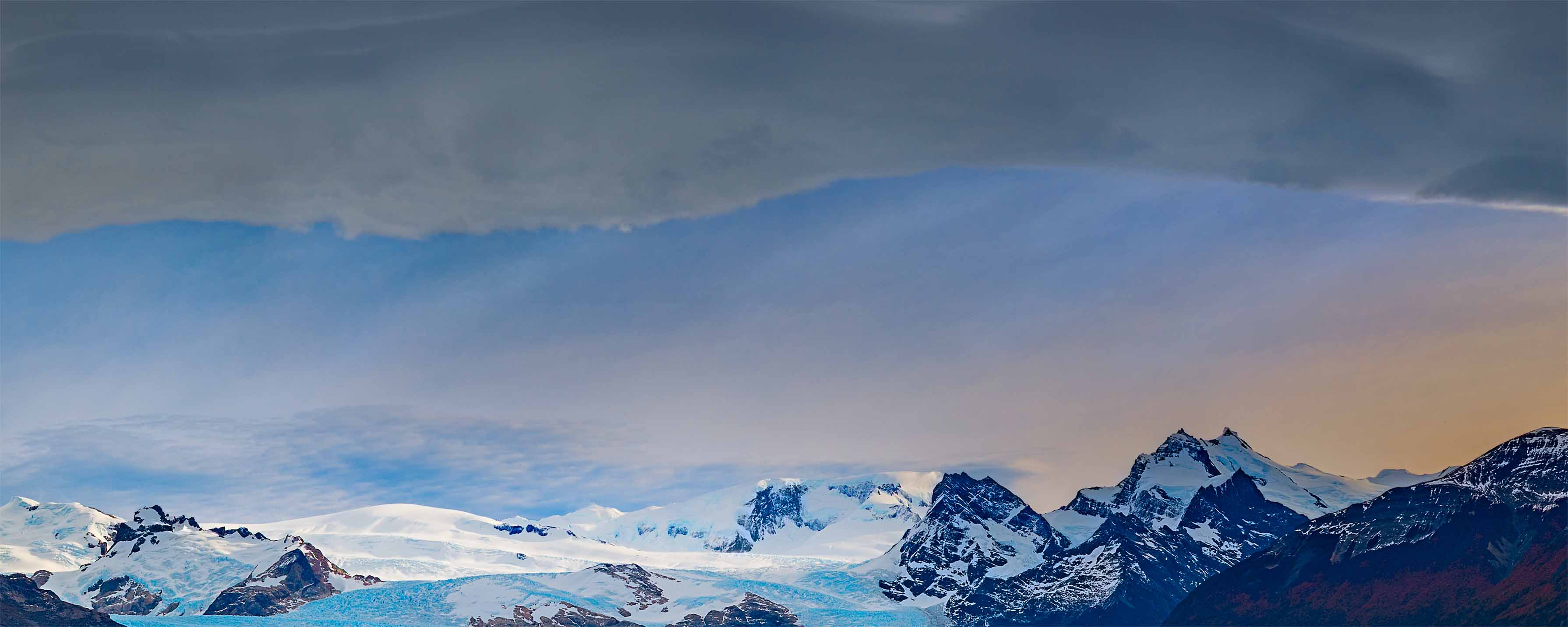
The cloud edge at about a third of the frame width. Along the underside of the lid the boundary shows its own fine structure, a run of scallops and torn hollows rather than a single clean line, which is what dissolving cloud looks like from below. Beneath it the clear band grades from blue at the left to warm at the right. Along the horizon the ice field separates into individual peaks and the glacier tongues descending between them, with the blue of the deeper ice visible against the white of the snow. Click to view at full size.
About This Photograph
The Perito Moreno Glacier, Los Glaciares National Park, Santa Cruz Province, Argentina, seen across the Canal de los Témpanos on Lago Argentino. This is a single frame image. The calving face stands roughly seventy meters above the water and runs about five kilometers wide, and the glacier flows east from the Southern Patagonian Ice Field behind it.
Two structures are visible in the sky, and they belong together. The dark lid across the top is a foehn wall, cloud piled against the Andean crest by Pacific air forced upward. The bright band beneath it with the hard lower edge is a foehn gap, where air descending the eastern slope has warmed by compression until it can no longer hold that cloud, and the cloud has dissolved from below.
Measured across the frame, the channels run red at eighty-seven, green at a hundred and six, and blue at a hundred and twenty-three. That ascending order is the signature of ice, which absorbs long wavelengths more than short ones, and it makes this the only photograph in the collection that is blue in the plain sense rather than violet.
Unveiled Heaven
Steve Austinhttps://www.steveaustinphotography.com/
Location
Perito Moreno Glacier, Santa Cruz, Argentina
Subject
Perito Moreno Glacier · calving face · foehn cloud
Capture
Single frame in breaking cloud
Format
Photograph · horizontal panorama, 5:2
Sizes
40 × 16 in · 60 × 24 in · 80 × 32 in
Print Media
TruLife Acrylic · ChromaLuxe Metal · Baryta paper
Edition
Limited, 25 / 50 / 100 by presentation
What it Does in a Room
This is the only piece in the collection that is blue in the ordinary sense. Several photographs here read as cool, but measured they are violet, with green suppressed below both red and blue. This one runs red lowest, green in the middle, blue highest, in the clean ascending order that ice produces. That distinction is invisible when you name it and unmistakable when two of them hang in the same room. A violet piece and a blue piece will not read as a pair; they will read as a mismatch nobody can quite locate. If this is going up alongside anything else from this collection, it should be the only cool piece on that wall.
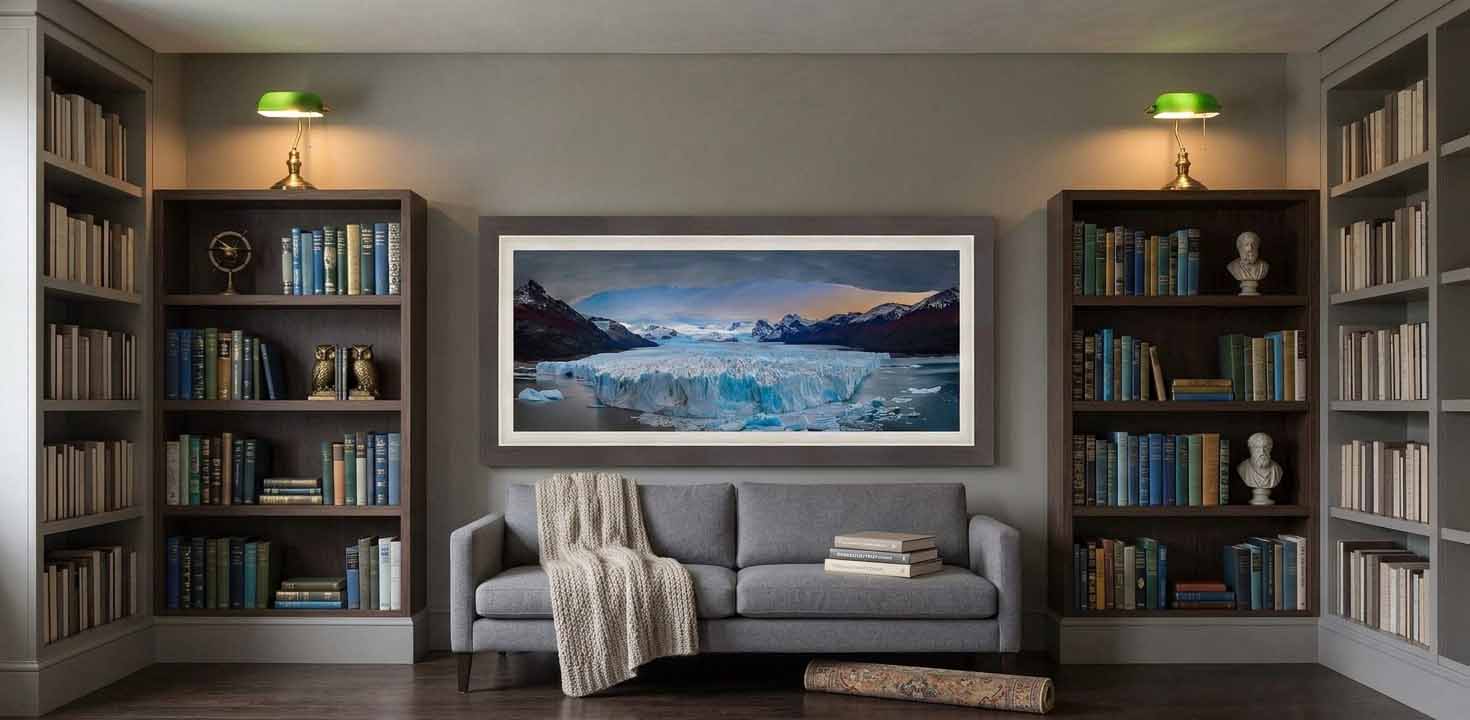
The composition is a horizontal sandwich with the weight in the middle. A dark cloud lid across the top, a bright band under it, then the ice wall running the full width, then water at the bottom. The mass and the detail are both concentrated in the central half of the frame, and the top and bottom edges carry almost nothing. That makes it forgiving about hanging: a few inches high or low costs very little, and it can sit above a tall piece of furniture that crops the bottom water without losing anything the picture needs. What it will not tolerate is anything cropping it at the sides, since the ice wall runs edge to edge and stopping it early makes the glacier look small.
It is also unusually clean at both ends of the range. Nothing in it reaches pure white, which is remarkable in a photograph of a sunlit ice face, and effectively nothing reaches black. What that means practically is that it survives poor conditions better than most: it will not blow out under a spotlight, it will not close up in a dim corner, and it holds its structure on paper as well as on acrylic. It is the least demanding piece here in terms of how it is printed and how it is lit.
Not sure which size the room calls for, or want dimensions not listed here? Sizes beyond 80 × 32 are available on request and ship crated by freight. That conversation is welcome before an order is placed. Start that conversation and I will answer within one business day.
How small is too small for a photograph this wide?
At the Intimate size the picture is forty inches across and sixteen inches tall. The big shapes all hold, the cloud lid, the bright band and its edge, the ice wall, the mountains on both sides. What goes is the face of the glacier. That wall is not a smooth surface, it is thousands of separate blades, towers, and fractures standing at every angle, and at sixteen inches tall they compress into a texture rather than staying as individual pieces of ice. The blue in the crevasses goes with them, which matters, because the blue is deepest where the ice is deepest and that relationship is the one thing the picture can show about how ice works. The Collected at sixty by twenty-four is where the face separates into pieces again. If you are weighing a size against a specific wall, choosing the right print size covers the measurements and the viewing distances in more detail.
What changes at the largest size?
The wall becomes individual towers. At eighty by thirty-two the calving face separates into distinct blades and pinnacles leaning at their own angles, with shadow between them and the fracture planes visible on their sides. Along the base the darker bands of trapped rock and grit read as separate layers running through the ice. The crevasses on the upper surface resolve one behind another all the way back toward the mountains, and the deep blue inside them becomes visibly deeper than the pale blue of the surface, which is the whole point. On the lake the floating pieces become individual bergs with their own shapes and shadows. In the sky the lower edge of the cloud lid shows its own fine structure rather than reading as a single line. Why scale matters covers what happens perceptually when a landscape reaches the size where the eye has to cross it.
What kind of room does this photograph suit?
Rooms with a wall long enough to take it whole. A library, a sitting room, a dining room, an office. It hangs at ordinary height and is forgiving about a few inches either way. On materials it is straightforward, since it carries one dominant color and that color is a plain blue rather than a difficult one: it works against warm wood, pale stone, and gray plaster alike, and it will make a warm room read warmer by contrast. Two things to avoid. Do not let furniture or an opening crop either end, since the ice wall runs the full width and cutting it short makes the glacier look small. And keep it away from another cool photograph from this collection, because most of the others are violet rather than blue and the difference shows when they are side by side. When your mind needs to rest takes the question further.
Every work ships insured and arrives with a signed certificate of authenticity.
If a piece is damaged in transit, the choice of replacement is always yours, and your edition number stays with you.
Production time runs 2 to 3 weeks for metal, 3 to 4 weeks for acrylic and paper, and 5 to 6 weeks for framed work.
Each print is made to order and takes its place in a numbered edition, so sales are final. Before you choose, I am glad to help: send a photo of your wall and I will show you this work in your room at true scale, at no charge. Start a conversation
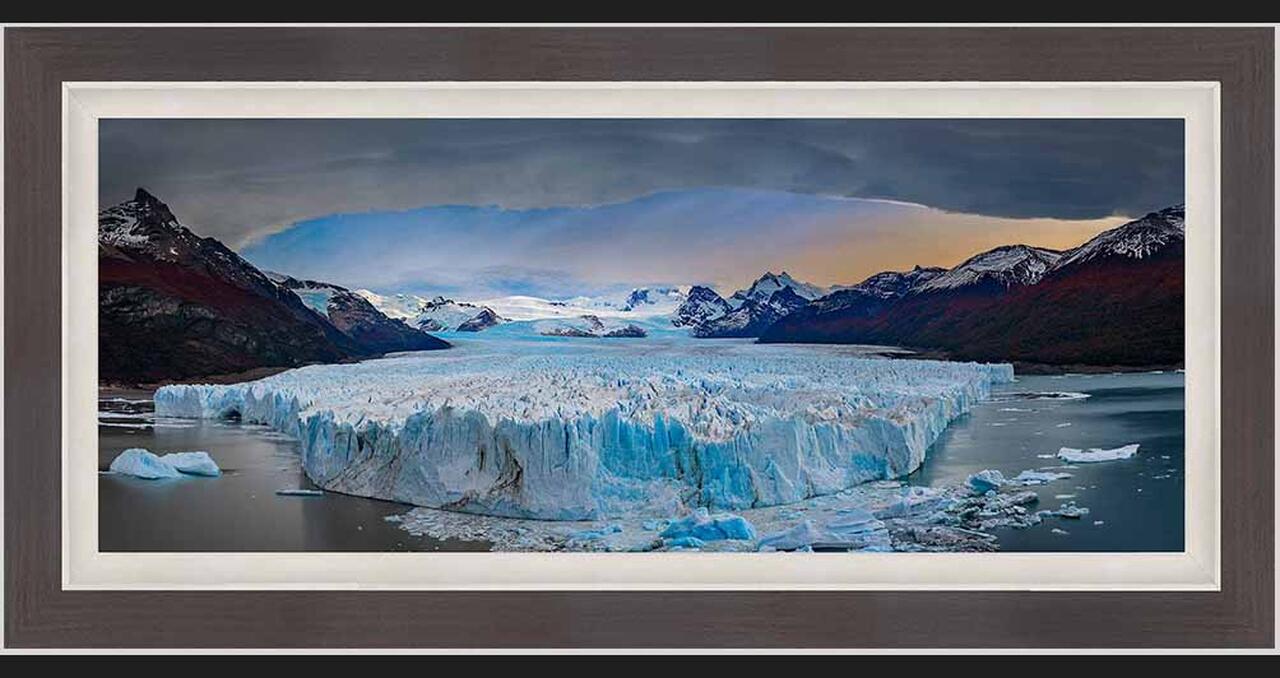
Collector's Choice · TruLife ® Acrylic in Italian Frame
Collector Edition of 25· Lumachrome TruLife Acrylic · Handcrafted Italian Frame
TruLife acrylic in a handcrafted Italian frame with a linen liner chosen for the image. Frame series, finish, and liner are settled with you after the order, and production begins from there. The frame and liner add about fourteen inches to the finished dimensions, worth allowing for when planning placement.
Signature Acrylic Edition of 50· Lumachrome TruLife · Gallery Float Mount
Face-mounted to TruLife acrylic and floated approximately one inch from the wall, with no frame to mediate between the image and the room. UV-resistant, anti-reflective, and scratch-resistant, with a lifetime guarantee against fading.
Signature Metal Edition of 50· ChromaLuxe Print · Gallery Float Mount
Color infused into the aluminum panel itself, floated from the wall on a concealed system. Where acrylic produces luminosity, metal produces clarity. Exceptional fade resistance with no glazing or coating required.
Fine Art Edition of 100· Hahnemühle Baryta Fine Art Paper
Printed without acrylic, so light meets the paper surface directly. Highlights stay luminous, shadows keep their nuance, and the surface has a tactile quality the other presentations approach differently. The understated choice, and the traditional one.
Complimentary shipping within the continental United States. International collector shipping available upon request.
Still deciding
Designing for Stillness
A guide to choosing art for restorative spaces
How to tell whether an image will still hold you in a year, how scale changes what a photograph does in a room, and how to match a piece to the work a room actually performs. It cites the research it draws on, and it is equally clear about where that research stops. About ten minutes to read.