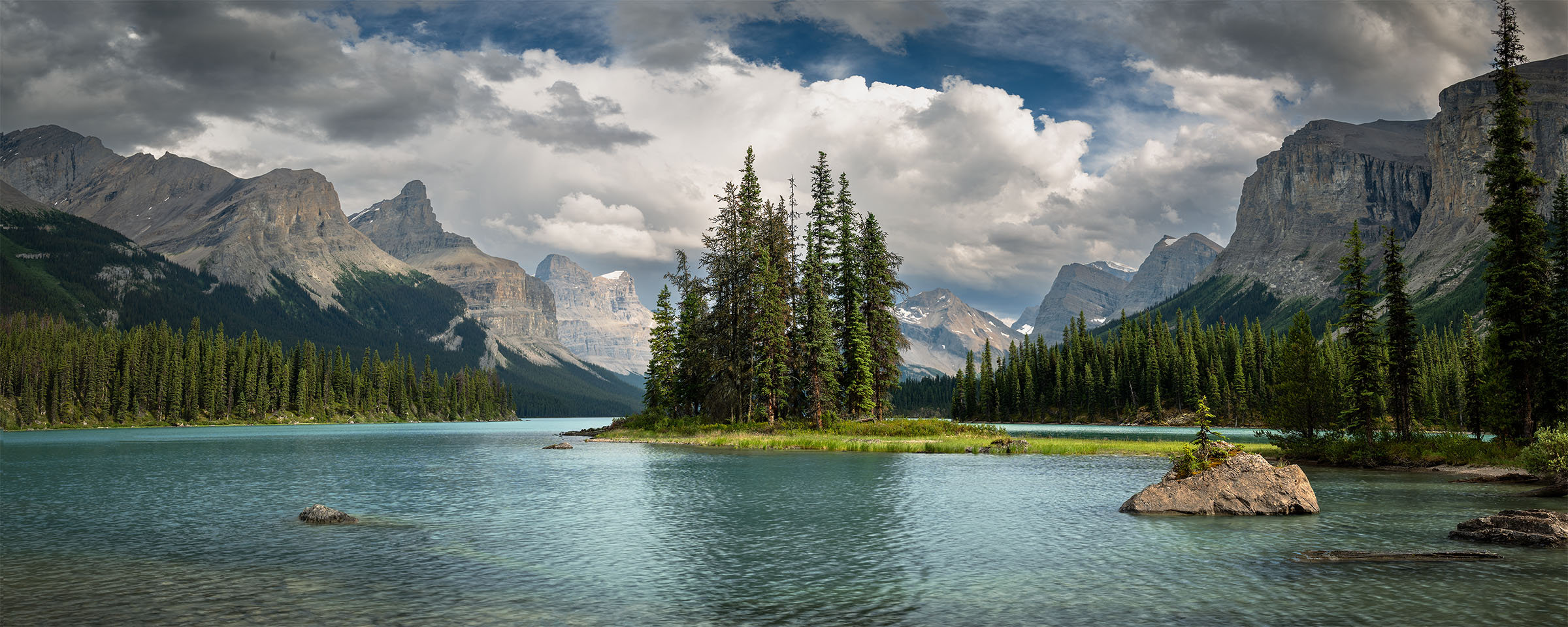
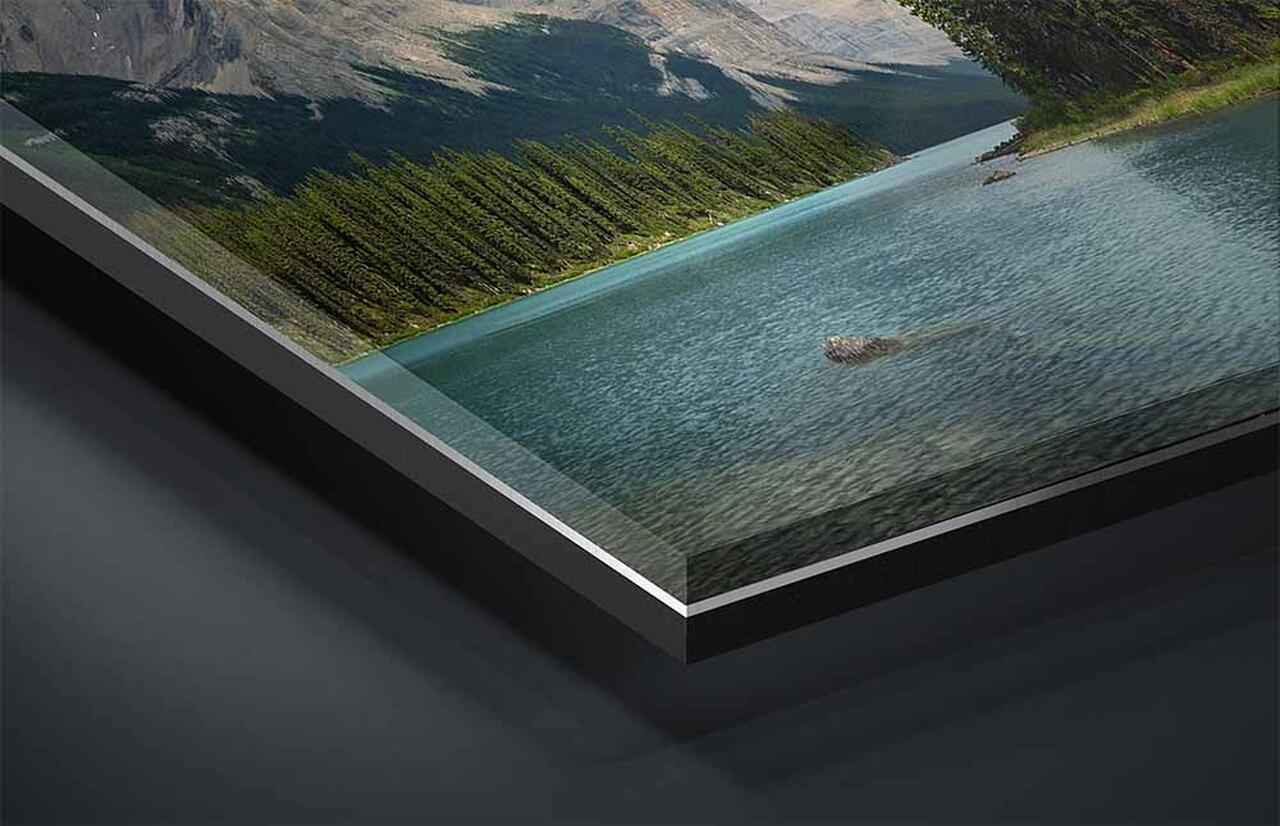
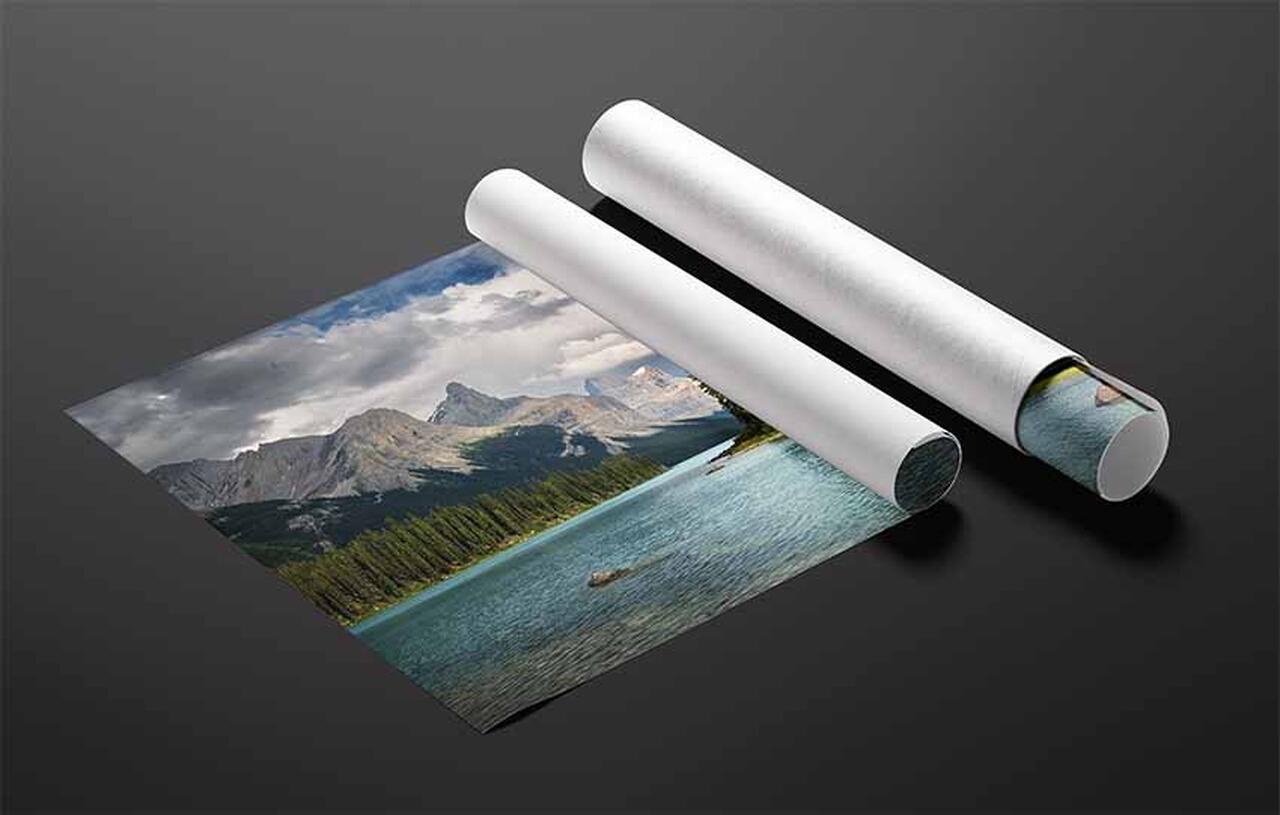
A 5:2 panoramic photograph of Spirit Island and Maligne Lake beneath the Rockies, Jasper National Park, Alberta, Canada, available as a limited edition print in three sizes.
Artist's Story
Getting to this island takes three hours in a kayak, and another three back. There is no trail to it and no road. I have made that trip more than once across more than a decade, to photograph a place nobody is permitted to set foot on.
There are twenty-seven trees on it. Mostly lodgepole pine, and when I made this frame most of them were still green.
A mountain pine beetle is roughly the size of a grain of rice. A female bores through the bark of a mature pine and cuts a vertical gallery in the living tissue beneath it, where she lays her eggs, and the larvae feed outward from that gallery in both directions. Enough of them working at once severs the layer that carries sugars down from the needles and water up from the roots, and the tree dies standing. The stages are legible from a boat: a year of rust-red needles, then several years of grey, then bare wood.
What let the beetle spread was warmth. A hard enough winter kills the larvae under the bark, and those winters came less often, so the insect moved into stands that had never had to survive it. The outbreak in Jasper peaked between 2017 and 2019, and a run of deep freezes in 2019 cut the population back sharply. The pines on this island were already infested. Five years later a fire came up the Maligne valley and burned much of the road in, and stopped short of the lake.
Whispers of Solitude is twenty-seven trees, photographed green, three hours by water from the nearest road in either direction.
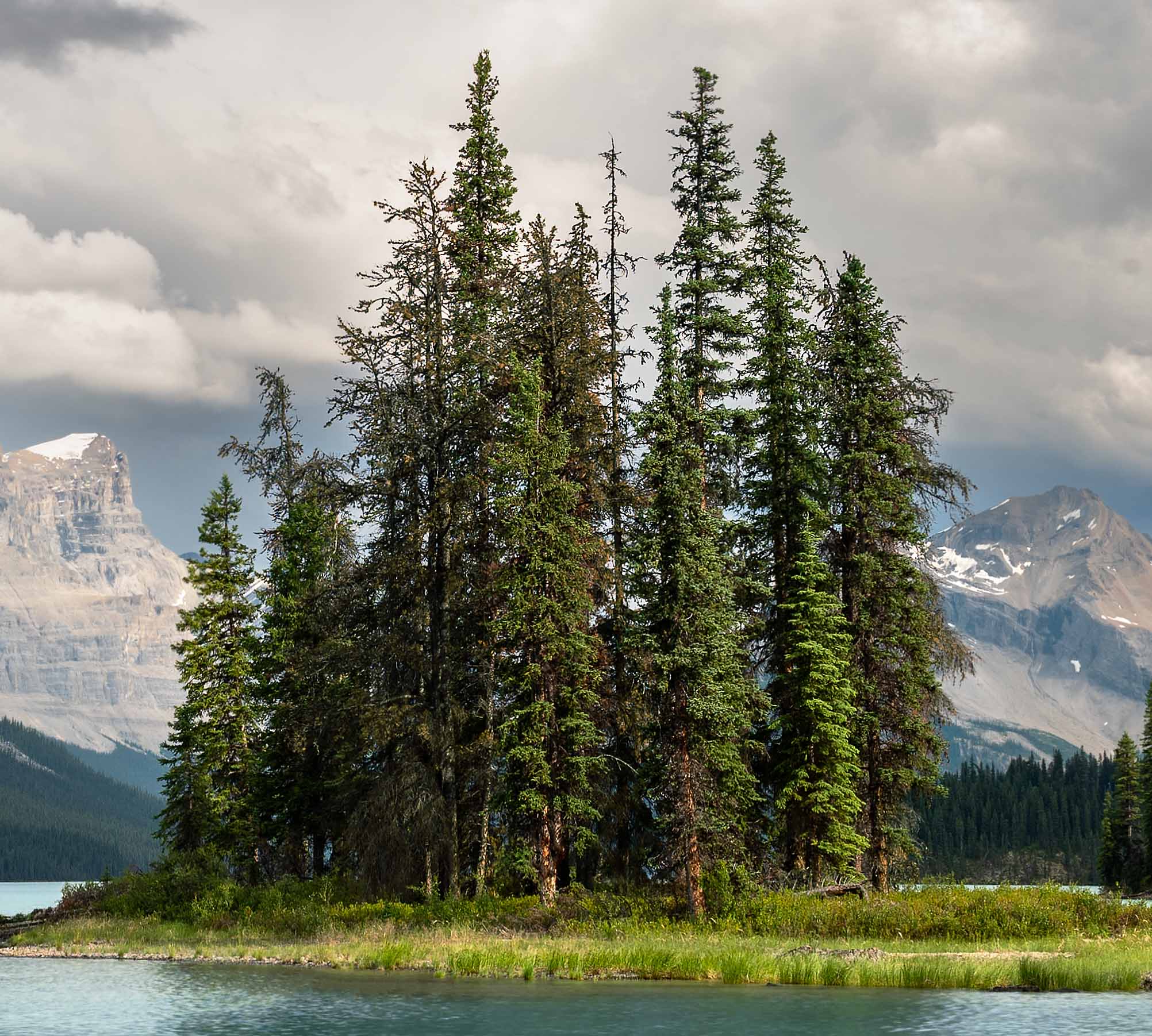
This crop is 15 percent of the frame width, about 12 inches across on the 80 inch print. The trees separate into individual trunks with sky between them, and the ones the beetle has taken are legible: two standing bare from the upper third down, and several more with thinned crowns and bark coming away in rust-colored patches. Behind them the peaks show their strata and the snow lying in the gullies, and along the waterline the grass fringe reads as grass. Click to view at full size.
About This Photograph
Spirit Island, in Maligne Lake, Jasper National Park, Alberta. Three frames stitched into a single panorama. There is no trail and no road to the island, which sits roughly nine miles down the lake from the launch at its northern end and can be reached only by water.
The pines here are lodgepole, and lodgepole depends on fire. Many of its cones are sealed shut with resin that melts only at the temperature of a burning forest, so the seeds stay locked in the canopy, sometimes for decades, until one comes through. A stand of even-aged lodgepole is a record of the last fire that passed. The tree the beetle has been killing across this valley is the one that needs the thing that burned the road in.
Measured across the frame, green is the dominant channel at a hundred and nine out of two hundred and fifty-five, above both red and blue, which has not happened on any other bright photograph in this collection.
Whispers of Solitude
Steve Austinhttps://www.steveaustinphotography.com/
Location
Spirit Island, Maligne Lake, Jasper National Park, Canada
Subject
Spirit Island · Maligne Lake · Canadian Rockies
Capture
Three-frame stitched panorama, summer
Format
Photograph · horizontal panorama, 5:2
Sizes
40 × 16 in · 60 × 24 in · 80 × 32 in
Print Media
TruLife Acrylic · ChromaLuxe Metal · Baryta paper
Edition
Limited, 25 / 50 / 100 by presentation
What it Does in a Room
Green is the dominant channel here, at a hundred and nine against a hundred for red and a hundred and four for blue, and green is the one hue the eye judges most finely. Human colour vision peaks in the middle of the spectrum, close to where these conifers sit, which means we separate shades of green more precisely than shades of anything else. The practical consequence is that green in the room around this print is a binary rather than a spectrum. A green cushion, a green ceramic, a living plant: each will either read as agreeing with the picture or as visibly wrong, with very little room in between. Any other colour you place nearby has latitude. Green has none.
It also has no highlight to hold on to. The brightest sustained passage measures two hundred and thirty-three, but only eight hundredths of one percent of the frame sits anywhere near white, which is the lowest figure of any bright photograph here. The clouds look brilliant because of what surrounds them rather than because they are actually light. That leaves the picture without an anchor at the top of its range, and anything that lifts the black point takes it away. Ambient light falling on the print, a glossy surface picking up the room, a lamp on the wall behind the viewer: each of these raises the shadows while the clouds stay where they are, and the whole picture drifts toward grey. It wants controlled light more than most.
And the subject is small. The island occupies about a fifth of the frame's width and sits in the middle distance, with more area given to the mountains above it and the water below. That is unusual here, where most pieces have a subject that fills the frame or a field with no subject at all. It sets a minimum distance. Standing close, the foreground water fills the field of view and the island falls to the edge of vision. The whole panel needs to be in view at once, which on the Statement size means standing back roughly thirteen feet. Hang it where that distance exists, and avoid corridors and narrow rooms.
Not sure which size the room calls for, or want dimensions not listed here? Sizes beyond 80 × 32 are available on request and ship crated by freight. That conversation is welcome before an order is placed. Start that conversation and I will answer within one business day.
Whispers of Solitude, limited edition printSteve Austin95012100USD11https://schema.org/InStock
Questions about this photograph
How small is too small for a photograph this wide?
At the Intimate size the picture is forty inches across and sixteen tall, and the valley holds. The peaks hold, the cloud holds, the water holds, and the island holds as a dark clump against the far shore. What goes is the island itself, which is the whole point of the photograph. Its trees merge into one mass at this size, so the twenty-seven of them stop being countable and become a shape. The grass fringe along its shoreline disappears. The far peaks stop separating from one another and read as a single ridge. The Collected at sixty by twenty-four brings the trees apart as trunks. If you are weighing a size against a specific wall, choosing the right print size covers the measurements and the viewing distances in more detail.
What changes at the largest size?
At eighty by thirty-two, working through the frame: the cloud separates into distinct layers with lit edges rather than reading as one bank, and the patch of clear sky at the upper right holds its shape. The far peaks separate from one another and show their strata and the snow lying in the gullies between them. On the island the trees become individual trunks, countable, with sky visible between them and the dead tops distinguishable from the living. The forest along both shores breaks into separate conifers. The grass fringe at the island's waterline reads as grass. And the boulder in the right foreground shows its lichen and the small conifer that has taken hold on top of it. Why scale matters covers what happens perceptually when a photograph reaches the size where the eye has to cross it.
What kind of room does this photograph suit?
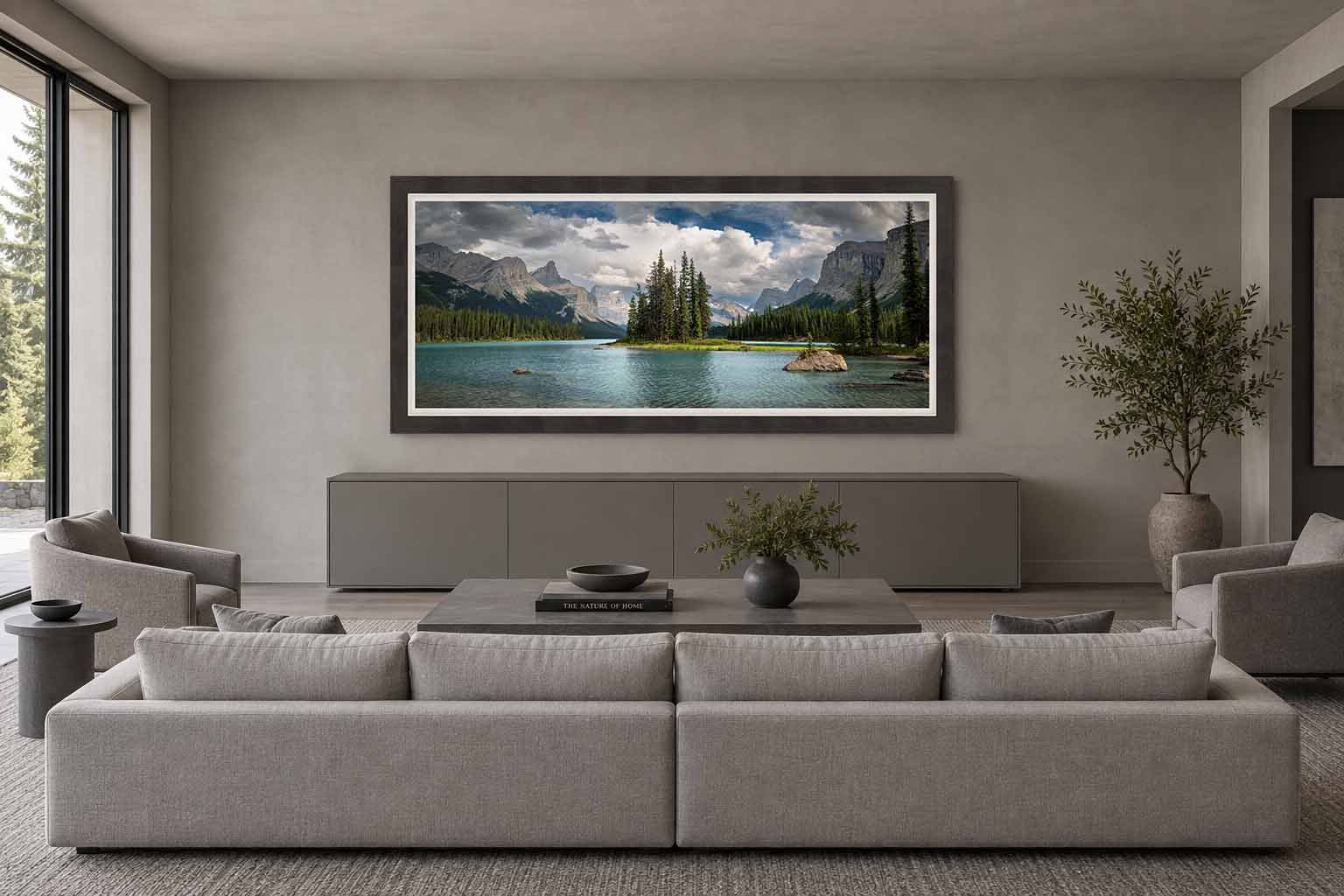
A long wall in a room with depth to it. A living room, a dining room, an office, a large landing. Hang it centered on its wall at standard height, with the center at about fifty-seven inches. On materials it wants cool neutrals: pale grey plaster, limestone, concrete, blackened steel, and grey or off-white upholstery. Three things to avoid. Keep green out of the immediate surround, including living plants, for the reason above. Do not aim any directed light at it, since the picture has almost no true highlight and any lift in the shadows flattens the whole tonal range. And do not hang it in the same sightline as another mountain and lake photograph, because the two will be compared against each other rather than looked at. When your mind needs to rest takes the question further.
Every work ships insured and arrives with a signed certificate of authenticity.
If a piece is damaged in transit, the choice of replacement is always yours, and your edition number stays with you.
Production time runs 2 to 3 weeks for metal, 3 to 4 weeks for acrylic and paper, and 5 to 6 weeks for framed work.
Each print is made to order and takes its place in a numbered edition, so sales are final. Before you choose, I am glad to help: send a photo of your wall and I will show you this work in your room at true scale, at no charge. Start a conversation
Collector's Choice · TruLife ® Acrylic in Italian Frame
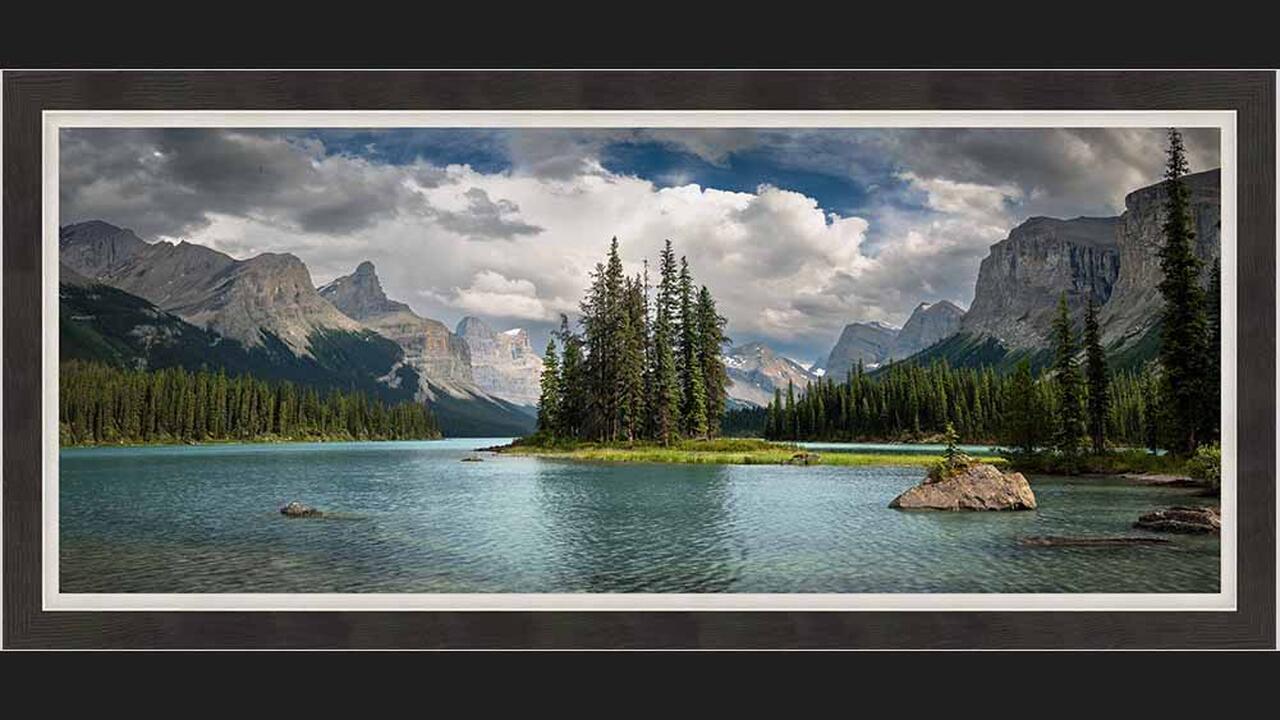
Collector Edition of 25· Lumachrome TruLife Acrylic · Handcrafted Italian Frame
TruLife acrylic in a handcrafted Italian frame with a linen liner chosen for the image. Frame series, finish, and liner are settled with you after the order, and production begins from there. The frame and liner add about fourteen inches to the finished dimensions, worth allowing for when planning placement.
Signature Acrylic Edition of 50· Lumachrome TruLife · Gallery Float Mount
Face-mounted to TruLife acrylic and floated approximately one inch from the wall, with no frame to mediate between the image and the room. UV-resistant, anti-reflective, and scratch-resistant, with a lifetime guarantee against fading.
Signature Metal Edition of 50· ChromaLuxe Print · Gallery Float Mount
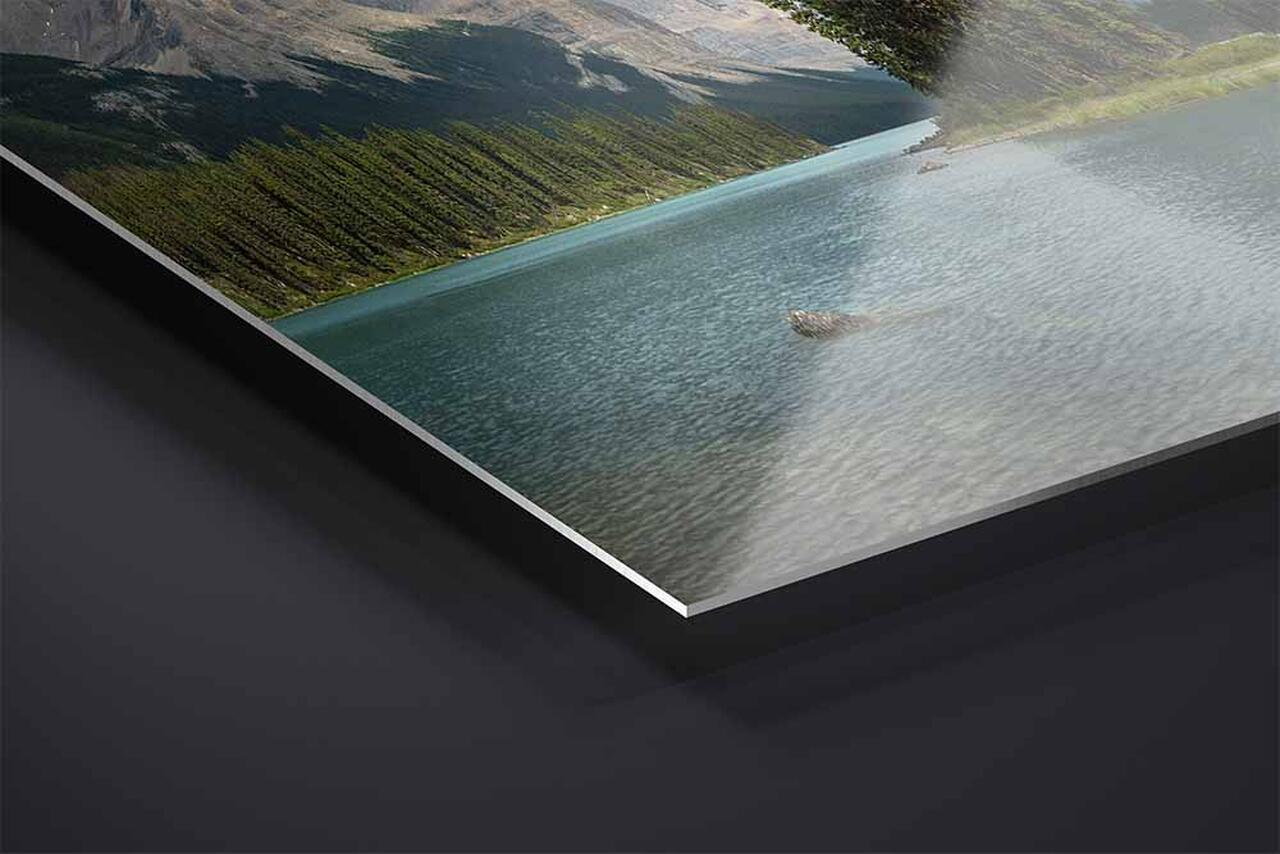
Color infused into the aluminum panel itself, floated from the wall on a concealed system. Where acrylic produces luminosity, metal produces clarity. Exceptional fade resistance with no glazing or coating required.
Fine Art Edition of 100· Hahnemühle Baryta Fine Art Paper
Printed without acrylic, so light meets the paper surface directly. Highlights stay luminous, shadows keep their nuance, and the surface has a tactile quality the other presentations approach differently. The understated choice, and the traditional one.
Complimentary shipping within the continental United States. International collector shipping available upon request.
Still deciding
Designing for Stillness
A guide to choosing art for restorative spaces
How to tell whether an image will still hold you in a year, how scale changes what a photograph does in a room, and how to match a piece to the work a room actually performs. It cites the research it draws on, and it is equally clear about where that research stops. About ten minutes to read.