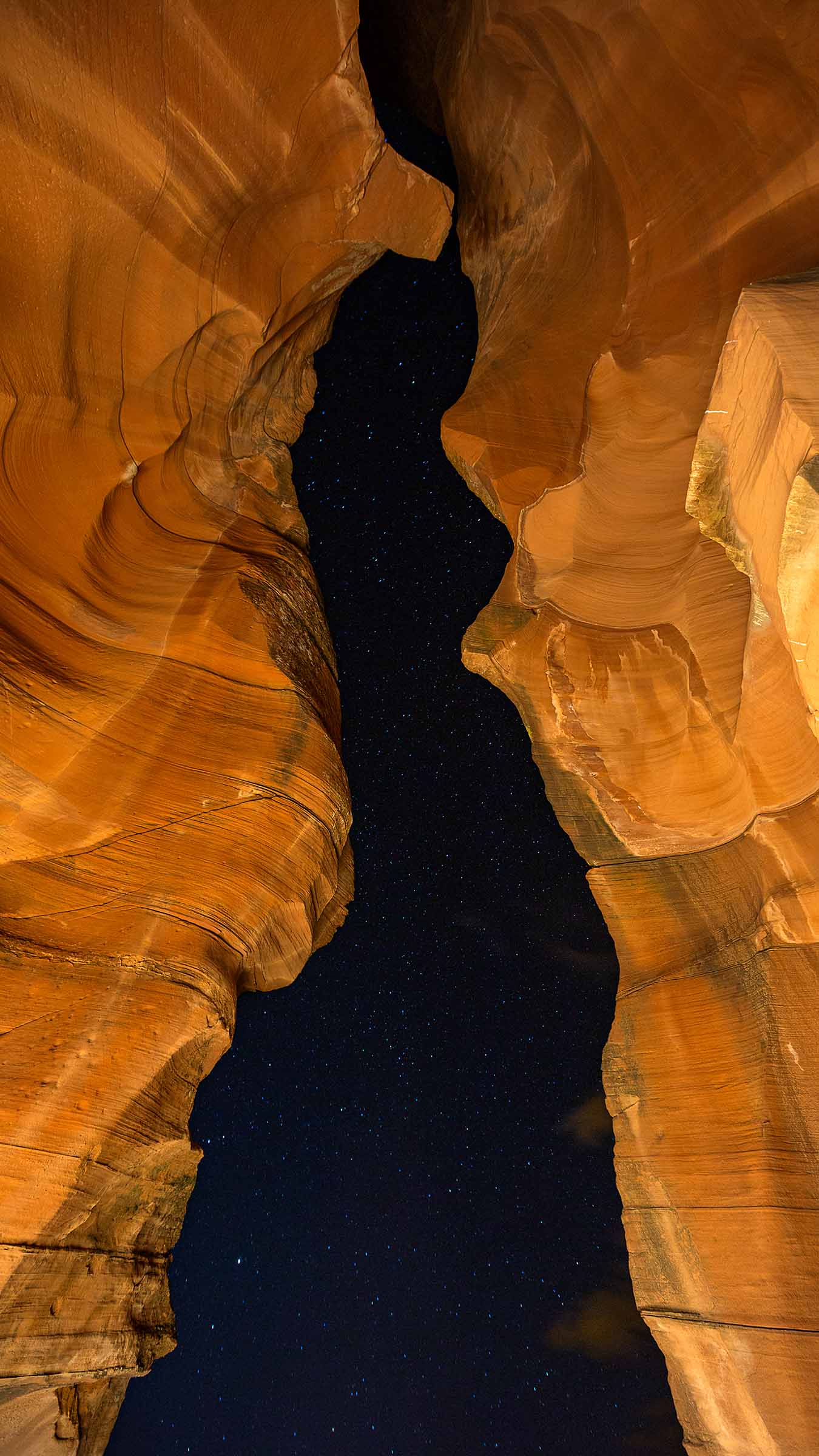
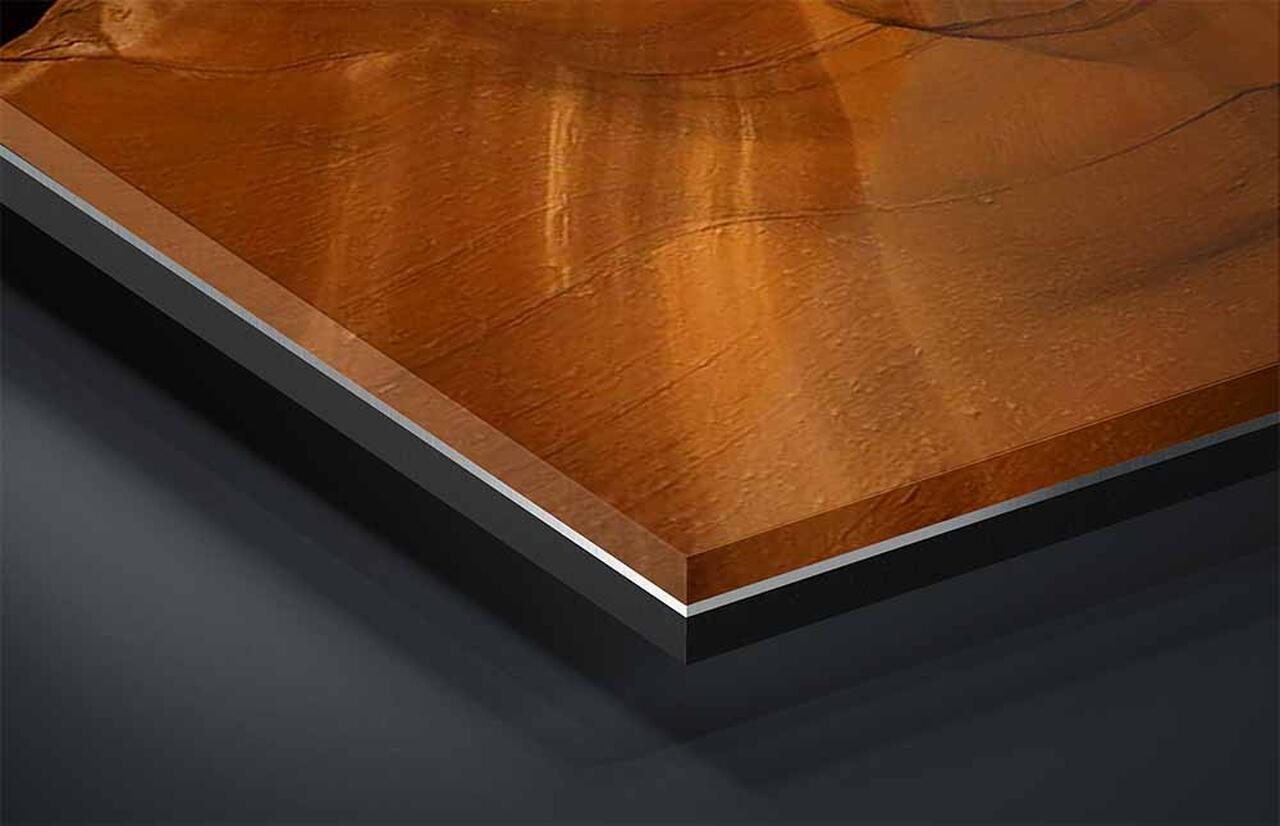
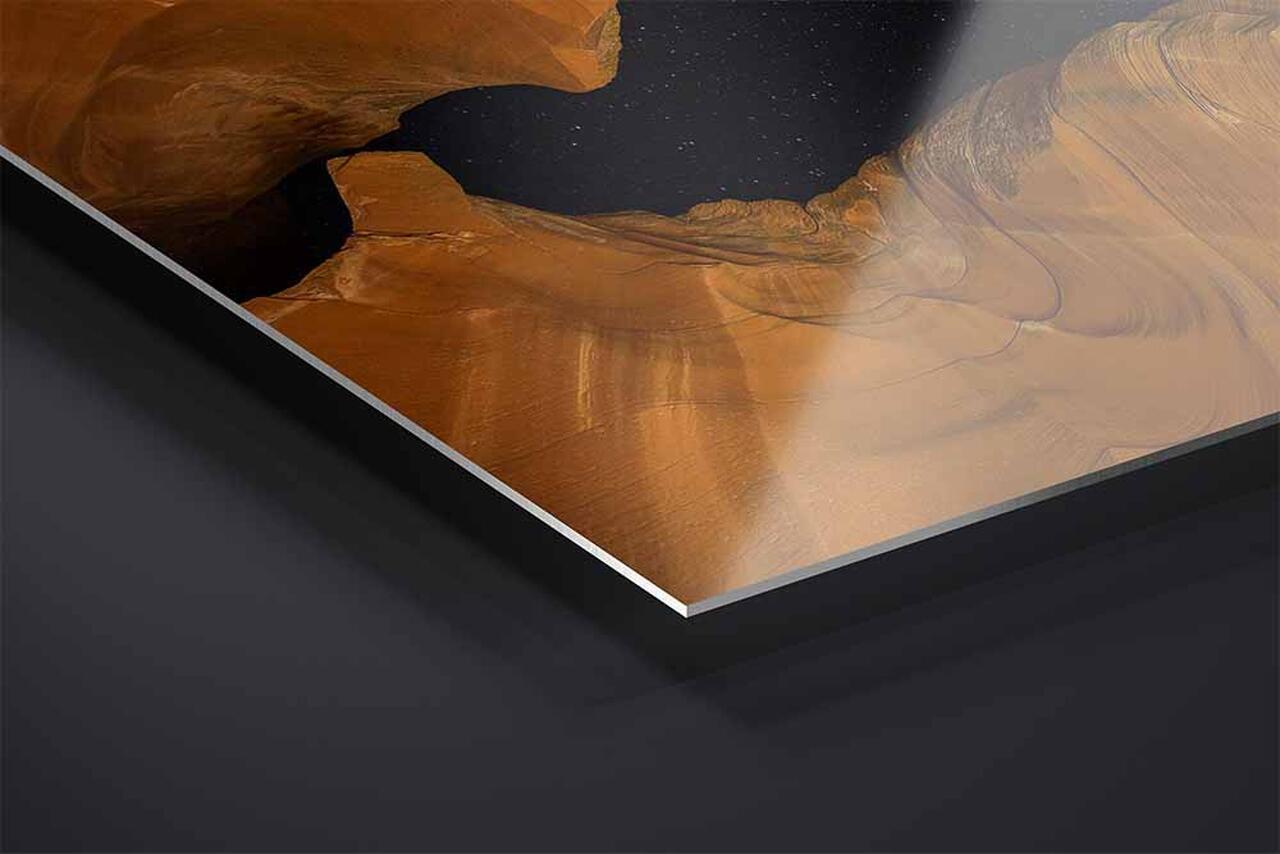
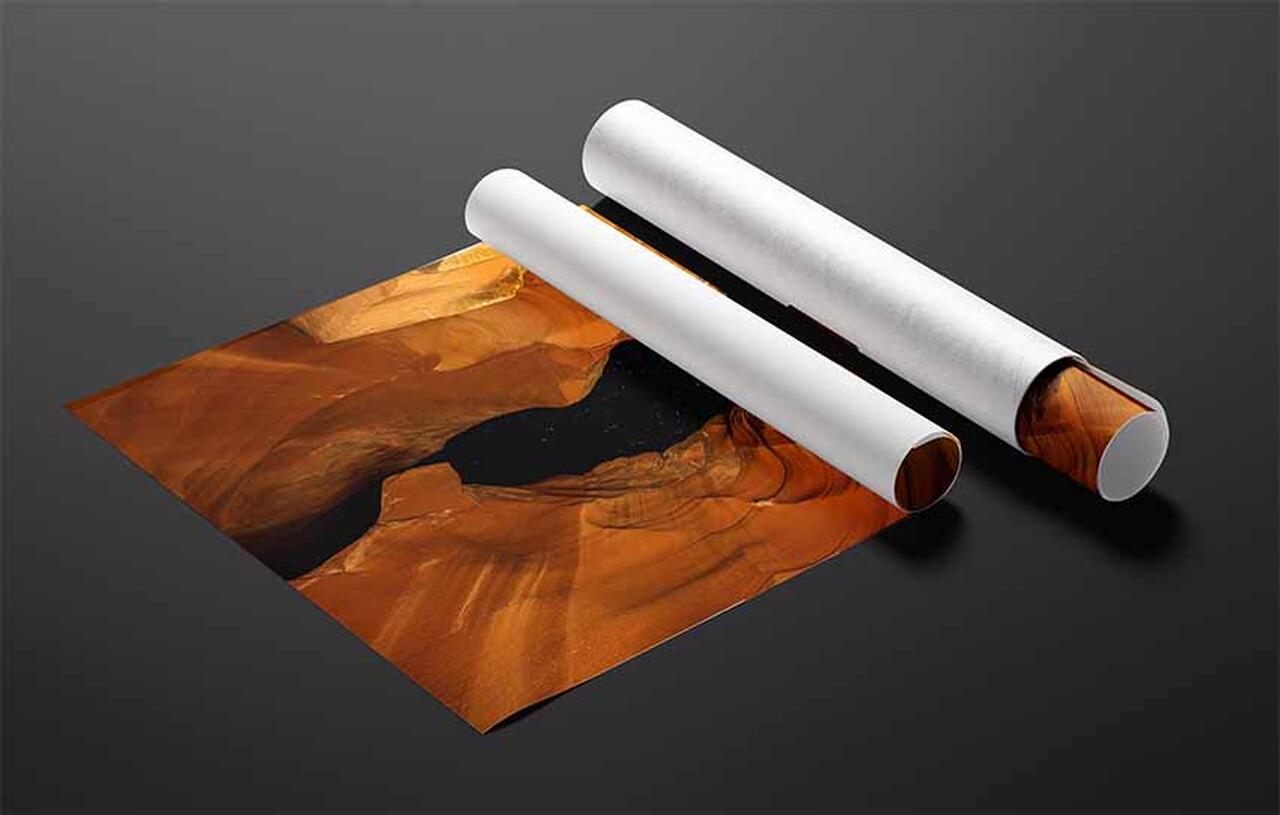
A 1:2 vertical photograph of the night sky seen through the slot at Antelope Canyon, Arizona, available as a limited edition print in three sizes and four presentations.
Artist's Story
At Antelope Canyon, near Page on the Navajo Nation, the rock does something to the sky. You stand at the bottom of a slot a few feet wide and a hundred feet deep, and the entire sky above you is reduced to a ribbon. Not a view. A seam.
I went in after dark with a guide, on one of the night tours, and we lit the walls by hand while the shutter stayed open long enough to gather the stars.
What surprises me is that the reduction does not feel like loss. A whole sky is more than attention can hold. It has no edges, nothing to fix on, and the eye slides across it without ever quite arriving. Cut it down to a ribbon between two walls of sandstone and it becomes graspable. You can actually attend to it. The stars in that seam get more of me than the stars in an open desert ever do, because there are few enough of them to receive.
Lady in the Night is that seam. A sky made small enough to look at, held open by rock that flash floods spent millions of years cutting.
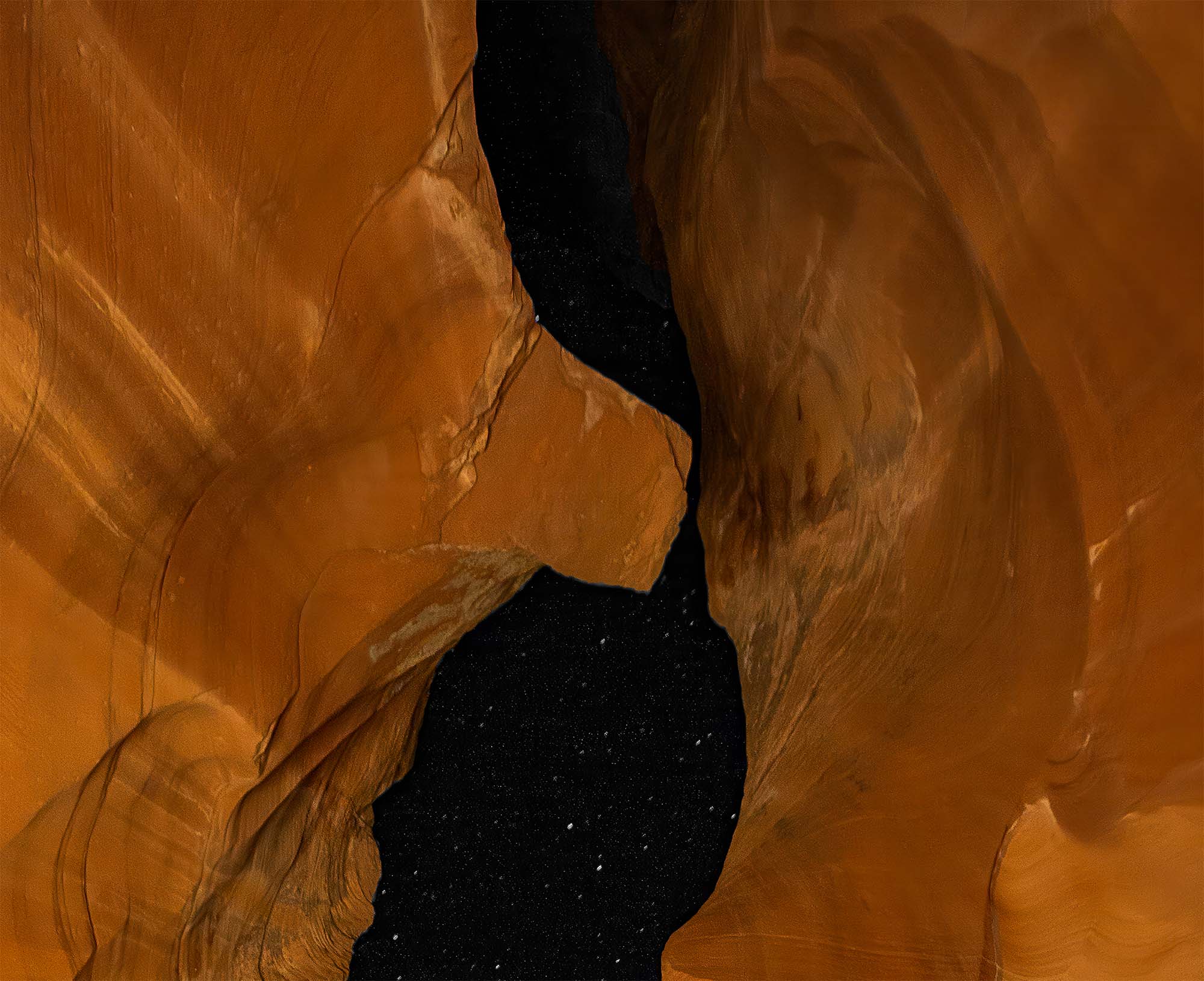
Detail at roughly one third of the frame width. The stars separate into individual points, and the floodwater fluting in the sandstone resolves layer by layer. At the smallest print size both read as texture. Click to view at full size.
About This Photograph
Photographed in Upper Antelope Canyon, near Page, Arizona, on the Navajo Nation, looking straight up from the canyon floor at night. Made on a guided night tour in a single frame, with the canyon walls lit by hand during a long exposure that also recorded the stars.
The subject is the carved wall of the slot canyon, with the night sky visible through the opening a hundred feet above. The canyon is cut into Navajo Sandstone by flash flooding, which is what produces the fluted, layered walls.
Upper Antelope Canyon is known in Navajo as Tse bighanilini, the place where water runs through. It lies within Navajo Tribal Park and is accessible only by permit with a Navajo guide.
Lady in the Night
Steve Austinhttps://www.steveaustinphotography.com/
Location
Upper Antelope Canyon, Page, Arizona
Subject
Night sky through the slot
Capture
Single frame at night, walls lit by hand
Format
Photograph · vertical, 1:2
Sizes
20 × 40 in · 30 × 60 in · 40 × 80 in
Print Media
TruLife Acrylic · ChromaLuxe Metal · Baryta paper
Edition
Limited, 25 / 50 / 100 by presentation
What it Does in a Room
A vertical photograph does something a wide one cannot. It gives the eye somewhere to fall. This one runs the other way.
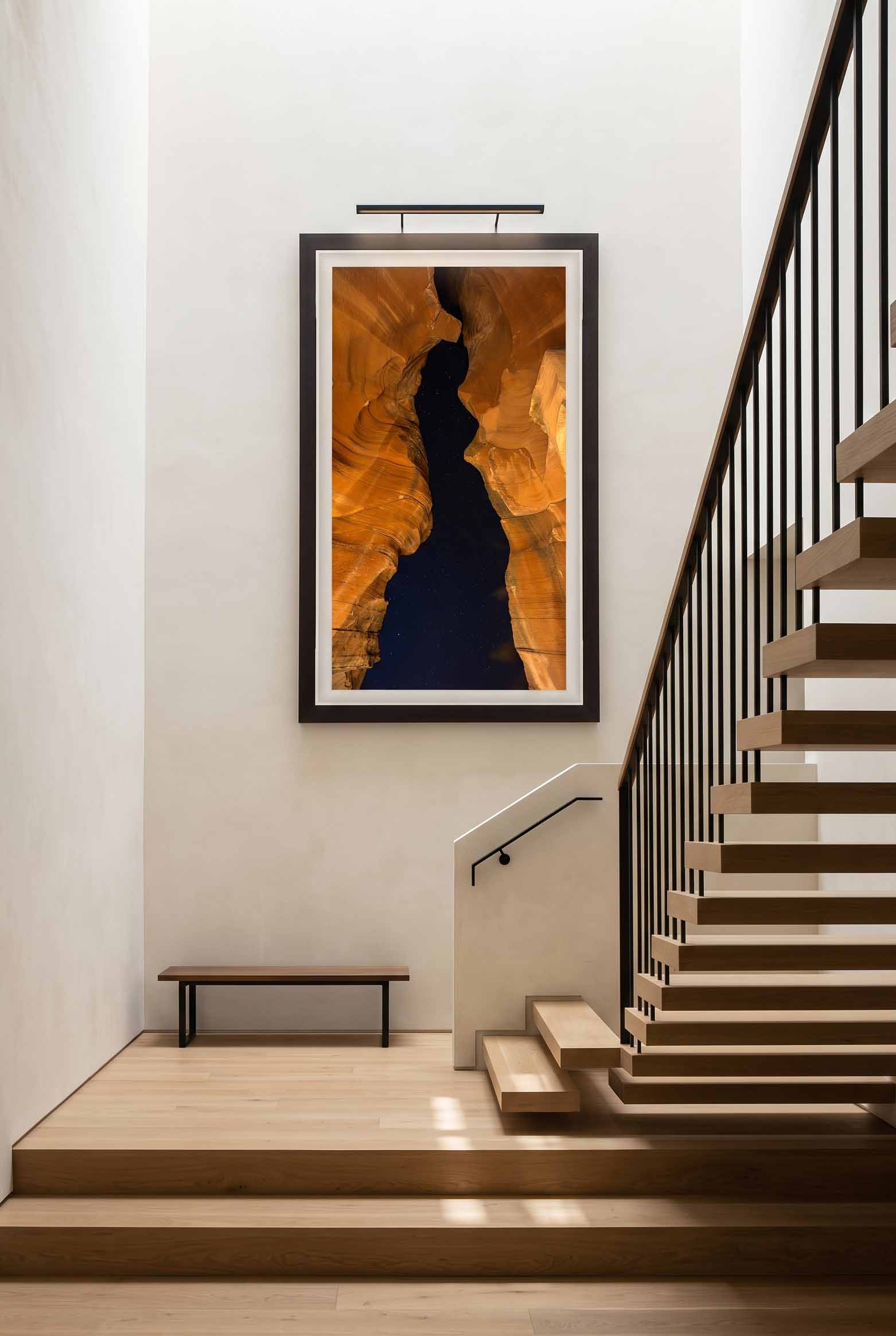
The frame is a climb rather than a descent. The rock closes in from both sides, the seam narrows as it rises, and the eye follows it up and out of the picture instead of down into it. That is unusual, and it is worth knowing before you hang it, because a photograph that lifts wants height above it rather than furniture beneath it. At one to two the proportion is decidedly tall, so it belongs on a chimney breast, a stairwell wall, the pier between two windows, a tall entry. It does not need a long run of wall. It needs headroom.
The two halves of the image are further apart than anything else in the collection. The lit sandstone measures near luminance 85 and runs deeply warm, red 130 points above blue. The star seam sits at 13, effectively black and faintly cool. There is no middle ground between them and none is wanted. That contrast is the subject, and on a wall it means the piece reads as two things at once: a warm mass you notice from across the room, and a dark channel that only reveals its stars when you come close.
On placement the warmth decides it. This is orange and red end to end with nothing cool anywhere except the seam itself, so it will set a room's palette rather than join one. Plaster, oak, walnut, travertine, linen, and concrete all agree with it. A room that already commits to blue or green will argue with it and lose. It also wants reasonable light, since the stars in the seam are faint by design and a dim room takes them first.
Not sure which size the room calls for, or want dimensions not listed here? Sizes beyond 40 × 80 are available on request and ship crated by freight. That conversation is welcome before an order is placed. Start that conversation and I will answer within one business day.
Lady in the Night, limited edition printSteve Austin112513400USD12https://schema.org/InStock
Questions about this photograph
How small is too small for a photograph this tall?
At one to two, the Intimate size is twenty inches across and forty inches tall. That is a narrow piece, and narrowness is the constraint rather than area. It reads well in a genuinely tight space, beside a doorway, on a pier between windows, in a hall where nothing wider would fit, and it reads poorly in the middle of an open wall, where it looks like a strip rather than a picture. The Collected at thirty by sixty is where it starts to hold a wall on its own. The Statement at forty by eighty is nearly seven feet tall, which needs a room with the ceiling height to take it. If you are weighing a size against a specific wall, choosing the right print size covers the measurements and the viewing distances in more detail.
What changes at the largest size?
The stars are the whole question. They are faint by nature, small points of light against a black seam, and at twenty by forty the sky reads as a dark channel with a suggestion of grain in it. Most people will take it for texture. At forty by eighty the stars separate into individual points, some brighter than others, scattered unevenly the way they actually are. The sandstone changes on the same curve. What reads small as smooth orange rock resolves into the fluting the floodwater left, layer on layer, with the tool marks of moving water still legible in it. That matters here more than on most photographs, because the argument is about a sky reduced to something you can actually attend to, and at the smallest size there is nothing in the seam to attend to. Why scale matters covers what happens perceptually when a landscape reaches the size where the eye has to travel across it.
What kind of room does this photograph suit?
One with height and reasonable light. Height because the frame is twice as tall as it is wide and it climbs rather than settles, so it wants a wall that lets the eye go up: a chimney breast, a stairwell, a pier between windows, a tall entry. Light because the stars in the seam are the reward and they are the first thing a dim room takes.
On color it is not flexible. Orange and red through the sandstone with nothing cool anywhere except the seam itself, so it sets a palette rather than joining one. Plaster, oak, walnut, travertine, and linen agree with it immediately. A room already committed to blue or green will fight it. What it will not do is brighten a space, since even the lit rock stops well short of white.
Every work ships insured and arrives with a signed certificate of authenticity.
If a piece is damaged in transit, the choice of replacement is always yours, and your edition number stays with you.
Production time runs 2 to 3 weeks for metal, 3 to 4 weeks for acrylic and paper, and 5 to 6 weeks for framed work.
Each print is made to order and takes its place in a numbered edition, so sales are final. Before you choose, I am glad to help: send a photo of your wall and I will show you this work in your room at true scale, at no charge. Start a conversation
Collector's Choice · TruLife ® Acrylic in Italian Frame
Collector Edition of 25· Lumachrome TruLife Acrylic · Handcrafted Italian Frame
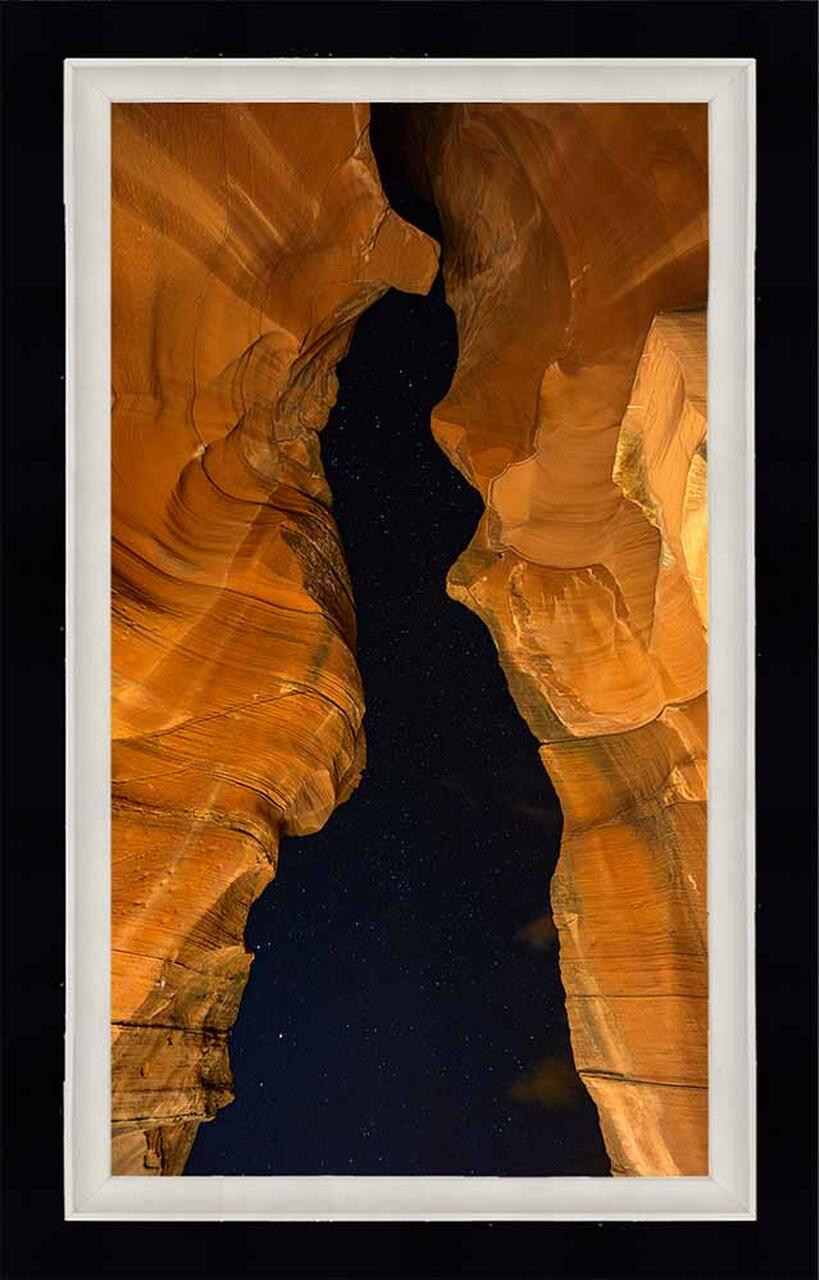
TruLife acrylic in a handcrafted Italian frame with a linen liner chosen for the image. Frame series, finish, and liner are settled with you after the order, and production begins from there. The frame and liner add about fourteen inches to the finished dimensions, worth allowing for when planning placement.
Signature Acrylic Edition of 50· Lumachrome TruLife · Gallery Float Mount
Face-mounted to TruLife acrylic and floated approximately one inch from the wall, with no frame to mediate between the image and the room. UV-resistant, anti-reflective, and scratch-resistant, with a lifetime guarantee against fading.
Signature Metal Edition of 50· ChromaLuxe Print · Gallery Float Mount
Color infused into the aluminum panel itself, floated from the wall on a concealed system. Where acrylic produces luminosity, metal produces clarity. Exceptional fade resistance with no glazing or coating required.
Fine Art Edition of 100· Hahnemühle Baryta Fine Art Paper
Printed without acrylic, so light meets the paper surface directly. Highlights stay luminous, shadows keep their nuance, and the surface has a tactile quality the other presentations approach differently. The understated choice, and the traditional one.
Complimentary shipping within the continental United States. International collector shipping available upon request.
Still deciding
Designing for Stillness
A guide to choosing art for restorative spaces
How to tell whether an image will still hold you in a year, how scale changes what a photograph does in a room, and how to match a piece to the work a room actually performs. It cites the research it draws on, and it is equally clear about where that research stops. About ten minutes to read.