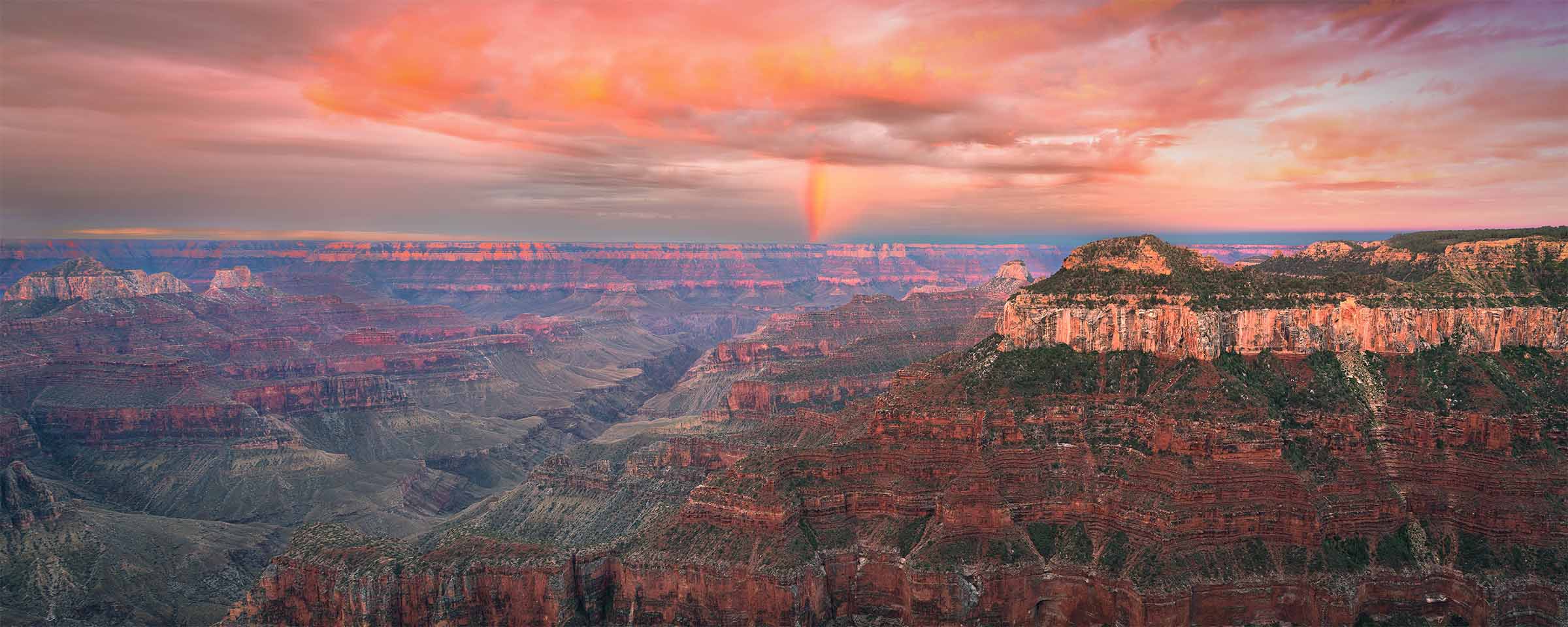
A 5:2 panoramic photograph of a red rainbow over the Grand Canyon from Bright Angel Point, Arizona, available as a limited edition print in three sizes.
Artist's Story
You do not know what you are going to get. You camp on the rim, you get up in the dark, you walk out to the point, and whatever the sky does is what you photograph. Most mornings it does very little.
This one kept getting better. The cloud came up pink with a storm still going off to the east, and then a rainbow started to build underneath it. As the sun cleared the horizon the rainbow changed color.
A rainbow is white sunlight taken apart by raindrops. But when the sun is within a degree or two of the horizon, its light has already crossed so much atmosphere that the blue and green have been scattered out of it before it arrives. There is nothing left at the short end to bend. What comes through the rain is red and orange, and the arc it makes is narrower and fainter than the ordinary kind. The rainbow had its colors taken before it was made.
Some of the people standing near me started crying. I have not seen that at a viewpoint before or since.
Only the Red is the cloud, the canyon underneath it, and the arc coming down out of the storm on the far side. The clouds are that color for the same reason the rainbow is. Everything you are looking at is made from the same surviving half of the light.
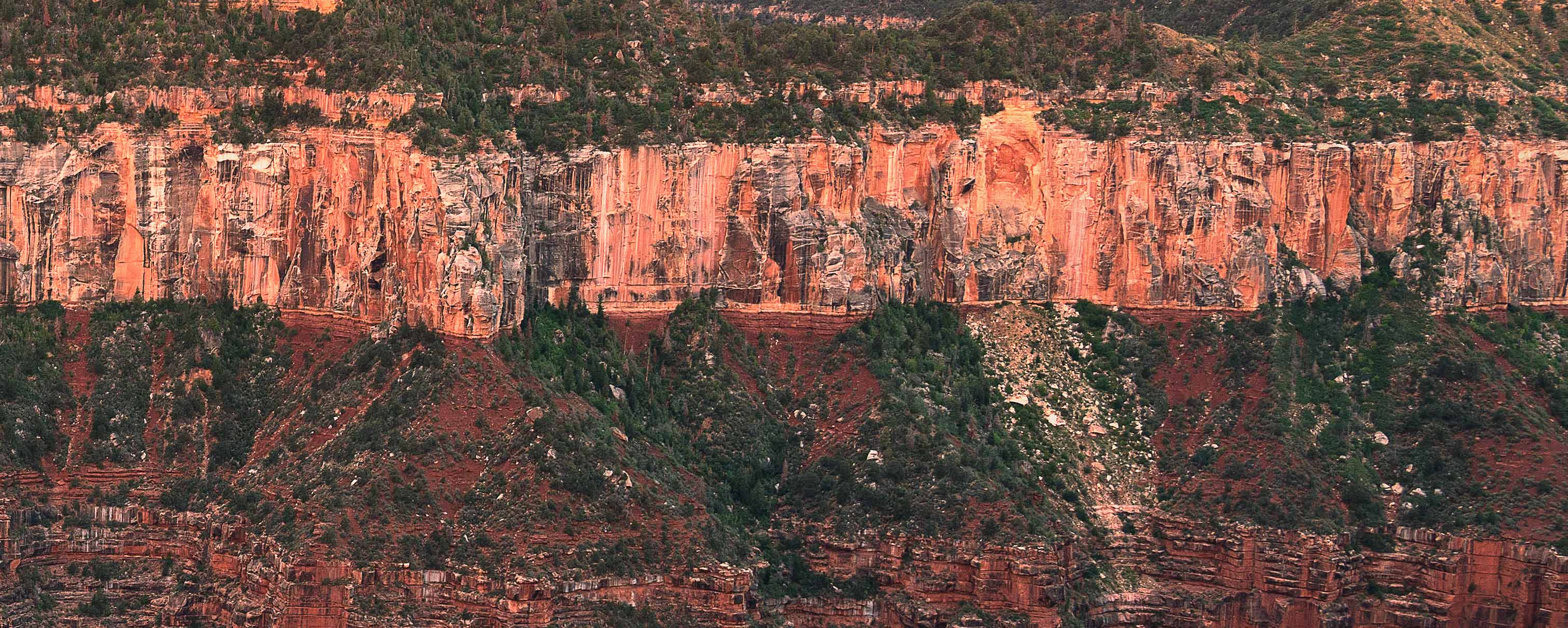
The near promontory at about a quarter of the frame width. On an eighty inch print this section runs roughly twenty-one inches across. The bedding runs level across the whole face, vertical weathering streaks drop down it where water has run, and individual trees become countable along the rim and in the breaks below. Click to view at full size.
About This Photograph
From Bright Angel Point on the North Rim of Grand Canyon National Park in northern Arizona, at sunrise, after camping overnight on the rim. This is a single frame image. The frame holds the canyon opening to the north, a storm cell still raining on the far side, a monochrome rainbow beneath it, and cloud lit pink across the whole upper third.
A monochrome or red rainbow forms when the sun sits within about two degrees of the horizon. The long atmospheric path removes the shorter wavelengths from the sunlight before it reaches the raindrops, so only the red end is left to refract. The resulting arc is narrower and fainter than a full-spectrum rainbow. The same scattering is what makes the cloud pink.
Bright Angel Point stands at the end of a short paved trail from the lodge area, on a narrow neck of rim with canyon falling away on both sides. The North Rim sits roughly a thousand feet higher than the South and is open only part of the year.
Only the Red
Steve Austinhttps://www.steveaustinphotography.com/
Location
Bright Angel Point, Grand Canyon North Rim, Arizona
Subject
Red rainbow · storm cell · sunrise
Capture
Single frame at sunrise
Format
Photograph · horizontal panorama, 5:2
Sizes
40 × 16 in · 60 × 24 in · 80 × 32 in
Print Media
TruLife Acrylic · ChromaLuxe Metal · Baryta paper
Edition
Limited, 25 / 50 / 100 by presentation
What it Does in a Room
This is the softest photograph in the collection, and the measurement is not close. Mean saturation runs 0.30 where the most intense piece in the catalog runs 0.76, and the whole frame sits in the middle of the tonal range with no deep black and no bright white. What that means on a wall is that it does not compete. Most large landscapes have to be given a wall of their own. This one will hang beside other work, near a strong textile, or across from a window without any of them fighting.
The palette is unusually narrow for a picture this size. Everything in it, the cloud, the rainbow, the lit rock, comes from the long half of the spectrum, so the frame carries no green and almost no blue anywhere. A picture built from one end of the spectrum reads as tonal rather than as colorful, closer to a warm neutral than to a color statement, which is why it settles into a room instead of setting its terms.
There is no foreground. The nearest thing in the frame is already half a mile away and everything else runs back twenty miles behind it, which makes this the only photograph in the collection with nothing close to the viewer. That is a large part of why it feels quiet. Nothing in it is at arm's length, nothing is pressing, and the eye is never asked to come back to the front of the picture. It stays out there.
Not sure which size the room calls for, or want dimensions not listed here? Sizes beyond 80 × 32 are available on request and ship crated by freight. That conversation is welcome before an order is placed. Start that conversation and I will answer within one business day.
Only the Red, limited edition printSteve Austin95012100USD11https://schema.org/InStock
Questions about this photograph
How small is too small for a photograph this wide?
At five to two, the Intimate size is forty inches across and sixteen inches tall. This picture takes that reasonably well because it is built from broad tonal areas rather than from a subject: a pink band across the top, a lit rim below it, and the canyon falling away underneath. All three read from anywhere. What goes at that size is the geology. At forty by sixteen the layering in the canyon walls, which is most of what is actually in the lower two thirds of the frame, compresses into a soft mass, and the buttes and side canyons stop separating from one another. The rainbow survives, but as a soft column rather than an arc with edges. That suits a wall seen from four or five feet and a room where the piece is one of several things. The Collected at sixty by twenty-four is where the strata come back. If you are weighing a size against a specific wall, choosing the right print size covers the measurements and the viewing distances in more detail.
What changes at the largest size?
The canyon separates into its parts. At the Statement size, eighty by thirty-two, the promontory on the right resolves into geology: a continuous band of cliff with its horizontal bedding running level across the whole face, vertical weathering streaks dropping down it where water has run, and separate ledges and spires standing out from the wall below. Individual trees become countable along the rim and in the breaks, and the pale rock of the lower ledges separates from the red above it. The rainbow does the opposite. It stays soft at every size, because a rainbow made only from the red end of the spectrum is fainter and more diffuse than a full one to begin with, and this one was twenty miles away through rain. It is a column of color rather than an arc with edges, and it does not sharpen. What changes beyond detail is the reach: nearly seven feet of frame holding a view that is entirely distant means the eye travels a long way and never arrives anywhere near. Why scale matters covers what happens perceptually when a landscape reaches the size where the eye has to cross it.
What kind of room does this photograph suit?
Almost any of them, and that is a function of how quiet it is rather than a claim about the picture. The narrow warm palette sits with bone, cream, warm plaster, oak, walnut, leather, and terracotta without argument, and because there is no green or blue in it, it will not fight a room that already has a color scheme running. It also works where other large photographs do not: beside other framed work, above a sofa with patterned textiles, in a room with a lot going on. Where it does its clearest work is a room people sit in for a while, since the whole picture is distance and distance takes time to cross. Why we are wired to need the natural world takes the question further.
Every work ships insured and arrives with a signed certificate of authenticity.
If a piece is damaged in transit, the choice of replacement is always yours, and your edition number stays with you.
Production time runs 2 to 3 weeks for metal, 3 to 4 weeks for acrylic and paper, and 5 to 6 weeks for framed work.
Each print is made to order and takes its place in a numbered edition, so sales are final. Before you choose, I am glad to help: send a photo of your wall and I will show you this work in your room at true scale, at no charge. Start a conversation
Collector's Choice · TruLife ® Acrylic in Italian Frame
Collector Edition of 25· Lumachrome TruLife Acrylic · Handcrafted Italian Frame
TruLife acrylic in a handcrafted Italian frame with a linen liner chosen for the image. Frame series, finish, and liner are settled with you after the order, and production begins from there. The frame and liner add about fourteen inches to the finished dimensions, worth allowing for when planning placement.
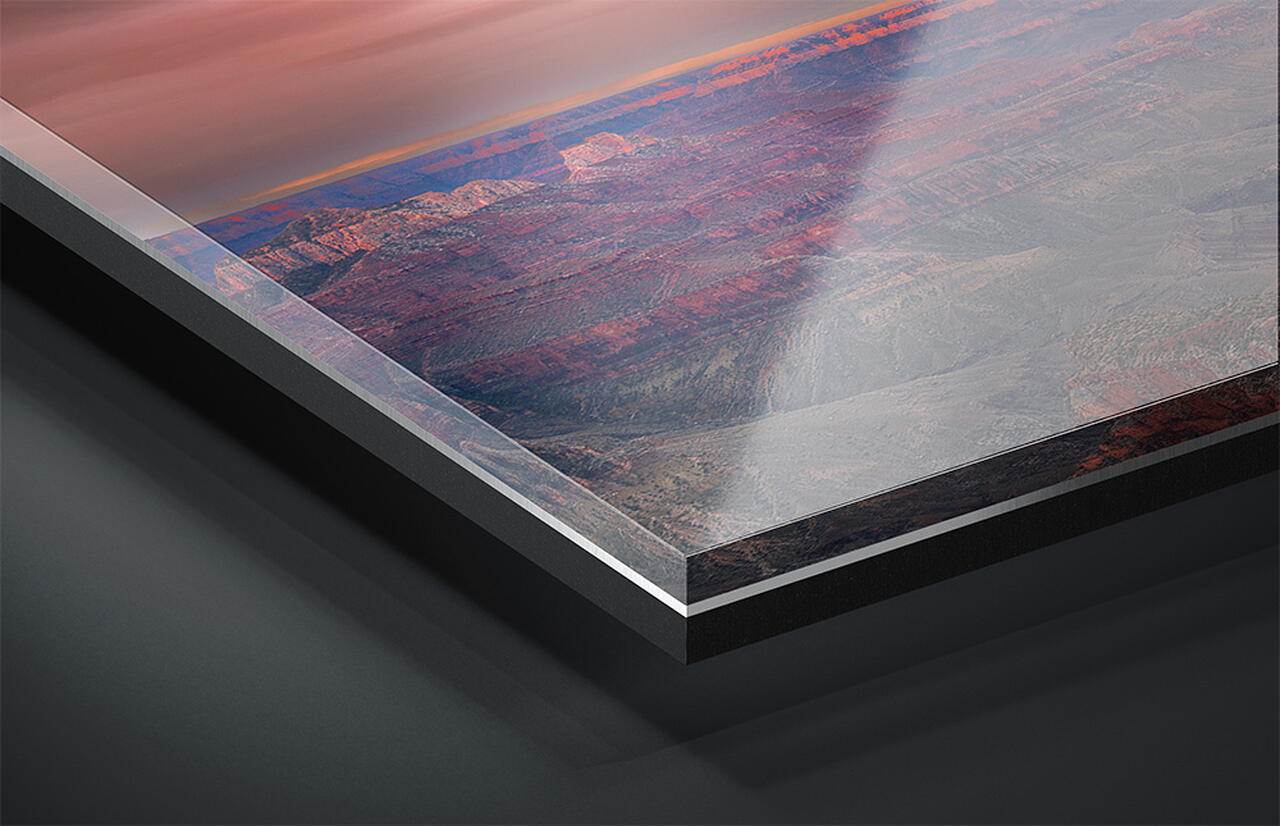
Signature Acrylic Edition of 50· Lumachrome TruLife · Gallery Float Mount
Face-mounted to TruLife acrylic and floated approximately one inch from the wall, with no frame to mediate between the image and the room. UV-resistant, anti-reflective, and scratch-resistant, with a lifetime guarantee against fading.
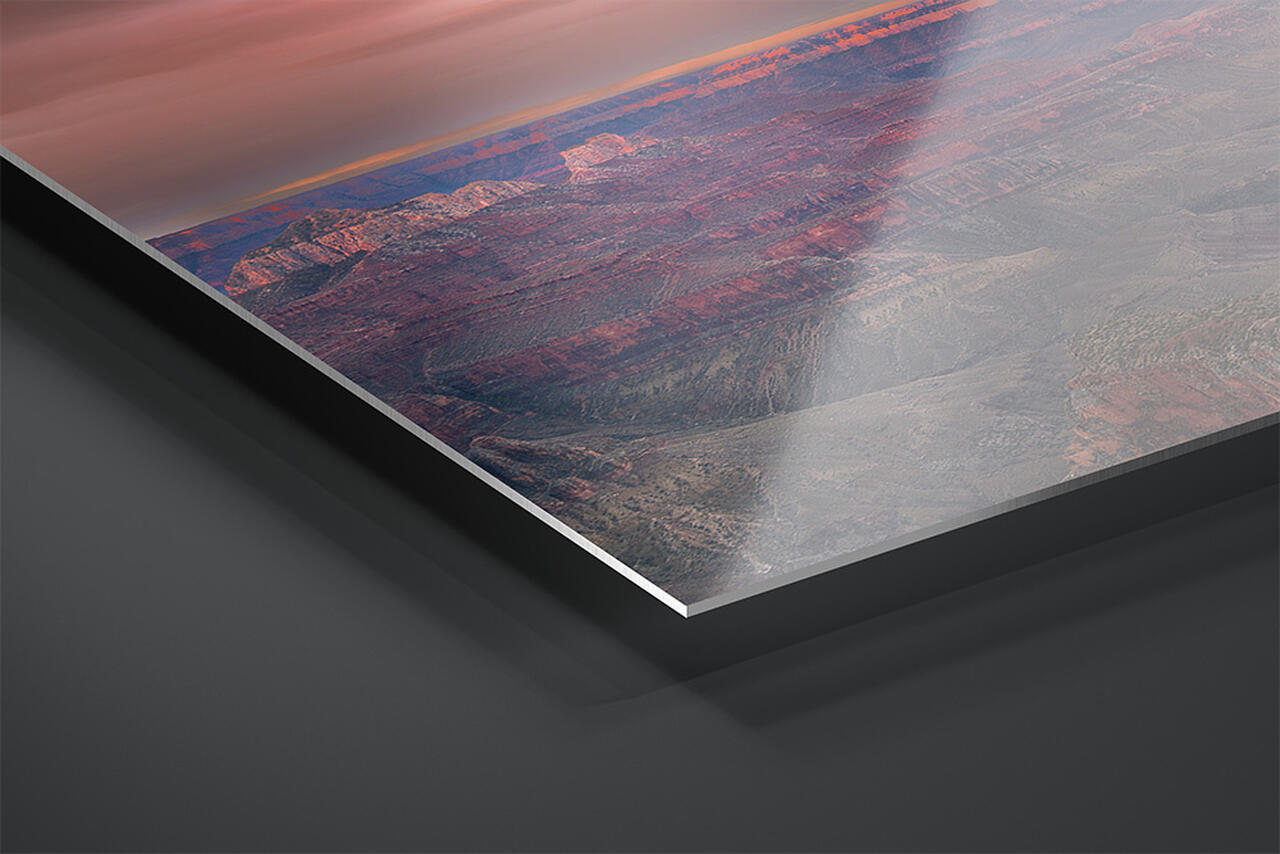
Signature Metal Edition of 50· ChromaLuxe Print · Gallery Float Mount
Color infused into the aluminum panel itself, floated from the wall on a concealed system. Where acrylic produces luminosity, metal produces clarity. Exceptional fade resistance with no glazing or coating required.
Fine Art Edition of 100· Hahnemühle Baryta Fine Art Paper
Printed without acrylic, so light meets the paper surface directly. Highlights stay luminous, shadows keep their nuance, and the surface has a tactile quality the other presentations approach differently. The understated choice, and the traditional one.
Complimentary shipping within the continental United States. International collector shipping available upon request.
Still deciding
Designing for Stillness
A guide to choosing art for restorative spaces
How to tell whether an image will still hold you in a year, how scale changes what a photograph does in a room, and how to match a piece to the work a room actually performs. It cites the research it draws on, and it is equally clear about where that research stops. About ten minutes to read.